
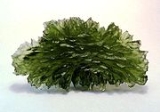
Moldavite is an olive-green or dull greenish vitreous substance possibly formed by a
meteoriteA meteorite is a natural object originating in outer space that survives impact with the Earth's surface. Meteorites can be big or small. Most meteorites derive from small astronomical objects called meteoroids, but they are also sometimes produced by impacts of asteroids...
impact. It is one kind of
tektiteTektites are natural glass rocks up to a few centimeters in size, which most scientists argue were formed by the impact of large meteorites on Earth's surface. Tektites are typically black or olive-green, and their shape varies from rounded to irregular.Tektites are among the "driest" rocks, with...
. It was named by A. Dufrnoy for the town of Moldauthein in
BohemiaBohemia is a historical region in central Europe, occupying the western two-thirds of the traditional Czech Lands. It is located in the contemporary Czech Republic with its capital in Prague...
(the
Czech RepublicThe Czech Republic is a landlocked country in Central Europe. The country is bordered by Poland to the northeast, Slovakia to the east, Austria to the south, and Germany to the west and northwest....
), where it occurs. It is sometimes cut and polished as an ornamental stone under the name of pseudo-chrysolite.
Origin
Moldavite's bottle-green
glassGlass is an amorphous solid material. Glasses are typically brittle and optically transparent.The most familiar type of glass, used for centuries in windows and drinking vessels, is soda-lime glass, composed of about 75% silica plus Na2O, CaO, and several minor additives...
colour led to its being commonly called Bouteillen-stein, and at one time it was regarded as an artificial product, but this view is opposed to the fact that no remains of glassworks are found in the neighbourhood of its occurrence; moreover, pieces of the substance are widely distributed in
TertiaryThe Tertiary is a deprecated term for a geologic period 65 million to 2.6 million years ago. The Tertiary covered the time span between the superseded Secondary period and the Quaternary...
and early
PleistoceneThe Pleistocene is the epoch from 2,588,000 to 11,700 years BP that spans the world's recent period of repeated glaciations. The name pleistocene is derived from the Greek and ....
deposits in
BohemiaBohemia is a historical region in central Europe, occupying the western two-thirds of the traditional Czech Lands. It is located in the contemporary Czech Republic with its capital in Prague...
and
MoraviaMoravia is a historical region in Central Europe in the east of the Czech Republic, and one of the former Czech lands, together with Bohemia and Silesia. It takes its name from the Morava River which rises in the northwest of the region...
. For a long time, it was generally believed to be a variety of
obsidianObsidian is a naturally occurring volcanic glass formed as an extrusive igneous rock.It is produced when felsic lava extruded from a volcano cools rapidly with minimum crystal growth...
, but its difficult fusibility and its chemical composition are rather against a volcanic origin hypothesis.
F. E. Suess pointed out that the
nodulesA nodule in petrology or mineralogy is a secondary structure, generally spherical or irregularly rounded in shape. Nodules are typically solid replacement bodies of chert or iron oxides formed during diagenesis of a sedimentary rock...
or small masses of moldavite presented curious pittings and wrinkles on the surface, which could not be due to the action of water, but resembled the characteristic markings on many meteorites. Boldly attributing the material to a
cosmicConstellation Observing System for Meteorology, Ionosphere, and Climate is a program designed to provide advances in meteorology, ionospheric research, climatology, and space weather by using GPS satellites in conjunction with low Earth orbiting satellites...
origin, he regarded moldavite as a special type of meteorite for which he proposed the name of
tektiteTektites are natural glass rocks up to a few centimeters in size, which most scientists argue were formed by the impact of large meteorites on Earth's surface. Tektites are typically black or olive-green, and their shape varies from rounded to irregular.Tektites are among the "driest" rocks, with...
. To this type are also referred the so-called obsidian bombs and buttons from
AustraliaAustralia , officially the Commonwealth of Australia, is a country in the Southern Hemisphere comprising the mainland of the Australian continent, the island of Tasmania, and numerous smaller islands in the Indian and Pacific Oceans. It is the world's sixth-largest country by total area...
and
TasmaniaTasmania is an Australian island and state. It is south of the continent, separated by Bass Strait. The state includes the island of Tasmania—the 26th largest island in the world—and the surrounding islands. The state has a population of 507,626 , of whom almost half reside in the greater Hobart...
, known sometimes as
australites, and called by R. H. Walcott obsidianites. Similar bodies have been found in
IndonesiaIndonesia , officially the Republic of Indonesia , is a country in Southeast Asia and Oceania. Indonesia is an archipelago comprising approximately 13,000 islands. It has 33 provinces with over 238 million people, and is the world's fourth most populous country. Indonesia is a republic, with an...
and have been termed billitonite, from the isle of
BelitungBelitung, , is an island on the east coast of Sumatra, Indonesia in the Java Sea. The island is known for its pepper and for its tin. It was in the possession of the British from 1812 until the British ceded control of the island to the Dutch in the Anglo-Dutch Treaty of 1824...
where they occur in
tinTin is a chemical element with the symbol Sn and atomic number 50. It is a main group metal in group 14 of the periodic table. Tin shows chemical similarity to both neighboring group 14 elements, germanium and lead and has two possible oxidation states, +2 and the slightly more stable +4...
-bearing
gravelGravel is composed of unconsolidated rock fragments that have a general particle size range and include size classes from granule- to boulder-sized fragments. Gravel can be sub-categorized into granule and cobble...
s. Usually they are flat, rounded or ellipsoidal bodies, sometimes surrounded by an equatorial girdle or rim, and often with a brilliant black superficial
lusterLustre is a description of the way light interacts with the surface of a crystal, rock, or mineral. The word lustre traces its origins back to the Latin word lux, meaning "light", and generally implies radiance, gloss, or brilliance....
, as though varnished. Moldavite has been reported also from
ScaniaScania is the southernmost of the 25 traditional non-administrative provinces of Sweden, constituting a peninsula on the southern tip of the Scandinavian peninsula, and some adjacent islands. The modern administrative subdivision Skåne County is almost, but not totally, congruent with the...
(
SwedenSweden , officially the Kingdom of Sweden , is a Nordic country on the Scandinavian Peninsula in Northern Europe. Sweden borders with Norway and Finland and is connected to Denmark by a bridge-tunnel across the Öresund....
).
It is also widely argued that the moldavite glass was formed 15 million years ago during the impact of a giant meteorite in present-day
Nördlinger RiesThe Nördlinger Ries is a large circular depression in western Bavaria, Germany, located north of the Danube in the district of Donau-Ries. The city of Nördlingen is located about southwest of the centre of the depression....
. Splatters of rocks that were melted by the impact cooled while they were actually airborne and most fell in central Bohemia - traversed by
VltavaThe Vltava is the longest river in the Czech Republic, running north from its source in Šumava through Český Krumlov, České Budějovice, and Prague, merging with the Elbe at Mělník...
river . As such the glass can be found in the Czech Republic, Austria and Germany.
IsotopeIsotopes are variants of atoms of a particular chemical element, which have differing numbers of neutrons. Atoms of a particular element by definition must contain the same number of protons but may have a distinct number of neutrons which differs from atom to atom, without changing the designation...
analysis of samples of moldavite have shown a
berylliumBeryllium is the chemical element with the symbol Be and atomic number 4. It is a divalent element which occurs naturally only in combination with other elements in minerals. Notable gemstones which contain beryllium include beryl and chrysoberyl...
-10 isotope composition typical of the Australasian and Ivory Coast tektites.
Use
The total amount of Moldavite scattered around the world is estimated at 275 tons. There are now only four moldavite mines that are in full operation in the Czech Republic. It is predicted that in less than ten years from now commercial Moldavite mining will come to an end. After this time, there will be virtually no appreciable amount of gem-grade Moldavite left in the ground.
The
Venus of WillendorfThe Venus of Willendorf, also known as the Woman of Willendorf, is an high statuette of a female figure estimated to have been made between 24,000 and 22,000 BCE. It was discovered in 1908 by archaeologist Josef Szombathy at a paleolithic site near Willendorf, a village in Lower Austria near the...
, which some have held to be an ancient goddess statue, was discovered in a site that contained a few amulets of Moldavite.
There are typically two grades of moldavite: high quality, often referred to as museum grade, and regular grade. Museum and regular grade moldavite can be told apart by the way they look: The regular grade pieces are usually darker and more saturated in their green colour, and the surface is seen as closely spaced pitting or weathering. This type sometimes appears to have been broken apart from a larger chunk.
The museum grade has a distinct fern-like pattern and is much more translucent than the regular grade. There is usually a fairly big difference in the price between the two. The museum grade "flower bursts" are much more prized by the connoisseur. High-quality moldavite stones are often used in hand-crafted jewellery and thus enter the market away from mainstream jewellery fashions, more centred around art and craft, and as such have gained an almost cult status.
Moldavite occurrences are reported mainly from Bohemia and
MoraviaMoravia is a historical region in Central Europe in the east of the Czech Republic, and one of the former Czech lands, together with Bohemia and Silesia. It takes its name from the Morava River which rises in the northwest of the region...
(Czech Republic), with occasional finds in
WaldviertelThe Waldviertel is the northwestern region of the Austrian state Lower Austria. It is bounded to the south by the Danube, to the southwest by Upper Austria, to the northwest and the north by the Czech Republic and to the east by the Manhartsberg , which is the survey point dividing Waldviertel...
(
AustriaAustria , officially the Republic of Austria , is a landlocked country of roughly 8.4 million people in Central Europe. It is bordered by the Czech Republic and Germany to the north, Slovakia and Hungary to the east, Slovenia and Italy to the south, and Switzerland and Liechtenstein to the...
) and
LusatiaLusatia is a historical region in Central Europe. It stretches from the Bóbr and Kwisa rivers in the east to the Elbe valley in the west, today located within the German states of Saxony and Brandenburg as well as in the Lower Silesian and Lubusz voivodeships of western Poland...
(
GermanyGermany , officially the Federal Republic of Germany , is a federal parliamentary republic in Europe. The country consists of 16 states while the capital and largest city is Berlin. Germany covers an area of 357,021 km2 and has a largely temperate seasonal climate...
).
External sources
- M. Trnka – S. Houzar: Moldavites: a review PDF . Bulletin of the Czech Geological Survey, Vol. 77, No. 4, 283–302, 2002 Czech Geological Survey, ISSN 1210-3527
- J. Baier: Zur Herkunft und Bedeutung der Ries-Auswurfprodukte für den Impakt-Mechanismus. - Jber. Mitt. oberrhein. geol. Ver., N. F. 91, 9-29, 2009.
- J. Baier: Die Auswurfprodukte des Ries-Impakts, Deutschland, in Documenta Naturae, Vol. 162, München, 2007. ISBN 978-3-86544-162-1
- F. Serefiddin, et al., Terrestrial Cosmic-Ray Exposure History of a 23-gram Moldavite and Evidence for the Presence of Meteoric Beryllium-10, Lunar and Planetary Science XXXVII (2006) PDF
- Mindat with location data