


Mind-body dichotomy

Encyclopedia
Metaphysics
Metaphysics is a branch of philosophy concerned with explaining the fundamental nature of being and the world, although the term is not easily defined. Traditionally, metaphysics attempts to answer two basic questions in the broadest possible terms:...
and philosophy of mind
Philosophy of mind
Philosophy of mind is a branch of philosophy that studies the nature of the mind, mental events, mental functions, mental properties, consciousness and their relationship to the physical body, particularly the brain. The mind-body problem, i.e...
. The problem arises because mental
Mind
The concept of mind is understood in many different ways by many different traditions, ranging from panpsychism and animism to traditional and organized religious views, as well as secular and materialist philosophies. Most agree that minds are constituted by conscious experience and intelligent...
phenomena appear to be qualitatively and substantially different from the physical bodies
Physical body
In physics, a physical body or physical object is a collection of masses, taken to be one...
on which they appear to depend. There are a few major theories on the resolution of the problem. Dualism
Dualism (philosophy of mind)
In philosophy of mind, dualism is a set of views about the relationship between mind and matter, which begins with the claim that mental phenomena are, in some respects, non-physical....
is the theory that mind and body are two distinct substance
Substance
Substance may refer to:*Chemical substance, a material with a definite chemical composition*Drug substance*Matter, the substance of which all physical objects are made*Substance theory, theory positing that a substance is distinct from its properties....
s, and monism
Monism
Monism is any philosophical view which holds that there is unity in a given field of inquiry. Accordingly, some philosophers may hold that the universe is one rather than dualistic or pluralistic...
is the theory that mind and body are, in reality, just one substance. Monist materialists (also called physicalists) take the view that they are both matter, and monist idealists take the view that they are both in the mind. Neutral monists
Neutral monism
Neutral monism, in philosophy, is the metaphysical view that the mental and the physical are two ways of organizing or describing the same elements, which are themselves "neutral," that is, neither physical nor mental. This view denies that the mental and the physical are two fundamentally...
take the view that both are reducible to a third, neutral substance.
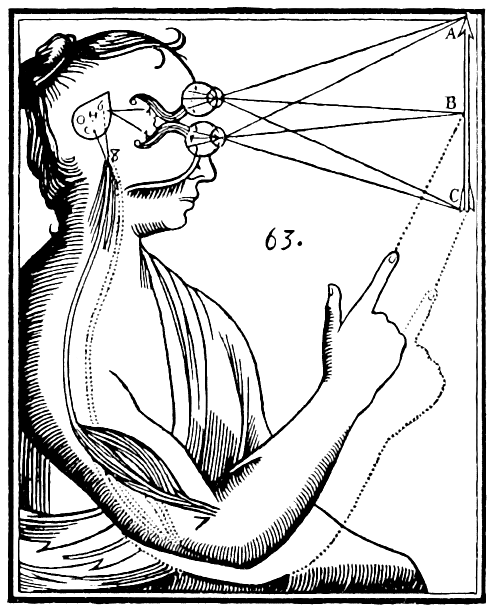
The problem was identified by René Descartes'
René Descartes
René Descartes ; was a French philosopher and writer who spent most of his adult life in the Dutch Republic. He has been dubbed the 'Father of Modern Philosophy', and much subsequent Western philosophy is a response to his writings, which are studied closely to this day...
in the sense known by the modern Western world, although the issue was also addressed by pre-Aristotelian
Aristotelianism
Aristotelianism is a tradition of philosophy that takes its defining inspiration from the work of Aristotle. The works of Aristotle were initially defended by the members of the Peripatetic school, and, later on, by the Neoplatonists, who produced many commentaries on Aristotle's writings...
philosophers and in Avicennian philosophy.
A dualist view of reality may lead one to consider the corporeal as little valued and trivial. The rejection of the mind-body dichotomy is found in French Structuralism
Structuralism
Structuralism originated in the structural linguistics of Ferdinand de Saussure and the subsequent Prague and Moscow schools of linguistics. Just as structural linguistics was facing serious challenges from the likes of Noam Chomsky and thus fading in importance in linguistics, structuralism...
, and is a position that generally characterized post-war French philosophy
French philosophy
French philosophy, here taken to mean philosophy in the French language, has been extremely diverse and has influenced Western philosophy as a whole for centuries, from the medieval scholasticism of Peter Abelard, through the founding of modern philosophy by René Descartes, to 20th century...
.
The absence of an empirically identifiable meeting point between the non-physical mind and its physical extension has proven problematic to dualism and many modern philosophers of mind maintain that the mind is not something separate from the body. These approaches have been particularly influential in the sciences, particularly in the fields of sociobiology
Sociobiology
Sociobiology is a field of scientific study which is based on the assumption that social behavior has resulted from evolution and attempts to explain and examine social behavior within that context. Often considered a branch of biology and sociology, it also draws from ethology, anthropology,...
, computer science
Computer science
Computer science or computing science is the study of the theoretical foundations of information and computation and of practical techniques for their implementation and application in computer systems...
, evolutionary psychology
Evolutionary psychology
Evolutionary psychology is an approach in the social and natural sciences that examines psychological traits such as memory, perception, and language from a modern evolutionary perspective. It seeks to identify which human psychological traits are evolved adaptations, that is, the functional...
and the various neuroscience
Neuroscience
Neuroscience is the scientific study of the nervous system. Traditionally, neuroscience has been seen as a branch of biology. However, it is currently an interdisciplinary science that collaborates with other fields such as chemistry, computer science, engineering, linguistics, mathematics,...
s.
Plato
PlatoPlato
Plato , was a Classical Greek philosopher, mathematician, student of Socrates, writer of philosophical dialogues, and founder of the Academy in Athens, the first institution of higher learning in the Western world. Along with his mentor, Socrates, and his student, Aristotle, Plato helped to lay the...
argued that, as the body is from the material world, the soul is from the world of ideas and is thus immortal. He believed the soul was temporarily united with the body and would only be separated at death, when it would return to the world of Forms. Since the soul does not exist in time and space, as the body does, it can access universal truths.
For Plato, ideas (or Forms) are the true reality, and are experienced by the soul. The body is for Plato empty in that it can not access the abstract reality
Theory of Forms
Plato's theory of Forms or theory of Ideas asserts that non-material abstract forms , and not the material world of change known to us through sensation, possess the highest and most fundamental kind of reality. When used in this sense, the word form is often capitalized...
of the world; it can only experience shadows. This is determined by Plato's essentially rationalistic
Rationalism
In epistemology and in its modern sense, rationalism is "any view appealing to reason as a source of knowledge or justification" . In more technical terms, it is a method or a theory "in which the criterion of the truth is not sensory but intellectual and deductive"...
epistemology.
See also
General- Bodymind
- Chinese roomChinese roomThe Chinese room is a thought experiment by John Searle, which first appeared in his paper "Minds, Brains, and Programs", published in Behavioral and Brain Sciences in 1980...
- ConsciousnessConsciousnessConsciousness is a term that refers to the relationship between the mind and the world with which it interacts. It has been defined as: subjectivity, awareness, the ability to experience or to feel, wakefulness, having a sense of selfhood, and the executive control system of the mind...
- Descartes' ErrorDescartes' ErrorDescartes' Error: Emotion, Reason, and the Human Brain is a book by neurologist Antonio R. Damasio presenting the author's "somatic marker hypothesis", a proposed mechanism by which emotions guide behavior and decision-making, and positing that rationality requires emotional input...
- Dualism (philosophy of mind)Dualism (philosophy of mind)In philosophy of mind, dualism is a set of views about the relationship between mind and matter, which begins with the claim that mental phenomena are, in some respects, non-physical....
- Embodied cognitionEmbodied cognitionPhilosophers, psychologists, cognitive scientists and artificial intelligence researchers who study embodied cognition and the embodied mind believe that the nature of the human mind is largely determined by the form of the human body. They argue that all aspects of cognition, such as ideas,...
- Explanatory gapExplanatory gapThe explanatory gap is the claim that consciousness and human experiences such as qualia cannot be fully explained just by identifying the corresponding physical processes. Bridging this gap is known as "the hard problem"...
- Hard problem of consciousnessHard problem of consciousnessThe hard problem of consciousness is the problem of explaining how and why we have qualitative phenomenal experiences. David Chalmers contrasts this with the "easy problems" of explaining the ability to discriminate, integrate information, report mental states, focus attention, etc...
- MindMindThe concept of mind is understood in many different ways by many different traditions, ranging from panpsychism and animism to traditional and organized religious views, as well as secular and materialist philosophies. Most agree that minds are constituted by conscious experience and intelligent...
- NamarupaNamarupaNāmarūpa is a dvandva compound in Sanskrit and Pali meaning "name and form ".-Nāmarūpa in Hinduism:The term nāmarūpa is used in Hindu thought, nāma describing the spiritual or essential properties of an object or being, and rūpa the physical presence that it manifests...
(Buddhist concept) - Philosophical zombiePhilosophical zombieA philosophical zombie or p-zombie in the philosophy of mind and perception is a hypothetical being that is indistinguishable from a normal human being except in that it lacks conscious experience, qualia, or sentience...
- Philosophy of artificial intelligencePhilosophy of artificial intelligenceThe philosophy of artificial intelligence attempts to answer such questions as:* Can a machine act intelligently? Can it solve any problem that a person would solve by thinking?...
- Philosophy of MindPhilosophy of mindPhilosophy of mind is a branch of philosophy that studies the nature of the mind, mental events, mental functions, mental properties, consciousness and their relationship to the physical body, particularly the brain. The mind-body problem, i.e...
- Problem of other mindsProblem of other mindsThe problem of other minds has traditionally been regarded as an epistemological challenge raised by the skeptic. The challenge may be expressed as follows: given that I can only observe the behavior of others, how can I know that others have minds? The thought behind the question is that no matter...
- Quantum mind–body problem
- Sacred-profane dichotomySacred-profane dichotomyFrench sociologist Émile Durkheim considered the dichotomy between the sacred and the profane to be the central characteristic of religion: "religion is a unified system of beliefs and practices relative to sacred things, that is to say, things set apart and forbidden." In Durkheim's theory, the...
- SentienceSentienceSentience is the ability to feel, perceive or be conscious, or to have subjective experiences. Eighteenth century philosophers used the concept to distinguish the ability to think from the ability to feel . In modern western philosophy, sentience is the ability to have sensations or experiences...
- Strange loopStrange loopA strange loop arises when, by moving up or down through a hierarchical system, one finds oneself back where one started.Strange loops may involve self-reference and paradox...
(self-reflective thoughts) - The Mind's IThe Mind's IThe Mind's I: Fantasies and reflections on self and soul is a 1981 book composed and arranged by Douglas R. Hofstadter and Daniel C. Dennett...
(book on the subject) - Turing testTuring testThe Turing test is a test of a machine's ability to exhibit intelligent behaviour. In Turing's original illustrative example, a human judge engages in a natural language conversation with a human and a machine designed to generate performance indistinguishable from that of a human being. All...
People
- John SearleJohn SearleJohn Rogers Searle is an American philosopher and currently the Slusser Professor of Philosophy at the University of California, Berkeley.-Biography:...
External links
- Wikibooks: Consciousness Studies
- The mind-body problem by Robert M. Young