

Natterjack Toad

Encyclopedia
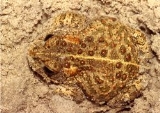
The Natterjack Toad is a toad
native to sandy and heathland
areas of Europe
. Adults are 60–70 mm in length and are distinguished from Common Toad
s by a yellow line down the middle of the back. They have relatively short legs, and this gives them a distinctive gait, contrasting with the hopping movement of many other toad species.
Natterjacks have a very loud and distinctive mating call, amplified by the single vocal sac found under the chin of the male animal.
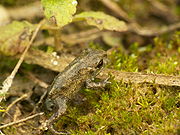
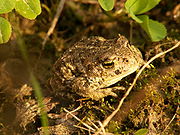 Natterjacks live for up to 15 years and feed on insects, worms and small reptiles. At night they move around open terrain with sparse vegetation, and in loose sand their tracks can often be seen. They move considerable distances each night, enabling the species to colonize new habitats very quickly.
For Natterjacks, pools need to have a very slight slope with sparse vegetation on the banks and in the water. As such pools are often temporary, sometimes the larvae die when the pools dry out. The Natterjack compensates for that risk by mating a few times each summer. Thus, the age of the juveniles can vary from a month to 3 months in September. It appears that the early breeders are not the same individuals as the toads that reproduce later in the season.
in County Kerry and also in County Wexford where it was introduced to a dune site.
It has also been sighted in a few secluded ponds on lambs head.
In England the toad's sand-dune
habitat is protected by several National Nature Reserve
s (Ainsdale
, North Walney
, Sandscale Haws
). In Scotland, where the species is confined to the Solway Firth
, there is a reserve at Caerlaverock
. In Wales the species became extinct in the twentieth century, but has been reintroduced.
has created ponds for the species with some funding from the Heritage Council
.
Toad
A toad is any of a number of species of amphibians in the order Anura characterized by dry, leathery skin , short legs, and snoat-like parotoid glands...
native to sandy and heathland
Heath (habitat)
A heath or heathland is a dwarf-shrub habitat found on mainly low quality acidic soils, characterised by open, low growing woody vegetation, often dominated by plants of the Ericaceae. There are some clear differences between heath and moorland...
areas of Europe
Europe
Europe is, by convention, one of the world's seven continents. Comprising the westernmost peninsula of Eurasia, Europe is generally 'divided' from Asia to its east by the watershed divides of the Ural and Caucasus Mountains, the Ural River, the Caspian and Black Seas, and the waterways connecting...
. Adults are 60–70 mm in length and are distinguished from Common Toad
Common Toad
The common toad or European toad is an amphibian widespread throughout Europe, with the exception of Iceland, Ireland and some Mediterranean islands...
s by a yellow line down the middle of the back. They have relatively short legs, and this gives them a distinctive gait, contrasting with the hopping movement of many other toad species.
Natterjacks have a very loud and distinctive mating call, amplified by the single vocal sac found under the chin of the male animal.
Life history
Reproduction
The Natterjack Toad spawns between the end of April and July, laying 'strings' of eggs in shallow, warm pools. Because the Natterjack Toad is often present in low numbers, its loud mating calls are important so that the sexes can find each other.For Natterjacks, pools need to have a very slight slope with sparse vegetation on the banks and in the water. As such pools are often temporary, sometimes the larvae die when the pools dry out. The Natterjack compensates for that risk by mating a few times each summer. Thus, the age of the juveniles can vary from a month to 3 months in September. It appears that the early breeders are not the same individuals as the toads that reproduce later in the season.
Distribution
Populations of the toad extend through seventeen European countries. In the British Isles the toad is almost completely confined to coastal sites. In mainland Europe, particularly in the southern part of its range, it lives inland in a variety of habitats.Ireland
The Natterjack Toad is the only species of toad native to Ireland. It is found on the Dingle peninsulaDingle Peninsula
The Dingle Peninsula is the northernmost of the major peninsulae in County Kerry. Its ends beyond the town of Dingle at Dunmore Head, the westernmost point of Ireland.-Name:...
in County Kerry and also in County Wexford where it was introduced to a dune site.
It has also been sighted in a few secluded ponds on lambs head.
UK
- In the UK this species is one of only three amphibians protected under the national Biodiversity Action PlanBiodiversity Action PlanA Biodiversity Action Plan is an internationally recognized program addressing threatened species and habitats and is designed to protect and restore biological systems. The original impetus for these plans derives from the 1992 Convention on Biological Diversity...
. Reasons for the threatened status of this organism include: - loss of habitat from human overpopulationOverpopulationOverpopulation is a condition where an organism's numbers exceed the carrying capacity of its habitat. The term often refers to the relationship between the human population and its environment, the Earth...
, - reduction in habitable coast from construction of dykes and seawalls,
- acidification of aquatic habitat from acid rainAcid rainAcid rain is a rain or any other form of precipitation that is unusually acidic, meaning that it possesses elevated levels of hydrogen ions . It can have harmful effects on plants, aquatic animals, and infrastructure. Acid rain is caused by emissions of carbon dioxide, sulfur dioxide and nitrogen...
and other pollutionPollutionPollution is the introduction of contaminants into a natural environment that causes instability, disorder, harm or discomfort to the ecosystem i.e. physical systems or living organisms. Pollution can take the form of chemical substances or energy, such as noise, heat or light...
factors.
In England the toad's sand-dune
Dune
In physical geography, a dune is a hill of sand built by wind. Dunes occur in different forms and sizes, formed by interaction with the wind. Most kinds of dunes are longer on the windward side where the sand is pushed up the dune and have a shorter "slip face" in the lee of the wind...
habitat is protected by several National Nature Reserve
National Nature Reserves in England
National Nature Reserves in England are managed by Natural England and are key places for wildlife and natural features in England. They were established to protect the most important areas of habitat and of geological formations...
s (Ainsdale
Ainsdale
Ainsdale-on-Sea is a village in the borough of Sefton, Merseyside, England, situated three miles south of Southport, of which it is a suburb. At the 2001 Census it had a population of 12,723.-Prior to 1600:...
, North Walney
North Walney
North Walney is a National Nature Reserve on Walney Island, England. The island is an esker. The reserve has an area of 646.5 ha and protects a sand dune system which supports a large number of Natterjack Toads....
, Sandscale Haws
Sandscale Haws
Sandscale Haws is a National Nature Reserve on the Duddon Estuary, Cumbria, England. It is managed by the National Trust. The reserve's sand dunes support a population of Natterjack Toads, a species which is nationally rare in Britain....
). In Scotland, where the species is confined to the Solway Firth
Solway Firth
The Solway Firth is a firth that forms part of the border between England and Scotland, between Cumbria and Dumfries and Galloway. It stretches from St Bees Head, just south of Whitehaven in Cumbria, to the Mull of Galloway, on the western end of Dumfries and Galloway. The Isle of Man is also very...
, there is a reserve at Caerlaverock
Caerlaverock
Caerlaverock is an area to the south of Dumfries and to the west of Annan in Dumfries and Galloway, Scotland.Caerlaverock NNR is a National Nature Reserve in the care of Scottish Natural Heritage....
. In Wales the species became extinct in the twentieth century, but has been reintroduced.
Ireland
To reverse habitat loss the National Parks and Wildlife ServiceNational Parks and Wildlife Service (Ireland)
The National Parks and Wildlife Service manages the Irish State's nature conservation responsibilities. It is part of the Department of the Environment, Heritage and Local Government....
has created ponds for the species with some funding from the Heritage Council
Heritage Council
The National Heritage Council is an organisation created by the Irish government to "propose policies and priorities for the identification, protection, preservation and enhancement of the national heritage."...
.
In fiction
- The Natterjack is a primary character in the book The Time Garden by Edward EagerEdward EagerEdward McMaken Eager was an American lyricist, playwright, and author of books for children. Eager's works for children were distinctive in their use of the theme of magic making an appearance in the lives of ordinary children - what would now be classed as contemporary fantasy...
. In it, the Natterjack is portrayed as a magical creature who understands the laws of magic and time and assists the children on their adventures.
- Natterjack is a character in the CBeebies show KerwhizzKerwhizzKerwhizz is a British children's television game show commissioned by Michael Carrington and aired on BBC One. The series uses a mix of CGI and live-action, and is targeted towards four to six-year-olds. Kerwhizz originally ran from 3 November 2008 to 11 May 2009. A new series began on CBeebies on...
.
External links
- Amphibians and Reptiles of Europe
- Fauna Europaea West Palaearctic distribution.