

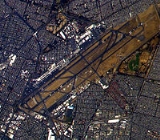
Mexico City International Airport

Encyclopedia
Benito Juárez International Airport , in Venustiano Carranza
, one of the sixteen boroughs into which Mexico's Federal District is divided, is a commercial airport that serves Mexico City
, the capital of Mexico
. It is Mexico
's busiest airport by both passenger traffic and aircraft movements and is the Latin America's
second busiest airport by passenger traffic after Guarulhos Airport in São Paulo
, Brazil
and the busiest airport by aircraft movements. Although Juárez was not its official name for several decades, it was formally named after the 19th century president Benito Juárez
in 2006, and is Mexico's main international and domestic gateway. The airport is owned by Grupo Aeroportuario de la Ciudad de México and operated by Aeropuertos y Servicios Auxiliares
, the government-owned corporation
, who also operates 21 others airports through Mexico. In recent years Toluca Airport
has become an alternate airport.
This hot and high
airport is served by 32 domestic and international airlines and offers direct flights to more than 100 destinations worldwide.It provides non-stop services from Mexico City to North America, Central America and Caribbean, South America, Europe and Asia (Aeromexico
is the only airline that flies to Asia
from Mexico City). In 2010, the airport served 24,130,535 passengers. In optimal conditions, and with the recent renovations and expansion projects completed, the Benito Juárez airport will be able to handle up to 32 million passengers per year. As the main hub for Mexico's largest airline Aeroméxico
and a secondary hub for its subsidiary Aeroméxico Connect, the airport has become a SkyTeam
hub. It is also a hub for Aeromar
, Interjet
and a focus city for VivaAerobus and Volaris
.
to the north and Venustiano Carranza
to the west, south and east. As the airport is east Mexico City and its runways run southwest-northeast, and airliner's landing approach is usually directly over Mexico City. Therefore, there is an important overflying problem.
operated by Mexicana
. President Miguel Alemán
opened the terminal in 1952, thus becoming a commercial airport. In the 1970s, president Luis Echeverría
closed three runways and gave that land to poor people in order to build their homes, leaving just two parallel runways. In 1980, the terminal was expanded to double its capacity, using a single large terminal rather than multiple terminals as in other airports. Ten years later in 1990, the mixed domestic/international gates were separated to increase the terminal's functionality, along with the separation of domestic and international check-in halls.
In 2001, the east wing of the terminal was opened as an international final call waiting area and was mainly used by SkyTeam
members. Because of the increasing demand, president Vicente Fox
announced the construction of a new, larger airport on 5,000 hectares (12,000 acres) in the municipalities of Texcoco
and San Salvador Atenco
, but when local violent protests aroused, the new airport was cancelled. Instead, he launched a program called Expansion of Mexico City Airport to its Maximum Capacity in 2002 to increase the airport's capacity. The whole terminal was expanded and upgraded with new check-in halls, 13 more baggage claim belts, the construction of Departures and Arrivals floors, construction of several new taxiways and a whole new terminal opposite of the original, thus breaking the single terminal concept. The project was started with an initial investment of $200,000,000 MXP. Nevertheless, its final cost was $800,000,000 MXP. The original quasi-Terminal 2, which only housed Aeromar
's operations in and out the airport was demolished, and the new Terminal 2 was built in less than two years.
On November 15, 2007, Terminal 2 was opened, increasing the airport's operational capacity by 40%. All SkyTeam
members moved their operations to it, except Air France
and KLM. It was officially inaugurated on March 2008, once the new road accesses and taxiways were finished. Terminal 2 increased the airport's contact positions by 40%, and the operational capacity by 15%.
in Toluca
, General Mariano Matamoros Airport
in Cuernavaca
or Hermanos Serdán International Airport
in Puebla
. Even with the inauguration of the new Terminal 2, the airport would be ideally designed to serve around 18 million passengers per year, according to the international standards for runway and terminal usage. Instead, the airport will keep increasing the number of passengers from around 26 million passengers in 2008 at a rate of 16% per year.
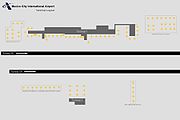
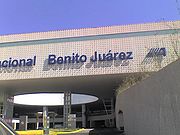
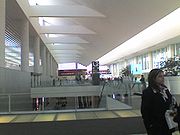
Mexico City's Terminal 1 is currently the largest airport terminal in the Americas
and the fourth largest in the world.
Terminal 2 is now housing all Aeroméxico
flights out of the airport, becoming the airline's main distribution center. Although the terminal was intended to be served by all-SkyTeam
member airlines, Air France
and KLM decided to remain at Terminal 1.
The airport houses a wide variety of lodging options for its passengers, including hotels inside Terminal 1 (the Hilton
Hotel, the Camino Real
and the Fiesta Inn), as well as a NH Hotel at Terminal 2.
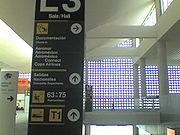
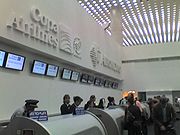
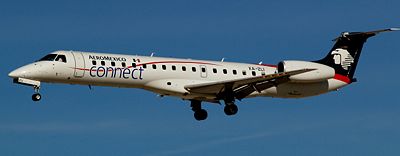
Notes: Aeromar has remote positions, just north of Terminal 2.
Other services.
in Bogotá
. Most passenger airlines, such as AeroMéxico and KLM use the airport to carry hold cargo on passenger flights, though most cargo is transported by all-cargo airlines. The following airlines operate the following scheduled destinations.
Airlines providing on-demand cargo services
, a government-owned corporation that operates airports in Mexico, has its headquarters on the airport property. The Aeromar
headquarters are located in Hangar 7 in Zone D of the General Aviation Terminal of the airport. Aviacsa
has its headquarters in Hangar 1 in Zone C.
in Bogotá and 35.5% more than Guarulhos Airport in São Paulo. For the 12-month period ending December 31, 2010, the airport had 339,898 aircraft operations, an average of 931 operations per day.
Notes: Official statistics include JFK and Newark airports.
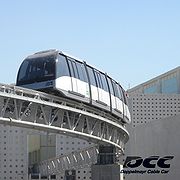 Terminal 2 is connected to Terminal 1 by the Aerotrén
monorail system in which only connecting passengers with hand baggage are allowed to use with their boarding pass. Technical and cabin crew can also use it. Normal operation hours are from 5:00 am to 11:00 pm, every day of the year, and the first run always begins from T2 to T1; the last run of the day is to T2. The distance between the terminals is 3 km. and the Airtrain's speed is 45 km. per hour. The Airtrain journey, once the doors are fully closed therefore takes approximately 4 minutes and 40 seconds between stations in both directions. Also, if you arrive as a train is leaving the maximum waiting period for the next train is 11 minutes. Also there is a land service between terminals called "inter-terminal transportation". These buses are located at entrance no. 6 of Terminal 1 and entrance no. 4 of Terminal 2.
Metro
station, which belongs to Line 5 of the subway, running from Pantitlán
station to Politécnico
station. It is located just outside the T1's national terminal.Terminals 1 and 2 have two land terminals operating 24 hours a day, 365 days a year. Different bus lines operate from here http://www.aicm.com.mx/serviciosausuarios_en/transportacion.php?Grupo=4, and provide continuous transportation services to the main cities located around Mexico City, such as Córdoba
, Cuernavaca
, Pachuca
, Puebla
, Querétaro
, Tlaxcala
and Toluca
. The Terminal 1 land terminal is located in front of the international area vehicular ramp and its facilities include various services for the comfort of the passengers. Among others, it offers VIP lounges, internet, resting, reading and meeting halls. The Terminal 2 land terminal is located at gate D, between entrance 4 and the national arrival passenger exit, and its facilities include resting halls and a fast food area.
of the Federal Government. The Terminal 1 taxi boarding areas are located at entrances 1 and 10; and in Terminal 2, boarding areas are located at entrances 3 and 4. Taxi rates are registered under the SCT and include passenger insurance, civil liability and medical expenses for all occupants. To receive the taxi service you must purchase the corresponding ticket previously at the authorized sale points located within the airport.
Venustiano Carranza, D.F.
Venustiano Carranza is one of the 16 delegaciones of Mexico's Federal District. The borough was formed in 1970 when the center of Mexico City was subdivided into four boroughs...
, one of the sixteen boroughs into which Mexico's Federal District is divided, is a commercial airport that serves Mexico City
Mexico City
Mexico City is the Federal District , capital of Mexico and seat of the federal powers of the Mexican Union. It is a federal entity within Mexico which is not part of any one of the 31 Mexican states but belongs to the federation as a whole...
, the capital of Mexico
Mexico
The United Mexican States , commonly known as Mexico , is a federal constitutional republic in North America. It is bordered on the north by the United States; on the south and west by the Pacific Ocean; on the southeast by Guatemala, Belize, and the Caribbean Sea; and on the east by the Gulf of...
. It is Mexico
Mexico
The United Mexican States , commonly known as Mexico , is a federal constitutional republic in North America. It is bordered on the north by the United States; on the south and west by the Pacific Ocean; on the southeast by Guatemala, Belize, and the Caribbean Sea; and on the east by the Gulf of...
's busiest airport by both passenger traffic and aircraft movements and is the Latin America's
Latin America
Latin America is a region of the Americas where Romance languages – particularly Spanish and Portuguese, and variably French – are primarily spoken. Latin America has an area of approximately 21,069,500 km² , almost 3.9% of the Earth's surface or 14.1% of its land surface area...
second busiest airport by passenger traffic after Guarulhos Airport in São Paulo
São Paulo
São Paulo is the largest city in Brazil, the largest city in the southern hemisphere and South America, and the world's seventh largest city by population. The metropolis is anchor to the São Paulo metropolitan area, ranked as the second-most populous metropolitan area in the Americas and among...
, Brazil
Brazil
Brazil , officially the Federative Republic of Brazil , is the largest country in South America. It is the world's fifth largest country, both by geographical area and by population with over 192 million people...
and the busiest airport by aircraft movements. Although Juárez was not its official name for several decades, it was formally named after the 19th century president Benito Juárez
Benito Juárez
Benito Juárez born Benito Pablo Juárez García, was a Mexican lawyer and politician of Zapotec origin from Oaxaca who served five terms as president of Mexico: 1858–1861 as interim, 1861–1865, 1865–1867, 1867–1871 and 1871–1872...
in 2006, and is Mexico's main international and domestic gateway. The airport is owned by Grupo Aeroportuario de la Ciudad de México and operated by Aeropuertos y Servicios Auxiliares
Aeropuertos y Servicios Auxiliares
Aeropuertos y Servicios Auxiliares is a federal government-owned corporation with its own equity capital and legal identity. It has its headquarters in Mexico City International Airport in Venustiano Carranza, Mexico City. It was created by the Mexican Federal Government in June 1965 to oversee...
, the government-owned corporation
Government-owned corporation
A government-owned corporation, state-owned company, state-owned entity, state enterprise, publicly owned corporation, government business enterprise, or parastatal is a legal entity created by a government to undertake commercial activities on behalf of an owner government...
, who also operates 21 others airports through Mexico. In recent years Toluca Airport
Lic. Adolfo López Mateos International Airport
Licenciado Adolfo López Mateos International Airport is an international airport located at Toluca, State of Mexico, Mexico. It is part of the Mexico City Metropolitan Airport Group, and it's being improved and promoted to handle some traffic for the city of Toluca, but it mainly serves as a...
has become an alternate airport.
This hot and high
Hot and high
In aviation, hot and high is a condition of low air density due to high ambient temperature and high airport elevation. Air density decreases with increasing temperature and altitude. Lower air density reduces the amount of lift generated by the wings or the rotors of an aircraft, which may hamper...
airport is served by 32 domestic and international airlines and offers direct flights to more than 100 destinations worldwide.It provides non-stop services from Mexico City to North America, Central America and Caribbean, South America, Europe and Asia (Aeromexico
Aeroméxico
Airways of Mexico, SA de CV , operating as Aeroméxico, is the flag carrier airline of Mexico based in Colonia Cuauhtémoc, Cuauhtémoc, Mexico City. It operates scheduled domestic and international services to North America, South America, Central America and the Caribbean, Europe, and Asia...
is the only airline that flies to Asia
Asia
Asia is the world's largest and most populous continent, located primarily in the eastern and northern hemispheres. It covers 8.7% of the Earth's total surface area and with approximately 3.879 billion people, it hosts 60% of the world's current human population...
from Mexico City). In 2010, the airport served 24,130,535 passengers. In optimal conditions, and with the recent renovations and expansion projects completed, the Benito Juárez airport will be able to handle up to 32 million passengers per year. As the main hub for Mexico's largest airline Aeroméxico
Aeroméxico
Airways of Mexico, SA de CV , operating as Aeroméxico, is the flag carrier airline of Mexico based in Colonia Cuauhtémoc, Cuauhtémoc, Mexico City. It operates scheduled domestic and international services to North America, South America, Central America and the Caribbean, Europe, and Asia...
and a secondary hub for its subsidiary Aeroméxico Connect, the airport has become a SkyTeam
SkyTeam
SkyTeam, branded as SKYTEAM, is an airline alliance with its centralised management team, SkyTeam Central, based at the World Trade Center Schiphol Airport on the grounds of Amsterdam Airport Schiphol in Haarlemmermeer, Netherlands...
hub. It is also a hub for Aeromar
Aeromar
For the Dominican Republic airline, see Aeromar Líneas Aéreas DominicanasTransportes Aeromar, S.A. de C.V, doing business as Aeromar, is an airline based in Hangar 7 of Zone D of the General Aviation Terminal at Mexico City International Airport in Venustiano Carranza, Mexico City, Mexico. Aeromar...
, Interjet
Interjet
ABC Aerolíneas, S.A. de C.V., operating as Interjet, is a low-cost airline with its headquarters in Lomas de Chapultepec, Miguel Hidalgo, Mexico City, Mexico. The airline operates scheduled flights to 24 domestic and 3 international destinations out of Toluca Airport and Mexico City International...
and a focus city for VivaAerobus and Volaris
Volaris
Concesionaria Vuela Compañía de Aviación, S.A. de C.V., operating as Volaris, is a low-cost airline from Mexico, and the country's second largest airline after Aeroméxico, thus being a leading competitor in the Mexican domestic market, with a market share of around 13-14% of domestic...
.
Location
The airport is 5 km. east from central Mexico City. The airport is surrounded by the built-up areas of Gustavo A. MaderoGustavo A. Madero, D.F.
Gustavo A. Madero is one of the 16 delegaciones into which Mexico's Federal District is divided.-Origins:Founded as "Villa de Guadalupe" in 1563, it became the city of "Villa de Guadalupe Hidalgo" in 1828, and finally a delegación in 1931; as such, it was named after Gustavo A. Madero, the brother...
to the north and Venustiano Carranza
Venustiano Carranza, D.F.
Venustiano Carranza is one of the 16 delegaciones of Mexico's Federal District. The borough was formed in 1970 when the center of Mexico City was subdivided into four boroughs...
to the west, south and east. As the airport is east Mexico City and its runways run southwest-northeast, and airliner's landing approach is usually directly over Mexico City. Therefore, there is an important overflying problem.
History
The airport first opened as Balbuena Military Airport with five runways. The first landing was on November 5, 1928 and regular service started a year later, but was officially inaugurated on May 15, 1931. Its first international route was to Los Angeles International AirportLos Angeles International Airport
Los Angeles International Airport is the primary airport serving the Greater Los Angeles Area, the second-most populated metropolitan area in the United States. It is most often referred to by its IATA airport code LAX, with the letters pronounced individually...
operated by Mexicana
Mexicana de Aviación
Founded in 1921, Compañía Mexicana de Aviación, S.A. de C.V. was Mexico's oldest airline, before ceasing operations on August 28, 2010. The group's closure was announced by the company's recently installed management team a short time after the group filed for Concurso Mercantil and US Chapter 15...
. President Miguel Alemán
Miguel Alemán
Miguel Alemán may refer to:*Miguel Alemán González, general in the Mexican Revolution; father of:*Miguel Alemán Valdés , president of Mexico from 1946 to 1952; father of:*Miguel Alemán Velasco Miguel Alemán may refer to:*Miguel Alemán González, general in the Mexican Revolution; father of:*Miguel...
opened the terminal in 1952, thus becoming a commercial airport. In the 1970s, president Luis Echeverría
Luis Echeverría
Luis Echeverría Álvarez served as President of Mexico from 1970 to 1976.-Early history:Echeverría joined the faculty of the National Autonomous University of Mexico in 1947 and taught political theory...
closed three runways and gave that land to poor people in order to build their homes, leaving just two parallel runways. In 1980, the terminal was expanded to double its capacity, using a single large terminal rather than multiple terminals as in other airports. Ten years later in 1990, the mixed domestic/international gates were separated to increase the terminal's functionality, along with the separation of domestic and international check-in halls.
In 2001, the east wing of the terminal was opened as an international final call waiting area and was mainly used by SkyTeam
SkyTeam
SkyTeam, branded as SKYTEAM, is an airline alliance with its centralised management team, SkyTeam Central, based at the World Trade Center Schiphol Airport on the grounds of Amsterdam Airport Schiphol in Haarlemmermeer, Netherlands...
members. Because of the increasing demand, president Vicente Fox
Vicente Fox
Vicente Fox Quesada is a Mexican former politician who served as President of Mexico from 1 December 2000 to 30 November 2006 and currently serves as co-President of the Centrist Democrat International, an international organization of Christian democratic political parties.Fox was elected...
announced the construction of a new, larger airport on 5,000 hectares (12,000 acres) in the municipalities of Texcoco
Texcoco, Mexico State
Texcoco is a city and municipality located in the northeast portion of Mexico State, 25 km northeast of Mexico City. In the pre-Hispanic era, this was a major Aztec city on the shores of Lake Texcoco. After the Conquest, the city was initially the second most important after Mexico City,...
and San Salvador Atenco
San Salvador Atenco
San Salvador Atenco is the municipal seat of Atenco, in the Mexican state of Mexico.The name "Atenco" comes from a Nahuatl phrase meaning "place on the edge of water". -The town:...
, but when local violent protests aroused, the new airport was cancelled. Instead, he launched a program called Expansion of Mexico City Airport to its Maximum Capacity in 2002 to increase the airport's capacity. The whole terminal was expanded and upgraded with new check-in halls, 13 more baggage claim belts, the construction of Departures and Arrivals floors, construction of several new taxiways and a whole new terminal opposite of the original, thus breaking the single terminal concept. The project was started with an initial investment of $200,000,000 MXP. Nevertheless, its final cost was $800,000,000 MXP. The original quasi-Terminal 2, which only housed Aeromar
Aeromar
For the Dominican Republic airline, see Aeromar Líneas Aéreas DominicanasTransportes Aeromar, S.A. de C.V, doing business as Aeromar, is an airline based in Hangar 7 of Zone D of the General Aviation Terminal at Mexico City International Airport in Venustiano Carranza, Mexico City, Mexico. Aeromar...
's operations in and out the airport was demolished, and the new Terminal 2 was built in less than two years.
On November 15, 2007, Terminal 2 was opened, increasing the airport's operational capacity by 40%. All SkyTeam
SkyTeam
SkyTeam, branded as SKYTEAM, is an airline alliance with its centralised management team, SkyTeam Central, based at the World Trade Center Schiphol Airport on the grounds of Amsterdam Airport Schiphol in Haarlemmermeer, Netherlands...
members moved their operations to it, except Air France
Air France
Air France , stylised as AIRFRANCE, is the French flag carrier headquartered in Tremblay-en-France, , and is one of the world's largest airlines. It is a subsidiary of the Air France-KLM Group and a founding member of the SkyTeam global airline alliance...
and KLM. It was officially inaugurated on March 2008, once the new road accesses and taxiways were finished. Terminal 2 increased the airport's contact positions by 40%, and the operational capacity by 15%.
Lack of capacity and slot restriction
The airport has suffered from a lack of capacity due to restrictions for expansion, since it is located in a densely-populated area. Some analysts have reported that if the airport had grown at the same speed as demand, it would now serve over 40 million passengers annually. The main issue with the airport is the limitation that its two runways provide, since they are used at 97.3% of their maximum capacity, leaving a very short room for new operations into the airport. Only government, military, commercial and specially authorized aircraft are allowed to land at the airport. Private aircraft must use alternate airports, such as Lic. Adolfo Lopez Mateos International AirportLic. Adolfo López Mateos International Airport
Licenciado Adolfo López Mateos International Airport is an international airport located at Toluca, State of Mexico, Mexico. It is part of the Mexico City Metropolitan Airport Group, and it's being improved and promoted to handle some traffic for the city of Toluca, but it mainly serves as a...
in Toluca
Toluca
Toluca, formally known as Toluca de Lerdo, is the state capital of Mexico State as well as the seat of the Municipality of Toluca. It is the center of a rapidly growing urban area, now the fifth largest in Mexico. It is located west-southwest of Mexico City and only about 40 minutes by car to the...
, General Mariano Matamoros Airport
General Mariano Matamoros Airport
General Mariano Matamoros Airport , also known as Cuernavaca Airport, is an airport located in Cuernavaca, Morelos, Mexico, near Mexico City. It handles national and international air traffic for the city of Cuernavaca. It is part of the Mexico City Metropolitan Airport Group, along with the...
in Cuernavaca
Cuernavaca
Cuernavaca is the capital and largest city of the state of Morelos in Mexico. It was established at the archeological site of Gualupita I by the Olmec, "the mother culture" of Mesoamerica, approximately 3200 years ago...
or Hermanos Serdán International Airport
Hermanos Serdán International Airport
Hermanos Serdán International Airport is an international airport located near Puebla, Puebla, Mexico. It handles national air traffic for the city of Puebla....
in Puebla
Puebla
Puebla officially Estado Libre y Soberano de Puebla is one of the 31 states which, with the Federal District, comprise the 32 Federal Entities of Mexico. It is divided in 217 municipalities and its capital city is Puebla....
. Even with the inauguration of the new Terminal 2, the airport would be ideally designed to serve around 18 million passengers per year, according to the international standards for runway and terminal usage. Instead, the airport will keep increasing the number of passengers from around 26 million passengers in 2008 at a rate of 16% per year.
Terminals and facilities
Terminals
Mexico City International Airport has two passenger terminals. Terminal 1 is separated from the other by the runways.Terminal 1
- Opened in 1958; expanded in 1970, 1989, 1998, 2000 and 2004
- Overall terminal surface: 548,000 sq meters
- Contact positions: 33
- Remote positions: 20 (34 Before New T2 was built)
- Number of jetways: 32
- Number of airside halls: 10 (A, B, C, D, E, F, G, H, I, J)
- Number of landside (check-in) halls: 9 (A1, A2, B, C, D, D1, F1, F2, F3)
- Number of mobile-lounges: 11 (A7-A, A7-B, A7-C, A9-A, A9-B, A9-C, A9-D, A9-E, F19-A, F19-C, F19-D)
- Hotel service: 600 rooms (Camino Real), 110 rooms (Hilton)
- Parking service: 3,100 vehicles (Domestic), 2,400 vehicles (International)
- Space per passenger in T1: 17 sq meters
- Number of baggage claiming carousels: 22
- Premium Lounges in T1: Salón Premier Internacional T1 (AeroméxicoAeroméxicoAirways of Mexico, SA de CV , operating as Aeroméxico, is the flag carrier airline of Mexico based in Colonia Cuauhtémoc, Cuauhtémoc, Mexico City. It operates scheduled domestic and international services to North America, South America, Central America and the Caribbean, Europe, and Asia...
), Red Carpet Club (United AirlinesUnited AirlinesUnited Air Lines, Inc., is the world's largest airline with 86,852 employees United Air Lines, Inc., is the world's largest airline with 86,852 employees United Air Lines, Inc., is the world's largest airline with 86,852 employees (which includes the entire holding company United Continental...
), Admirals Club (American AirlinesAmerican AirlinesAmerican Airlines, Inc. is the world's fourth-largest airline in passenger miles transported and operating revenues. American Airlines is a subsidiary of the AMR Corporation and is headquartered in Fort Worth, Texas adjacent to its largest hub at Dallas/Fort Worth International Airport...
), American Express Lounge (American ExpressAmerican ExpressAmerican Express Company or AmEx, is an American multinational financial services corporation headquartered in Three World Financial Center, Manhattan, New York City, New York, United States. Founded in 1850, it is one of the 30 components of the Dow Jones Industrial Average. The company is best...
), Elite Lounge Nacional (MexicanaMexicana de AviaciónFounded in 1921, Compañía Mexicana de Aviación, S.A. de C.V. was Mexico's oldest airline, before ceasing operations on August 28, 2010. The group's closure was announced by the company's recently installed management team a short time after the group filed for Concurso Mercantil and US Chapter 15...
), Elite Lounge Internacional (MexicanaMexicana de AviaciónFounded in 1921, Compañía Mexicana de Aviación, S.A. de C.V. was Mexico's oldest airline, before ceasing operations on August 28, 2010. The group's closure was announced by the company's recently installed management team a short time after the group filed for Concurso Mercantil and US Chapter 15...
).
Mexico City's Terminal 1 is currently the largest airport terminal in the Americas
Americas
The Americas, or America , are lands in the Western hemisphere, also known as the New World. In English, the plural form the Americas is often used to refer to the landmasses of North America and South America with their associated islands and regions, while the singular form America is primarily...
and the fourth largest in the world.
Terminal 2
- Opened in 2007
- Overall terminal surface: 242,000 sq meters
- Contact positions: 23
- Remote positions: 17 (AeromarAeromarFor the Dominican Republic airline, see Aeromar Líneas Aéreas DominicanasTransportes Aeromar, S.A. de C.V, doing business as Aeromar, is an airline based in Hangar 7 of Zone D of the General Aviation Terminal at Mexico City International Airport in Venustiano Carranza, Mexico City, Mexico. Aeromar...
and Aeromexico Connect) - Number of jetways: 23
- Number of airside halls: 2 (Domestic, International)
- Number of landside (check-in) halls: 3 (L1, L2, L3)
- Hotel service: 287 rooms (NH)
- Parking service: 3,000 vehicles
- Space per passenger in T2: 22 sq meters
- Number of baggage claiming carousels: 15
- Premium Lounges in T2: Club Diamante (AeromarAeromarFor the Dominican Republic airline, see Aeromar Líneas Aéreas DominicanasTransportes Aeromar, S.A. de C.V, doing business as Aeromar, is an airline based in Hangar 7 of Zone D of the General Aviation Terminal at Mexico City International Airport in Venustiano Carranza, Mexico City, Mexico. Aeromar...
), Salón Premier (AeroméxicoAeroméxicoAirways of Mexico, SA de CV , operating as Aeroméxico, is the flag carrier airline of Mexico based in Colonia Cuauhtémoc, Cuauhtémoc, Mexico City. It operates scheduled domestic and international services to North America, South America, Central America and the Caribbean, Europe, and Asia...
), Salón Premier Internacional T2 (AeroméxicoAeroméxicoAirways of Mexico, SA de CV , operating as Aeroméxico, is the flag carrier airline of Mexico based in Colonia Cuauhtémoc, Cuauhtémoc, Mexico City. It operates scheduled domestic and international services to North America, South America, Central America and the Caribbean, Europe, and Asia...
), Riedel Wine Room (AeroméxicoAeroméxicoAirways of Mexico, SA de CV , operating as Aeroméxico, is the flag carrier airline of Mexico based in Colonia Cuauhtémoc, Cuauhtémoc, Mexico City. It operates scheduled domestic and international services to North America, South America, Central America and the Caribbean, Europe, and Asia...
) , Travel Pass Elite Lounge (Banamex) , Centurion American Express Lounge American ExpressAmerican ExpressAmerican Express Company or AmEx, is an American multinational financial services corporation headquartered in Three World Financial Center, Manhattan, New York City, New York, United States. Founded in 1850, it is one of the 30 components of the Dow Jones Industrial Average. The company is best...
. - Platform surface: 426,000 sq meters
- Inter-terminal AerotrénAerotrenThe Aerotrén is a people mover operating at Mexico City International Airport, near Mexico City, in Mexico. The automated people mover provides a link between Terminal 1 and Terminal 2....
capacity: 7,800 daily passengers
Terminal 2 is now housing all Aeroméxico
Aeroméxico
Airways of Mexico, SA de CV , operating as Aeroméxico, is the flag carrier airline of Mexico based in Colonia Cuauhtémoc, Cuauhtémoc, Mexico City. It operates scheduled domestic and international services to North America, South America, Central America and the Caribbean, Europe, and Asia...
flights out of the airport, becoming the airline's main distribution center. Although the terminal was intended to be served by all-SkyTeam
SkyTeam
SkyTeam, branded as SKYTEAM, is an airline alliance with its centralised management team, SkyTeam Central, based at the World Trade Center Schiphol Airport on the grounds of Amsterdam Airport Schiphol in Haarlemmermeer, Netherlands...
member airlines, Air France
Air France
Air France , stylised as AIRFRANCE, is the French flag carrier headquartered in Tremblay-en-France, , and is one of the world's largest airlines. It is a subsidiary of the Air France-KLM Group and a founding member of the SkyTeam global airline alliance...
and KLM decided to remain at Terminal 1.
The airport houses a wide variety of lodging options for its passengers, including hotels inside Terminal 1 (the Hilton
Hilton Hotels
Hilton Hotels & Resorts is an international chain of full-service hotels and resorts founded by Conrad Hilton and now owned by Hilton Worldwide. Hilton hotels are either owned by, managed by, or franchised to independent operators by Hilton Worldwide. Hilton Hotels became the first coast-to-coast...
Hotel, the Camino Real
Camino Real Hotels
Camino Real Hotels is a Mexican-based hotel chain consisting of hotels and resorts.-History:Camino Real was the name given by 16th century Spaniards to the road that led to the capital of New Spain, today known as Mexico....
and the Fiesta Inn), as well as a NH Hotel at Terminal 2.
Airlines and destinations
Notes: Aeromar has remote positions, just north of Terminal 2.
Other services.
- CanJetCanJetCanJet Airlines is a low-cost chartered airline based in Enfield and in the Halifax Regional Municipality, Nova Scotia, Canada at the Halifax International Airport. It operates contract and ad hoc charters throughout Canada and the United States...
- Global AirGlobal Air (Mexico)Global Air is an airline based in Mexico City, Mexico. It operated domestic services, but ceased operations after both of its aircraft were leased out in April 2006.-History :...
- Miami Air InternationalMiami Air InternationalMiami Air International is an American charter airline based in Miami-Dade County, Florida, United States. It operates worldwide passenger charter flights for diverse groups including cruise operators, professional sports teams and the United States military...
- Sunwing AirlinesSunwing AirlinesSunwing Airlines Inc. is an airline headquartered in Toronto, Ontario, Canada, offering scheduled and chartered services to Canada, the United States, Mexico, the Caribbean, Europe, Central America, South America as well as domestic services during the summer season.It is a subsidiary of Sunwing...
Cargo airlines
As of November 2011, Mexico City airport is served by 18 cargo airlines flying directly to Europe, Central, North and South America. Over 393,000 metric tonnes pass through the airport in 2010, making it the second busiest by cargo traffic in Latin America, after El Dorado International AirportEl Dorado International Airport
El Dorado International Airport is an international airport located in Bogotá, Colombia. It is the largest Latin America airport in terms of cargo movements with 593,946 tons and the third in terms of passenger traffic, only behind São Paulo-Guarulhos International Airport and Mexico City's...
in Bogotá
Bogotá
Bogotá, Distrito Capital , from 1991 to 2000 called Santa Fé de Bogotá, is the capital, and largest city, of Colombia. It is also designated by the national constitution as the capital of the department of Cundinamarca, even though the city of Bogotá now comprises an independent Capital district...
. Most passenger airlines, such as AeroMéxico and KLM use the airport to carry hold cargo on passenger flights, though most cargo is transported by all-cargo airlines. The following airlines operate the following scheduled destinations.
Airlines providing on-demand cargo services
|
Contract Air Cargo Contract Air Cargo is a cargo airline based in Waterford, Michigan, USA. It operates ad hoc cargo services as well as contract charters for General Motors and Ford.-History:... Kalitta Air Kalitta Air is an American cargo airline headquartered in Ypsilanti Township, Michigan, United States. It operates international scheduled and ad-hoc cargo charter services. Its main base is Willow Run Airport near Ypsilanti.-History:... Líneas Aéreas Suramericanas Líneas Aéreas Suramericanas is a cargo airline based in Bogotá, Colombia. It operates domestic cargo charters and international services to North and South America, Mexico, and the Caribbean. Its main base is El Dorado International Airport, Bogotá.- History :... Martinair For the American cargo airline, see Martinaire.Martinair Holland N.V., operating as Martinair, is an airline headquartered in the TransPort Building on the grounds of Amsterdam Airport Schiphol in Haarlemmermeer, Netherlands. It operates cargo services to over 50 destinations worldwide. Services... Regional Cargo Regionalcargo Holdings, S.A. de C.V., operating as Regional Cargo, is a Mexican cargo airline. Its headquarters are on the grounds of Querétaro International Airport and in Colón, Querétaro, near Santiago de Querétaro.- History :... |
USA Jet Airlines USA Jet Airlines is an American air carrier with its headquarters on the grounds of Willow Run Airport and in Van Buren Township, Michigan. USA Jet operates on-demand air charter passenger and freight flights out of Willow Run Airport as well as aircraft on a government contract out of Kirtland... |
Other facilities
Aeropuertos y Servicios AuxiliaresAeropuertos y Servicios Auxiliares
Aeropuertos y Servicios Auxiliares is a federal government-owned corporation with its own equity capital and legal identity. It has its headquarters in Mexico City International Airport in Venustiano Carranza, Mexico City. It was created by the Mexican Federal Government in June 1965 to oversee...
, a government-owned corporation that operates airports in Mexico, has its headquarters on the airport property. The Aeromar
Aeromar
For the Dominican Republic airline, see Aeromar Líneas Aéreas DominicanasTransportes Aeromar, S.A. de C.V, doing business as Aeromar, is an airline based in Hangar 7 of Zone D of the General Aviation Terminal at Mexico City International Airport in Venustiano Carranza, Mexico City, Mexico. Aeromar...
headquarters are located in Hangar 7 in Zone D of the General Aviation Terminal of the airport. Aviacsa
Aviacsa
Consorcio Aviaxsa, S.A. de C.V., doing business as Aviacsa, is a low-cost airline of Mexico with its headquarters in Hangar 1 of Zone C on the property of Mexico City International Airport in Venustiano Carranza, Mexico City, Mexico...
has its headquarters in Hangar 1 in Zone C.
Traffic statistics
| Year | Total passengers | % change | Aircraft movements | % change | Cargo [TM] | % change |
|---|---|---|---|---|---|---|
| 2006 | 24,727,296 | 2.5 | 355,593 | 6.9 | - | - |
| 2007 | 25,881,662 | 4.7 | 378,161 | 6.3 | - | - |
| 2008 | 26,210,217 | 1.3 | 366,561 | 3.1 | 376,095.71 | - |
| 2009 | 24,243,056 | 7.5 | 348,306 | 5.0 | 321,133.44 | 14.61 |
| 2010 | 24,130,535 | 0.46 | 339,898 | 2.4 | 393,075.87 | 22.40 |
| 2011 | [Jan-Oct] 21,466,128 |
6.71 | 288,189 | 0.80 | 336,891.85 | 4.72 |
Operations
In 2010, Benito Juárez was the busiest airport in Latin America by aircraft movements with 27.3% more operations than El Dorado International AirportEl Dorado International Airport
El Dorado International Airport is an international airport located in Bogotá, Colombia. It is the largest Latin America airport in terms of cargo movements with 593,946 tons and the third in terms of passenger traffic, only behind São Paulo-Guarulhos International Airport and Mexico City's...
in Bogotá and 35.5% more than Guarulhos Airport in São Paulo. For the 12-month period ending December 31, 2010, the airport had 339,898 aircraft operations, an average of 931 operations per day.
| Rank | City | Passengers | Rank change | Carriers |
|---|---|---|---|---|
| 1 |  Los Angeles, CA, USA Los Angeles, CA, USALos Angeles International Airport Los Angeles International Airport is the primary airport serving the Greater Los Angeles Area, the second-most populated metropolitan area in the United States. It is most often referred to by its IATA airport code LAX, with the letters pronounced individually... |
665,399 | Aeroméxico Aeroméxico Airways of Mexico, SA de CV , operating as Aeroméxico, is the flag carrier airline of Mexico based in Colonia Cuauhtémoc, Cuauhtémoc, Mexico City. It operates scheduled domestic and international services to North America, South America, Central America and the Caribbean, Europe, and Asia... , Alaska Alaska Airlines Alaska Airlines is an airline based in the Seattle suburb of SeaTac, Washington in the United States. The airline originated in 1932 as McGee Airways. After many mergers with and acquisitions of other airlines, including Star Air Service, it became known as Alaska Airlines in 1944... , United United Airlines United Air Lines, Inc., is the world's largest airline with 86,852 employees United Air Lines, Inc., is the world's largest airline with 86,852 employees United Air Lines, Inc., is the world's largest airline with 86,852 employees (which includes the entire holding company United Continental... , Volaris Volaris Concesionaria Vuela Compañía de Aviación, S.A. de C.V., operating as Volaris, is a low-cost airline from Mexico, and the country's second largest airline after Aeroméxico, thus being a leading competitor in the Mexican domestic market, with a market share of around 13-14% of domestic... |
|
| 2 | Houston, TX, USA George Bush Intercontinental Airport George Bush Intercontinental Airport, is a Class B international airport in Houston, Texas, serving the Houston–Sugar Land–Baytown metropolitan area, the sixth-largest metropolitan area in the United States. Located north of Downtown Houston between Interstate 45 and U.S. Highway 59... |
621,097 | 2 | Aeroméxico, Aeroméxico Connect, Continental Continental Airlines Continental Airlines was a major American airline now merged with United Airlines. On May 3, 2010, Continental Airlines, Inc. and UAL, Inc. announced a merger via a stock swap, and on October 1, 2010, the merger closed and UAL changed its name to United Continental Holdings, Inc... , ExpressJet Airlines ExpressJet Airlines ExpressJet Airlines, Inc. is an American regional airline based in the A-Tech Center in College Park, Georgia. It is a wholly owned subsidiary of Atlantic Southeast Airlines which is in turn a subsidiary of the airline holding company SkyWest, Inc., parent company of the air carrier SkyWest... |
| 3 | New York, NY, USA New York City New York is the most populous city in the United States and the center of the New York Metropolitan Area, one of the most populous metropolitan areas in the world. New York exerts a significant impact upon global commerce, finance, media, art, fashion, research, technology, education, and... (JFK John F. Kennedy International Airport John F. Kennedy International Airport is an international airport located in the borough of Queens in New York City, about southeast of Lower Manhattan. It is the busiest international air passenger gateway to the United States, handling more international traffic than any other airport in North... and Newark airports) |
590,506 | 1 | Aeroméxico, Continental, Delta Delta Air Lines Delta Air Lines, Inc. is a major airline based in the United States and headquartered in Atlanta, Georgia. The airline operates an extensive domestic and international network serving all continents except Antarctica. Delta and its subsidiaries operate over 4,000 flights every day... |
| 4 | Miami, FL, USA Miami International Airport Miami International Airport , also known as MIA and historically Wilcox Field, is the primary airport serving the South Florida area... |
553,836 | 1 | Aeroméxico, Aeroméxico Connect, American American Airlines American Airlines, Inc. is the world's fourth-largest airline in passenger miles transported and operating revenues. American Airlines is a subsidiary of the AMR Corporation and is headquartered in Fort Worth, Texas adjacent to its largest hub at Dallas/Fort Worth International Airport... |
| 5 |  Madrid, Spain Madrid, Spain |
496,443 | Aeroméxico, Air Europa, Iberia Iberia The name Iberia refers to three historical regions of the old world:* Iberian Peninsula, in Southwest Europe, location of modern-day Portugal and Spain** Prehistoric Iberia... |
|
| 6 | Dallas, TX, USA Dallas-Fort Worth International Airport Dallas/Fort Worth International Airport is located between the cities of Dallas and Fort Worth, Texas, and is the busiest airport in the U.S. state of Texas... |
404,351 | American | |
| 7 |  Paris, France Paris, France |
386,259 | Aeroméxico, Air France Air France Air France , stylised as AIRFRANCE, is the French flag carrier headquartered in Tremblay-en-France, , and is one of the world's largest airlines. It is a subsidiary of the Air France-KLM Group and a founding member of the SkyTeam global airline alliance... |
|
| 8 | Chicago, IL, USA |
310,838 | Aeroméxico, American, United | |
| 9 | Atlanta, GA, USA Hartsfield-Jackson Atlanta International Airport Hartsfield–Jackson Atlanta International Airport , known locally as Atlanta Airport, Hartsfield Airport, and Hartsfield–Jackson, is located seven miles south of the central business district of Atlanta, Georgia, United States... |
269,571 | 2 | Delta |
| 10 |  Panama City, Panama Panama City, PanamaTocumen International Airport Tocumen International Airport is an international airport located from Panama City, Panama. In 2006, it underwent a major expansion and renovation program in order to modernize and improve its facilities... |
267,889 | 1 | Copa Copa Airlines Compañía Panameña de Aviación, S.A., operating as Copa Airlines ', is an airline based in Panama City, Panama, and serves as Panama's flag carrier... |
| 11 |  Bogotá, Colombia Bogotá, ColombiaEl Dorado International Airport El Dorado International Airport is an international airport located in Bogotá, Colombia. It is the largest Latin America airport in terms of cargo movements with 593,946 tons and the third in terms of passenger traffic, only behind São Paulo-Guarulhos International Airport and Mexico City's... |
253,483 | 3 | Aeroméxico, Avianca Avianca Avianca S.A. is the flag carrier airline of Colombia since December 5, 1919 when it was initially registered under the name SCADTA. It is headquartered in Bogotá, D.C. with its hub at the El Dorado International Airport... , Copa Airlines Colombia Copa Airlines Colombia AeroRepública S.A., operating as Copa Airlines Colombia, is an airline based in Bogotá, Colombia. It is the third largest air carrier in Colombia . It operates scheduled services from Bogotá to 11 domestic destinations, Panama, Venezuela, Cuba, Mexico, Guatemala and Ecuador as well as charter... |
| 12 | San Francisco, CA, USA San Francisco International Airport San Francisco International Airport is a major international airport located south of downtown San Francisco, California, United States, near the cities of Millbrae and San Bruno in unincorporated San Mateo County. It is often referred to as SFO... |
237,148 | 2 | Aeroméxico, United |
| 13 |  Frankfurt, Germany Frankfurt, GermanyFrankfurt Airport Frankfurt Airport may refer to:Airports of Frankfurt, Germany:*Frankfurt Airport , the largest airport in Germany*Frankfurt Egelsbach Airport, a general aviation airport*Frankfurt-Hahn Airport , a converted U.S... |
215,922 | Lufthansa Lufthansa Deutsche Lufthansa AG is the flag carrier of Germany and the largest airline in Europe in terms of overall passengers carried. The name of the company is derived from Luft , and Hansa .The airline is the world's fourth-largest airline in terms of overall passengers carried, operating... |
|
| 14 | .svg.png) San José, Costa Rica San José, Costa RicaJuan Santamaría International Airport Juan Santamaría International Airport is located in Alajuela Province, about from downtown San José, Costa Rica. It is a hub airport for TACA/Lacsa, and focus city airport for Copa Airlines. It is named after Costa Rica's national hero Juan Santamaría, a courageous drummer boy who died in 1856... |
211,408 | 1 | Aeroméxico, LACSA Lacsa Lacsa , is the national airline of Costa Rica and is based in San José. It operates international scheduled services to over 35 destinations in Central, North and South America. All international services are now operated by Grupo TACA... |
| 15 |  Lima, Peru Lima, PeruJorge Chávez International Airport Jorge Chávez International Airport , known as Aeropuerto Internacional Jorge Chávez in Spanish, is Peru's main international and domestic airport. It is located in Callao, 11 kilometers from the Historic Centre of Lima and 17 km from Miraflores. Callao is the port city now fully... |
210,628 | 9 | Aeroméxico, LAN Perú LAN Peru LAN Perú S.A. is an airline based in Lima, Peru. It is a subsidiary of Chilean publicly-traded company LAN Airlines , which owns 49% of the airline. It operates scheduled domestic and international services. Its main base is on the grounds of Jorge Chávez International Airport... , TACA Perú TACA Peru TACA Peru is an airline based in Lima, Peru. It operates domestic services and international services. Its main base is Jorge Chávez International Airport , Lima. The airline operates out of 18 airports. It is part of Grupo TACA and operates its flights with TACA's codes.- History :The airline was... |
| 16 |  São Paulo, Brazil São Paulo, Brazil |
196,396 | 3 | Aeroméxico, TAM Airlines |
| 17 |  Amsterdam, Netherlands Amsterdam, Netherlands |
177,627 | 1 | KLM |
| 18 | Phoenix, AZ, USA Phoenix Sky Harbor International Airport Phoenix Sky Harbor International Airport is a joint civil-military public airport located southeast of the central business district of the city of Phoenix, in Maricopa County, Arizona, United States... |
173,614 | 9 | US Airways US Airways US Airways, Inc. is a major airline based in the U.S. city of Tempe, Arizona. The airline is an operating unit of US Airways Group and is the sixth largest airline by traffic and eighth largest by market value in the country.... |
| 19 | Las Vegas, NV, USA McCarran International Airport McCarran International Airport is the principal commercial airport serving Las Vegas and Clark County, Nevada, United States. The airport is located five miles south of the central business district of Las Vegas, in the unincorporated area of Paradise in Clark County. It covers an area of and... |
167,256 | 2 | Aeroméxico, Volaris |
| 20 |  Santiago de Chile, Chile Santiago de Chile, ChileComodoro Arturo Merino Benítez International Airport Comodoro Arturo Merino Benítez International Airport , also known as Pudahuel Airport and Santiago International Airport, located in Pudahuel, north-west of downtown Santiago, is Chile's largest aviation facility and the busiest international air passenger gateway to the country... |
161,807 | 2 | Aeroméxico, LAN LAN Airlines LAN Airlines S.A. is an airline based in Santiago, Chile. LAN is currently positioned amongst the largest airlines in Latin America, serving Latin America, United States, the Caribbean, Oceania, and Europe. It is a member of the Oneworld airline alliance... |
| 21 |  Guatemala City, Guatemala Guatemala City, GuatemalaLa Aurora International Airport La Aurora International Airport serves Guatemala City, Guatemala. It is located south of Guatemala City's center and from Antigua. It is administered by the Dirección General de Aeronáutica Civil.... |
157,273 | 9 | Aeroméxico, TACA, Interjet Interjet ABC Aerolíneas, S.A. de C.V., operating as Interjet, is a low-cost airline with its headquarters in Lomas de Chapultepec, Miguel Hidalgo, Mexico City, Mexico. The airline operates scheduled flights to 24 domestic and 3 international destinations out of Toluca Airport and Mexico City International... |
| 22 |  Havana, Cuba Havana, CubaJosé Martí International Airport José Martí International Airport , sometimes known by its former name Rancho-Boyeros Airport, is located southwest of Havana, Cuba, and is a hub for Cubana de Aviación, Aerogaviota and Aero Caribbean, and former Latin American hub for Aeroflot Soviet Airlines... |
153,980 | 2 | Aeroméxico, Cubana Cubana de Aviación Cubana de Aviación S.A., commonly known as Cubana, is Cuba's largest airline and flag carrier. The airline was founded on 8 October 1929, and has its corporate headquarters in Havana. Its main base is at José Martí International Airport... , Interjet |
| 23 |  Toronto, Canada Toronto, CanadaToronto Pearson International Airport Toronto Pearson International Airport is an international airport serving Toronto, Ontario, Canada; its metropolitan area; and the Golden Horseshoe, an urban agglomeration that is home to 8.1 million people – approximately 25% of Canada's population... |
145,180 | 7 | Air Canada Air Canada Air Canada is the flag carrier and largest airline of Canada. The airline, founded in 1936, provides scheduled and charter air transport for passengers and cargo to 178 destinations worldwide. It is the world's tenth largest passenger airline by number of destinations, and the airline is a... |
| 24 |  Buenos Aires, Argentina Buenos Aires, ArgentinaMinistro Pistarini International Airport Ministro Pistarini International Airport , more commonly known as Ezeiza International Airport owing to its location within the Ezeiza Partido in the Greater Buenos Aires, is an international airport located south-southwest of Buenos Aires, the capital city of Argentina... |
128,748 | 3 | Aerolíneas Argentinas Aerolíneas Argentinas Aerolíneas Argentinas , formally Aerolíneas Argentinas S.A., is Argentina's largest airline and serves as the country's flag carrier. Owned in its majority by the Argentine Government, the airline is headquartered in the Torre Bouchard, located in San Nicolás, Buenos Aires... , Aeroméxico |
| 25 | London, United Kingdom London Heathrow Airport London Heathrow Airport or Heathrow , in the London Borough of Hillingdon, is the busiest airport in the United Kingdom and the third busiest airport in the world in terms of total passenger traffic, handling more international passengers than any other airport around the globe... |
126,732 | 2 | British Airways British Airways British Airways is the flag carrier airline of the United Kingdom, based in Waterside, near its main hub at London Heathrow Airport. British Airways is the largest airline in the UK based on fleet size, international flights and international destinations... |
Notes: Official statistics include JFK and Newark airports.
| Rank | City | Passengers | Rank change | Carriers |
|---|---|---|---|---|
| 1 |  Cancún, Quintana Roo Cancún, Quintana RooCancún International Airport Cancún International Airport is located in Cancún, Quintana Roo, on the Caribbean coast of Mexico's Yucatán Peninsula. It is Mexico's second busiest airport, after Mexico City International Airport in Mexico City, but the biggest in Mexico and Latin America for International passengers... |
1,973,959 | Aeroméxico, Interjet, Magni Magnicharters Grupo Aereo Monterrey S.A. de C.V., doing business as Magnicharters, is a airline with its headquarters in Colonia Juárez, Cuauhtémoc, Mexico City, operating domestic holiday flights out of Mexico City International Airport.-History:... , VivaAerobus, Volaris Volaris Concesionaria Vuela Compañía de Aviación, S.A. de C.V., operating as Volaris, is a low-cost airline from Mexico, and the country's second largest airline after Aeroméxico, thus being a leading competitor in the Mexican domestic market, with a market share of around 13-14% of domestic... |
|
| 2 |  Monterrey, Nuevo León Monterrey, Nuevo LeónGeneral Mariano Escobedo International Airport General Mariano Escobedo International Airport is an international airport located in Apodaca, Nuevo León, Mexico. Together with Del Norte International Airport, General Mariano Escobedo International Airport handles domestic and international operations for the city of Monterrey and its... |
1,837,278 | Aeroméxico, Aeroméxico Connect, Interjet, VivaAerobus, Volaris | |
| 3 |  Guadalajara, Jalisco Guadalajara, JaliscoDon Miguel Hidalgo y Costilla International Airport Guadalajara International Airport , also known as Don Miguel Hidalgo y Costilla International Airport . It opened in 1966 and is located 16 km south of the city centre of Guadalajara. In 2010, the airport handled 6,953,900 passengers, representing a 7.8% increase from 2009... |
1,628,333 | Aeroméxico, Aeroméxico Connect, Interjet, VivaAerobus, Volaris | |
| 4 |  Tijuana, Baja California Tijuana, Baja California |
824,865 | Aeroméxico, Aeroméxico Connect, Interjet, Volaris | |
| 5 |  Mérida, Yucatán Mérida, YucatánManuel Crescencio Rejón International Airport Manuel Crescencio Rejón International Airport, formerly known as Mérida-Rejón Airport is an international airport located in the Mexican city of Mérida, Yucatán... |
755,921 | Aeroméxico, Aeroméxico Connect, Interjet, Magni, VivaAerobus | |
| 6 |  Tuxtla Gutiérrez, Chiapas Tuxtla Gutiérrez, ChiapasAngel Albino Corzo International Airport Ángel Albino Corzo International Airport is a new international airport located at the Mexican municipality of Chiapa de Corzo, Chiapas. It handles air traffic for the city of Tuxtla Gutiérrez and central Chiapas.... |
596,567 | Aeroméxico, Aeroméxico Connect, Interjet, VivaAerobus | |
| 7 |  Villahermosa, Tabasco Villahermosa, TabascoCarlos Rovirosa Pérez International Airport Carlos Rovirosa Pérez International Airport or Villahermosa International Airport is an international airport located at Villahermosa, Tabasco, Mexico. It handles national and international air traffic for the city of Villahermosa.... |
518,667 | Aeroméxico, Aeroméxico Connect, Interjet, VivaAerobus | |
| 8 |  Veracruz, Veracruz Veracruz, VeracruzGeneral Heriberto Jara International Airport General Heriberto Jara International Airport or Veracruz International Airport is an international airport located at Veracruz, Veracruz, Mexico. It handles national and international air traffic for the city of Veracruz.-Expansion and Renovation Works:... |
433,227 | Aeromar, Aeroméxico, Aeroméxico Connect, Interjet | |
| 9 |  Hermosillo, Sonora Hermosillo, SonoraGeneral Ignacio Pesqueira Garcia International Airport General Ignacio Pesqueira García International Airport , also known as General Ignacio L. Pesqueira International Airport , is an international airport located in Hermosillo, Sonora, Mexico. The airport is named after Ignacio Pesqueira, a general who helped the Mexican army resist the French during... |
428,656 | Aeroméxico, Interjet, Volaris | |
| 10 | Puerto Vallarta, Jalisco Lic. Gustavo Díaz Ordaz International Airport Licenciado Gustavo Díaz Ordaz International Airport is an international airport located at Puerto Vallarta, Jalisco in Mexico. Located at the Pacific Ocean coast, it receives thousands of tourists all year. It handled 2,645,300 passengers in 2009 and 2,735,300 in 2010... |
370,790 | 1 | Aeroméxico, Aeroméxico Connect, Interjet, Magni |
| 11 |  Acapulco, Guerrero Acapulco, GuerreroGeneral Juan N. Álvarez International Airport General Juan N. Álvarez International Airport , also known as Acapulco International Airport, is an aviation facility located from Acapulco, Guerrero, Mexico... |
358,185 | 1 | Aeromar Aeromar For the Dominican Republic airline, see Aeromar Líneas Aéreas DominicanasTransportes Aeromar, S.A. de C.V, doing business as Aeromar, is an airline based in Hangar 7 of Zone D of the General Aviation Terminal at Mexico City International Airport in Venustiano Carranza, Mexico City, Mexico. Aeromar... , AeroMéxico, Aeroméxico Connect, Interjet |
| 12 |  Los Cabos, Baja California Sur Los Cabos, Baja California SurLos Cabos International Airport Los Cabos International Airport is the seventh busiest airport in Mexico, located at San José del Cabo, Baja California Sur, Mexico. The airport serves Los Cabos area: San José del Cabo and Cabo San Lucas. This airport has three terminals with 4 concourses... |
338,306 | 1 | Aeroméxico, Aeroméxico Connect, Interjet, Magni, Volaris |
| 13 |  Tampico, Tamaulipas Tampico, TamaulipasGeneral Francisco Javier Mina International Airport General Francisco Javier Mina International Airport or Tampico International Airport is an international airport located at Tampico, Tamaulipas, Mexico. It is named after General Francisco Javier Mina, a leader in Mexico's War of Independence... |
332,108 | 1 | Aeroméxico Connect, Interjet, VivaAerobus |
| 14 |  Chihuahua, Chihuahua Chihuahua, ChihuahuaGeneral Roberto Fierro Villalobos International Airport General Roberto Fierro Villalobos International Airport is an international airport located in Chihuahua, Chihuahua, Mexico. It handles national and international air traffic of the city of Chihuahua. In 2010, Chihuahua Airport handled 828,123 passengers.... |
317,052 | 5 | Aeroméxico, Aeroméxico Connect, Interjet, Volaris |
| 15 |  Oaxaca, Oaxaca Oaxaca, OaxacaXoxocotlán International Airport Xoxocotlán International airport Is an international airport located at Oaxaca, Oaxaca, Mexico. It handles national and international air traffic of the city of Oaxaca. It only has one terminal.-Airlines and destinations:-Air Taxi:... |
316,627 | 1 | Aeroméxico, Aeroméxico Connect, VivaAerobus |
| 16 | Ciudad Juárez, Chihuahua Abraham González International Airport Abraham González International Airport is an international airport located in Ciudad Juárez, Chihuahua, Mexico, near the U.S.-Mexico border opposite with El Paso, Texas. It accommodates national and international air traffic of the city of Ciudad Juárez... |
305,852 | 1 | Aeroméxico, Aeroméxico Connect, Interjet, VivaAerobus |
| 17 | Bahías de Huatulco, Oaxaca Bahías de Huatulco International Airport Bahías de Huatulco International Airport is an international airport located at Huatulco, in the state of Oaxaca on Mexico. The airport handles national and international air traffic for the Pacific coast south of the city of Oaxaca.... |
300,159 | 1 | Aeromar, Aeroméxico Connect, Interjet, Magni, VivaAerobus |
| 18 |  Culiacán, Sinaloa Culiacán, SinaloaFederal de Bachigualato International Airport Federal Bachigualato International Airport Is an international airport located at Culiacán, Sinaloa, Mexico. It handles national and international air traffic of the city of Culiacán.... |
294,714 | Aeroméxico, Aeroméxico Connect, Interjet, Volaris | |
| 19 |  León/El Bajío, Guanajuato León/El Bajío, GuanajuatoDel Bajío International Airport Del Bajío International Airport is an international airport located in Silao, Guanajuato, close to León, Guanajuato, Mexico. It handles national and international air traffic of the area that includes the city of León and the state capital, Guanajuato... |
233,362 | 2 | Aeroméxico Connect |
| 20 |  Torreón/Gómez Palacio, Coahuila Torreón/Gómez Palacio, CoahuilaFrancisco Sarabia International Airport Francisco Sarabia International Airport is an international airport located in Torreón, Coahuila, Mexico. It handles the national and international air traffic of the Comarca Lagunera, considering Gómez Palacio and Lerdo in the State of Durango.The management of this airport is the responsibility... |
230,791 | 3 | Aeroméxico, Aeroméxico Connect, VivaAerobus |
| 21 | Ixtapa/Zihuatanejo, Guerrero Ixtapa-Zihuatanejo International Airport Ixtapa-Zihuatanejo International Airport is an international airport in the state of Guerrero on Mexico's Pacific Ocean coast. It receives thousands of tourists all year to visit beaches and resorts... |
217,276 | 1 | Aeromar, Aeroméxico Connect, Interjet, Magni |
| 22 |  Ciudad del Carmen, Campeche Ciudad del Carmen, CampecheCiudad del Carmen International Airport Ciudad del Carmen International Airport is an international airport located in Ciudad del Carmen, Campeche, Mexico. It handles national and international air traffic of the city of Ciudad del Carmen. It is operated by Aeropuertos y Servicios Auxiliares, a federal government-owned... |
214,147 | Aeroméxico, Aeroméxico Connect, Interjet | |
| 23 | Mexicali, Baja California General Rodolfo Sánchez Taboada International Airport General Rodolfo Sánchez Taboada International Airport Is an international airport located outside Mexicali, Baja California, Mexico. It is the northern-most airport in the state of Baja California and the country of Mexico.- Information :... |
200,680 | Aeroméxico, Aeroméxico Connect, Volaris | |
| 24 | Tapachula, Chiapas Tapachula International Airport Tapachula International Airport is an international airport located at Tapachula, Chiapas, Mexico, is Mexico's southernmost airport. It handles national and international air traffic for the city of Tapachula and the Port of Chiapas.-External links:*... |
181,337 | ? | Aeroméxico Connect |
| 25 | Mazatlan, Sinaloa General Rafael Buelna International Airport General Rafael Buelna International Airport , also known as Mazatlán International Airport, is located in Mazatlán, Sinaloa, Mexico. This airport is the most important in Sinaloa for its international operations, and second to Culiacan International Airport for its domestic operations. It has one... |
180,091 | Aeroméxico Connect, VivaAerobus |
Inter-terminal transportation
Aerotren
The Aerotrén is a people mover operating at Mexico City International Airport, near Mexico City, in Mexico. The automated people mover provides a link between Terminal 1 and Terminal 2....
monorail system in which only connecting passengers with hand baggage are allowed to use with their boarding pass. Technical and cabin crew can also use it. Normal operation hours are from 5:00 am to 11:00 pm, every day of the year, and the first run always begins from T2 to T1; the last run of the day is to T2. The distance between the terminals is 3 km. and the Airtrain's speed is 45 km. per hour. The Airtrain journey, once the doors are fully closed therefore takes approximately 4 minutes and 40 seconds between stations in both directions. Also, if you arrive as a train is leaving the maximum waiting period for the next train is 11 minutes. Also there is a land service between terminals called "inter-terminal transportation". These buses are located at entrance no. 6 of Terminal 1 and entrance no. 4 of Terminal 2.
Ground transportation
Metro and bus services
The airport is served by the Terminal AéreaMetro Terminal Aérea
Metro Terminal Aérea is a station along Line 5 of the Mexico City Metro. It is located in the Venustiano Carranza borough of Mexico City. It serves the Colonia Peñón de los Baños and Colonia Moctezuma 2ª sección neighbourhoods....
Metro
Mexico City Metro
The Mexico City Metro , officially called Sistema de Transporte Colectivo, is a metro system that serves the metropolitan area of Mexico City...
station, which belongs to Line 5 of the subway, running from Pantitlán
Metro Pantitlán
Metro Pantitlán is a station on the Mexico City Metro. It is located in the Iztacalco borough, to the east of downtown Mexico City city centre...
station to Politécnico
Metro Politécnico
Metro Politécnico is a station on the Mexico City Metro. It is located in the north of Mexico City, in the Gustavo A. Madero borough. It is the northern terminus for Line 5....
station. It is located just outside the T1's national terminal.Terminals 1 and 2 have two land terminals operating 24 hours a day, 365 days a year. Different bus lines operate from here http://www.aicm.com.mx/serviciosausuarios_en/transportacion.php?Grupo=4, and provide continuous transportation services to the main cities located around Mexico City, such as Córdoba
Córdoba, Veracruz
Córdoba, officially known as Heroica Córdoba, is a city and the seat of the municipality of the same name in the Mexican state of Veracruz. It was founded in 1618....
, Cuernavaca
Cuernavaca
Cuernavaca is the capital and largest city of the state of Morelos in Mexico. It was established at the archeological site of Gualupita I by the Olmec, "the mother culture" of Mesoamerica, approximately 3200 years ago...
, Pachuca
Pachuca
Pachuca, formally Pachuca de Soto is the capital of the Mexican state of Hidalgo. It is located in the south-central part of the state. Pachuca de Soto is also the name of the municipality of which the city serves as municipal seat...
, Puebla
Puebla, Puebla
The city and municipality of Puebla is the capital of the state of Puebla, and one of the five most important colonial cities in Mexico. Being a planned city, it is located to the east of Mexico City and west of Mexico's main port, Veracruz, on the main route between the two.The city was founded...
, Querétaro
Santiago de Querétaro
Santiago de Querétaro is the capital and largest city of the state of Querétaro, located in central Mexico. It is located 213 km northwest of Mexico City, 96 km southeast of San Miguel de Allende and 200 km south of San Luis Potosí...
, Tlaxcala
Tlaxcala, Tlaxcala
The city of Tlaxcala is the capital and chief center of population of the Mexican state of Tlaxcala. The city is located at in the south-central portion of the state. In the census of 2005 the city had a population of 15,777 inhabitants and was by far the smallest state capital in Mexico. It is...
and Toluca
Toluca
Toluca, formally known as Toluca de Lerdo, is the state capital of Mexico State as well as the seat of the Municipality of Toluca. It is the center of a rapidly growing urban area, now the fifth largest in Mexico. It is located west-southwest of Mexico City and only about 40 minutes by car to the...
. The Terminal 1 land terminal is located in front of the international area vehicular ramp and its facilities include various services for the comfort of the passengers. Among others, it offers VIP lounges, internet, resting, reading and meeting halls. The Terminal 2 land terminal is located at gate D, between entrance 4 and the national arrival passenger exit, and its facilities include resting halls and a fast food area.
Authorized taxis
Taxis are in operation in Terminals 1 and 2 and there are two models of service: Ordinary service in a sedan type vehicle for 4 passengers. Executive service in 8 passengers vans. At present there are 5 taxi groups in operation. These are the only taxis authorized by the Ministry of Communications and Transport (SCT)Secretariat of Communications and Transportation (Mexico)
The Secretariat of Communications and Transportation of Mexico is a federal entity that regulates commercial road traffic and broadcasting...
of the Federal Government. The Terminal 1 taxi boarding areas are located at entrances 1 and 10; and in Terminal 2, boarding areas are located at entrances 3 and 4. Taxi rates are registered under the SCT and include passenger insurance, civil liability and medical expenses for all occupants. To receive the taxi service you must purchase the corresponding ticket previously at the authorized sale points located within the airport.
Parking
T1 National parking lot is located on Av. Capitán Carlos León in front of entrances 1 and 2 of the terminal building, in the national arrivals zone . It has the capacity of 1,971 vehicles which are permanently monitored by a modern security and surveillance system, by way of closed circuit TV cameras. T1 International parking lot is located on Av. Capitán Carlos León in front of the international area of the terminal building, on one side of the long-distance bus terminal. It has a capacity of 2,106 vehicles. An additional parking option for Terminal 1 airport users is Parking Lot 06, located on Sonora street in front of the taxi rank. Because of its location, it is a useful alternative for those visiting the airport customs, loading area, customs agencies and some airline offices. The new AICM Terminal 2 parking lot is located on one side of the Terminal's great central patio. It has the capacity of 2,437 vehicles.Accidents and incidents
- On 10 April 1968, Douglas R4D-3 XA-GEV of Aerovías Rojas crashed on approach, killing all eighteen people on board. The aircraft was operating a domestic scheduled passenger flight, which was the airline's inaugural flight from Aguascalientes International Airport to Mexico City.
- On October 31, 1979, Western Airlines Flight 2605Western Airlines Flight 2605On October 31, 1979, Western Airlines Flight 2605, a McDonnell Douglas DC-10-10 flying from Los Angeles to Mexico City, landed on a closed runway at Benito Juarez International Airport in early morning fog and burst into flames after striking a parked truck...
crash-landed. The crew of the DC-10 had landed on the wrong runway and the jetliner hit construction vehicles that were on the closed runwayRunwayAccording to ICAO a runway is a "defined rectangular area on a land aerodrome prepared for the landing and take-off of aircraft." Runways may be a man-made surface or a natural surface .- Orientation and dimensions :Runways are named by a number between 01 and 36, which is generally one tenth...
. There were 78 fatalities (including one on the ground) and 14 survivors. - An Aero CaliforniaAero CaliforniaAero California was a low-cost airline with its headquarters in La Paz, Baja California Sur, Mexico, operating a network of domestic passenger flights with its hub at the city's Manuel Márquez de León International Airport..-History:...
DC-9-15 overran in 2006, during an intense storm at the airport. There were no victims, but the aircraft was scrapped. However, a woman died later due to a heart attack. - On September 9, 2009, hijacked Aeroméxico Flight 576Aeroméxico Flight 576AeroMéxico Flight 576 was a Mexican domestic passenger flight from Cancún to Mexico City that was hijacked on 9 September 2009. The plane was flown to Mexico City International Airport where the passengers were released. A short while later, the crew was also released and authorities detained five...
landed at Mexico City International Airport from Cancun International AirportCancún International AirportCancún International Airport is located in Cancún, Quintana Roo, on the Caribbean coast of Mexico's Yucatán Peninsula. It is Mexico's second busiest airport, after Mexico City International Airport in Mexico City, but the biggest in Mexico and Latin America for International passengers...
. - On September 13, 2009, Lufthansa CargoLufthansa CargoLufthansa Cargo AG is a cargo airline from Germany, operating worldwide air freight and logistics services on behalf of Lufthansa, of which it is a wholly owned subsidiary. The company is headquartered in Building 451 of the Frankfurt Airport area in Frankfurt, the major hub of Lufthansa...
McDonnell-Douglas MD-11 D-ALCO was damaged in a heavy landing. Post landing inspection revealed that there were wrinkles in the fuselage skin and the nose gear was bent. According to a Lufthansa spokesman, the aircraft will be repaired and returned into full service.