

Mews

Encyclopedia
British English
British English, or English , is the broad term used to distinguish the forms of the English language used in the United Kingdom from forms used elsewhere...
formerly describing a row of stable
Stable
A stable is a building in which livestock, especially horses, are kept. It most commonly means a building that is divided into separate stalls for individual animals...
s, usually with carriage house
Carriage house
A carriage house, also called remise or coach house, is an outbuilding which was originally built to house horse-drawn carriages and the related tack.In Great Britain the farm building was called a Cart Shed...
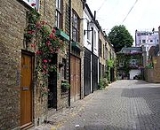
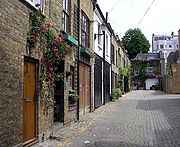
s below and living quarters above, built around a paved yard or court, or along a street, behind large city houses, such as those of London, during the 17th and 18th centuries. The word may also refer to the lane, alley or back street onto which such stables open. It is sometimes applied to rows or groups of garages or, more broadly, to a narrow passage or a confined place. Today most mews stables have been converted into dwellings, some greatly modernised and considered highly desirable residences.
The term mews is plural in form but singular in construction, and arose from "mews
Mews (falconry)
In falconry, a mews is a birdhouse designed to house one or more birds of prey.In falconry there are several mews designs, the freeloft and a traditional mews. Traditional mews usually consist of partitioned spaces designed to keep tethered birds separated with perches for each bird in the...
" in the sense of a building where birds used for falconry
Falconry
Falconry is "the taking of wild quarry in its natural state and habitat by means of a trained raptor". There are two traditional terms used to describe a person involved in falconry: a falconer flies a falcon; an austringer flies a hawk or an eagle...
are kept. Originating in London, its use has spread to parts of Canada and the United States (see, for example, Washington Mews
Washington Mews
Washington Mews is a private gated street in New York City between 5th Avenue and University Place just north of Washington Square Park. It was originally a mews that serviced horses from homes in the area...
in Greenwich Village
Greenwich Village
Greenwich Village, , , , .in New York often simply called "the Village", is a largely residential neighborhood on the west side of Lower Manhattan in New York City. A large majority of the district is home to upper middle class families...
, New York City).
From 1377 onwards the king's falconry birds were kept in the King's Mews at Charing Cross
Charing Cross
Charing Cross denotes the junction of Strand, Whitehall and Cockspur Street, just south of Trafalgar Square in central London, England. It is named after the now demolished Eleanor cross that stood there, in what was once the hamlet of Charing. The site of the cross is now occupied by an equestrian...
. The name remained when it became the royal stables starting in 1537. It was demolished in the early 19th century and Trafalgar Square
Trafalgar Square
Trafalgar Square is a public space and tourist attraction in central London, England, United Kingdom. At its centre is Nelson's Column, which is guarded by four lion statues at its base. There are a number of statues and sculptures in the square, with one plinth displaying changing pieces of...
was built on the site. The present Royal Mews
Royal Mews
A Royal Mews is a mews of the British Royal Family. In London the Royal Mews has occupied two main sites, formerly at Charing Cross, and since the 1820s at Buckingham Palace....
was then built in the grounds of Buckingham Palace
Buckingham Palace
Buckingham Palace, in London, is the principal residence and office of the British monarch. Located in the City of Westminster, the palace is a setting for state occasions and royal hospitality...
. The stables of St James's Palace, which occupied the site where Lancaster House
Lancaster House
Lancaster House is a mansion in the St. James's district in the West End of London. It is close to St. James's Palace and much of the site was once part of the palace complex...
was later built, were also referred to as the "Royal Mews" on occasion, including on John Rocque
John Rocque
John Rocque was a surveyor and cartographer.Rocque was born no later than 1709, since that was the year he moved to England with his parents, who were French Huguenot émigrés...
's 1740s map of London.
The term "mews" is not used for large individual non-royal British stable blocks, a feature of country houses. For example the grand stable block at Chatsworth House
Chatsworth House
Chatsworth House is a stately home in North Derbyshire, England, northeast of Bakewell and west of Chesterfield . It is the seat of the Duke of Devonshire, and has been home to his family, the Cavendish family, since Bess of Hardwick settled at Chatsworth in 1549.Standing on the east bank of the...
is referred to as the stables, not the mews. Instead the word was applied to service streets and the stables in them in cities, primarily London. In the 18th and 19th centuries London housing for wealthy people generally consisted of streets of large terraced house
Terraced house
In architecture and city planning, a terrace house, terrace, row house, linked house or townhouse is a style of medium-density housing that originated in Great Britain in the late 17th century, where a row of identical or mirror-image houses share side walls...
s with stables at the back, which opened onto a small service street. The mews had horse stalls and a carriage house on the ground floor, and stable servants' living accommodation above. Generally this was mirrored by another row of stables on the opposite side of the service street, backing onto another row of terraced houses facing outward into the next street. Sometimes there were variations such as small courtyards. Most mews are named after one of the principal streets which they back onto. Most but not all have the word "mews" in their name. This arrangement was different from most of Continental Europe
Continental Europe
Continental Europe, also referred to as mainland Europe or simply the Continent, is the continent of Europe, explicitly excluding European islands....
, where the stables in wealthy urban residences were usually off a front or central courtyard. The advantage of the British system was that it hid the sounds and smells of the stables away from the family when they were not using the horses.
Mews lost their equestrian function in the early 20th century when motor cars were introduced. At the same time, after World War I
World War I
World War I , which was predominantly called the World War or the Great War from its occurrence until 1939, and the First World War or World War I thereafter, was a major war centred in Europe that began on 28 July 1914 and lasted until 11 November 1918...
and especially after World War II
World War II
World War II, or the Second World War , was a global conflict lasting from 1939 to 1945, involving most of the world's nations—including all of the great powers—eventually forming two opposing military alliances: the Allies and the Axis...
, the number of people who could afford to live in the type of houses which had a mews attached fell sharply. Some mews were demolished or put to commercial use, but the majority were converted into homes. These "mews houses", nearly always located in the wealthiest districts, are themselves now fashionable residences.
External links
- Part of Belgravia in London - There are numerous mews on this map of BelgraviaBelgraviaBelgravia is a district of central London in the City of Westminster and the Royal Borough of Kensington and Chelsea. Noted for its immensely expensive residential properties, it is one of the wealthiest districts in the world...
. Belgrave SquareBelgrave SquareBelgrave Square is one of the grandest and largest 19th century squares in London, England. It is the centrepiece of Belgravia, and was laid out by the property contractor Thomas Cubitt for the 2nd Earl Grosvenor, later the 1st Marquess of Westminster, in the 1820s. Most of the houses were occupied...
has mews on each of its four sides, although one of them is called Montrose Place. - Encyclopaedia Britannica 1911: "Mew"