

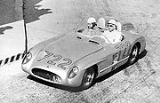
Mercedes-Benz 300 SLR

Encyclopedia
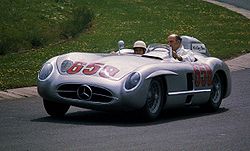
1955 World Sportscar Championship season
The 1955 World Sportscar Championship season was the 3rd season of the FIA World Sportscar Championship. It was a series for sportscars that ran in many worldwide endurance events. It ran from January 23, 1955 to October 16, 1955, and was composed of six races.-Schedule:-Season results:Points...
, which it won.
Technical highlights
Despite a misleading name, the Mercedes-Benz 300SLR was based neither on the famous 1954 300SL (W198) GullwingMercedes-Benz 300SL
The Mercedes-Benz 300SL was introduced in 1954 as a two-seat, closed sports car with distinctive gull-wing doors. Later it was offered as an open roadster...
road car, nor the earlier 1952 (W194) race car, although it bears a strong resemblance to both (including, in the coupe version, the distinctive 'gullwing doors'). Instead, it was based on the 1954-1955 Formula 1 Mercedes-Benz W196
Mercedes-Benz W196
The Mercedes-Benz W196 was the Mercedes-Benz Formula One entry in the and Formula One seasons, winning 9 of 12 races entered in the hands of Juan Manuel Fangio and Stirling Moss....
race car; it was Mercedes' marketing department, who found 'W196S' an uninspiring name, who ordered the name '300SLR'. It is generally accepted that this name references the car's lightweight construction as 'Sport Leicht Rennen'.
The car was of a front-mid-engined design (where the engine block is squarely behind the front axles), to give more neutral front/rear weight distribution. It used a spaceframe chassis and magnesium-alloy (Elektron
Elektron (alloy)
Elektron was a magnesium alloy developed in Germany during the First World War between 1914-18 as a substitute for aluminium alloy. Elektron is unusually light and has a specific gravity of about 1.8 compared with the 2.8 of aluminium alloy. Elektron was used to make incendiary bombs: the B-1E...
) bodywork, which has a specific gravity of just 1.8 (for reference, the S.G. of iron is 7.8), both of which contributed to a dry weight of just 880 kg (1,940 lb). The preceding Formula 1 car's 8 cylinder in-line engine was used, increased in capacity from 2,496.87 cc (76.0 x 68.8 mm) to 2,981.70 cc (78.0 x 78.0 mm). This boosted output from 290 bhp at 8,500 rpm to about 310 hp at 7,400 rpm, depending on the intake manifold; maximum torque of 318 newton metre came at 5,950 rpm (193.9 psi (1,336,893.4 Pa) BMEP), providing strong pulling power. The engine was longitudinally mounted, and was canted over at a 33-degree angle above horizontal to lower its profile for aerodynamic reasons, resulting in the distinctive bonnet bulge on the passenger side of the car. The engine was also unusual in that it used desmodromic valve
Desmodromic valve
A desmodromic valve is a reciprocating engine valve that is positively closed by a cam and leverage system, rather than by a more conventional spring...
actuation instead of springs. Fuel injection
Fuel injection
Fuel injection is a system for admitting fuel into an internal combustion engine. It has become the primary fuel delivery system used in automotive petrol engines, having almost completely replaced carburetors in the late 1980s....
was still a novelty then. The engine protruded some way back into cockpit, forcing drivers of the monoposto to straddle the driveshaft and clutch bellhousing with his feet to reach the pedals. To reduce crank flexing, power takeoff from the engine was at the center of the engine, via a gear, rather than at the end of the crankshaft. This was not the only oddity of the drivetrain - the car was fitted with vast inboard drum brakes which dwarfed the car's 16"-wheels; the unusual shaft-linked brakes were originally to have been part of a planned four-wheel-drive system which never came to fruition. The rear independent suspension used a low roll centre swing axle system, where a beam attached to each hub was mounted on the opposite side of the chassis. Thus, the beams were aligned slightly differently and crossed over in the centre line. Cornering forces did not jack the car up, as occurs with short swing axles.
The car's fuel itself was also odd - a high-octane fuel mixture of 65 percent low-lead gasoline and 35 percent benzene
Benzene
Benzene is an organic chemical compound. It is composed of 6 carbon atoms in a ring, with 1 hydrogen atom attached to each carbon atom, with the molecular formula C6H6....
; in some races, alcohol was also used to further increase performance. As a rule, the car left the starting line with 44 gallons of fuel and more than nine gallons of oil on board, although Moss and Jenkinson began their assault on the 1955 Mille Miglia with as much as 70 gallons of fuel in the tank .
At Le Mans in 1955, the 300 SLRs were also equipped with "air brakes
Air brake (aircraft)
In aeronautics, air brakes or speedbrakes are a type of flight control surface used on an aircraft to increase drag or increase the angle of approach during landing....
" similar in principle to those used on aircraft - this was a large hood that hinged up behind the occupants in order to slow down the cars at the end of the fast straights. The idea for this "wind brake" came from director of motorsports Alfred Neubauer, who was looking to develop a system to reduce the wear on the huge drum brakes and tires during long-distance races such as Le Mans and Reims. Neubauer foresaw wind resistance slow the car especially at Le Mans, as the French track's layout forced drivers to use the brakes hard and often to bring the car down from its maximum speed - around 180 mi/h - to as little as 25 mph. In tests the 0.7m² (7.5 ft²) light-alloy spoiler slowed the car dramatically and improved cornering. In addition, this innovation was required as the car's traditional drum brakes were inferior to the new disc brakes of main rival Jaguar
Jaguar (car)
Jaguar Cars Ltd, known simply as Jaguar , is a British luxury car manufacturer, headquartered in Whitley, Coventry, England. It is part of the Jaguar Land Rover business, a subsidiary of the Indian company Tata Motors....
.
The SLR also had two seats, as required for sports racing cars of the day. In some racing events a co-driver, mechanic or navigator was given a ride. In the 300SLR's short career, this was only during the Mille Miglia
Mille Miglia
The Mille Miglia was an open-road endurance race which took place in Italy twenty-four times from 1927 to 1957 ....
, as the 1955 Carrera Panamericana
Carrera Panamericana
The Carrera Panamericana was a border-to-border sports car racing event on open roads in Mexico similar to the Mille Miglia and Targa Florio in Italy. Running for five consecutive years from 1950 to 1954, it was widely held by contemporaries to be the most dangerous race of any type in the world...
was cancelled due to the Le Mans accident. On short circuits (this includes the Targa Florio
Targa Florio
The Targa Florio was an open road endurance automobile race held in the mountains of Sicily near Palermo. Founded in 1906, it was the oldest sports car racing event, part of the World Sportscar Championship between 1955 and 1973...
) passengers were not helpful, thus the passenger seat was covered and the passenger windshield removed to improve aerodynamics.
Nine W196S chassis were built.
Triumph and tragedy
Stirling MossStirling Moss
Sir Stirling Craufurd Moss, OBE FIE is a former racing driver from England...
won the 1955 Mille Miglia
Mille Miglia
The Mille Miglia was an open-road endurance race which took place in Italy twenty-four times from 1927 to 1957 ....
in a 300 SLR with an average speed of 157.65 kilometre per hour over 1600 km (994.2 mi). He was assisted by his co-driver Denis Jenkinson
Denis Jenkinson
Denis Sargent Jenkinson , Jenks or DSJ as he was known in the pages of Motor Sport, was a journalist deeply involved in motorsports...
, a British motor-racing journalist, who informed him with previously taken notes, ancestors to the pacenotes
Pacenotes
In rallying, pacenotes are a commonly used method of accurately describing the route to be driven in extreme detail. As well as dictating the general route to be taken, in terms of turnings, junctions, etc, all notable features of the route which might affect the way it is driven at speed are...
used in modern rallying
Rallying
Rallying, also known as rally racing, is a form of auto racing that takes place on public or private roads with modified production or specially built road-legal cars...
.
The 300 SLRs later scored additional victories in Germany, Sweden, Ireland, and at the Targa Florio
Targa Florio
The Targa Florio was an open road endurance automobile race held in the mountains of Sicily near Palermo. Founded in 1906, it was the oldest sports car racing event, part of the World Sportscar Championship between 1955 and 1973...
in Sicily, and won the 1955 World Sportscar Championship season
1955 World Sportscar Championship season
The 1955 World Sportscar Championship season was the 3rd season of the FIA World Sportscar Championship. It was a series for sportscars that ran in many worldwide endurance events. It ran from January 23, 1955 to October 16, 1955, and was composed of six races.-Schedule:-Season results:Points...
(constructors' ranking, as there was no driver ranking yet).
However, these impressive victories were overshadowed when the 300 SLRs, leading the 1955 24 Hours of Le Mans
1955 24 Hours of Le Mans
The 1955 24 Hours of Le Mans was the 23rd Grand Prix of Endurance, and took place on June 11 and 12, 1955. It was also the fourth round of the World Sportscar Championship....
, were withdrawn after the horrific accident
1955 Le Mans disaster
The 1955 Le Mans disaster occurred during the 1955 24 Hours of Le Mans motor race, when a crash caused large parts of racing car debris to fly into the crowd. The driver was killed, as were 83 spectators. A further 120 people were injured...
involving the car driven by Pierre Levegh
Pierre Levegh
Pierre Eugène Alfred Bouillin was a French sportsman and racing driver. He took the racing name Pierre Levegh in memory of his uncle, a pioneering driver who died in 1904...
. 82 spectators, and one competitor - Levegh - lost their lives in what remains the highest-fatality accident in the history of motorsport. Aspects of the accident were directly related to the SLR's unusual design - even with the innovative air-brake, the drum brakes were not effective enough to stop Levegh ploughing into the back of an Austin-Healey, causing the car to become airborne. Worse, the ultra-lightweight Elektron bodywork's high magnesium content caused it to ignite in the ensuing fuel fire, causing significant injury and loss of life amongst spectators; the magnesium fire was exacerbated by the race fire crew's unpreparedness for it, as they initially tried to extinguish it with water (which only made it burn hotter.) Following this tragedy, Mercedes withdrew from competitive motorsport until the mid-1980s.
Mercedes-Benz 300SLR Uhlenhaut Coupé
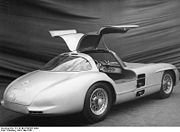
Rudolf Uhlenhaut
Rudolf Uhlenhaut , was an Anglo-German engineer and executive for Mercedes-Benz...
had ordered two to be set aside for modification into a sort of hybrid between the SLR and the SL, featuring a slightly widened version of the SLR's chassis with enclosed bodywork for aerodynamic purposes. Again, the strong, high sill beams of the spaceframe required the fitment of the same famous 'gull-wing' top-hinged doors of the other two types. For testing, and in preparation for a possible Mercedes participation in the 1956 race season, two road-legal SLRs were built. Due to Mercedes' planned withdrawal from competitive motorsport at the end of 1955, the programme was abandoned, leaving Uhlenhaut to use one of the cars as a company car. This prolonged road use required the fitting of an extra suitcase-sized muffler to the near-unsilenced exhaust pipes to avoid arrest for breach of the peace.
This Uhlenhaut Coupé was regarded as the world's fastest car in the 1950s, and it is rumoured that, running late for a meeting, Uhlenhaut exploited the unlimited autobahns to make today's two-and-a-half-hour journey from Munich to Stuttgart (approximately 137 miles/220km) in just over an hour . The Uhlenhaut Coupe was road tested by the US magazine Motor Trend
Motor Trend
Motor Trend is an American automobile magazine. It first appeared in September 1949, issued by Petersen Publishing Company in Los Angeles, and bearing the tag line "The Magazine for a Motoring World". Petersen Publishing was sold to British publisher EMAP in 1998, who sold the former Petersen...
and by two English journalists from Automobile Revue at four o'clock in the morning on a closed section of motorway outside Munich. The latter wrote; "We are driving a car which barely takes a second to overtake the rest of the traffic and for which 120 mph on a quiet motorway is little more than walking pace. With its unflappable handling through corners, it treats the laws of centrifugal force with apparent disdain," after a total of more than 2000 miles (3,218.7 km). His only regret was that this was a sports car "which we will never be able to buy and which the average driver would never buy anyway.".
See also
- Mercedes-Benz in motorsportMercedes-Benz in motorsportThroughout its long history, Mercedes-Benz has been involved in a range of motorsport activities, including sportscar racing and rallying, and is currently active in Formula Three, DTM and Formula One.-Early history:...
- List of Mercedes-Benz cars
- Mercedes-Benz SLR McLarenMercedes-Benz SLR McLarenThe Mercedes-Benz SLR McLaren is an Anglo-German grand tourer car jointly developed by Mercedes-Benz and McLaren Automotive, built in Portsmouth and the McLaren Technology Centre in Woking, Surrey, England and sold from 2003 to 2009...
(the new "SLR")