

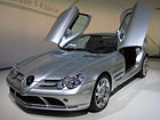
Mercedes-Benz SLR McLaren

Encyclopedia
The Mercedes-Benz SLR McLaren is an Anglo
-German
grand tourer
car jointly developed by Mercedes-Benz
and McLaren Automotive
, built in Portsmouth
and the McLaren Technology Centre
in Woking
, Surrey
, England
and sold from 2003 to 2009. When it was developed, Mercedes-Benz owned 40 percent of the McLaren Group
.
Due to the automatic gear box, front mid-engined arrangement, and its driving characteristics, some commentators classify the SLR McLaren as a GT
, whose rivals would be vehicles such as the Aston Martin DBS V12
and Ferrari 599 GTB Fiorano
.
SLR stands for "Sport, Leicht, Rennsport" (sport, light, racing). Mercedes-Benz stated that they would build 3,500 SLRs over seven years, with an annual production of 500 cars. The car's base price, GB£
295,337 (approx. US$450,000, €
350,000, CHF
500,000 or C$ 500,000. 2009), made it the ninth most expensive street-legal car in the year 2008.
F1 race car. It was introduced on 17 Nov 2003. On 4 April 2008, Mercedes announced they would cease production of the SLR. The last of the coupes rolled off the production line at the end of 2007 and the roadster version was discontinued in early 2009.
system. The brake disc
s are carbon-ceramic and provide better stopping power and fade resistance than steel discs when operating under ideal working temperature. Mercedes-Benz claims these discs are fade resistant to 1200 °C (2,192 °F). The front discs are internally vented and 370 mm (14.6 in) in diameter. 8 piston calipers are used. Rear discs are 360 mm (14.2 in) in diameter with 4 piston calipers. During wet conditions the calipers automatically skim the surface of the discs to keep them dry.
To improve braking performance there is an automatic air brake, when engaged the rear elevation angle of the rear spoiler is set to 65 degrees. The additional rear downforce in addition to the markedly increased aerodynamic drag increases peak deceleration ~90%.
The brakes have been strongly criticized by such review sources as Top Gear due to lacking modulation and having an on-off operation. This is due to road cars not regularly reaching normal operating temperature for ceramic discs in stop-go traffic conditions.
Unlike most of its contemporaries, its engine is front-mid mounted. McLaren took the original concept car designed by Mercedes and moved the engine 1 metres (39.4 in) behind the front bumper, and around 50 centimetres (19.7 in) behind the front axle. They also optimized the design of the center firewall.
5-speed automatic transmission with 3 manual modes. For durability Mercedes selected a 5-speed transmission rather than their 7-speed gearbox which was more complex and used more parts.
Car and Driver achieved a 0-60 mi/h time of 3.4 seconds, and a quarter-mile time of 11.2 seconds at 130 mi/h C&D suggests the times may be even lower if temperatures were lower. Motor Trend tested the SLR and achieved a 0-60 mph time of 3.3 seconds in April 2006. Car and Driver achieved top gear acceleration 30-50 mph and 50-70 mph times of 1.7 and 2.4 seconds, which are the fastest ever recorded by the magazine in a production car. The SLR also pulled 1.13 g on the skidpad.
Road and Track tested the car in their July 2005 Road Test and reached 60 mi/h from a standstill in 3.5 seconds. The 0 - 100 mph (160.9 km/h) sprint was achieved in 7.5 seconds and a quarter mile run was completed in 11.5 seconds at 126 mph (202.8 km/h).
In June 2004 the SLR was tested at Nardo and performed the 0-100 km/h (62.1 mph) exercise in 3.8 seconds, 0-200 kilometre per hour in 10.7 seconds and 0-300 km/h (186.4 mph) in 30.6 seconds.
, and its lighter, less expensive, less powerful sibling, Gallardo
. Still, on the Episode 2 from Season 13 of BBC
car show Top Gear
the Lamborghini Murciélago LP670-4 SV performed a little slower than the SLR McLaren 722 Edition during a race special in Abu Dhabi although the Lamborghini weighed 1565 kg (3,450 lb) and had about 20 PS more. Also, the same show put the SLR and the Porsche Carrera GT
on its track, and after multiple attempts, the Porsche
beat the SLR-McLaren by just over a second (1:19.8 vs. 1:20.9). However, on a separate race around their short track, the SLR was fractionally quicker than the Carrera GT. In a straight line, the SLR is quicker after around 100 miles per hour.
and his co-driver Denis Jenkinson
in a Mercedes-Benz 300 SLR with the starting number 722 (indicating a start time of 7:22 a.m.) at the Mille Miglia
in 1955.
The "722 Edition" includes an engine rated 650 PS@6500rpm and 820 newton metre@4000rpm, with top speed of 337 km/h (209.4 mph) (3 km/h (1.9 mph) faster than the standard SLR). 19-inch light-alloy wheels were used to reduce unsprung weight, while modifications were also made to the suspension, with a stiffer damper
setup and 10 mm (0.393700787401575 in) lower ride height introduced for improved handling. Larger 390 mm (15.4 in) diameter front brakes and a revised front air dam and rear diffuser
were fitted.
Exterior changes, other than the larger 19 inches (482.6 mm) black light-alloy wheels, include red "722" badging, harking back to the original 722 racer, and slightly different tail lights and headlamps.
The SLR 722 can accelerate from 0 to 100 km/h (62.1 mph) in 3.6 seconds, 200 km/h (124.3 mph) in 10.2 seconds and 300 km/h (186.4 mph) in 27.6 seconds, and can reach a top speed of 337 km/h (209.4 mph).
However, as a convertible the roadster was burdened with extra weight, which affected performance and handling. The Roadster's roof is made from a "newly developed material" and does not take the form of a folding metal arrangement, as is common on many modern cars. Following a manual unlatching, it takes a mere ten seconds to fold away electrically. According to an official Mercedes document, the cabin of the roadster is capable of allowing conversation between driver and passenger up to a speed of 200 km/h (124.3 mph) with the roof retracted. This roadster is aimed to compete against other sports cars such as the Pagani Zonda
F Roadster.
The model went on sale on 2009-01-01 for around $750,000.00.
with approval from Mercedes-Benz. The car features new wider bodywork to accommodate 19 in (483 mm) OZ racing wheels. The front grill vents are removed and larger, free flowing air extractors sit on the hood and flank the side of the car. The rear now has a racing wing and diffuser.
Under the body, the car has shed 398 kg (877.4 lb) and reduced its dry weight to 1300 kg (2,866 lb) . The engine remains in relatively stock specification but now produces 680 PS and 830 newton metre at 1.75 bar (175 kPa) boost. Inside, the car is stripped out with only the essential functions being available, controlled from a carbon fiber binnacle. New carbon fiber door panels and full roll cage complete the transformation.
Renntech announced 21 SLR McLaren 722 GT would be available to the North American market exclusively through RENNtech
, for €795,000 (1.2 million USD).
race car, and was by Korean designer Yoon Il-hun. It was to be the last series of the McLaren SLR built under the partnership between Mercedes-Benz and McLaren, until McLaren announced their own final edition of the SLR in late 2010.
The supercharged V8 engine is rated 650 PS. The car's top speed is 350 km/h (217.5 mph) with acceleration from 0–100 km/h in less than 3.5 seconds. The car is approximately 200 kg (440.9 lb) lighter than the regular model.
The SLR Stirling Moss began production in June 2009, after SLR Roadster's production ended in May 2009. All 75 cars were produced by December 2009. The SLR Stirling Moss has MSRP of €750,000 and was available only to SLR owners.
The vehicle was unveiled in 2009 NAIAS
.
Total sales were 615 units in 2005, 261 units in 2006, and 275 units in 2007, falling well below Mercedes-McLaren's goal of selling 500 units annually.
has entered an SLR McLaren in the Speed World Challenge
GT class, driving for TRG Motorsports.
United Kingdom
The United Kingdom of Great Britain and Northern IrelandIn the United Kingdom and Dependencies, other languages have been officially recognised as legitimate autochthonous languages under the European Charter for Regional or Minority Languages...
-German
Germany
Germany , officially the Federal Republic of Germany , is a federal parliamentary republic in Europe. The country consists of 16 states while the capital and largest city is Berlin. Germany covers an area of 357,021 km2 and has a largely temperate seasonal climate...
grand tourer
Grand tourer
A grand tourer is a high-performance luxury automobile designed for long-distance driving. The most common format is a two-door coupé with either a two-seat or a 2+2 arrangement....
car jointly developed by Mercedes-Benz
Mercedes-Benz
Mercedes-Benz is a German manufacturer of automobiles, buses, coaches, and trucks. Mercedes-Benz is a division of its parent company, Daimler AG...
and McLaren Automotive
McLaren Automotive
McLaren Automotive, commonly referred to as McLaren, is a British automotive manufacturer of high-performance vehicles. The company was established as McLaren Cars in 1989 as a producer of road cars based on Formula One technology...
, built in Portsmouth
Portsmouth
Portsmouth is the second largest city in the ceremonial county of Hampshire on the south coast of England. Portsmouth is notable for being the United Kingdom's only island city; it is located mainly on Portsea Island...
and the McLaren Technology Centre
McLaren Technology Centre
The McLaren Technology Centre is the headquarters of the McLaren Group, located on a 500,000 m² site in Woking, Surrey, England. It is a large, roughly semi-circular, glass-walled building, designed by the architect Norman Foster and his company, Foster and Partners. The building was short-listed...
in Woking
Woking
Woking is a large town and civil parish that shares its name with the surrounding local government district, located in the west of Surrey, UK. It is part of the Greater London Urban Area and the London commuter belt, with frequent trains and a journey time of 24 minutes to Waterloo station....
, Surrey
Surrey
Surrey is a county in the South East of England and is one of the Home Counties. The county borders Greater London, Kent, East Sussex, West Sussex, Hampshire and Berkshire. The historic county town is Guildford. Surrey County Council sits at Kingston upon Thames, although this has been part of...
, England
England
England is a country that is part of the United Kingdom. It shares land borders with Scotland to the north and Wales to the west; the Irish Sea is to the north west, the Celtic Sea to the south west, with the North Sea to the east and the English Channel to the south separating it from continental...
and sold from 2003 to 2009. When it was developed, Mercedes-Benz owned 40 percent of the McLaren Group
McLaren Group
The McLaren Group, based at the McLaren Technology Centre in Woking, Surrey, England, is a group of companies created by Ron Dennis, described by the International Herald Tribune as "a small conglomerate"...
.
Due to the automatic gear box, front mid-engined arrangement, and its driving characteristics, some commentators classify the SLR McLaren as a GT
Grand tourer
A grand tourer is a high-performance luxury automobile designed for long-distance driving. The most common format is a two-door coupé with either a two-seat or a 2+2 arrangement....
, whose rivals would be vehicles such as the Aston Martin DBS V12
Aston Martin DBS V12
The modern Aston Martin DBS is a high performance GT sports car from the UK manufacturer Aston Martin. Aston has used the DBS name once before on their 1967–72 grand tourer coupe...
and Ferrari 599 GTB Fiorano
Ferrari 599 GTB Fiorano
The 599 GTB Fiorano is an Italian gran turismo produced by Ferrari. It is the brand's two-seat flagship, replacing the 575 M Maranello in 2006 as a 2007 model....
.
SLR stands for "Sport, Leicht, Rennsport" (sport, light, racing). Mercedes-Benz stated that they would build 3,500 SLRs over seven years, with an annual production of 500 cars. The car's base price, GB£
Pound sterling
The pound sterling , commonly called the pound, is the official currency of the United Kingdom, its Crown Dependencies and the British Overseas Territories of South Georgia and the South Sandwich Islands, British Antarctic Territory and Tristan da Cunha. It is subdivided into 100 pence...
295,337 (approx. US$450,000, €
Euro
The euro is the official currency of the eurozone: 17 of the 27 member states of the European Union. It is also the currency used by the Institutions of the European Union. The eurozone consists of Austria, Belgium, Cyprus, Estonia, Finland, France, Germany, Greece, Ireland, Italy, Luxembourg,...
350,000, CHF
Swiss franc
The franc is the currency and legal tender of Switzerland and Liechtenstein; it is also legal tender in the Italian exclave Campione d'Italia. Although not formally legal tender in the German exclave Büsingen , it is in wide daily use there...
500,000 or C$ 500,000. 2009), made it the ninth most expensive street-legal car in the year 2008.
History
The Mercedes-Benz SLR McLaren was inspired by the Mercedes-Benz 300 SLR Uhlenhaut Coupe & Racecar of 1955, which was a modified Mercedes-Benz W196Mercedes-Benz W196
The Mercedes-Benz W196 was the Mercedes-Benz Formula One entry in the and Formula One seasons, winning 9 of 12 races entered in the hands of Juan Manuel Fangio and Stirling Moss....
F1 race car. It was introduced on 17 Nov 2003. On 4 April 2008, Mercedes announced they would cease production of the SLR. The last of the coupes rolled off the production line at the end of 2007 and the roadster version was discontinued in early 2009.
Brakes
The SLR features Sensotronic, a type of brake-by-wireBrake-by-wire
Drive-by-wire technology in automotive industry replaces the traditional mechanical and hydraulic control systems with electronic control systems using electromechanical actuators and human-machine interfaces such as pedal and steering feel emulators...
system. The brake disc
Disc brake
The disc brake or disk brake is a device for slowing or stopping the rotation of a wheel while it is in motion.A brake disc is usually made of cast iron, but may in some cases be made of composites such as reinforced carbon–carbon or ceramic matrix composites. This is connected to the wheel and/or...
s are carbon-ceramic and provide better stopping power and fade resistance than steel discs when operating under ideal working temperature. Mercedes-Benz claims these discs are fade resistant to 1200 °C (2,192 °F). The front discs are internally vented and 370 mm (14.6 in) in diameter. 8 piston calipers are used. Rear discs are 360 mm (14.2 in) in diameter with 4 piston calipers. During wet conditions the calipers automatically skim the surface of the discs to keep them dry.
To improve braking performance there is an automatic air brake, when engaged the rear elevation angle of the rear spoiler is set to 65 degrees. The additional rear downforce in addition to the markedly increased aerodynamic drag increases peak deceleration ~90%.
The brakes have been strongly criticized by such review sources as Top Gear due to lacking modulation and having an on-off operation. This is due to road cars not regularly reaching normal operating temperature for ceramic discs in stop-go traffic conditions.
Aerodynamics
The SLR features active aerodynamics; there is a spoiler mounted on the rear integral air brake flap. The spoiler increases downforce depending on its angle of elevation (angle of attack). At speeds above 95 km/h (59 mph) the spoiler/brake automatically raises to 10 degrees (15 in 722 edition), when demanded via the driver's switch, the elevation can be increased to 30 degrees (35 in 722 version) for increased rear downforce, at the cost of increased steady state drag, also when the driver applies the brakes the spoiler raises.Engine
The SLR sports a 232 kg (511.5 lb) hand-built 5439 cc, supercharged, all-aluminium, SOHC V8 engine. The cylinders are angled at 90 degrees with three valves per cylinder and lubricated via a dry sump system. The compression ratio is 8.8:1 and the bore and stroke is 97 millimetre (3.82 in) and 92 millimeters (3.62 in), respectively. The Lysholm-type twin-screw supercharger rotates at 23000 revolutions per minute and produces 0.9 bar (13 psi) of boost. The compressed air is then cooled via two intercoolers. The engine generates a maximum power of 626 PS@6500rpm and maximum torque of 780 newton metre@3250-5000rpm.Unlike most of its contemporaries, its engine is front-mid mounted. McLaren took the original concept car designed by Mercedes and moved the engine 1 metres (39.4 in) behind the front bumper, and around 50 centimetres (19.7 in) behind the front axle. They also optimized the design of the center firewall.
Transmission
The SLR uses AMG SPEEDSHIFT R5G-Tronic
The Mercedes-Benz 5G-TRONIC is an electronically shifted 5-speed overdrive automatic transmission. It is in the process of being replaced by the Mercedes Benz 7G-Tronic Transmission which was introduced in 2003...
5-speed automatic transmission with 3 manual modes. For durability Mercedes selected a 5-speed transmission rather than their 7-speed gearbox which was more complex and used more parts.
Performance
The car uses carbon fibre for its entire body construction in an attempt to keep the weight low. Despite CFRP materials the total curb weight is 1750 kg (3,858 lb).Car and Driver achieved a 0-60 mi/h time of 3.4 seconds, and a quarter-mile time of 11.2 seconds at 130 mi/h C&D suggests the times may be even lower if temperatures were lower. Motor Trend tested the SLR and achieved a 0-60 mph time of 3.3 seconds in April 2006. Car and Driver achieved top gear acceleration 30-50 mph and 50-70 mph times of 1.7 and 2.4 seconds, which are the fastest ever recorded by the magazine in a production car. The SLR also pulled 1.13 g on the skidpad.
Road and Track tested the car in their July 2005 Road Test and reached 60 mi/h from a standstill in 3.5 seconds. The 0 - 100 mph (160.9 km/h) sprint was achieved in 7.5 seconds and a quarter mile run was completed in 11.5 seconds at 126 mph (202.8 km/h).
In June 2004 the SLR was tested at Nardo and performed the 0-100 km/h (62.1 mph) exercise in 3.8 seconds, 0-200 kilometre per hour in 10.7 seconds and 0-300 km/h (186.4 mph) in 30.6 seconds.
| speed | time in seconds |
|---|---|
| 0-100 km/h (62.1 mph) | 3.8 |
| 0-200 kilometre per hour | 10.7 |
| 0-300 km/h (186.4 mph) | 30.6 |
Comparison
Despite its near 2-ton weight, the fuel economy is generally better than the lighter Lamborghini MurciélagoLamborghini Murciélago
The Lamborghini Murciélago is a two-door, two-seat sports car produced by Italian automaker Lamborghini between 2001 and 2010. Successor to the Diablo and flagship of the automaker's lineup, the Murciélago was introduced as a coupé in 2001. The automaker's first new design in eleven years, the car...
, and its lighter, less expensive, less powerful sibling, Gallardo
Lamborghini Gallardo
The Lamborghini Gallardo is a sports car built by Lamborghini. The Gallardo is Lamborghini's most-produced model to date, with over 10,000 built in its first seven years of production...
. Still, on the Episode 2 from Season 13 of BBC
BBC
The British Broadcasting Corporation is a British public service broadcaster. Its headquarters is at Broadcasting House in the City of Westminster, London. It is the largest broadcaster in the world, with about 23,000 staff...
car show Top Gear
Top Gear (current format)
Top Gear is a British television series about motor vehicles, primarily cars. It began in 1977 as a conventional motoring magazine show. Over time, and especially since a relaunch in 2002, it has developed a quirky, humorous style...
the Lamborghini Murciélago LP670-4 SV performed a little slower than the SLR McLaren 722 Edition during a race special in Abu Dhabi although the Lamborghini weighed 1565 kg (3,450 lb) and had about 20 PS more. Also, the same show put the SLR and the Porsche Carrera GT
Porsche Carrera GT
The Porsche Carrera GT is a mid-engined sports car that was manufactured by Porsche in Leipzig, Germany.- History :The development of the Carrera GT can be traced back to the 911 GT1 and LMP1-98 racing cars. Due in part to the FIA and ACO rule changes in 1998, both designs had ended. Porsche at...
on its track, and after multiple attempts, the Porsche
Porsche
Porsche Automobil Holding SE, usually shortened to Porsche SE a Societas Europaea or European Public Company, is a German based holding company with investments in the automotive industry....
beat the SLR-McLaren by just over a second (1:19.8 vs. 1:20.9). However, on a separate race around their short track, the SLR was fractionally quicker than the Carrera GT. In a straight line, the SLR is quicker after around 100 miles per hour.
722 Edition
A new version was introduced in 2006 called the Mercedes-Benz SLR McLaren 722 Edition. The "722" refers to the victory by Stirling MossStirling Moss
Sir Stirling Craufurd Moss, OBE FIE is a former racing driver from England...
and his co-driver Denis Jenkinson
Denis Jenkinson
Denis Sargent Jenkinson , Jenks or DSJ as he was known in the pages of Motor Sport, was a journalist deeply involved in motorsports...
in a Mercedes-Benz 300 SLR with the starting number 722 (indicating a start time of 7:22 a.m.) at the Mille Miglia
Mille Miglia
The Mille Miglia was an open-road endurance race which took place in Italy twenty-four times from 1927 to 1957 ....
in 1955.
The "722 Edition" includes an engine rated 650 PS@6500rpm and 820 newton metre@4000rpm, with top speed of 337 km/h (209.4 mph) (3 km/h (1.9 mph) faster than the standard SLR). 19-inch light-alloy wheels were used to reduce unsprung weight, while modifications were also made to the suspension, with a stiffer damper
Shock absorber
A shock absorber is a mechanical device designed to smooth out or damp shock impulse, and dissipate kinetic energy. It is a type of dashpot.-Nomenclature:...
setup and 10 mm (0.393700787401575 in) lower ride height introduced for improved handling. Larger 390 mm (15.4 in) diameter front brakes and a revised front air dam and rear diffuser
Diffuser (automotive)
A diffuser, in an automotive context, is a shaped section of the car underbody which improves the car's aerodynamic properties by enhancing the transition between the high-velocity airflow underneath the car and the much slower freestream airflow of the ambient atmosphere...
were fitted.
Exterior changes, other than the larger 19 inches (482.6 mm) black light-alloy wheels, include red "722" badging, harking back to the original 722 racer, and slightly different tail lights and headlamps.
The SLR 722 can accelerate from 0 to 100 km/h (62.1 mph) in 3.6 seconds, 200 km/h (124.3 mph) in 10.2 seconds and 300 km/h (186.4 mph) in 27.6 seconds, and can reach a top speed of 337 km/h (209.4 mph).
Roadster
A roadster version of the SLR went on sale in September 2007 for £350,000 ($534 485 U.S.). It uses the same supercharged V8 AMG power plant as its coupé siblings, developing 626 PS, to propel it to a top speed of 334 km/h (207.5 mph) and enable 0-100 km/h (62.1 mph) acceleration time of 3.8 seconds.However, as a convertible the roadster was burdened with extra weight, which affected performance and handling. The Roadster's roof is made from a "newly developed material" and does not take the form of a folding metal arrangement, as is common on many modern cars. Following a manual unlatching, it takes a mere ten seconds to fold away electrically. According to an official Mercedes document, the cabin of the roadster is capable of allowing conversation between driver and passenger up to a speed of 200 km/h (124.3 mph) with the roof retracted. This roadster is aimed to compete against other sports cars such as the Pagani Zonda
Pagani Zonda
The Pagani Zonda is a sports car built by the Italian manufacturer Pagani. It debuted in 1999, and production ended in 2011. As of June 2009, 206 Zondas had been built, including test mules. Both 2-seat coupe and convertible versions have been produced. Construction is mainly of carbon...
F Roadster.
Roadster 722 S (2009)
A limited edition (150 units) of the 722 roadster. It can reach 100 km/h (62.1 mph) from standstill in 3.6 seconds and has top speed of 334 km/h (207.5 mph).The model went on sale on 2009-01-01 for around $750,000.00.
722 GT (2007-)
The 722 GT is a tuned version of the SLR 722 which is developed for a one-make racing series. The cars are built by Ray Mallock Ltd.Ray Mallock Ltd.
Ray Mallock Ltd., also known as RML Group, is a motorsports racing team and engineering company. In 2010, RML is engaged in the Le Mans Series as well as being the works Chevrolet team in the British Touring Car Championship and the World Touring Car Championship.-Early history:Ray Mallock began...
with approval from Mercedes-Benz. The car features new wider bodywork to accommodate 19 in (483 mm) OZ racing wheels. The front grill vents are removed and larger, free flowing air extractors sit on the hood and flank the side of the car. The rear now has a racing wing and diffuser.
Under the body, the car has shed 398 kg (877.4 lb) and reduced its dry weight to 1300 kg (2,866 lb) . The engine remains in relatively stock specification but now produces 680 PS and 830 newton metre at 1.75 bar (175 kPa) boost. Inside, the car is stripped out with only the essential functions being available, controlled from a carbon fiber binnacle. New carbon fiber door panels and full roll cage complete the transformation.
Renntech announced 21 SLR McLaren 722 GT would be available to the North American market exclusively through RENNtech
RENNtech
Renntech is a Florida company established in 1989 by Hartmut Feyhl. It is best known for performance modifications of Mercedes-AMG automobiles....
, for €795,000 (1.2 million USD).
Stirling Moss (2009)
The SLR Stirling Moss is a limited edition (75 vehicles) of the series, which uses a speedster styling that does not include roof or windscreen. The design is inspired by the 300 SLRMercedes-Benz 300 SLR
The Mercedes-Benz 300 SLR was a sportscar racing car for the 1955 World Sportscar Championship season, which it won.-Technical highlights:...
race car, and was by Korean designer Yoon Il-hun. It was to be the last series of the McLaren SLR built under the partnership between Mercedes-Benz and McLaren, until McLaren announced their own final edition of the SLR in late 2010.
The supercharged V8 engine is rated 650 PS. The car's top speed is 350 km/h (217.5 mph) with acceleration from 0–100 km/h in less than 3.5 seconds. The car is approximately 200 kg (440.9 lb) lighter than the regular model.
The SLR Stirling Moss began production in June 2009, after SLR Roadster's production ended in May 2009. All 75 cars were produced by December 2009. The SLR Stirling Moss has MSRP of €750,000 and was available only to SLR owners.
The vehicle was unveiled in 2009 NAIAS
North American International Auto Show
The North American International Auto Show is an annual auto show held in Detroit, Michigan at Cobo Center, usually in January. It is among the largest auto shows in North America.-History:...
.
McLaren Edition (2011)
In December 2010, more than a year after the SLR was discontinued, McLaren announced a final body conversion of the supercar. The 25-unit limited McLaren Edition is based on any earlier variant of the SLR besides the Stirling Moss and includes revised bodywork (front and rear bumper, grille, top shell, side gills, rear diffuser, rims) and interior parts, along with upgraded steering and suspension components and a new sports exhaust.Aftermarket variants
So far, the SLR McLaren has been tuned by many specialist companies, including Mansory, Hamann, FAB Design, ASMA Design, Renntech and Brabus. Tuning car company Mansory named their model (which was based on the SLR McLaren) "Renovatio"; changes include the increase in horsepower to 690 PS from 626 PS, and cosmetic changes to the exterior and interior. Hamann named their model "Volcano"; modifications include horsepower increase to 700 PS and cosmetic changes to exterior and interior. FAB Design has turned the SLR into an even faster model, now with a 750 PS, 1080 Nm engine and a complex body kit, named "Desire". ASMA Design decided to call their car "Perfectus" and its engine now produces 700 PS and 885 Nm. Several modifications have been made to the body of the car which is dressed with naked carbon fiber and a re-styled body kit. Renntech made changes to the engine of the 722 version which, after extensive reworking, produces 740 PS. Brabus increased the horsepower of the car from 626 to 650, and made changes in the exterior and interior of the SLR McLaren.Sales
| Calendar Year | Total | United States |
|---|---|---|
| 2003 | n/a | |
| 2004 | 45 | |
| 2005 | 615 | 200 |
| 2006 | 261 | 141 |
| 2007 | 275 | 104 |
| 2008 | 106 | |
| 2009 | 110 | |
| 2010 | 7 |
Total sales were 615 units in 2005, 261 units in 2006, and 275 units in 2007, falling well below Mercedes-McLaren's goal of selling 500 units annually.
Motorsports
Spencer PumpellySpencer Pumpelly
Spencer Pumpelly is an American race car driver, born 28 December 1974, in Arlington, Virginia.Currently residing in Atlanta, Georgia, Pumpelly is active in the American Le Mans Series, Rolex Sports Car Series and the Continental Tire Sports Car Challenge driving for The Racer's Group.Pumpelly...
has entered an SLR McLaren in the Speed World Challenge
SPEED World Challenge
The Pirelli World Challenge is a North American auto racing series that is sanctioned by the Sports Car Club of America . Founded in 1985, it consists of four classes: grand touring, touring car, a "GTS" class since 2010, and a "touring car B-spec" since 2012...
GT class, driving for TRG Motorsports.
External links
- Mercedes SLR AMG Overview
- McLaren Mercedes-Benz SLR pages: SLR coupe, SLR Roadster, SLR 722 coupe, Roadster 722 S
- RENNtech SLR McLaren 722 GT