
All Topics  
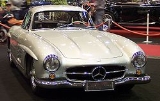
Mercedes-Benz 300SL

 
Mercedes Benz 300SL

   Email Print
   Bookmark   Link


Mercedes-Benz 300SL


The Mercedes-Benz 300SL was introduced in 1954 as a two-seat, closed sports car
Sports car

A sports car is a term used to describe a class of automobile. The exact definition varies, but generally it is used to refer to a low to ground, light weight vehicle with a powerful engine....
 with characteristic gull-wing door
Gull-wing door

Gull-wing door is an automotive industry term describing car doors that are hinged at the roof rather than the side, as pioneered by the 1952 Mercedes-Benz 300SL race car and its road-legal version introduced in 1954....
s. Later it was offered as an open roadster
Roadster

A roadster, also known as a spyder or spider, is a two-seater car, traditionally without a roof and no side or rear windows. Modern day two-seaters commonly have windows and feature retractable roofs ....
.

Built by Daimler-Benz
Daimler-Benz

Daimler-Benz AG was a German manufacturer of automobiles, motor vehicles, and engines which was founded in 1926. An Agreement of Mutual Interest?which was valid until year 2000?was signed on May 1 1924 between Karl Benz's Benz & Cie....
 AG and internally numbered W198, the fuel-injected road version was based (somewhat loosely) on the company's highly successful competition-only sports car of 1952, the Mercedes-Benz 300SL (W194) which had less power, as it still had carburetors.

The road model was suggested by Max Hoffman
Max Hoffman

Max Hoffman, , was an Austrian-born importer of automobiles into the United States during the 1950s. Doing business among gentlemen who knew one another well, he was renowned for his handshake deals that always were upheld without a written contract....
.


Discussion
Ask a question about 'Mercedes-Benz 300SL'
Start a new discussion about 'Mercedes-Benz 300SL'
Answer questions from other users
Full Discussion Forum


Recent Posts


Encyclopedia


The Mercedes-Benz 300SL was introduced in 1954 as a two-seat, closed sports car
Sports car

A sports car is a term used to describe a class of automobile. The exact definition varies, but generally it is used to refer to a low to ground, light weight vehicle with a powerful engine....
 with characteristic gull-wing door
Gull-wing door

Gull-wing door is an automotive industry term describing car doors that are hinged at the roof rather than the side, as pioneered by the 1952 Mercedes-Benz 300SL race car and its road-legal version introduced in 1954....
s. Later it was offered as an open roadster
Roadster

A roadster, also known as a spyder or spider, is a two-seater car, traditionally without a roof and no side or rear windows. Modern day two-seaters commonly have windows and feature retractable roofs ....
.

Built by Daimler-Benz
Daimler-Benz

Daimler-Benz AG was a German manufacturer of automobiles, motor vehicles, and engines which was founded in 1926. An Agreement of Mutual Interest?which was valid until year 2000?was signed on May 1 1924 between Karl Benz's Benz & Cie....
 AG and internally numbered W198, the fuel-injected road version was based (somewhat loosely) on the company's highly successful competition-only sports car of 1952, the Mercedes-Benz 300SL (W194) which had less power, as it still had carburetors.

The road model was suggested by Max Hoffman
Max Hoffman

Max Hoffman, , was an Austrian-born importer of automobiles into the United States during the 1950s. Doing business among gentlemen who knew one another well, he was renowned for his handshake deals that always were upheld without a written contract....
. Because it was intended for customers whose preferences were reported to Hoffman by dealers he supplied in the booming, post-war American market, it was introduced at the 1954 New York Auto Show—unlike previous models introduced at either the Frankfurt or Geneva shows. The 300SL was best known for both its distinctive gull wing or butterfly wing doors and for being the first-ever gasoline-powered car
Four-stroke cycle

Today, internal combustion engines in automobile, trucks, motorcycles, aircraft, construction machinery and many others, most commonly use a four-stroke cycle....
 equipped with fuel injection
Fuel injection

Fuel injection is a system for mixing fuel with air in an internal combustion engine. It has become the primary fuel delivery system used in gasoline Automobile engines, having almost completely replaced carburetors in the late 1980s....
 directly into the combustion chamber. The gull wing version was available from March 1955 to 1957. In Mercedes-Benz fashion, the "300" referred to the engine's cylinder displacement, in this case, three liters. The "SL", as applied to a roadster, stood for "Sport Leicht" or "Sport Light."

More widely produced (25,881 units) and starting in 1954 was the similar-looking 190SL
Mercedes-Benz 190SL

The Mercedes-Benz 190SL was a two door Grand tourer convertible with a removable hardtop. It was produced by Mercedes-Benz between May 1955 and February 1963....
 with a 4cyl engine, available only as roadster (or with an additional hardtop, as Coupe Roadster). The 190SL, based on a shortened 180 saloon floorpan, was equivalent to today's SLK in its market positioning when compared to the SL. Production for both the 190SL and 300SL ended in 1963 when the 230SL was introduced.

A race car for the street

The gull wing doors, hinged at the roof and so named because the open doors resembled a bird's outstretched wings, were implemented as such to accommodate for the car's tubular chassis, designed by DBAG's chief developing engineer, Rudolf Uhlenhaut
Rudolf Uhlenhaut

Rudolf Uhlenhaut , was a German engineer and executive for Mercedes-Benz. He had a long association with the Mercedes-Benz racing programme of the '30s and '50s, and is best known for his road legal gullwing door Uhlenhaut Coup? version of the 1955 Mercedes-Benz 300SLR race car....
. Part of the chassis passed through what would be the lower half of a standard door.

1955 Mercedes Benz 300sl Gullwing Coupe 34
This tubular chassis was a necessity, as the original car was designed solely for racing and needed to be as light as possible due to the rather underpowered original, carbureted, engine, while still providing a high level of strength. This required the driver and any passengers to do some gymnastics to get in or out of the car, usually by sitting on and sliding across the wide door sill. A steering wheel with a tilt-away column made the process considerably easier became known as the "fat man's steering wheel".

It was Max Hoffman
Max Hoffman

Max Hoffman, , was an Austrian-born importer of automobiles into the United States during the 1950s. Doing business among gentlemen who knew one another well, he was renowned for his handshake deals that always were upheld without a written contract....
, Daimler-Benz's official importer in the USA, who convinced DBAG management in Stuttgart that a street version of the 300SL would be a commercial success, especially in the US. Hoffman's prediction was correct since more than 80% of the vehicle's total production of approximately 1400 units were sold in the US, making the Gull wing the first Mercedes-Benz which sold in bulk outside its home market. The 300SL is credited for changing the company's image in America from a manufacturer of solid, but staid, automobiles to that of a producer of sporty cars.

The body was mainly steel, except for the aluminum hood, doors and trunk lid. The 300SL could also be ordered with an all-aluminium outer skin, saving 80 kg (176 lb), but at tremendous added cost.

First with fuel injection


The engine, canted at a fifty-degree angle to the left to allow for a lower hoodline, was the same 3.0 litre straight-6
Straight-6

The straight-6 or inline-6 engine is a six cylinder internal combustion engine with all six cylinder mounted in a straight line along the crankcase....
 as the regular four-door 300 but with a Bosch
Robert Bosch GmbH

Robert Bosch Gesellschaft mit beschr?nkter Haftung is a German diversified technology-based corporation which was started in 1886 by Robert Bosch in Stuttgart, Germany....
 mechanical direct fuel injection
Fuel injection

Fuel injection is a system for mixing fuel with air in an internal combustion engine. It has become the primary fuel delivery system used in gasoline Automobile engines, having almost completely replaced carburetors in the late 1980s....
 system that almost doubled its original power of 86 kW (115 hp) in the original carbureted trim. This new injection system was a first in any gasoline-powered car - apart from the rather small Gutbrod
Gutbrod

Gutbrod was a Germany automobile manufacturer. The firm was founded by Wilhelm Gutbrod in 1926. It originally built motorcycles, and from 1933 to 1935, Standard Superior cars were built with rear-engine designs....
 where the Mercedes engineers, who had developed the principle for the DB 601 fighter aircraft engine, had to work after the war. It allowed a top speed of up to 260 km/h (161 mph) depending on gear ratio
Gear ratio

The gear ratio is the relationship between the number of teeth on two gears that are meshed or two sprockets connected with a common roller chain, or the circumferences of two pulleys connected with a drive belt ....
 (several options were available) and drag (bumpers were optional, and race tyres fitted for tests), making the 300SL the fastest production car of its time. The maintenance requirements were high, unlike the current electrically powered fuel injection systems, the mechanical fuel pump would continue to inject gasoline into the engine during the interval between shutting off the ignition and the engine's coming to a stop; this gasoline was of course not burned, and washed the oil from the cylinder walls and ended up diluting the engine's lubricating oil, particularly if the engine was not driven hard enough nor long enough to reach a temperature high enough to evaporate it out of the oil.

300sl Roadster
Exacerbating the problem were the large oil cooler as well as the large volume of oil (10 liters), both oriented more to racing than to street driving, which virtually guaranteed that the oil would not reach a high enough temperature. In practice, many street drivers would block off airflow through the oil cooler, and the recommended oil change interval was . Operation of the clutch was very heavy, many drivers would have a sore lower back the next day. The later roadster had an improved clutch arm helper spring which reduced the pedal force and, from March of 1963, a light alloy crankcase (209 built) .

Aerodynamics
Aerodynamics

Aerodynamics is a branch of Dynamics concerned with studying the motion of air, particularly when it interacts with a moving object. Aerodynamics is a subfield of fluid dynamics and gas dynamics, with much theory shared between them....
 played an important role in the car's speed. Mercedes-Benz engineers even went so far as to place horizontal "eyebrows" over the wheel openings. Given the car's overall styling, it has been suggested that the eyebrows were added to make the car more appealing to American buyers rather than to serve any functional purpose since American cars of the period were rather flamboyant by comparison to the 300SL. Unlike many cars of the 1950s, the steering was relatively precise and the four-wheel independent suspension allowed for a reasonably comfortable ride and markedly better overall handling. However, the rear swing axle
Swing axle

A swing axle is a simple type of independent suspension first used in early aircraft , such as the Sopwith and Fokker, usually with rubber bungee and no damping....
, jointed only at the differential
Differential (mechanics)

A differential is a device, usually but not necessarily employing gears, capable of transmitting torque and rotation through three shafts, almost always used in one of two ways....
, not at the wheels themselves, could be treacherous at high speeds or on imperfect roads due to extreme changes in camber
Camber angle

Camber angle is the angle made by the wheel of an automobile; specifically, it is the angle between the vertical axis of the wheel and the vertical axis of the vehicle when viewed from the front or rear....
.


Racing history


Original racing history

Mercedes Benz 300 Sl Transaxle
In 1952, the original 300SL (model Mercedes-Benz W194) scored overall wins at the 24 Hours of Le Mans
24 Hours of Le Mans

The 24 Hours of Le Mans is a sports car racing endurance racing held annually since near the town of Le Mans, Sarthe, France. Commonly known as the Grand Prix of Endurance, it is organised by the Automobile Club de l'Ouest and runs on a Circuit de la Sarthe containing closed public roads that are meant not only to test a car and dr...
, in Berne
Berne

The city of Berne or Bern is the Bundesstadt of Switzerland and, with 128,041 people , the fifth most populous city in Switzerland ....
-Bremgarten
Bremgarten bei Bern

Bremgarten bei Bern is a Municipalities of Switzerland in the district of Bern in the Cantons of Switzerland of Canton of Berne in Switzerland....
, in the sportscar race of the Eifelrennen
Eifelrennen

The ADAC Eifelrennen was an annual motor race, organised by ADAC Automobile Club from 1922 to 2003, held in Germany's Eifel mountain region even before the N?rburgring was built there....
 at the Nürburgring
Nürburgring

The N?rburgring, simply known as "The Ring" by enthusiasts, is a motorsport race track in N?rburg, Germany. It was built in the 1920s around the village and medieval castle of N?rburg in the Eifel, which is about south of Cologne, and northwest of Frankfurt....
, and in Mexico's Carrera Panamericana
Carrera Panamericana

The Carrera Panamericana was a sports car racing event on open roads in Mexico, similar to the Mille Miglia and Targa Florio in Italy. It ran from a southern Mexican west-coast city towards Texas, and counted towards the World Sportscar Championships....
. It also managed second and fourth places at its first outing, the Mille Miglia
Mille Miglia

The Mille Miglia was an open-road endurance racing which took place in Italy twenty-four times from 1927 to 1957 .Like the older Targa Florio and later the Carrera Panamericana, the MM made Gran Turismo sports cars like Alfa Romeo, Ferrari, Maserati and Porsche famous....
 in 1952.

These successes, especially those on the high speed open road races, were rather surprising as the engine then was fitted only with carburetors, producing , which was not only less than the competing cars by Ferrari
Ferrari

Ferrari S.p.A. is an Italian sports car manufacturer based in Maranello, Italy. Founded by Enzo Ferrari in 1928 as Scuderia Ferrari, the company sponsored drivers and manufactured race cars before moving into production of street-legal vehicles in 1947 as Ferrari Joint stock company....
 and Jaguar
Jaguar (car)

Jaguar Cars, Ltd. is an Automotive_industry of luxury and executive cars operating under the Jaguar marque. The company's headquarters are in Coventry, England, where it was founded by William_Lyons in 1922....
, but also less than the road car of 1954. Low weight and low aerodynamic drag made the 300SL fast enough to be competitive in endurance races.

Fitch land speed record attempt

In 2005, a 300SL coupe driven by 87 year old John Fitch
John Fitch (driver)

John Cooper Fitch is a racecar driver born in Indianapolis, Indiana. He was the first American to race automobiles successfully in Europe in the postwar era....
, who had been a Mercedes-Benz factory racing driver in 1955, attempted to set a new land speed record
Land speed record

The land speed record is the fastest speed achieved by any wheeled vehicle on land, as opposed to one on water or in the air. There is no single body for validation and regulation; what is used in practice is the Category C flying start regulations, officiated by regional or national organizations under the auspices of the F?d?ration In...
 for the F/GT class at Bonneville Speedway
Bonneville Speedway

Bonneville Speedway is an area of the Bonneville Salt Flats near Wendover, Utah, that is marked out for motor sports. It is particularly noted as the venue for numerous land speed records....
, but was thwarted by a balky fuel pump
Fuel pump

A fuel pump is a frequently essential component on a automobile or other internal combustion engined device. Many engines do not require any fuel pump at all, requiring only gravity to feed fuel from the fuel tank through a line or hose to the engine....
 that limited top speed to . After the run, the team vowed to return for a second attempt the next year. Fitch noted that he had driven these cars faster than that at night, in the rain, on the road with 60 other cars. The attempt is documented in the film Gull wing at Twilight: The Bonneville Ride of John Fitch, which was aired on PBS .

The 300SL today

Today, the 300SL with its unique doors, technological firsts, and low production numbers is considered one of the most collectible Mercedes-Benz models of all time, with prices reaching well past the US$400,000 mark. In addition, Sports Car International
Sports Car International Top Sports Cars

Sports Car International magazine compiled a list of the Top Sports Cars of the last few decades. The selections were simply the opinions of the magazine's editors....
 magazine ranked the 300SL as the number 5 sports car of all time.

The Mercedes-Benz SLR McLaren
Mercedes-Benz SLR McLaren

The Mercedes-Benz SLR McLaren is an United Kingdom-Germany sports car jointly developed by Mercedes-Benz and McLaren Automotive, built in Portsmouth and the McLaren Technology Centre in Woking, Surrey, England....
 is inspired by these 1950s automobiles.