

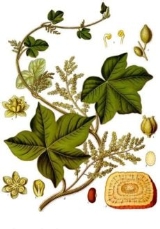
Menispermaceae

Encyclopedia
Menispermaceae, the botanical name
for a family
of flowering plants, has been universally recognized by taxonomists. Tubocurare
, a neuromuscular blocker and active ingredient in curare
, is derived from plants of this family.
The APG II system
, of 2003 (unchanged from the APG system
, of 1998), also recognizes this family and places it in the order Ranunculales
, in the clade eudicots
.
It is a medium sized family of 70 genera
totaling 420 extant species
, mostly of climbing plants. The great majority of the genera are tropical, but with a few (notably Menispermum
and Cocculus
) reaching temperate climates in eastern North America
and eastern Asia
.
Botanical name
A botanical name is a formal scientific name conforming to the International Code of Botanical Nomenclature and, if it concerns a plant cultigen, the additional cultivar and/or Group epithets must conform to the International Code of Nomenclature for Cultivated Plants...
for a family
Family (biology)
In biological classification, family is* a taxonomic rank. Other well-known ranks are life, domain, kingdom, phylum, class, order, genus, and species, with family fitting between order and genus. As for the other well-known ranks, there is the option of an immediately lower rank, indicated by the...
of flowering plants, has been universally recognized by taxonomists. Tubocurare
Curare
Curare is a common name for various arrow poisons originating from South America. The three main types of curare are:* tubocurare...
, a neuromuscular blocker and active ingredient in curare
Curare
Curare is a common name for various arrow poisons originating from South America. The three main types of curare are:* tubocurare...
, is derived from plants of this family.
The APG II system
APG II system
The APG II system of plant classification is the second, now obsolete, version of a modern, mostly molecular-based, system of plant taxonomy that was published in April 2003 by the Angiosperm Phylogeny Group. It was a revision of the first APG system, published in 1998, and was superseded in 2009...
, of 2003 (unchanged from the APG system
APG system
The APG system of plant classification is the first, now obsolete, version of a modern, mostly molecular-based, system of plant taxonomy that was published in 1998 by the Angiosperm Phylogeny Group. It was superseded in 2003 by a revision, the APG II system, and then in 2009 by a further...
, of 1998), also recognizes this family and places it in the order Ranunculales
Ranunculales
Ranunculales is an order of flowering plants. Of necessity it contains the family Ranunculaceae, the buttercup family, because the name of the order is based on the name of a genus in that family. Ranunculales belongs to a paraphyletic group known as the basal eudicots...
, in the clade eudicots
Eudicots
Eudicots and Eudicotyledons are botanical terms introduced by Doyle & Hotton to refer to a monophyletic group of flowering plants that had been called tricolpates or non-Magnoliid dicots by previous authors...
.
It is a medium sized family of 70 genera
Genus
In biology, a genus is a low-level taxonomic rank used in the biological classification of living and fossil organisms, which is an example of definition by genus and differentia...
totaling 420 extant species
Species
In biology, a species is one of the basic units of biological classification and a taxonomic rank. A species is often defined as a group of organisms capable of interbreeding and producing fertile offspring. While in many cases this definition is adequate, more precise or differing measures are...
, mostly of climbing plants. The great majority of the genera are tropical, but with a few (notably Menispermum
Menispermum
Menispermum is a small genus of deciduous climbing woody vines in the moonseed family . Plants in this genus have small dioecious flowers, and clusters of small grape-like drupes. The name, moonseed , comes from the shape of the seed, which resembles a crescent moon...
and Cocculus
Cocculus
Cocculus is a genus of 11 species of woody vines and shrubs, native to warm temperate to tropical regions of North America, Asia and Africa. The common name Moonseed is also used for the closely related genus Menispermum. The related Indian Berry is known as "Cocculus Indicus" in...
) reaching temperate climates in eastern North America
North America
North America is a continent wholly within the Northern Hemisphere and almost wholly within the Western Hemisphere. It is also considered a northern subcontinent of the Americas...
and eastern Asia
Asia
Asia is the world's largest and most populous continent, located primarily in the eastern and northern hemispheres. It covers 8.7% of the Earth's total surface area and with approximately 3.879 billion people, it hosts 60% of the world's current human population...
.
Selected genera
|
Dioscoreophyllum Dioscoreophyllum is a genus of three species of flowering plants in the family Menispermaceae, native to Africa. The species are lianas.Species*Dioscoreophyllum gossweileri Exell*Dioscoreophyllum oligotrichum Diels... Hyperbaena Hyperbaena is a genus of plant in family Menispermaceae. It contains the following species :* Hyperbaena allenii, Standl.* Hyperbaena jalcomulcensis, E. Pérez & Cast.-Campos* Hyperbaena prioriana, Miers... Legnephora Legnephora is a genus of flowering plants, consisting of five climbing species, found in Malesia and Australia. The name comes from ancient Greek, referring to a feature of the fruit anatomy being “border bearing”.... Menispermum Menispermum is a small genus of deciduous climbing woody vines in the moonseed family . Plants in this genus have small dioecious flowers, and clusters of small grape-like drupes. The name, moonseed , comes from the shape of the seed, which resembles a crescent moon... Odontocarya Odontocarya is a plant genus in the family Menispermaceae.... |
Stephania Stephania is a genus of flowering plants in the family Menispermaceae, native to eastern and southern Asia and Australasia. They are herbaceous perennial vines growing to around four metres tall, with a large, woody caudex. The leaves are arranged spirally on the stem, and are peltate, with the... Tiliacora Tiliacora is a genus of flowering plants, consisting of 22 species. 19 species are found in Africa and 3 in Asia.... Triclisia Triclisia is a genus of plant in family Menispermaceae.-Species:It contains the following species :* Triclisia lanceolata, Troupin* Triclisia macrophylla, Oliv.... |
External links
- Menispermaceae in L. Watson and M.J. Dallwitz (1992 onwards). The families of flowering plants: descriptions, illustrations, identification, information retrieval. Version: 3rd May 2006. http://delta-intkey.com.
- Menispermaceae in the Flora of North America
- NCBI Taxonomy Browser
- links at CSDL
- Menispermaceae of Mongolia in FloraGREIF