
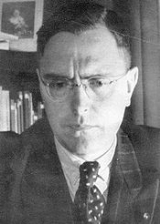
Machgielis Euwe (last name is pronounced ˈøːwə) (May 20, 1901 – November 26, 1981) was a
DutchThe Netherlands is a constituent country of the Kingdom of the Netherlands, located mainly in North-West Europe and with several islands in the Caribbean. Mainland Netherlands borders the North Sea to the north and west, Belgium to the south, and Germany to the east, and shares maritime borders...
chessChess is a two-player board game played on a chessboard, a square-checkered board with 64 squares arranged in an eight-by-eight grid. It is one of the world's most popular games, played by millions of people worldwide at home, in clubs, online, by correspondence, and in tournaments.Each player...
Grandmaster,
mathematicianA mathematician is a person whose primary area of study is the field of mathematics. Mathematicians are concerned with quantity, structure, space, and change....
, and author. He was the fifth player to become
World Chess ChampionThe World Chess Championship is played to determine the World Champion in the board game chess. Men and women of any age are eligible to contest this title....
(1935–37). Euwe also served as President of FIDE, the World Chess Federation, from 1970 to 1978.
Early years
Euwe was born in
WatergraafsmeerThe Watergraafsmeer is a polder in The Netherlands. It was reclaimed in 1629. In the 17th and 18th centuries, there were many buitenplaatsen in the Watergraafsmeer, though nowadays only one, Frankendael, remains....
, near
AmsterdamAmsterdam is the largest city and the capital of the Netherlands. The current position of Amsterdam as capital city of the Kingdom of the Netherlands is governed by the constitution of August 24, 1815 and its successors. Amsterdam has a population of 783,364 within city limits, an urban population...
. He studied
mathematicsMathematics is the study of quantity, space, structure, and change. Mathematicians seek out patterns and formulate new conjectures. Mathematicians resolve the truth or falsity of conjectures by mathematical proofs, which are arguments sufficient to convince other mathematicians of their validity...
at the University of Amsterdam, earning his doctorate in 1926, and taught mathematics, first in
RotterdamRotterdam is the second-largest city in the Netherlands and one of the largest ports in the world. Starting as a dam on the Rotte river, Rotterdam has grown into a major international commercial centre...
, and later at a girls' Lyceum in
AmsterdamAmsterdam is the largest city and the capital of the Netherlands. The current position of Amsterdam as capital city of the Kingdom of the Netherlands is governed by the constitution of August 24, 1815 and its successors. Amsterdam has a population of 783,364 within city limits, an urban population...
. He published a mathematical analysis of the game of chess from an intuitionistic point of view, in which he showed, using the
Thue-Morse sequenceIn mathematics, the Thue–Morse sequence, or Prouhet–Thue–Morse sequence, is a binary sequence that begins:Any other ordered pair of symbols may be used instead of 0 and 1; the logical structure of the Thue–Morse sequence does not depend on the symbols that are used to represent it.- Direct...
, that the then-official rules did not exclude the possibility of infinite games.
Early career
Euwe won every
Dutch chess championshipThe Dutch Chess Championship was officially established in 1909, although unofficial champions stretch back to the 1870s.-Early years:-Official championships:...
that he participated in from 1921 until 1952, and additionally won the title in 1955 – his 12 titles are still a record. The only other winners during this period were
Salo LandauSalo Landau was a Dutch chess player, who died in a Nazi concentration camp.-Early life:...
in 1936, when Euwe, then world champion, did not compete, and
Jan Hein DonnerJohannes Hendrikus Donner was a Dutch chess grandmaster and writer. Donner was born in The Hague and won the Dutch Championship in 1954, 1957, and 1958. FIDE, the World Chess Federation, awarded him the GM title in 1959. He played 11 times for the Netherlands in the Chess Olympiads...
in 1954. He became the
world amateur chess championThe World Amateur Chess Championship was a tournament organized by the World Chess Federation, FIDE.FIDE intended to promote amateur chess play by holding championship tournaments linked to the Olympic Games, but only two events were held....
in 1928, at The Hague, with a score of 12/15.
Euwe had a young family and could only play competitive chess during school vacations, so his opportunities for international chess competition at the top level were limited. But he performed well in the few tournaments and matches for which he could find time from the early 1920s to the mid 1930s. Fine comments, "Euwe's main international successes came in the form of narrow defeats" – but these were in matches against the world's best:
AlekhineAlexander Alexandrovich Alekhine was the fourth World Chess Champion. He is often considered one of the greatest chess players ever.By the age of twenty-two, he was already among the strongest chess players in the world. During the 1920s, he won most of the tournaments in which he played...
(1926), Capablanca (1931), and
SpielmannRudolf Spielmann was an Austrian-Jewish chess player of the romantic school, and chess writer.-Career:He was a lawyer but never worked as one....
(1935); and Euwe drew a match with
FlohrSalomon Mikhailovich Flohr was a leading Czech and later Soviet chess grandmaster of the mid-20th century, who became a national hero in Czechoslovakia during the 1930s. His name was used to sell many of the luxury products of the time, including Salo Flohr cigarettes, slippers and eau-de-cologne...
in 1932. His playing strength gradually increased, so that by 1932 he and Flohr were regarded as Alekhine's most credible challengers.
At
ZürichZurich is the largest city in Switzerland and the capital of the canton of Zurich. It is located in central Switzerland at the northwestern tip of Lake Zurich...
1934, Euwe finished second, behind only World Champion
Alexander AlekhineAlexander Alexandrovich Alekhine was the fourth World Chess Champion. He is often considered one of the greatest chess players ever.By the age of twenty-two, he was already among the strongest chess players in the world. During the 1920s, he won most of the tournaments in which he played...
, and he defeated Alekhine in their game. Alekhine was in an eight-year stretch, from 1927–35, where he lost only six games in tournament play.
World Champion
On December 15, 1935 after 30 games played in 13 different cities around The Netherlands over a period of 80 days, Euwe defeated Alekhine by 15½–14½, becoming the fifth World Chess Champion. Alekhine quickly went two games ahead, but from game 13 onwards Euwe won twice as many games as Alekhine. His title gave a huge boost to chess in The Netherlands. This was also the first world championship match in which the players had seconds to help them with analysis during adjournments.
Euwe's win was a major upset—he reportedly had believed that beating Alekhine was unlikely—and is sometimes attributed to Alekhine's alcoholism. But
Salo FlohrSalomon Mikhailovich Flohr was a leading Czech and later Soviet chess grandmaster of the mid-20th century, who became a national hero in Czechoslovakia during the 1930s. His name was used to sell many of the luxury products of the time, including Salo Flohr cigarettes, slippers and eau-de-cologne...
, who was helping Euwe during the match, thought over-confidence was more of a problem than alcohol for Alekhine in this match, and Alekhine himself said he would win easily. Former World Champions
Vasily SmyslovVasily Vasilyevich Smyslov was a Soviet and Russian chess grandmaster, and was World Chess Champion from 1957 to 1958. He was a Candidate for the World Chess Championship on eight occasions . Smyslov was twice equal first at the Soviet Championship , and his total of 17 Chess Olympiad medals won...
,
Boris SpasskyBoris Vasilievich Spassky is a Soviet-French chess grandmaster. He was the tenth World Chess Champion, holding the title from late 1969 to 1972...
,
Anatoly KarpovAnatoly Yevgenyevich Karpov is a Russian chess grandmaster and former World Champion. He was the official world champion from 1975 to 1985 when he was defeated by Garry Kasparov. He played three matches against Kasparov for the title from 1986 to 1990, before becoming FIDE World Champion once...
, and
Garry KasparovGarry Kimovich Kasparov is a Russian chess grandmaster, a former World Chess Champion, writer, political activist, and one of the greatest chess players of all time....
analyzed the match for their own benefit and concluded that Euwe deserved to win and that the standard of play was worthy of a world championship. Former World Champion
Vladimir KramnikVladimir Borisovich Kramnik is a Russian chess grandmaster. He was the Classical World Chess Champion from 2000 to 2006, and the undisputed World Chess Champion from 2006 to 2007...
has said that Euwe won the 1935 match on merit and that the result was not affected by Alekhine's drinking before or during the match.
Euwe's performances in the great tournaments of
Nottingham 1936Nottingham 1936, was a 15-player round robin chess tournament held August 10-28 at the University of Nottingham. It was one of the strongest of all time....
and the 1938
AVRO tournamentThe AVRO tournament was a chess tournament held in the Netherlands in 1938, sponsored by the Dutch broadcasting company AVRO. The event was a double round-robin tournament...
indicate he was a worthy champion, even if he was not as dominant as the earlier champions.
Reuben FineReuben Fine was one of the strongest chess players in the world from the early 1930s through the 1940s, an International Grandmaster, psychologist, university professor, and author of many books on both chess and psychology.Fine won five medals in three chess Olympiads. Fine won the U.S...
wrote, "In the two years before the return match, Euwe's strength increased. Although he never enjoyed the supremacy over his rivals that his predecessors had, he had no superiors in this period."
Euwe lost the title to Alekhine in a rematch in 1937, also played in The Netherlands, by the lopsided margin of 15½–9½. Alekhine had given up alcohol to prepare for the rematch, although he would start drinking again later. Alekhine got back to the sort of form he had shown from 1927–35, when he dominated chess. The match was a real contest initially, but Euwe's play collapsed near the end and he lost four of the last five games. Fine, who was Euwe's
secondSecond is a unit of time.Second or Seconds may also refer to:* 2 , as an ordinal * Arcsecond, a unit of angle* Second of right ascension, in astronomy...
in this match, attributed the collapse to nervous tension, possibly aggravated by Euwe's attempts to maintain a calm appearance.
The two world title matches against Alekhine represent the heart of Euwe's career. Altogether, the two played 86 competitive games, and Alekhine had a +28 −20 =38 lead, according to chessgames.com. Many of Alekhine's wins came early in their series; he was nine years older, and had more experience during that time. Then in the return match, Alekhine won by six points. So, during the period 1925–35, the two were very closely matched.
Later career
Euwe finished equal fourth with Alekhine and
ReshevskySamuel "Sammy" Herman Reshevsky was a famous chess prodigy and later a leading American chess Grandmaster...
in the
AVRO tournamentThe AVRO tournament was a chess tournament held in the Netherlands in 1938, sponsored by the Dutch broadcasting company AVRO. The event was a double round-robin tournament...
of 1938 in The Netherlands, which featured the world's top eight players and was an attempt to decide who should challenge Alekhine for the world championship. Euwe also had a major organizational role in the event.
He played a match with
Paul KeresPaul Keres , was an Estonian chess grandmaster, and a renowned chess writer. He was among the world's top players from the mid-1930s to the mid-1960s....
in The Netherlands in 1939–40, losing 6½–7½.
After Alekhine's death in 1946, Euwe was considered by some to have a moral right to the position of world champion, based at least partially on his clear second place finish in the great
tournament at Groningen in 1946Groningen 1946 was the first major international chess tournament to be held after World War II.Held at Groningen in August and September 1946, it was considered a miracle that the Netherlands could stage such an event just fifteen months after the end of the war.Mikhail Botvinnik won the...
, behind
Mikhail BotvinnikMikhail Moiseyevich Botvinnik, Ph.D. was a Soviet and Russian International Grandmaster and three-time World Chess Champion. Working as an electrical engineer and computer scientist at the same time, he was one of the very few famous chess players who achieved distinction in another career while...
. But Euwe consented to participate in a five-player tournament to select the new champion, the
World Chess Championship 1948The 1948 World Chess Championship was a tournament played to determine a new World Chess Champion following the death of the previous champion Alexander Alekhine in 1946. The tournament marked the passing of control of the championship title to FIDE, the International Chess Federation which had...
. However at 47, Euwe was significantly older than the other players, and well past his best. He finished last.
His final major tournament was the
Candidates' Tournament in Zurich, 1953Zurich 1953 was a chess tournament won by Vasily Smyslov. It was a Candidates Tournament for the 1954 World Chess Championship.-References:...
, in which he finished next to last.
He played for The Netherlands in a total of seven Chess Olympiads, from 1927 to 1962, a 35-year-span, always on first board. He scored 10½/15 at London 1927, 9½/13 at
Stockholm 1937The 7th Chess Olympiad, organized by the FIDE and comprising an open and women's tournament, as well as several events designed to promote the game of chess, took place between July 31 and August 14, 1937, in Stockholm, Sweden]....
for a bronze medal, 8/12 at
Dubrovnik 1950The 9th Chess Olympiad, organized by the FIDE and comprising an open and women's tournament, as well as several events designed to promote the game of chess, took place between August 20 and September 11, 1950, in Dubrovnik, SR Croatia, Yugoslavia .The final results were as follows:-Final :The...
, 7½/13 at
Amsterdam 1954The 11th Chess Olympiad, organized by the FIDE and comprising an open and women's tournament, as well as several events designed to promote the game of chess, took place between September 4 and September 25, 1954, in Amsterdam, Netherlands...
, 8½/11 at
Munich 1958The 13th Chess Olympiad, organized by the FIDE and comprising an open and women's tournament, as well as several events designed to promote the game of chess, took place between September 30 and October 23, 1958, in Munich, West Germany.-References:...
for a silver medal at age 57, 6½/16 at
Leipzig 1960The 14th Chess Olympiad, organized by the FIDE and comprising an open and women's tournament, as well as several events designed to promote the game of chess, took place between October 26 and November 9, 1960, in Leipzig, East Germany.-References:...
, and finally 4/7 at
Varna 1962The 15th Chess Olympiad, organized by the FIDE and comprising an open and women's tournament, as well as several events designed to promote the game of chess, took place between September 15 and October 10, 1962, in Varna, Bulgaria.-References:* OlimpBase...
. His aggregate was 54½/87 for 62.6 percent.
In 1957 Euwe played a short match against 14-year-old future world champion
Bobby FischerRobert James "Bobby" Fischer was an American chess Grandmaster and the 11th World Chess Champion. He is widely considered one of the greatest chess players of all time. Fischer was also a best-selling chess author...
, winning one game and drawing the other. His lifetime score against Fischer was one win, one loss, and one draw.
Euwe won a total of 102 first prizes in tournaments during his career. While it is true that many of those were local and were not very strong, the total is very impressive, considering that Euwe was never a true professional player.
FIDE President
From 1970 (at age 69) until 1978, he was president of the
FIDEThe Fédération Internationale des Échecs or World Chess Federation is an international organization that connects the various national chess federations around the world and acts as the governing body of international chess competition. It is usually referred to as FIDE , its French acronym.FIDE...
. As president, Euwe usually did what he considered morally right rather than what was politically expedient. On several occasions this brought him into conflict with the Soviet Chess Federation, which thought it had the right to predominate matters because it contributed a very large share of FIDE's budget and Soviet players dominated the world rankings – in effect they treated chess as an extension of the
Cold WarThe Cold War was the continuing state from roughly 1946 to 1991 of political conflict, military tension, proxy wars, and economic competition between the Communist World—primarily the Soviet Union and its satellite states and allies—and the powers of the Western world, primarily the United States...
. These conflicts included:
- The events leading up to Bobby Fischer
Robert James "Bobby" Fischer was an American chess Grandmaster and the 11th World Chess Champion. He is widely considered one of the greatest chess players of all time. Fischer was also a best-selling chess author...
's participation in the World Chess Championship 1972 match against Boris SpasskyBoris Vasilievich Spassky is a Soviet-French chess grandmaster. He was the tenth World Chess Champion, holding the title from late 1969 to 1972...
, which led to Fischer's becoming the first non-Soviet champion since World War II. Euwe thought it important for the health and reputation of the game that Fischer should have the opportunity to challenge for the title as soon as possible and interpreted the rules very flexibly to enable Fischer to play in the 1971 Candidates TournamentThe Candidates Tournament is a chess tournament organized by the world chess federation FIDE since 1950, as the final contest to determine the challenger for the World Chess Championship...
.
- The defection of grandmaster Gennadi Sosonko
Gennadi Borisovich Sosonko is a Dutch chess Grandmaster .At the beginning of his career, in 1958, he won in the Leningrad juniors championship.Sosonko moved from the Soviet Union to the Netherlands via Israel in 1972...
in 1972. The Soviets demanded that Sosonko should be treated as an "unperson", excluded from competitive chess, television or any other event that might be evidence of his defection. Euwe refused, and no Soviet players took part in the 1974 Wijk aan ZeeWijk aan Zee is a small town on the coast of the North Sea in the municipality of Beverwijk in the province of North Holland of the Netherlands. The prestigious Tata Steel chess tournament formerly Corus chess tournament and before that called Hoogovens tournament takes place there every year.Due...
tournament in The Netherlands because Sosonko competed.
- In 1976, world championship contender Viktor Korchnoi
Viktor Lvovich Korchnoi ; pronounced in the original Russian as "karch NOY"; Ви́ктор Льво́вич Корчно́й, born March 23, 1931 is a professional chess player, author and currently the oldest active grandmaster on the tournament circuit...
sought political asylum in The Netherlands. In a discussion a few days earlier Euwe told Korchnoi, "...of course you will retain all your rights ..." and opposed Soviet efforts to prevent Korchnoi from challenging for Anatoly KarpovAnatoly Yevgenyevich Karpov is a Russian chess grandmaster and former World Champion. He was the official world champion from 1975 to 1985 when he was defeated by Garry Kasparov. He played three matches against Kasparov for the title from 1986 to 1990, before becoming FIDE World Champion once...
's title in 1978.
- Later in 1976, Euwe supported FIDE's decision to hold the 1976 Chess Olympiad
The Chess Olympiad is a biennial chess tournament in which teams from all over the world compete against each other. The event is organised by FIDE, which selects the host nation.-Birth of the Olympiad:The first Olympiad was unofficial...
in IsraelThe State of Israel is a parliamentary republic located in the Middle East, along the eastern shore of the Mediterranean Sea...
, which the Soviet Union did not recognizeDiplomatic recognition in international law is a unilateral political act with domestic and international legal consequences, whereby a state acknowledges an act or status of another state or government in control of a state...
as a country. The Central CommitteeCentral Committee was the common designation of a standing administrative body of communist parties, analogous to a board of directors, whether ruling or non-ruling in the twentieth century and of the surviving, mostly Trotskyist, states in the early twenty first. In such party organizations the...
of Communist Party of the Soviet UnionThe Communist Party of the Soviet Union was the only legal, ruling political party in the Soviet Union and one of the largest communist organizations in the world...
then started plotting to depose Euwe as president of FIDE.
Euwe lost some of the battles with the Soviets; for example, in 1973 he accepted the Soviets' demand that
Bent LarsenJørgen Bent Larsen was a Danish chess Grandmaster and author. Larsen was known for his imaginative and unorthodox style of play and he was the first western player to pose a serious challenge to the Soviet Union's dominance of chess...
and
Robert HübnerRobert Hübner is a respected German chess Grandmaster, chess writer, and papyrologist . At eighteen, he was joint winner of the West German Chess Championship...
, the two strongest non-Soviet contenders (Fischer was now champion), should play in the Leningrad
InterzonalInterzonal chess tournaments were tournaments organized by FIDE, the World Chess Federation, and were a stage in the triennial World Chess Championship cycle.- Zonal tournaments :...
tournament rather than the weaker one in
PetrópolisPetrópolis , also known as The Imperial City of Brazil, is a town in the state of Rio de Janeiro, about 65 km from the city of Rio de Janeiro....
. Larsen and Hübner were eliminated from the competition for the World Championship because Korchnoi and Karpov took the first two places at Leningrad. Some commentators have also questioned whether Euwe did as much as he could have to prevent Fischer from forfeiting his world title in 1975.
Despite the turbulence of the period, most assessments of Euwe's performance as president of FIDE are sympathetic:
- Spassky, who had nominated Euwe for the job: "He should certainly not have disqualified Fischer, and he should have been a little tougher with the Soviets ... you get a pile of complicated problems. But Euwe, of course, was the man for the job."
- Karpov said Euwe was a very good FIDE President, although he did commit one very serious error, rapidly extending the membership of FIDE to many small third-world countries. "But neither he nor I could have foreseen what this would lead to. ... This led not only to the inflation of the grandmaster title, but also to the leadership vacuum at the head of the world of chess."
- Garry Kasparov
Garry Kimovich Kasparov is a Russian chess grandmaster, a former World Chess Champion, writer, political activist, and one of the greatest chess players of all time....
was blunter: "... unfortunately, he could not foresee the dangers flowing from a FIDE practically under Soviet dominance."
- Korchnoi regarded Euwe as the last honorable president of FIDE.
- Yuri Averbakh
Yuri Lvovich Averbakh is a Soviet and Russian chess player and author. He is currently the oldest living chess grandmaster.-Life and career:...
, who was a Soviet chess official as well as a grandmaster: "... he always sought to understand the opposing point of view ... Such behavior was in sharp contrast to the behavior of the Soviet delegation leaders ... Max Euwe was, without a doubt, the best President FIDE ever had."
He died in 1981, age 80, of a heart attack. Revered around the chess world for his many contributions, he had travelled extensively while FIDE President, bringing many new members into the organization.
Assessment of Euwe's chess
Euwe was noted for his logical approach and for his knowledge of the openings, in which he made major contributions to chess theory. Paradoxically his two title matches with
Alexander AlekhineAlexander Alexandrovich Alekhine was the fourth World Chess Champion. He is often considered one of the greatest chess players ever.By the age of twenty-two, he was already among the strongest chess players in the world. During the 1920s, he won most of the tournaments in which he played...
were displays of tactical ferocity from both sides. But the comments by Kmoch and Alekhine (below) may explain this: Euwe "strode confidently into some extraordinarily complex variations" if he thought logic was on his side; and he was extremely good at calculating these variations. On the other hand he "often lacked the stamina to pull himself out of bad positions".
Alekhine was allegedly more frank in his Russian-language articles than in those he wrote in English, French or German. In his Russian articles he often described Euwe as lacking in originality and in the mental toughness required of a world champion.
Gennadi SosonkoGennadi Borisovich Sosonko is a Dutch chess Grandmaster .At the beginning of his career, in 1958, he won in the Leningrad juniors championship.Sosonko moved from the Soviet Union to the Netherlands via Israel in 1972...
thought Euwe's modesty was a handicap in top-class chess (although Euwe was well aware of how much stronger he was than "ordinary" grandmasters).
Vladimir KramnikVladimir Borisovich Kramnik is a Russian chess grandmaster. He was the Classical World Chess Champion from 2000 to 2006, and the undisputed World Chess Champion from 2006 to 2007...
also says Euwe anticipated
BotvinnikMikhail Moiseyevich Botvinnik, Ph.D. was a Soviet and Russian International Grandmaster and three-time World Chess Champion. Working as an electrical engineer and computer scientist at the same time, he was one of the very few famous chess players who achieved distinction in another career while...
's emphasis on technical preparation, and Euwe was usually in good shape physically because he was a keen sportsman.
Chess books by Euwe
Euwe wrote over 70 chess books, far more than any other World Champion; some of the best-known are
The Road to Chess Mastery,
Judgement and Planning in Chess,
The Logical Approach to Chess, and
Strategy and Tactics in Chess Play. Former Soviet grandmaster
Gennadi SosonkoGennadi Borisovich Sosonko is a Dutch chess Grandmaster .At the beginning of his career, in 1958, he won in the Leningrad juniors championship.Sosonko moved from the Soviet Union to the Netherlands via Israel in 1972...
used Euwe's
Practical Chess Lessons (
Practische Schaaklessen) as a textbook when teaching in the Leningrad House of Pioneers, and considers it "one of the best chess books ever".
Fischer World Champion, an account of the 1972 World Chess Championship match, co-authored by Euwe with
Jan TimmanJan Timman is a Dutch chess Grandmaster who was one of the world's leading players from the late 1970s to the early 1990s. At the peak of his career he was considered to be the best non-Soviet player and was known as "The Best of the West"...
, was written in 1972 but not published in English until 2002.
Other interesting accounts
In Amsterdam there is a Max Euwe Plein (square) (near the
LeidsepleinThe Leidseplein is a square in central Amsterdam, the Netherlands. Lying in the southwest of the Grachtengordel district of Amsterdam, the Leidseplein is immediately northeast of the Singelgracht canal. It is situated on the crossroads of the Weteringschans, the Marnixstraat, and the Leidsestraat...
) with a large chess set and statue, where the 'Max Euwe Stichting' is located in a former jailhouse. It has a
Max Euwe museum and a large collection of
chess books.
His granddaughter, Esmee Lammers, has written a children's book called
Lang Leve de Koningin (
Long Live the Queen), which is popular among the youth. It is a fairytale about a young girl who learns to play chess and at the same time finds her father. Lammers filmed the story in 1995. (
IMDB entry.)
Notable chess games
- Max Euwe vs Efim Bogolyubov, Budapest 1921, French Defence, MacCutcheon Variation (C12), 1–0 With wins like these, the 20-year-old Euwe was building his strength and experience.
- Max Euwe vs Geza Maroczy, Bad Aussee match 1921, game 4, King's Gambit Declined (C30), 1–0 The great Maroczy was a bit past his peak by this stage, spotting Euwe 31 years.
- Siegbert Tarrasch vs Max Euwe, Amsterdam 1923, King's Indian Defence (E90), 0–1 In a battle of the two great amateurs, Euwe foreshadows what is to come with the King's Indian Defence in the years ahead.
- Sir George Thomas vs Max Euwe, Karlsbad 1923, English Opening, Symmetrical Variation (A31), 0–1 In a very sharp tactical game, Euwe displays a style which would become very popular in upcoming years.
- Frank Marshall vs Max Euwe, Bad Kissingen 1928, Torre Attack, King's Fianchetto Defence (A48), 0–1 Euwe again adopts a kingside fianchetto to take off the legendary attacker Marshall.
- Max Euwe vs Alexander Alekhine, Zurich 1934, Queen's Gambit (D31), 1–0 White unleashes a lovely tactic with his 31st move.
- Mikhail Botvinnik vs Max Euwe, Hastings 1934–35, Caro–Kann Defence, Panov–Botvinnik Attack (B13), 0–1 The young Soviet Botvinnik was playing his first tournament in the West, and adopts his favourite line, to no avail.
- Max Euwe vs Alexander Alekhine, World Championship Match 1935, game 5, Dutch Defense (A91), 1–0 Euwe had been losing 3–1 in the match so far, but managed this impressive win to turn the tide.
- Max Euwe vs Alexander Alekhine, Zandvoort-Wch 1935 (26th game of the match), Dutch (A90), 1–0 Game called "The Pearl of Zandvoort"; the decisive victory of the match and at the same time a beautiful demonstration of the strength of passed pawns.
- Alexander Alekhine vs Max Euwe, Amsterdam 1936, Four Knights' Game (C49), 0–1 Euwe comes out on top after a very hard-fought endgame.
- Paul Keres vs Max Euwe, Zandvoort 1936, French Defense: Advance Variation. Nimzowitsch System (C02), 0–1 Struggle around White's advanced e5-pawn transforms into an attack against the white king.
- Max Euwe vs Alexander Alekhine, World Championship Match 1937, game 17, Slav Defence, Czech Variation (D19),(1–0) Outstanding precision by the champion.
- Max Euwe vs Alexander Alekhine, World Championship Match 1937, game 29, Queen's Gambit (D40), 1–0 Alekhine called this game Euwe's best of the entire series.
- Efim Geller vs Max Euwe, Zurich (candidates tournament) 1953 Nimzo–Indian Defense, Saemisch Variation, 0–1 Geller tries to smash Euwe off the board, but Euwe sacrifices a rook for a deadly counterattack.
- Max Euwe vs Robert James Fischer, New York m 1957, Queen's Gambit Declined, Exchange Variation (D35), 1–0 The ex-champion teaches the future champion how to attack in a very witty short game.
Quotations
- "Strategy requires thought; tactics requires observation." — Max Euwe
- "Does the general public, do even our friends the critics realize that Euwe virtually never made an unsound combination? He may, of course, occasionally fail to take account of an opponent's combination, but when he has the initiative in a tactical operation his calculation is impeccable." — Alexander Alekhine
- "If Richard Reti
Réti composed one of the most famous chess studies, shown in this diagram. It was published in Ostrauer Morgenzeitung 4 December 1921. It seems impossible for the white king to catch the advanced black pawn, while the white pawn can be easily stopped by the black king...
was interested only in the exceptions to positional rules, then Max Euwe believed perhaps a little too much in their immutability." — Alexander Alekhine
- "He is logic personified, a genius of law and order. One would hardly call him an attacking player, yet he strides confidently into some extraordinarily complex variations." — Hans Kmoch
Johann "Hans" Joseph Kmoch was an Austrian-Dutch-American chess International Master , International Arbiter , and a chess journalist and author, for which he is best known....
- "Euwe can only breathe freely when he is smothered in work." — Hans Kmoch
- "Euwe resting would not be Euwe. His star is work, work, and more work. Work is his entertainment, his strength and his destiny." — Hans Kmoch
- "There's something wrong with that man. He's too normal." — Bobby Fischer
External links
- Machgielis Euwe Euwe's biography
- Max Euwe Centrum, Amsterdam
- Remembering Max Euwe (PDF
Portable Document Format is an open standard for document exchange. This file format, created by Adobe Systems in 1993, is used for representing documents in a manner independent of application software, hardware, and operating systems....
). Personal reminiscences of GM Genna Sosonko on the 100th anniversary of Euwe's birth.
- Machgielis (Max) Euwe a short history of Euwe's playing career