

Second Party System

Encyclopedia
The Second Party System is a term of periodization
used by historians and political scientists to name the political party system
existing in the United States
from about 1828 to 1854. The system was characterized by rapidly rising levels of voter interest beginning in 1828, as demonstrated by election day turnout, rallies, partisan newspapers, and a high degree of personal loyalty to party.
The major parties were the Democratic Party
, led by Andrew Jackson
, and the Whig Party
, assembled by Henry Clay
from the National Republicans
and other opponents of Jackson. Minor parties included the Anti-Masonic Party
, which was an important innovator from 1827–34; the abolitionist Liberty Party
in 1840; and the anti-slavery Free Soil Party in 1848 and 1852. The Second Party System reflected and shaped the political, social, economic and cultural currents of the Jacksonian Era
, until succeeded by the Third Party System
.
is most responsible for defining the term. He concluded:
, Martin Van Buren
, John C. Calhoun
, James K. Polk
, Lewis Cass
, and Stephen Douglas. On the Whig side, Henry Clay
, Daniel Webster
, William H. Seward
, and Thurlow Weed
.
, William Crawford
, Andrew Jackson
, and John Quincy Adams
), all of whom were nominally Democratic Republicans, had a regional base of support involving factions in the various states. With no electoral college
majority, the choice devolved on the United States House of Representatives
. Clay was not among the three finalists, but as Speaker of the House
he negotiated the settlement. Jackson, despite having won the most popular votes and the most electoral votes, was not elected. John Quincy Adams, son of former President John Adams
, was elected, and he immediately chose Clay as Secretary of State.
Jackson, the most famous of the nation's Indian fighters, and a hero of the War of 1812
, loudly denounced the "corrupt bargain
." Campaigning vigorously, and appealing both to local militia companies and to state political factions, Jackson assembled a coalition, the embryonic Democratic Party, that ousted Adams in 1828. Martin Van Buren
, brilliant leader of New York politics, was Jackson's key aide, bringing along the large electoral votes of Virginia and Pennsylvania. His reward was appointment as Secretary of State and later nomination and election to the vice presidency as heir to the Jacksonian tradition. The Adams-Clay wing of the Democratic-Republican Party became known as the National Republicans, although Adams never considered himself a loyal member of the party.
. Headquartered in Philadelphia, with offices in major cities around the country, the federally chartered Bank operated somewhat like a central bank (like the Federal Reserve System a century later). Local bankers and politicians annoyed by the controls exerted by Nicholas Biddle
grumbled loudly. Jackson did not like any banks (paper money was anathema to Jackson; he believed only gold and silver ["specie"] should circulate.) After Herculean battles with Henry Clay
, the chief protagonist, Jackson finally broke Biddle's bank.
Jackson continued to attack the banking system. His Specie Circular
of July 1836 rejected paper money issued by banks (it could no longer be used to buy federal land), insisting on gold and silver coins. Most businessmen and bankers (but not all) went over to the Whig party, and the commercial and industrial cities became Whig strongholds. Jackson meanwhile became even more popular with the subsistence farmers and day laborers who distrusted bankers and finance.
Jackson systematically used the federal patronage system, what was called the Spoils System
. Jackson not only rewarded past supporters; he promised future jobs if local and state politicians joined his team. As Syrett explains: When Jackson became President, he implemented the theory of rotation in office, declaring it "a leading principle in the republican creed." He believed that rotation in office would prevent the development of a corrupt civil service. On the other hand, Jackson's supporters wanted to use the civil service to reward party loyalists to make the party stronger. In practice, this meant replacing civil servants with friends or party loyalists into those offices. The spoils system did not originate with Jackson. It originated under Thomas Jefferson
when he removed Federalist
office-holders after becoming president. Also, Jackson did not out the entire civil service. At the end of his term, Jackson had only dismissed less than twenty percent of the original civil service. While Jackson did not start the spoils system, he did encourage its growth and it became a central feature of the Second Party System, as well as the Third Party System
, until it ended in the 1890s. As one historian explains:
were mobilized into a new anti-Jackson force; they called themselves Whigs
. Just as the Whigs of 1776 were patriots who battled the tyranny of King George III, so too the new party saw itself battling "King Andrew". In the northeast, a moralistic crusade against the highly secretive Masonic order matured into a regular political party, the Anti-Masons, which soon combined with the Whigs. Jackson fought back by aggressive use of federal patronage, by timely alliances with local leaders, and with a rhetoric that identified the Bank and its agents as the greatest threat to the republican spirit. Eventually his partisans called themselves "Democrats." The Whigs had an elaborate program for modernizing the economy. To stimulate the creation of new factories, they proposed a high tariff on imported manufactured goods.
The Democrats said that would fatten the rich; the tariff should be low—for "revenue only" (thus not to foster manufacturing). Whigs argued that banks and paper money were needed; the Democrats countered that no honest man wants them. Public works programs to build roads, canals and railroads would give the country the infrastructure it needed for rapid economic development, said the Whigs. Democrats replied they did not want that kind of complex change. Rather the Democrats called for more of the same—especially more farms to raise the families in the traditional style. More land is needed for that, Democrats said, so they pushed for expansion south and west. Jackson conquered Florida for the US. Over intense Whig opposition, his political heir, James Polk (1844-48) added Texas, the Southwest, California, and Oregon. Next on the Democratic agenda would be Cuba
.
In most cities the rich men were solidly Whig—85-90% of the men worth over $100,000 in Boston and New York City voted Whig.. In rural America, the Whigs were stronger in market towns and commercial areas, and the Democrats stronger on the frontier and in more isolated areas. Ethnic and religious communities usually went the same way, with Irish and German Catholics heavily Democratic, and pietistic Protestants more Whiggish. .
underwent fundamental change after 1820 under the rubric of Jacksonian Democracy
. While Jackson himself did not initiate the changes, he took advantage in 1828 and symbolized many of the changes. For the first time politics assumed a central role in voters' lives. Before then deference to upper class elites, and general indifference most of the time, characterized local politics across the country. The suffrage laws were not at fault for they allowed mass participation; rather few men were interested in politics before 1828, and fewer still voted or became engaged because politics did not seem important. Changes followed the psychological shock of the panic of 1819
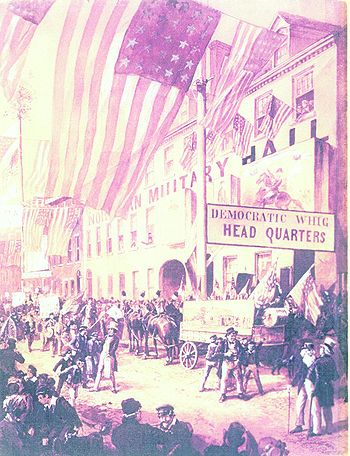
, and the 1828 election of Andrew Jackson, with his charismatic personality and controversial policies. By 1840, Gienapp argues, the revolution was complete: "With the full establishment of the second party system, campaigns were characterized by appeals to the common man, mass meetings, parades, celebrations, and intense enthusiasm, while elections generated high voter participation. In structure and ideology, American politics had been democratized."
emerged early as the leader in Illinois—where he usually was bested by an even more talented politician, Stephen Douglas. While Douglas and the Democrats were somewhat behind the Whigs in newspaper work, they made up for this weakness by emphasis on party loyalty. Anyone who attended a Democratic convention, from precinct level to national level, was honor bound to support the final candidate, whether he liked him or not. This rule produced numerous schisms, but on the whole the Democrats controlled and mobilized their rank and file more effectively than the Whigs did.
By the mid-1850s, the question of slavery dominated the political landscape, and the Whigs, unable to agree on an approach to the issue, began to disintegrate. A few Whigs lingered, claiming that, with the alternatives being a pro-Northern Republican party and a pro-Southern Democratic party, they were the only political party that could preserve the Union. In 1856, the remaining Whigs endorsed the Know-Nothing campaign of Millard Fillmore
and in 1860 they endorsed the Constitutional Union
ticket of John Bell
, but, with the outbreak of the Civil War in 1861, the Whig party ceased to exist.
Most of the prominent men in most towns and cities were Whigs, and they controlled local offices and judgeships, in addition to many state offices. Thus the outcome of the political process was mixed. In Springfield, Illinois
, a strong Whig enclave in a Democratic region, poll books that show how individuals voted indicates the rise of the Whigs took place in 1836
in opposition to the presidential candidacy of Martin Van Buren
and was consolidated in 1840
. Springfield Whigs tend to validate historical studies elsewhere: they were largely native-born, either in New England or Kentucky, professional men or farm owners, and devoted to partisan organization. Abraham Lincoln
's career mirrors the Whigs' political rise, but by the 1840s Springfield began to fall into the hands of the Democrats, as immigrants changed the city's political makeup. By the 1860 presidential election, Lincoln was barely able to win the city.
was ready to emerge.
Periodization
Periodization is the attempt to categorize or divide time into named blocks. The result is a descriptive abstraction that provides a useful handle on periods of time with relatively stable characteristics...
used by historians and political scientists to name the political party system
Political parties in the United States
This article presents the historical development and role of political parties in United States politics, and outlines more extensively the significant modern political parties. Throughout most of its history, American politics have been dominated by a two-party system...
existing in the United States
United States
The United States of America is a federal constitutional republic comprising fifty states and a federal district...
from about 1828 to 1854. The system was characterized by rapidly rising levels of voter interest beginning in 1828, as demonstrated by election day turnout, rallies, partisan newspapers, and a high degree of personal loyalty to party.
The major parties were the Democratic Party
History of the United States Democratic Party
The history of the Democratic Party of the United States is an account of the oldest political party in the United States and arguably the oldest democratic party in the world....
, led by Andrew Jackson
Andrew Jackson
Andrew Jackson was the seventh President of the United States . Based in frontier Tennessee, Jackson was a politician and army general who defeated the Creek Indians at the Battle of Horseshoe Bend , and the British at the Battle of New Orleans...
, and the Whig Party
Whig Party (United States)
The Whig Party was a political party of the United States during the era of Jacksonian democracy. Considered integral to the Second Party System and operating from the early 1830s to the mid-1850s, the party was formed in opposition to the policies of President Andrew Jackson and his Democratic...
, assembled by Henry Clay
Henry Clay
Henry Clay, Sr. , was a lawyer, politician and skilled orator who represented Kentucky separately in both the Senate and in the House of Representatives...
from the National Republicans
National Republican Party (United States)
The National Republicans were a political party in the United States. During the administration of John Quincy Adams , the president's supporters were referred to as Adams Men or Anti-Jackson. When Andrew Jackson was elected President of the United States in 1828, this group went into opposition...
and other opponents of Jackson. Minor parties included the Anti-Masonic Party
Anti-Masonic Party
The Anti-Masonic Party was the first "third party" in the United States. It strongly opposed Freemasonry and was founded as a single-issue party aspiring to become a major party....
, which was an important innovator from 1827–34; the abolitionist Liberty Party
Liberty Party (1840s)
The Liberty Party was a minor political party in the United States in the 1840s . The party was an early advocate of the abolitionist cause...
in 1840; and the anti-slavery Free Soil Party in 1848 and 1852. The Second Party System reflected and shaped the political, social, economic and cultural currents of the Jacksonian Era
Jacksonian democracy
Jacksonian democracy is the political movement toward greater democracy for the common man typified by American politician Andrew Jackson and his supporters. Jackson's policies followed the era of Jeffersonian democracy which dominated the previous political era. The Democratic-Republican Party of...
, until succeeded by the Third Party System
Third Party System
The Third Party System is a term of periodization used by historians and political scientists to describe a period in American political history from about 1854 to the mid-1890s that featured profound developments in issues of nationalism, modernization, and race...
.
Patterns
Historian Richard P. McCormickRichard P. McCormick
Richard Patrick McCormick was a historian, former University Professor of History, administrator, professor emeritus at Rutgers University in New Brunswick, New Jersey and President of the New Jersey Historical Society. Dr...
is most responsible for defining the term. He concluded:
- It was a distinct party system.
- It formed over a 15-year period that varied by state.
- It was produced by leaders trying to win the presidency, with contenders building their own national coalitions.
- Regional effects strongly affected developments, with the Adams forces strongest in New England, for example, and the Jacksonians in the Southwest.
- For the first time two-party politics was extended to the South and West (which had been one-party regions).
- In each region the two parties were about equal—the first and only party system showing this.
- Because of the regional balance it was vulnerable to region-specific issues (like slavery).
- The same two parties appeared in every state, and contested both the electoral vote and state offices.
- Most critical was the abrupt emergence of a two-party South in 1832-34 (mostly as a reaction against Van Buren).
- The Anti-Masonic party flourished in only those states with a weak second party.
- Methods varied somewhat but everywhere the political conventionPolitical conventionIn politics, a political convention is a meeting of a political party, typically to select party candidates.In the United States, a political convention usually refers to a presidential nominating convention, but it can also refer to state, county, or congressional district nominating conventions...
replaced the caucusCaucusA caucus is a meeting of supporters or members of a political party or movement, especially in the United States and Canada. As the use of the term has been expanded the exact definition has come to vary among political cultures.-Origin of the term:...
. - The parties had an interest of their own, in terms of the office-seeking goals of party activists.
- The System brought forth a new, popular campaign style.
- Close elections—not charismatic candidates or particular issues—brought out the voters.
- Party leaders formed the parties to some degree in their own image.
Leaders
Among the best-known figures (on the Democratic side) were: Andrew JacksonAndrew Jackson
Andrew Jackson was the seventh President of the United States . Based in frontier Tennessee, Jackson was a politician and army general who defeated the Creek Indians at the Battle of Horseshoe Bend , and the British at the Battle of New Orleans...
, Martin Van Buren
Martin Van Buren
Martin Van Buren was the eighth President of the United States . Before his presidency, he was the eighth Vice President and the tenth Secretary of State, under Andrew Jackson ....
, John C. Calhoun
John C. Calhoun
John Caldwell Calhoun was a leading politician and political theorist from South Carolina during the first half of the 19th century. Calhoun eloquently spoke out on every issue of his day, but often changed positions. Calhoun began his political career as a nationalist, modernizer, and proponent...
, James K. Polk
James K. Polk
James Knox Polk was the 11th President of the United States . Polk was born in Mecklenburg County, North Carolina. He later lived in and represented Tennessee. A Democrat, Polk served as the 17th Speaker of the House of Representatives and the 12th Governor of Tennessee...
, Lewis Cass
Lewis Cass
Lewis Cass was an American military officer and politician. During his long political career, Cass served as a governor of the Michigan Territory, an American ambassador, a U.S. Senator representing Michigan, and co-founder as well as first Masonic Grand Master of the Grand Lodge of Michigan...
, and Stephen Douglas. On the Whig side, Henry Clay
Henry Clay
Henry Clay, Sr. , was a lawyer, politician and skilled orator who represented Kentucky separately in both the Senate and in the House of Representatives...
, Daniel Webster
Daniel Webster
Daniel Webster was a leading American statesman and senator from Massachusetts during the period leading up to the Civil War. He first rose to regional prominence through his defense of New England shipping interests...
, William H. Seward
William H. Seward
William Henry Seward, Sr. was the 12th Governor of New York, United States Senator and the United States Secretary of State under Abraham Lincoln and Andrew Johnson...
, and Thurlow Weed
Thurlow Weed
Thurlow Weed was a New York newspaper publisher, politician, and party boss. He was the principal political advisor to the prominent New York politician William H...
.
Origins
The 1824 presidential election, operated without political parties, came down to a four-man race. Each candidate (Henry ClayHenry Clay
Henry Clay, Sr. , was a lawyer, politician and skilled orator who represented Kentucky separately in both the Senate and in the House of Representatives...
, William Crawford
William Crawford
William Crawford is the name of:* William Crawford , Scottish painter* William Crawford , Member of Parliament for Mid Durham, 1885–1890...
, Andrew Jackson
Andrew Jackson
Andrew Jackson was the seventh President of the United States . Based in frontier Tennessee, Jackson was a politician and army general who defeated the Creek Indians at the Battle of Horseshoe Bend , and the British at the Battle of New Orleans...
, and John Quincy Adams
John Quincy Adams
John Quincy Adams was the sixth President of the United States . He served as an American diplomat, Senator, and Congressional representative. He was a member of the Federalist, Democratic-Republican, National Republican, and later Anti-Masonic and Whig parties. Adams was the son of former...
), all of whom were nominally Democratic Republicans, had a regional base of support involving factions in the various states. With no electoral college
Electoral college
An electoral college is a set of electors who are selected to elect a candidate to a particular office. Often these represent different organizations or entities, with each organization or entity represented by a particular number of electors or with votes weighted in a particular way...
majority, the choice devolved on the United States House of Representatives
United States House of Representatives
The United States House of Representatives is one of the two Houses of the United States Congress, the bicameral legislature which also includes the Senate.The composition and powers of the House are established in Article One of the Constitution...
. Clay was not among the three finalists, but as Speaker of the House
Speaker of the United States House of Representatives
The Speaker of the United States House of Representatives, or Speaker of the House, is the presiding officer of the United States House of Representatives...
he negotiated the settlement. Jackson, despite having won the most popular votes and the most electoral votes, was not elected. John Quincy Adams, son of former President John Adams
John Adams
John Adams was an American lawyer, statesman, diplomat and political theorist. A leading champion of independence in 1776, he was the second President of the United States...
, was elected, and he immediately chose Clay as Secretary of State.
Jackson, the most famous of the nation's Indian fighters, and a hero of the War of 1812
War of 1812
The War of 1812 was a military conflict fought between the forces of the United States of America and those of the British Empire. The Americans declared war in 1812 for several reasons, including trade restrictions because of Britain's ongoing war with France, impressment of American merchant...
, loudly denounced the "corrupt bargain
Corrupt Bargain
The term Corrupt Bargain refers to three separate events that each involved a United States presidential election and a deal that was struck that many viewed to be corrupt from many standpoints, such as in the Election of 1824 controversy over the House of Representative's choice for president with...
." Campaigning vigorously, and appealing both to local militia companies and to state political factions, Jackson assembled a coalition, the embryonic Democratic Party, that ousted Adams in 1828. Martin Van Buren
Martin Van Buren
Martin Van Buren was the eighth President of the United States . Before his presidency, he was the eighth Vice President and the tenth Secretary of State, under Andrew Jackson ....
, brilliant leader of New York politics, was Jackson's key aide, bringing along the large electoral votes of Virginia and Pennsylvania. His reward was appointment as Secretary of State and later nomination and election to the vice presidency as heir to the Jacksonian tradition. The Adams-Clay wing of the Democratic-Republican Party became known as the National Republicans, although Adams never considered himself a loyal member of the party.
Jackson: Bank War and Spoils System
Jackson considered himself a reformer, but he was committed to the old ideals of Republicanism, and bitterly opposed anything that smacked of special favors for special interests. While Jackson never engaged in a duel as president, he had shot political opponents before and was just as determined to destroy his enemies on the battlefields of politics. The Second Party System came about primarily because of Jackson's determination to destroy the Second Bank of the United StatesSecond Bank of the United States
The Second Bank of the United States was chartered in 1816, five years after the First Bank of the United States lost its own charter. The Second Bank of the United States was initially headquartered in Carpenters' Hall, Philadelphia, the same as the First Bank, and had branches throughout the...
. Headquartered in Philadelphia, with offices in major cities around the country, the federally chartered Bank operated somewhat like a central bank (like the Federal Reserve System a century later). Local bankers and politicians annoyed by the controls exerted by Nicholas Biddle
Nicholas Biddle (banker)
Nicholas Biddle was an American financier who served as the president of the Second Bank of the United States.-Ancestry and early life:...
grumbled loudly. Jackson did not like any banks (paper money was anathema to Jackson; he believed only gold and silver ["specie"] should circulate.) After Herculean battles with Henry Clay
Henry Clay
Henry Clay, Sr. , was a lawyer, politician and skilled orator who represented Kentucky separately in both the Senate and in the House of Representatives...
, the chief protagonist, Jackson finally broke Biddle's bank.
Jackson continued to attack the banking system. His Specie Circular
Specie Circular
The Specie Circular was an executive order issued by U.S. President Andrew Jackson in 1836 and carried out by President Martin Van Buren. It required payment for government land to be in gold and silver.-History:...
of July 1836 rejected paper money issued by banks (it could no longer be used to buy federal land), insisting on gold and silver coins. Most businessmen and bankers (but not all) went over to the Whig party, and the commercial and industrial cities became Whig strongholds. Jackson meanwhile became even more popular with the subsistence farmers and day laborers who distrusted bankers and finance.
Jackson systematically used the federal patronage system, what was called the Spoils System
Spoils system
In the politics of the United States, a spoil system is a practice where a political party, after winning an election, gives government jobs to its voters as a reward for working toward victory, and as an incentive to keep working for the party—as opposed to a system of awarding offices on the...
. Jackson not only rewarded past supporters; he promised future jobs if local and state politicians joined his team. As Syrett explains: When Jackson became President, he implemented the theory of rotation in office, declaring it "a leading principle in the republican creed." He believed that rotation in office would prevent the development of a corrupt civil service. On the other hand, Jackson's supporters wanted to use the civil service to reward party loyalists to make the party stronger. In practice, this meant replacing civil servants with friends or party loyalists into those offices. The spoils system did not originate with Jackson. It originated under Thomas Jefferson
Thomas Jefferson
Thomas Jefferson was the principal author of the United States Declaration of Independence and the Statute of Virginia for Religious Freedom , the third President of the United States and founder of the University of Virginia...
when he removed Federalist
Federalist Party (United States)
The Federalist Party was the first American political party, from the early 1790s to 1816, the era of the First Party System, with remnants lasting into the 1820s. The Federalists controlled the federal government until 1801...
office-holders after becoming president. Also, Jackson did not out the entire civil service. At the end of his term, Jackson had only dismissed less than twenty percent of the original civil service. While Jackson did not start the spoils system, he did encourage its growth and it became a central feature of the Second Party System, as well as the Third Party System
Third Party System
The Third Party System is a term of periodization used by historians and political scientists to describe a period in American political history from about 1854 to the mid-1890s that featured profound developments in issues of nationalism, modernization, and race...
, until it ended in the 1890s. As one historian explains:
"Although Jackson dismissed far fewer government employees than most of his contemporaries imagined and although he did not originate the spoils system, he made more sweeping changes in the Federal bureaucracy than had any of his predecessors. What is even more significant is that he defended these changes as a positive good. At present when the use of political patronage is generally considered an obstacle to good government, it is worth remembering that Jackson and his followers invariably described rotation in public office as a "reform." In this sense the spoils system was more than a way to reward Jackson's friends and punish his enemies; it was also a device for removing from public office the representatives of minority political groups that Jackson insisted had been made corrupt by their long tenure."
Modernizing Whigs
Meanwhile economic modernizers, bankers, businessmen, commercial farmers, many of whom were already National Republicans, and Southern planters angry at Jackson's handling of the Nullification crisisNullification Crisis
The Nullification Crisis was a sectional crisis during the presidency of Andrew Jackson created by South Carolina's 1832 Ordinance of Nullification. This ordinance declared by the power of the State that the federal Tariff of 1828 and 1832 were unconstitutional and therefore null and void within...
were mobilized into a new anti-Jackson force; they called themselves Whigs
Whig Party (United States)
The Whig Party was a political party of the United States during the era of Jacksonian democracy. Considered integral to the Second Party System and operating from the early 1830s to the mid-1850s, the party was formed in opposition to the policies of President Andrew Jackson and his Democratic...
. Just as the Whigs of 1776 were patriots who battled the tyranny of King George III, so too the new party saw itself battling "King Andrew". In the northeast, a moralistic crusade against the highly secretive Masonic order matured into a regular political party, the Anti-Masons, which soon combined with the Whigs. Jackson fought back by aggressive use of federal patronage, by timely alliances with local leaders, and with a rhetoric that identified the Bank and its agents as the greatest threat to the republican spirit. Eventually his partisans called themselves "Democrats." The Whigs had an elaborate program for modernizing the economy. To stimulate the creation of new factories, they proposed a high tariff on imported manufactured goods.
The Democrats said that would fatten the rich; the tariff should be low—for "revenue only" (thus not to foster manufacturing). Whigs argued that banks and paper money were needed; the Democrats countered that no honest man wants them. Public works programs to build roads, canals and railroads would give the country the infrastructure it needed for rapid economic development, said the Whigs. Democrats replied they did not want that kind of complex change. Rather the Democrats called for more of the same—especially more farms to raise the families in the traditional style. More land is needed for that, Democrats said, so they pushed for expansion south and west. Jackson conquered Florida for the US. Over intense Whig opposition, his political heir, James Polk (1844-48) added Texas, the Southwest, California, and Oregon. Next on the Democratic agenda would be Cuba
Ostend Manifesto
The Ostend Manifesto was a document written in 1854 that described the rationale for the United States to purchase Cuba from Spain and implied the U.S. should declare war if Spain refused. Cuba's annexation had long been a goal of U.S. expansionists, particularly as the U.S. set its sights...
.
In most cities the rich men were solidly Whig—85-90% of the men worth over $100,000 in Boston and New York City voted Whig.. In rural America, the Whigs were stronger in market towns and commercial areas, and the Democrats stronger on the frontier and in more isolated areas. Ethnic and religious communities usually went the same way, with Irish and German Catholics heavily Democratic, and pietistic Protestants more Whiggish. .
Democratization
Gienapp (1982) points out that the American political systemunderwent fundamental change after 1820 under the rubric of Jacksonian Democracy
Jacksonian democracy
Jacksonian democracy is the political movement toward greater democracy for the common man typified by American politician Andrew Jackson and his supporters. Jackson's policies followed the era of Jeffersonian democracy which dominated the previous political era. The Democratic-Republican Party of...
. While Jackson himself did not initiate the changes, he took advantage in 1828 and symbolized many of the changes. For the first time politics assumed a central role in voters' lives. Before then deference to upper class elites, and general indifference most of the time, characterized local politics across the country. The suffrage laws were not at fault for they allowed mass participation; rather few men were interested in politics before 1828, and fewer still voted or became engaged because politics did not seem important. Changes followed the psychological shock of the panic of 1819
Panic of 1819
The Panic of 1819 was the first major financial crisis in the United States, and had occurred during the political calm of the Era of Good Feelings. The new nation previously had faced a depression following the war of independence in the late 1780s and led directly to the establishment of the...
, and the 1828 election of Andrew Jackson, with his charismatic personality and controversial policies. By 1840, Gienapp argues, the revolution was complete: "With the full establishment of the second party system, campaigns were characterized by appeals to the common man, mass meetings, parades, celebrations, and intense enthusiasm, while elections generated high voter participation. In structure and ideology, American politics had been democratized."
Party strengths
The Whigs built a strong party organization in most states; they were weak only on the frontier. The Whigs used newspapers effectively, and soon adopted the exciting campaign techniques that lured 75 to 85% of the eligible voters to the polls. Abraham LincolnAbraham Lincoln
Abraham Lincoln was the 16th President of the United States, serving from March 1861 until his assassination in April 1865. He successfully led his country through a great constitutional, military and moral crisis – the American Civil War – preserving the Union, while ending slavery, and...
emerged early as the leader in Illinois—where he usually was bested by an even more talented politician, Stephen Douglas. While Douglas and the Democrats were somewhat behind the Whigs in newspaper work, they made up for this weakness by emphasis on party loyalty. Anyone who attended a Democratic convention, from precinct level to national level, was honor bound to support the final candidate, whether he liked him or not. This rule produced numerous schisms, but on the whole the Democrats controlled and mobilized their rank and file more effectively than the Whigs did.
Whig weaknesses
One fundamental weakness was its inability to take a position on slavery. As a coalition of Northern National Republicans and Southern Nullifiers, Whigs in each of the two regions held opposing views on slavery. Therefore, the Whig party was only able to conduct successful campaigns as long as the slavery issue was ignored.By the mid-1850s, the question of slavery dominated the political landscape, and the Whigs, unable to agree on an approach to the issue, began to disintegrate. A few Whigs lingered, claiming that, with the alternatives being a pro-Northern Republican party and a pro-Southern Democratic party, they were the only political party that could preserve the Union. In 1856, the remaining Whigs endorsed the Know-Nothing campaign of Millard Fillmore
Millard Fillmore
Millard Fillmore was the 13th President of the United States and the last member of the Whig Party to hold the office of president...
and in 1860 they endorsed the Constitutional Union
Constitutional Union Party (United States)
The Constitutional Union Party was a political party in the United States created in 1860. It was made up of conservative former Whigs who wanted to avoid disunion over the slavery issue...
ticket of John Bell
John Bell (Tennessee politician)
John Bell was a U.S. politician, attorney, and plantation owner. A wealthy slaveholder from Tennessee, Bell served in the United States Congress in both the House of Representatives and Senate. He began his career as a Democrat, he eventually fell out with Andrew Jackson and became a Whig...
, but, with the outbreak of the Civil War in 1861, the Whig party ceased to exist.
Most of the prominent men in most towns and cities were Whigs, and they controlled local offices and judgeships, in addition to many state offices. Thus the outcome of the political process was mixed. In Springfield, Illinois
Springfield, Illinois
Springfield is the third and current capital of the US state of Illinois and the county seat of Sangamon County with a population of 117,400 , making it the sixth most populated city in the state and the second most populated Illinois city outside of the Chicago Metropolitan Area...
, a strong Whig enclave in a Democratic region, poll books that show how individuals voted indicates the rise of the Whigs took place in 1836
United States presidential election, 1836
The United States presidential election of 1836 ushered Martin Van Buren into the White House. It is predominantly remembered for three reasons:...
in opposition to the presidential candidacy of Martin Van Buren
Martin Van Buren
Martin Van Buren was the eighth President of the United States . Before his presidency, he was the eighth Vice President and the tenth Secretary of State, under Andrew Jackson ....
and was consolidated in 1840
United States presidential election, 1840
The United States presidential election of 1840 saw President Martin Van Buren fight for re-election against an economic depression and a Whig Party unified for the first time behind war hero William Henry Harrison and his "log cabin campaign"...
. Springfield Whigs tend to validate historical studies elsewhere: they were largely native-born, either in New England or Kentucky, professional men or farm owners, and devoted to partisan organization. Abraham Lincoln
Abraham Lincoln
Abraham Lincoln was the 16th President of the United States, serving from March 1861 until his assassination in April 1865. He successfully led his country through a great constitutional, military and moral crisis – the American Civil War – preserving the Union, while ending slavery, and...
's career mirrors the Whigs' political rise, but by the 1840s Springfield began to fall into the hands of the Democrats, as immigrants changed the city's political makeup. By the 1860 presidential election, Lincoln was barely able to win the city.
Democrats dominant in 1852
By the 1850s most Democratic party leaders had accepted many Whiggish ideas, and no one could deny the economic modernization of factories and railroads was moving ahead rapidly. The old economic issues died about the same time old leaders like Calhoun, Webster, Clay, Jackson and Polk passed from the scene. New issues, especially the questions of slavery, nativism and religion came to the fore. 1852 was the last hurrah for the Whigs; everyone realized they could win only if the Democrats split in two. With the healing of the Free Soil revolt after 1852, Democratic dominance seemed assured. The Whigs went through the motions, but both rank and file and leaders quietly dropped out. The Third Party SystemThird Party System
The Third Party System is a term of periodization used by historians and political scientists to describe a period in American political history from about 1854 to the mid-1890s that featured profound developments in issues of nationalism, modernization, and race...
was ready to emerge.
See also
- First Party SystemFirst Party SystemThe First Party System is a model of American politics used by political scientists and historians to periodize the political party system existing in the United States between roughly 1792 and 1824. It featured two national parties competing for control of the presidency, Congress, and the states:...
, 1790s–1820s - Third Party SystemThird Party SystemThe Third Party System is a term of periodization used by historians and political scientists to describe a period in American political history from about 1854 to the mid-1890s that featured profound developments in issues of nationalism, modernization, and race...
, 1850s–1890s - American election campaigns in the 19th centuryAmerican election campaigns in the 19th CenturyIn the 19th century, a number of new methods for conducting American Election Campaigns developed in the United States. For the most part the techniques were original, not copied from Europe or anywhere else...
- Anti-Nebraska PartyAnti-Nebraska PartyThe Anti-Nebraska Party was an American political party formed in response to the Kansas-Nebraska Act of 1854. Its founders, including Salmon P. Chase, held deep moral opposition to slavery, and were thus appalled by legislation that could lead to more slave-holding states...
– created in 1854 in response to the Kansas–Nebraska Act - Political parties in the United StatesPolitical parties in the United StatesThis article presents the historical development and role of political parties in United States politics, and outlines more extensively the significant modern political parties. Throughout most of its history, American politics have been dominated by a two-party system...
Biographical
- Brands, H. W. (2005) Andrew Jackson: His Life and Times
- Cole, Donald B. (1984). Martin Van Buren And The American Political System
- Foner, Eric. "Lincoln, the Law, and the Second Party System," in The Fiery Trial: Abraham Lincoln and American Slavery (2010) ch 2
- Remini, Robert V. (1998). The Life of Andrew Jackson, abridged version of his 3-volume biography
- Syrett, Harold C. Andrew Jackson: His Contribution to the American Tradition (1953) online
- Van Deusen, Glyndon G. Thurlow Weed, Wizard of the Lobby (1947)
Regional, state, local studies
online- Formisano, Ronald P. (1971). The Birth of Mass Political Parties: Michigan, 1827-1861
- Mueller, Henry R. The Whig Party in Pennsylvania (1922) online
- Ratcliffe, Donald J. The Politics of Long Division: The Birth of the Second Party System in Ohio, 1818-1828. (2000). 455 pp.
- Winkle, Kenneth J. "The Second Party System in Lincoln's Springfield." Civil War History (1998) 44(4): 267-284. Issn: 0009-8078
Primary sources
- Blau, Joseph L. ed. Social Theories of Jacksonian Democracy: Representative Writings of the Period 1825-1850 (1947), 386 pages of excerpts
- Hammond, J. D. History of Political Parties in the State of New York (2 vols., Albany, 1842). online
External links
- American Political History Online links
- Michael Holt, The Second American Party System, short topical essays
- "The Campaign of 1840: William Henry Harrison and Tyler, Too" high school level lesson plans and documents