

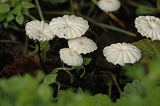
Marasmius

Encyclopedia
Marasmius is a genus
of mushroom
s, in the family Marasmiaceae
. It contains about 500 species
of agarics
, of which a few, such as Marasmius oreades
, are edible
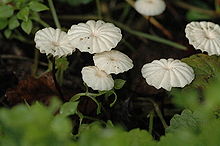
. However, most members of this genus are small, unimpressive brown mushrooms. Their humble appearance contributes to their not being readily distinguishable to non-specialists, and they are therefore seldom collected by mushroom hunters. Several of the species are known to grow in the characteristic fairy ring
pattern.
 The author of the genus was Elias Magnus Fries
, who in 1838 classified white-spored agarics having a tough central stipe
in this taxon if they were marcescent
, i.e. they could dry out, but later revive when moistened. For Fries, marcescence (by contrast with the "putrescent" (decomposing) nature of most mushrooms) was an important character for classification, which he used to separate this group from genus Collybia
(which has now been split into many newer genera). The name Marasmius itself comes from a Greek word marasmos, meaning "drying out". Modern mycologists no longer consider the marcescence/putrescence distinction a reliable criterion for taxonomy
, but Fries's definition of the genus is still roughly applicable.
Genus
In biology, a genus is a low-level taxonomic rank used in the biological classification of living and fossil organisms, which is an example of definition by genus and differentia...
of mushroom
Mushroom
A mushroom is the fleshy, spore-bearing fruiting body of a fungus, typically produced above ground on soil or on its food source. The standard for the name "mushroom" is the cultivated white button mushroom, Agaricus bisporus; hence the word "mushroom" is most often applied to those fungi that...
s, in the family Marasmiaceae
Marasmiaceae
The Marasmiaceae are a family of basidiomycete fungi which have white spores. They mostly have a tough stem and the capability of shrivelling up during a dry period and later recovering. The widely consumed edible fungus Lentinula edodes, the Shiitake mushroom, is a member of this family...
. It contains about 500 species
Species
In biology, a species is one of the basic units of biological classification and a taxonomic rank. A species is often defined as a group of organisms capable of interbreeding and producing fertile offspring. While in many cases this definition is adequate, more precise or differing measures are...
of agarics
Agaricales
The fungal order Agaricales, also known as gilled mushrooms , or euagarics, contains some of the most familiar types of mushrooms. The order has 33 extant families, 413 genera, and over 13000 described species, along with five extinct genera known only from the fossil record...
, of which a few, such as Marasmius oreades
Marasmius oreades
Marasmius oreades is also known as the scotch bonnet or fairy ring mushroom. The latter name tends to cause some confusion, as many other mushrooms grown in fairy rings .-Distribution and habitat:Marasmius oreades grows extensively throughout North America...
, are edible
Edible mushroom
Edible mushrooms are the fleshy and edible fruiting bodies of several species of fungi. Mushrooms belong to the macrofungi, because their fruiting structures are large enough to be seen with the naked eye. They can appear either below ground or above ground where they may be picked by hand...
. However, most members of this genus are small, unimpressive brown mushrooms. Their humble appearance contributes to their not being readily distinguishable to non-specialists, and they are therefore seldom collected by mushroom hunters. Several of the species are known to grow in the characteristic fairy ring
Fairy ring
A fairy ring, also known as fairy circle, elf circle, elf ring or pixie ring, is a naturally occurring ring or arc of mushrooms. The rings may grow to over in diameter, and they become stable over time as the fungus grows and seeks food underground. They are found mainly in forested areas, but...
pattern.
Elias Magnus Fries
-External links:*, Authors of fungal names, Mushroom, the Journal of Wild Mushrooming.*...
, who in 1838 classified white-spored agarics having a tough central stipe
Stipe (mycology)
thumb|150px|right|Diagram of a [[basidiomycete]] stipe with an [[annulus |annulus]] and [[volva |volva]]In mycology a stipe refers to the stem or stalk-like feature supporting the cap of a mushroom. Like all tissues of the mushroom other than the hymenium, the stipe is composed of sterile hyphal...
in this taxon if they were marcescent
Marcescence
Marcescence is the retention of dead plant organs that normally are shed. It is most obvious in deciduous trees that retain leaves through the winter. Several trees normally have marcescent leaves such as oak , beech and hornbeam . Marcescent leaves of pin oak complete development of their...
, i.e. they could dry out, but later revive when moistened. For Fries, marcescence (by contrast with the "putrescent" (decomposing) nature of most mushrooms) was an important character for classification, which he used to separate this group from genus Collybia
Collybia
Collybia is a genus of mushrooms in the Tricholomataceae family. The genus has a widespread but rare distribution in north temperate areas, and contains three species that grow on the decomposing remains of other mushrooms....
(which has now been split into many newer genera). The name Marasmius itself comes from a Greek word marasmos, meaning "drying out". Modern mycologists no longer consider the marcescence/putrescence distinction a reliable criterion for taxonomy
Taxonomy
Taxonomy is the science of identifying and naming species, and arranging them into a classification. The field of taxonomy, sometimes referred to as "biological taxonomy", revolves around the description and use of taxonomic units, known as taxa...
, but Fries's definition of the genus is still roughly applicable.
Species
Selected species:- M. alliaceusMarasmius alliaceusMarasmius alliaceus, commonly known as the Garlic Parachute, is one of the larger mushrooms of the Marasmius genus, having a beige cap of up to 4 cm and a long tough slender stipe. It emanates a strong smell of garlic, and this is the significance of the Latin species name, alliaceus...
- garlic parachute - M. androsaceus - horsehair parachute
- M. anomalus
- M. atrocastaneus
- M. auklandicus
- M. aurantiobasalis
- M. bambusinus
- M. bellus
- M. bulliardii
- M. buxi - box parachute
- M. caperatus
- M. caricis
- M. chordalis
- M. cohaerens
- M. collinus
- M. corbariensis
- M. crinis-equiMarasmius crinis-equiMarasmius crinis-equi is a plant pathogen.- External links :* *...
- M. croceus
- M. curranii
- M. curreyi
- M. cylindraceocampanulatus
- M. delicatus
- M. delectans
- M. elegansMarasmius elegansMarasmius elegans, commonly known as the velvet parachute, is a species of fungus in the Marasmiaceae family of mushrooms. It has a reddish-brown cap, and a whitish stem with white hairs at the base. It can be found in eucalypt forests in Australia....
- velvet parachute - M. epiphylloides
- M. epiphyllus - leaf parachute
- M. exocarpi
- M. exustoides
- M. favrei
- M. fishii
- M. funalisMarasmius funalisMarasmius funalis is a species of Marasmiaceae fungus known only from Japan. The species produces small mushrooms with reddish-brown caps up to in diameter and dark-brown, threadlike stems of up to in length. The species has a number of distinctive microscopic features, including very long...
- M. galbinus
- M. gelatinosipes
- M. graminum
- M. haematocephalus
- M. hudsonii - holly parachute
- M. nigripes
- M. insititius
- M. kanukaneus
- M. kroumirensis
- M. limosus
- M. masonii
- M. meridionalis
- M. micraster
- M. minutus
- M. oreadesMarasmius oreadesMarasmius oreades is also known as the scotch bonnet or fairy ring mushroom. The latter name tends to cause some confusion, as many other mushrooms grown in fairy rings .-Distribution and habitat:Marasmius oreades grows extensively throughout North America...
- fairy ring mushroom - M. otagensis
- M. pallenticeps
- M. palmivorus
- M. perpusillus
- M. phalaricola
- M. podocarpicola
- M. prasiosmus
- M. pulcherripes
- M. pyrrhocephalus
- M. pusillissimus
- M. pusio
- M. quercophilus
- M. resinosus
- M. rhombisporus
- M. rhopalostylidis
- M. rimuphilus
- M. rosulatus
- M. rotulaMarasmius rotulaMarasmius rotula is a species of fungus in the Marasmiaceae family of mushrooms. It is commonly known variously as the pinwheel mushroom, the pinwheel Marasmius, the little wheel, the collared parachute, or the horse hair fungus. It is a widespread and common fungus, and is the type species of the...
- collared parachute or pinwheel mushroom - M. sacchariMarasmius sacchariMarasmius sacchari is a fungal plant pathogen which has been identified as causing root rot of Sugar Cane.- External links :* *...
- M. saccharinus
- M. sasicolaMarasmius sasicolaMarasmius sasicola is a species of Marasmiaceae fungus known from Kanagawa Prefecture, Japan. First collected in 2000, it was described in 2002 by Haruki Takahashi. The species produces small mushrooms with white caps and very short, very thin black stems. Unlike in other, similar species, the...
- M. semiustusMarasmius semiustusMarasmius semiustus is a plant pathogen responsible for banana plant disease commonly found in the West Indies. The only known remedy is the removal and burning of diseased plants.This fungus is also found in Malaysia, Hawaii, Taiwan, and Costa Rica....
- M. setosus
- M. siccus
- M. spaniophyllus
- M. splachnoides
- M. subsupinus
- M. stenophyllusMarasmius stenophyllusMarasmius stenophyllus is a plant pathogen.- External links :* *...
- M. strictipes
- M. sullivantiiMarasmius sullivantiiMarasmius sullivantii is a species of fungus in the Marasmiaceae family. The species was originally described by the French botanist Jean Pierre François Camille Montagne in 1856....
- M. tenuiparietalis
- M. tenuissimusMarasmius tenuissimusMarasmius tenuissimus is a plant pathogen.- External links :* *...
- M. tinctorius
- M. torquescens
- M. unilamellatus
- M. wettsteinii
- M. wynneae - pearly parachute
External links
- Genus Marasmius at Mushroom Expert.com