


Marae

Encyclopedia
Tongan language
Tongan is an Austronesian language spoken in Tonga. It has around 200,000 speakers and is a national language of Tonga. It is a VSO language.-Related languages:...
), malae (in Samoan
Samoan language
Samoan Samoan Samoan (Gagana Sāmoa, is the language of the Samoan Islands, comprising the independent country of Samoa and the United States territory of American Samoa. It is an official language—alongside English—in both jurisdictions. Samoan, a Polynesian language, is the first language for most...
and Hawaiian
Hawaiian language
The Hawaiian language is a Polynesian language that takes its name from Hawaii, the largest island in the tropical North Pacific archipelago where it developed. Hawaiian, along with English, is an official language of the state of Hawaii...
), is a communal or sacred place which serves religious and social purposes in Polynesian
Polynesian culture
Polynesian culture refers to the indigenous peoples' culture of Polynesia who share common traits in language, customs and society. Chronologically, the development of Polynesian culture can be divided into four different historical eras:...
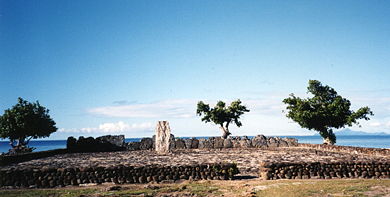
societies. In all these languages, the word also means "cleared, free of weeds, trees, etc." It generally consists of an area of cleared land roughly rectangular (the marae itself), bordered with stones or wooden posts (called au in Tahitian and Cook Islands Māori) perhaps with terraces (paepae) which were traditionally used for ceremonial purposes; and in some cases, a central stone ahu or a'u. In the Rapanui
Rapanui
The Rapa Nui or Rapanui are the native Polynesian inhabitants of Easter Island, or Rapa Nui, in the Pacific Ocean. The easternmost Polynesian culture, the Rapa Nui people make up 60% of Easter Island's population, with some living also in mainland Chile...
culture of Easter Island
Easter Island
Easter Island is a Polynesian island in the southeastern Pacific Ocean, at the southeasternmost point of the Polynesian triangle. A special territory of Chile that was annexed in 1888, Easter Island is famous for its 887 extant monumental statues, called moai, created by the early Rapanui people...
"ahu" has become a synonym for the whole marae complex).
In some modern Polynesian societies, notably that of the Māori of New Zealand, the marae is still a vital part of everyday life. However, in tropical Polynesia, most marae were destroyed or abandoned with the arrival of Christianity in the 19th Century and some of them have become an attraction for tourists or archaeologists. Nevertheless, the place where the marae were built are still considered as tapu in most islands. In the Cook Islands, a few marae (Arai-te-Tonga, Vaerota, Taputapuātea) are still maintained, and are quickly tidied up before the investiture of a new ariki
Ariki
An Ariki , ‘Ariki , Aliki , Ali‘i , Ari'i or ‘Eiki is or was a member of a hereditary chiefly or noble rank in Polynesia.-Aotearoa Ariki:Political leadership or governance in Māori society has traditionally come from two...
.
Etymology
The word has been reconstructed by linguists to Eastern Oceanic *malaqe with the meaning "open,cleared space used as meeting-place or ceremonial place".Marae in New Zealand
Tangihanga
Tangihanga, or more commonly, Tangi, is a Māori funeral rite.Each iwi differs on how they honour those who pass. Tangihanga generally take three days with burial on the third day. From the moment of death, the tūpāpaku is rarely alone. The tūpāpaku is transported to the marae...
), can be performed. Like the related institutions of old Polynesia, the marae is a wāhi tapu, a 'sacred place' which carries great cultural meaning.
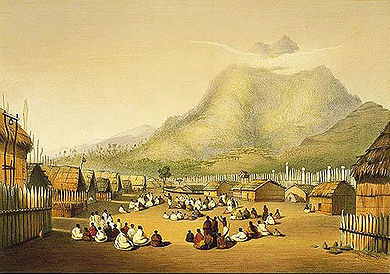
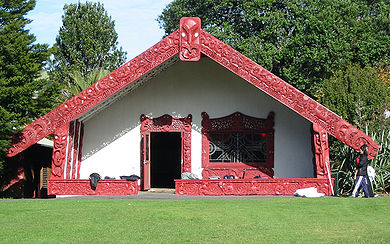
In Māori usage, the marae atea (often shortened to marae) is the open space in front of the wharenui
Wharenui
A wharenui is a communal house of the Māori people of New Zealand, generally situated as the focal point of a marae. Wharenui are usually called 'meeting houses' in New Zealand English.-Wharenui:...
or meeting house (literally "large building"). However, the term marae is generally used to refer to the whole complex, including the buildings and the open space. This area is used for pōwhiri
Powhiri
A Pōwhiri is a Māori welcoming ceremony involving speeches, dancing, singing and finally the hongi...
- welcome ceremonies featuring oratory. Some marae do not allow women to perform oratory there. The meeting house is the locale for important meetings, sleepovers, and craft and other cultural activities. The wharekai (dining hall) is used primarily for communal meals, but other activities may be carried out there. Many of the words associated with marae in tropical Polynesia are retained in the Māori context. For example, the word paepae refers to the bench where the speakers sit; this means it retains its sacred and ceremonial associations. A marae hosts special occasions such as weddings and funerals held in it. Marae can also differ in size, with some wharenui being a bit bigger than a double garage and some being larger than a town hall.
Legal status
A marae is a meeting place registered as a reserve under the Te Ture Whenua Māori Act 1993 ('The Māori Land Act'). Each marae has a group of trustees who are responsible for the operations of the marae. The Act governs the regulation of marae as reservations and sets out the responsibilities of the trustees in relation to the beneficiaries. Generally each marae has a charter which the trustees have negotiated with the beneficiaries of the marae. The charter details matters such as:- the name of the marae, and a description of it;
- a list of the beneficiaries: usually iwiIwiIn New Zealand society, iwi form the largest everyday social units in Māori culture. The word iwi means "'peoples' or 'nations'. In "the work of European writers which treat iwi and hapū as parts of a hierarchical structure", it has been used to mean "tribe" , or confederation of tribes,...
(tribes/nations), hapūHapuA hapū is sometimes described as "the basic political unit within Maori society".A named division of a Māori iwi , membership is determined by genealogical descent; a hapū is made up of a number of whānau groups. Generally hapū range in size from 150-200 although there is no upper limit...
(clans) or whānauWhanauWhānau , is a Māori-language word for extended family, now increasingly entering New Zealand English, particularly in official publications.In Māori society, the whānau is also a political unit, below the level of hapū and iwi, and the word itself also has other meanings: as a verb meaning to give...
(families); in some cases, the marae is dedicated to the common good of the people of New Zealand. - the methods used to select trustees;
- general governing principles of the marae;
- the ways in which the trustees may be held accountable by the beneficiaries, and methods for conflict resolution;
- principles governing appointment and recognition of committees to administer the marae;
- procedures for amending the charter, and for ensuring adherence to its principles.
The New Zealand Māori Arts and Crafts Institute
New Zealand Māori Arts and Crafts Institute
The New Zealand Māori Arts and Crafts Institute opened in 1967 in Rotorua, New Zealand due to the impending threat of the loss of traditional Māori arts. In 1926 a Māori Arts and Crafts school had been established in Rotorua by Sir Apirana Ngata, and the new school continued the tradition in a...
Act, 1963 was passed and the institute built to maintain the tradition of Whakairo. The NZMACI is responsible for the restoration and building of over 40 marae around New Zealand
New Zealand
New Zealand is an island country in the south-western Pacific Ocean comprising two main landmasses and numerous smaller islands. The country is situated some east of Australia across the Tasman Sea, and roughly south of the Pacific island nations of New Caledonia, Fiji, and Tonga...
.
Tangihanga
Like in pre-European times, marae continue to be the location of many ceremonial events, including birthdays, weddings, and anniversaries. The most important event located at marae is the tangihangaTangihanga
Tangihanga, or more commonly, Tangi, is a Māori funeral rite.Each iwi differs on how they honour those who pass. Tangihanga generally take three days with burial on the third day. From the moment of death, the tūpāpaku is rarely alone. The tūpāpaku is transported to the marae...
. Tangihanga are the means by which the dead are farewelled and the surviving family members supported in Māori society. As indicated by Ka'ai and Higgins, "the importance of the tangihanga and its central place in marae custom is reflected in the fact that it takes precedence over any other gathering on the marae" (p. 90).
Traditional, church, and educational uses
Plimmerton
The township of Plimmerton is adjacent to one of the more congenial beaches in the northwest part of the Wellington urban area of Porirua in New Zealand...
, the home of renowned writer Patricia Grace
Patricia Grace
Patricia Frances Grace, DCNZM, QSO, is a notable Māori writer of novels, short stories, and children's books....
. Since the second half of the 20th century, Māori in urban areas have been establishing intertribal marae such as Maraeroa in eastern Porirua
Porirua
Porirua is a city in the Wellington Region of New Zealand, immediately north of the city of Wellington, with their central business districts 20 km apart. A large proportion of the population commutes to Wellington, so it may be considered a satellite city. It almost completely surrounds...
. For many Māori, the marae is just as important to them as their own homes.
Some New Zealand churches also operate marae of their own, in which all of the functions of a traditional marae are carried out. Churches operating marae include the Anglican, Presbyterian, and Catholic churches. In recent years, it has become common for educational institutions, including primary and secondary schools, technical colleges, and universities, to build marae for the use of the students and for the teaching of Māori culture. These marae may also serve as a venue for the performance of official ceremonies relating to the school. The marae of the University of Auckland
University of Auckland
The University of Auckland is a university located in Auckland, New Zealand. It is the largest university in the country and the highest ranked in the 2011 QS World University Rankings, having been ranked worldwide...
, for instance, is used for graduation ceremonies of the Māori Department, as well as welcoming ceremonies for new staff of the University as a whole. Its primary function is to serve as a venue for the teaching of whaikōrero (oratory), Māori language and culture, and important ceremonies for distinguished guests of the University. Two spectacular secondary school marae are located in the Waikato at Te Awamutu College and Fairfield College. The latter was designed by a Māori architect with a detailed knowledge of carving and weaving. The wharenui features an intricately carved revolving pou as well as many other striking features. In addition to school activies it is used for weddings.
Rapa Nui/Easter Island
In the remote southeastern corner of the Polynesian TrianglePolynesian Triangle
The Polynesian Triangle is a region of the Pacific Ocean with three island groups at its corners: Hawaii, Easter Island and New Zealand. It is often used as a simple way to define Polynesia....
elements of the traditional Polynesian
Polynesian culture
Polynesian culture refers to the indigenous peoples' culture of Polynesia who share common traits in language, customs and society. Chronologically, the development of Polynesian culture can be divided into four different historical eras:...
marae evolved into the Rapa Nui/Easter Island Ahu and their iconic Moai
Moai
Moai , or mo‘ai, are monolithic human figures carved from rock on the Chilean Polynesian island of Easter Island between the years 1250 and 1500. Nearly half are still at Rano Raraku, the main moai quarry, but hundreds were transported from there and set on stone platforms called ahu around the...
(giant forms of Polynesian statues).
Tahiti
In TahitiTahiti
Tahiti is the largest island in the Windward group of French Polynesia, located in the archipelago of the Society Islands in the southern Pacific Ocean. It is the economic, cultural and political centre of French Polynesia. The island was formed from volcanic activity and is high and mountainous...
, marae were dedicated to specific deities, and also connected with specific lineages said to have built them. During the 1994 restoration of Taputapuātea marae
Taputapuatea marae
Marae Taputapuatea is a large marae complex at Opoa in Taputapuatea, on the south eastern coast of Raiatea. The site features a number of marae and other stone structures and was once considered the central temple and religious center of Eastern Polynesia....
at Ra'iātea
Raiatea
Raiatea , is the second largest of the Society Islands, after Tahiti, in French Polynesia. The island is widely regarded as the 'center' of the eastern islands in ancient Polynesia and it is likely that the organised migrations to Hawaii, Aotearoa and other parts of East Polynesia started at...
island by archaeologists from the Tahiti Museum, human bones were discovered under some of the structures. It is possible they were the remains of sacrifices to the Polynesian god Oro
'Oro
Oro is a god of the Polynesian pantheon. The veneration of Oro, although practiced in varying intensity among the islands, was a major cult of the Society Islands in the 17th and 18th centuries, especially Tahiti and Raiatea. On Tahiti 'Oro was the main deity and the god of war. The secret society...
, revered in Tahiti.
External links
- New Zealand in History: the marae - meeting place
- Gérard, Bertrand, Le marae: description morphologique in Cahiers des Sciences Humaines, 1978, Vol. 15, No 4, p. 407-448. Architecture and morphology of Society Islands Marae
- John Joseph Knight Hutchin, E Tuatua no te apai atinga ki mua i te marae, i te tuatau etene anga ("Tale of the offerings at the marae in heathen time") in "Collected songs and legends from the southern Cook Islands (c. 1883-1912)", notebook 2