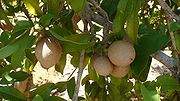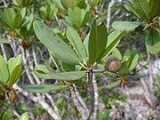
Manilkara

Encyclopedia
- "Sapota" redirects here. This can also specifically refer to the SapodillaSapodillaManilkara zapota, commonly known as the sapodilla, is a long-lived, evergreen tree native to southern Mexico, Central America and the Caribbean. An example natural occurrence is in coastal Yucatan in the Petenes mangroves ecoregion, where it is a subdominant plant species...
(M. zapodilla).
Manilkara is a genus
Genus
In biology, a genus is a low-level taxonomic rank used in the biological classification of living and fossil organisms, which is an example of definition by genus and differentia...
of tree
Tree
A tree is a perennial woody plant. It is most often defined as a woody plant that has many secondary branches supported clear of the ground on a single main stem or trunk with clear apical dominance. A minimum height specification at maturity is cited by some authors, varying from 3 m to...
s in the family
Family (biology)
In biological classification, family is* a taxonomic rank. Other well-known ranks are life, domain, kingdom, phylum, class, order, genus, and species, with family fitting between order and genus. As for the other well-known ranks, there is the option of an immediately lower rank, indicated by the...
Sapotaceae
Sapotaceae
Sapotaceae is a family of flowering plants, belonging to order Ericales. The family includes approximately 800 species of evergreen trees and shrubs in approximately 65 genera . Distribution is pantropical....
. Collectively known as manilkara trees, they occur throughout the tropics
Tropics
The tropics is a region of the Earth surrounding the Equator. It is limited in latitude by the Tropic of Cancer in the northern hemisphere at approximately N and the Tropic of Capricorn in the southern hemisphere at S; these latitudes correspond to the axial tilt of the Earth...
. A close relative is the genus Pouteria
Pouteria
Pouteria is a genus of flowering trees in the gutta-percha family, Sapotaceae. The genus is widespread throughout the tropical regions of the world. It includes the Canistel , the Mamey Sapote and the Lúcuma...
.
Trees of this genus yield edible fruit
Fruit
In broad terms, a fruit is a structure of a plant that contains its seeds.The term has different meanings dependent on context. In non-technical usage, such as food preparation, fruit normally means the fleshy seed-associated structures of certain plants that are sweet and edible in the raw state,...
, useful wood
Wood
Wood is a hard, fibrous tissue found in many trees. It has been used for hundreds of thousands of years for both fuel and as a construction material. It is an organic material, a natural composite of cellulose fibers embedded in a matrix of lignin which resists compression...
and latex
Latex
Latex is the stable dispersion of polymer microparticles in an aqueous medium. Latexes may be natural or synthetic.Latex as found in nature is a milky fluid found in 10% of all flowering plants . It is a complex emulsion consisting of proteins, alkaloids, starches, sugars, oils, tannins, resins,...
. The best-known species
Species
In biology, a species is one of the basic units of biological classification and a taxonomic rank. A species is often defined as a group of organisms capable of interbreeding and producing fertile offspring. While in many cases this definition is adequate, more precise or differing measures are...
are M. bidentata (Balatá), M. chicle (Chicle) and M. zapota (Sapodilla). M. hexandra
Manilkara hexandra
Manilkara hexandra is a species in the tribe Sapoteae, in the Sapotaceae family that is native to much of south Asia Manilkara hexandra is a species in the tribe Sapoteae, in the Sapotaceae family that is native to much of south Asia Manilkara hexandra is a species in the tribe Sapoteae, in the...
is the floral emblem
Floral emblem
In a number of countries, plants have been chosen as symbols to represent specific geographic areas. Some countries have a country-wide floral emblem; others in addition have symbols representing subdivisions. Different processes have been used to adopt these symbols - some are conferred by...
of Prachuap Khiri Khan Province
Prachuap Khiri Khan Province
Prachuap Khiri Khan is one of the central provinces of Thailand. Neighboring provinces are Phetchaburi in the north and Chumphon in the south. To the west it borders Tanintharyi Division of Myanmar....
in Thailand
Thailand
Thailand , officially the Kingdom of Thailand , formerly known as Siam , is a country located at the centre of the Indochina peninsula and Southeast Asia. It is bordered to the north by Burma and Laos, to the east by Laos and Cambodia, to the south by the Gulf of Thailand and Malaysia, and to the...
, where it is known as rayan. M. obovata shares the vernacular name of African pear with another completely different species, Dacryodes edulis
Dacryodes edulis
Dacryodes edulis or safou is a fruit tree native to Africa, sometimes called African pear, Nsafu, bush butter tree, or native pear.- Description :...
, and neither should be confused with Baillonella toxisperma
Baillonella toxisperma
Baillonella toxisperma is a species of plant in the Sapotaceae family. It is found in Angola, Cameroon, the Republic of the Congo, the Democratic Republic of the Congo, Gabon, and Nigeria. Its natural habitat is subtropical or tropical moist lowland forests. It is threatened by habitat loss...
, known by the very similar name, African pearwood.
The generic name, Manilkara, is derived from manil-kara, a vernacular name for M. kauki in Malayalam.
Manilkara trees are often significant, or even dominant species in their native ecosystem
Ecosystem
An ecosystem is a biological environment consisting of all the organisms living in a particular area, as well as all the nonliving , physical components of the environment with which the organisms interact, such as air, soil, water and sunlight....
s, such as East Deccan dry evergreen forests
East Deccan dry evergreen forests
The East Deccan dry evergreen forests are an ecoregion of southeastern India. The ecoregion includes the coastal region behind the Coromandel Coast on the Bay of Bengal, between the Eastern Ghats and the sea...
, Central America
Central America
Central America is the central geographic region of the Americas. It is the southernmost, isthmian portion of the North American continent, which connects with South America on the southeast. When considered part of the unified continental model, it is considered a subcontinent...
n premontane
Foothills
Foothills are geographically defined as gradual increases in elevation at the base of a mountain range. They are a transition zone between plains and low relief hills to the adjacent topographically high mountains.-Examples:...
tropical wet forests, or together with Cynometra
Cynometra
Cynometra is genus of tropical forest trees with a pantropical distribution. It is particularly important as a forest component in west Africa and the neotropics. Cynometra alexandri is a familiar timber tree of central and east Africa...
, in the Arabuko Sokoke National Park
Arabuko Sokoke National Park
The Arabuko-Sokoke Forest is located on the coast of Kenya, 110 km north of Mombassa and is protected as a national Forest Reserve. The Arabuko-Sokoke National Park is only a small portion of the Arabuko-Sokoke Forest Reserve, a few square kilometres in size and is located on the north-western...
.
Manilkara fruit are an important food item for various frugivore
Frugivore
A frugivore is a fruit eater. It can be any type of herbivore or omnivore where fruit is a preferred food type. Because approximately 20% of all mammalian herbivores also eat fruit, frugivory is considered to be common among mammals. Since frugivores eat a lot of fruit they are highly dependent...
s, in particular bird
Bird
Birds are feathered, winged, bipedal, endothermic , egg-laying, vertebrate animals. Around 10,000 living species and 188 families makes them the most speciose class of tetrapod vertebrates. They inhabit ecosystems across the globe, from the Arctic to the Antarctic. Extant birds range in size from...
s.
The Red Fruit Bat
Red Fruit Bat
The Red Fruit Bat or Red Fig-eating Bat is a species of bat in the family Phyllostomidae, in the monotypic genus Stenoderma. It is found in Puerto Rico and the U.S. Virgin Islands...
(Stenoderma rufum) is the primary – and possibly the only – seed disperser of M. bidentata in parts of the Caribbean
Caribbean
The Caribbean is a crescent-shaped group of islands more than 2,000 miles long separating the Gulf of Mexico and the Caribbean Sea, to the west and south, from the Atlantic Ocean, to the east and north...
.
Tuckerella xiamenensis, a species of peacock mite
Peacock mite
The peacock mites are a significant pest in the tropics, for example on citrus fruit. It is the only genus of the mite family Tuckerellidae. Peacock mites are so named because of the elaborate ornamentations adorning the dorsal surface of their bodies ...
, was described from a Sapodilla tree.
Several species are endangered due to overexploitation
Overexploitation
Overexploitation, also called overharvesting, refers to harvesting a renewable resource to the point of diminishing returns. Sustained overexploitation can lead to the destruction of the resource...
and habitat destruction
Habitat destruction
Habitat destruction is the process in which natural habitat is rendered functionally unable to support the species present. In this process, the organisms that previously used the site are displaced or destroyed, reducing biodiversity. Habitat destruction by human activity mainly for the purpose of...
. M. gonavensis
Manilkara gonavensis
Manilkara gonavensis is a tree species in the Sapodilla family, found nowhere else but Haiti. It has only ever been collected one time for study, when the type specimen was taken. This was in the early 20th century, before 1929, which is the year it was described...
of Haiti
Haiti
Haiti , officially the Republic of Haiti , is a Caribbean country. It occupies the western, smaller portion of the island of Hispaniola, in the Greater Antillean archipelago, which it shares with the Dominican Republic. Ayiti was the indigenous Taíno or Amerindian name for the island...
and M. spectabilis
Manilkara spectabilis
Manilkara spectabilis, or Bully Tree , is a little-understood, critically endangered species of tree in the Sapodilla family. It has only ever been collected for botanical study once, from a single site near Limón in the Atlantic coastal forests of Costa Rica...
of Costa Rica
Costa Rica
Costa Rica , officially the Republic of Costa Rica is a multilingual, multiethnic and multicultural country in Central America, bordered by Nicaragua to the north, Panama to the southeast, the Pacific Ocean to the west and the Caribbean Sea to the east....
are almost extinct.
Selected species
Manilkara adolfo-friederici (Engl. & K.Krause) H.J.Lam Manilkara altissima (Engl.) H.J.Lam Manilkara amazonica (Huber) Standl. Manilkara angolensis Lecomte ex Pellegr. Manilkara argentea Pierre ex Dubard Manilkara aubrevillei Sillans Manilkara balata (Aubl.) Dubard Manilkara bella Manilkara bella Manilkara bella is a species of plant in the Sapotaceae family. It is endemic to Brazil, where it is threatened by habitat loss.... Monach. Manilkara bequaertii (De Wild.) H.J.Lam Manilkara bidentata (A.DC.) A.Chev. – Balatá, Ausubo, Bulletwood, Massaranduba, Cow-tree or Purple-heart Manilkara boivinii Aubrév. Manilkara bojeri (A.DC.) H.J.Lam Manilkara bolivarensis Manilkara bolivarensis Manilkara bolivarensis is a species of plant in the Sapotaceae family. It is endemic to Venezuela.... T.D.Penn. Manilkara breviloba Gilly Manilkara butugi Chiov. Manilkara calcicola (Pittier) Gilly Manilkara calderonii Gilly Manilkara calophylloides H.J.Lam Manilkara capuronii Aubrév. Manilkara casteelsii (De Wild.) H.J.Lam Manilkara cavalcantei Manilkara cavalcantei Manilkara cavalcantei is a species of plant in the Sapotaceae family. It is endemic to Brazil, where it is threatened by habitat loss.... Pires & Rodrigues ex T.D.Penn. Manilkara chicle (Pittier) Gilly – Chicle Manilkara concolor (Harv. ex C.H.Wr.) Gerstn. Manilkara celebica H.J.Lam Manilkara conzattii Gilly Manilkara cordifolia P.Royen Manilkara costata Dubard Manilkara cuneifolia Dubard Manilkara dardanoi Manilkara dardanoi Manilkara dardanoi is a tree species in the Sapodilla family. It is endemic to Brazil, and only found in a small portion of Pernambuco. Here it grows in forests mostly along the coast, or elswhere deeper inland where there is old secondary forest. Unfortunately, its natural habitat is gradually... Ducke Manilkara darienensis (Pittier) Standl. Manilkara dawei (Stapf) Chiov. Manilkara decrescens Manilkara decrescens Manilkara decrescens is a species of plant in the Sapotaceae family. It is endemic to Brazil, and is threatened by habitat loss.... T.D.Penn Manilkara discolor (Sond.) J.H.Hemsl. Manilkara dissecta Dubard Manilkara doeringii (Engl. & K.Krause) H.J.Lam Manilkara duckei Monach. Manilkara dukensis (Engl. & K.Krause) H.J.Lam Manilkara duplicata (Sessé & Moc.) Dubard Manilkara eickii (Engl.) H.J.Lam Manilkara elata Manilkara elata Manilkara elata is a species of plant in the Sapotaceae family. Endemic to Brazil, it is endangered by habitat loss.... (Allemão ex Miq.) Monach. Manilkara excelsa Manilkara excelsa Manilkara excelsa is a species of plant in the Sapotaceae family. It is endemic to Brazil, and threatened by habitat loss.... (Ducke) Standl. Manilkara excisa Manilkara excisa Manilkara excisa is an endangered species of tall tree in the Sapodilla family. It is endemic to the extremely steep, forested limestone hills of Trelawny, Cockpit Country and St. James parishes in Jamaica, where, although it is highly prized for its wood, it is threatened by habitat loss.... (Urb.) H.J.Lam Manilkara fasciculata (Warb.) H.J.Lam & Maas Geester. Manilkara fischeri (Engl.) H.J.Lam Manilkara floribunda (Mart.) Dubard Manilkara fouilloyana Aubrév. & Pellegr. Manilkara frondosa (Hiern) H.J.Lam Manilkara gaumeri Gilly Manilkara gonavensis Manilkara gonavensis Manilkara gonavensis is a tree species in the Sapodilla family, found nowhere else but Haiti. It has only ever been collected one time for study, when the type specimen was taken. This was in the early 20th century, before 1929, which is the year it was described... (Urb. & Ekman) Gilly ex Cronquist Manilkara grisebachii (Pierre) Dubard Manilkara guillotii (Hochr.) H.J.Lam Manilkara hexandra Manilkara hexandra Manilkara hexandra is a species in the tribe Sapoteae, in the Sapotaceae family that is native to much of south Asia Manilkara hexandra is a species in the tribe Sapoteae, in the Sapotaceae family that is native to much of south Asia Manilkara hexandra is a species in the tribe Sapoteae, in the... (Roxb.) Dubard – Palai, Palu or Rayan Manilkara hoshinoi (Kaneh.) P.Royen Manilkara howardii Gilly Manilkara huberi (Ducke) A.Chev. Manilkara ilendensis (Engl.) H.J.Lam Manilkara inundata (Ducke) Ducke ex Monach. Manilkara jaimiqui (C.Wright) Dubard – Wild Dilly Manilkara kanosiensis Manilkara kanosiensis Manilkara kanosiensis is a species of tree in the Sapodilla family. It is thinly dispersed in low-lying rainforests over a large range, from the Muluku Islands of Indonesia to the Bismarck Archipelago of Papua New Guinea... H.J.Lam & B.Meeuse – Torem or Sawai Manilkara kauki (L.) Dubard – Caqui or Wongi Manilkara koechlinii Aubrév. & Pellegr. Manilkara kribensis (Engl.) H.J.Lam Manilkara kurziana H.J.Lam & B.Meeuse Manilkara lacera Dubard Manilkara laciniata (Lecomte) P.Royen Manilkara letestui Aubrév. & Pellegr. Manilkara letouzei Aubrév. Manilkara littoralis Dubard |
Manilkara longiciliata Ducke Manilkara longifolia Manilkara longifolia Manilkara longifolia, commonly known as Masseranduba, is a species of plant in the Sapotaceae family. It is endemic to Brazil, where it is threatened by habitat loss.- External links : from the Economic Botany Collection of Richard Spruce... (A.DC.) Dubard Manilkara longistyla (De Wild.) C.M.Evrard Manilkara lososiana Kenfack & Ewango Manilkara mabokeensis Aubrév. Manilkara macaulayae (Hutch. & Corbishly) H.J.Lam Manilkara maclaudii Pierre ex Lecomte Manilkara matanou Aubrév. & Pellegr. Manilkara maxima Manilkara maxima Manilkara maxima is a species of plant in the Sapotaceae family. It is endemic to Brazil, where it is threatened by habitat loss.... T.D.Penn Manilkara mayarensis Manilkara mayarensis Manilkara mayarensis is a plant species in the family of Sapodillas, which grows wild only in Cuba's Oriente Province. Here its members range in scale from shrubs to small trees... (Ekman ex Urb.) Cronquist Manilkara menyhartii (Engl.) H.J.Lam Manilkara meridionalis Gilly Manilkara microphylla Aubrév. & Pellegr. Manilkara mochisia (Bak.) Dubard Manilkara multifida Manilkara multifida Manilkara multifida is a species of plant in the Sapotaceae family. It is endemic to Brazil, and threatened by habitat loss.... T.D.Penn Manilkara multinervis Dubard Manilkara napali P.Royen Manilkara natalensis Dubard Manilkara nato-lahyensis P.Royen Manilkara nicholsonii Manilkara nicholsonii Manilkara nicholsonii is a species of plant in the Sapotaceae family. It is endemic to South Africa , and is threatened by habitat loss.... A.E.van Wyk Manilkara nitida (Sessé & Moc.) Dubard Manilkara obovata (Sabine & G.Don) J.H.Hemsl. – African pear Manilkara pancheri Dubard Manilkara paraensis Manilkara paraensis Manilkara paraensis is a species of plant in the Sapotaceae family. It is endemic to Brazil, where it is threatened by habitat loss.... (Huber) Standl. Manilkara pleeana Manilkara pleeana Manilkara pleeana is a species of plant in the Sapotaceae family. It is endemic to Puerto Rico.... (Pierre ex Baill.) Cronquist Manilkara pellegriniana Tisserant & Sillans Manilkara perrieri Aubrév. Manilkara pobeguinii Pierre ex Dubard Manilkara propinqua (S.Moore) H.J.Lam Manilkara pubicarpa Manilkara pubicarpa Manilkara pubicarpa is a species of plant in the Sapotaceae family. It is endemic to Guyana.... Monach. Manilkara remotifolia Pierre ex Dubard Manilkara rojasii Gilly Manilkara roxburghiana (Wight) Dubard Manilkara rufula Manilkara rufula Manilkara rufula is a species of tree in the Sapodilla family. It is endemic to the northeastern submontane forests of Bahia, Sergipe, Pernambuco, Paraíba, Ceará and Piauí states of Brazil... (Miq.) H.J.Lam Manilkara sahafarensis Aubrév. Manilkara salzmannii (A.DC.) H.J.Lam Manilkara samoensis H.J.Lam & B.Meeuse Manilkara schweinfurthii Dubard Manilkara seretii (De Wild.) H.J.Lam Manilkara sideroxylon (Hook.) Dubard Manilkara siqueiraei Ducke Manilkara smithiana H.J.Lam & Maas Geester. Manilkara sohihy Aubrév. Manilkara spectabilis Manilkara spectabilis Manilkara spectabilis, or Bully Tree , is a little-understood, critically endangered species of tree in the Sapodilla family. It has only ever been collected for botanical study once, from a single site near Limón in the Atlantic coastal forests of Costa Rica... (Pittier) Standl. Manilkara spiculosa (Hutch. & Corbishly) H.J.Lam Manilkara staminodella Gilly Manilkara striata Gilly Manilkara suarezensis Aubrév. Manilkara subsericea Manilkara subsericea Manilkara subsericea is a species of plant in the Sapotaceae family. It is endemic to Brazil, and threatened by habitat loss.... (Mart.) Dubard Manilkara sulcata Dubard Manilkara surinamensis (Miq.) Dubard Manilkara sylvestris Aubrév. & Pellegr. Manilkara tabogaensis Gilly Manilkara tampoloensis Aubrév. Manilkara teysmanni Dubard Manilkara thouvenotii (Lecomte) P.Royen Manilkara triflora (Allemão) Monach. Manilkara udoido Kaneh. Manilkara umbraculigera (Hutch. & Corbishly) H.J.Lam Manilkara valenzuelana Manilkara valenzuelana Manilkara valenzuelana is a species of tree or tall shrub in the Sapodilla family. It is found in coastal and subcoastal semi-deciduous forests in Cuba , the Dominican Republic, Haiti, and possibly Puerto Rico. Its habitat has been declining rapidly under pressure from charcoal makers, logging, and... (A.Rich.) T.D.Penn. Manilkara vitiensis (H.J.Lam & v.Olden) B.Meeuse Manilkara welwitschii Dubard Manilkara williamsii Standl. Manilkara wrightiana (Pierre) Dubard Manilkara zanzibarensis Dubard Manilkara zapota (L.) P.Royen – Sapodilla, Sapota, Sapoti or Dilly (Bahamas), Naseberry (Caribbean), Chico, Chiku, Ciku, Snake fruit, Níspero, Nipero, Mespel Manilkara zenkeri Lecomte ex Aubrév. & Pellegr. |
- List sources :