

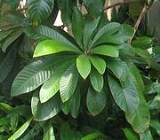
Sapotaceae

Overview
Family (biology)
In biological classification, family is* a taxonomic rank. Other well-known ranks are life, domain, kingdom, phylum, class, order, genus, and species, with family fitting between order and genus. As for the other well-known ranks, there is the option of an immediately lower rank, indicated by the...
of flowering plant
Flowering plant
The flowering plants , also known as Angiospermae or Magnoliophyta, are the most diverse group of land plants. Angiosperms are seed-producing plants like the gymnosperms and can be distinguished from the gymnosperms by a series of synapomorphies...
s, belonging to order
Order (biology)
In scientific classification used in biology, the order is# a taxonomic rank used in the classification of organisms. Other well-known ranks are life, domain, kingdom, phylum, class, family, genus, and species, with order fitting in between class and family...
Ericales
Ericales
The Ericales are a large and diverse order of dicotyledons, including for example tea, persimmon, blueberry, Brazil nut, and azalea. The order includes trees and bushes, lianas and herbaceous plants. Together with ordinary autophytic plants, the Ericales include chlorophyll-deficient...
. The family includes approximately 800 species
Species
In biology, a species is one of the basic units of biological classification and a taxonomic rank. A species is often defined as a group of organisms capable of interbreeding and producing fertile offspring. While in many cases this definition is adequate, more precise or differing measures are...
of evergreen
Evergreen
In botany, an evergreen plant is a plant that has leaves in all seasons. This contrasts with deciduous plants, which completely lose their foliage during the winter or dry season.There are many different kinds of evergreen plants, both trees and shrubs...
trees and shrubs in approximately 65 genera (35-75, depending on generic definition). Distribution is pantropical
Tropics
The tropics is a region of the Earth surrounding the Equator. It is limited in latitude by the Tropic of Cancer in the northern hemisphere at approximately N and the Tropic of Capricorn in the southern hemisphere at S; these latitudes correspond to the axial tilt of the Earth...
.
Many species produce edible fruits, and/or have other economic uses. Species noted for their edible fruits include Manilkara
Manilkara
Manilkara is a genus of trees in the family Sapotaceae. Collectively known as manilkara trees, they occur throughout the tropics. A close relative is the genus Pouteria....
(Sapodilla, Sapota), Chrysophyllum cainito
Chrysophyllum cainito
Chrysophyllum cainito is a tropical tree of the family Sapotaceae, native to the lowlands of Central America and the West Indies. It grows rapidly and reaches 20 m in height....
(Star-apple
Chrysophyllum cainito
Chrysophyllum cainito is a tropical tree of the family Sapotaceae, native to the lowlands of Central America and the West Indies. It grows rapidly and reaches 20 m in height....
or Golden Leaf Tree), Pouteria
Pouteria
Pouteria is a genus of flowering trees in the gutta-percha family, Sapotaceae. The genus is widespread throughout the tropical regions of the world. It includes the Canistel , the Mamey Sapote and the Lúcuma...
(Abiu
Abiu
Pouteria caimito, the abiu, is a tropical fruit tree originated in the Amazonian region of South America. It will grow an average of high, and can grow as high as under good conditions. Its fruit’s shape varies from round to oval with a point. When ripe, it has smooth bright yellow skin and will...
, Canistel
Canistel
The canistel is an evergreen tree native to southern Mexico and Central America. It is cultivated in other countries, such as Brazil, Taiwan, and Vietnam for its fruit....
, Lúcuma
Lúcuma
The lúcuma is a subtropical fruit native to the Peru's Andean region. Lucuma has been found on ceramics at burial sites of the indigenous people of coastal Peru...
, Mamey sapote
Mamey sapote
The mamey sapote is a species of tree native to southern Mexico. Today, the tree is cultivated not only in Mexico, but also in Central America, the Caribbean, and South Florida for its fruit, which is commonly eaten in many Latin American countries...
), Vitellaria paradoxa
Shea
Vitellaria paradoxa, also classified as Butyrospermum parkii and B. paradoxa, commonly known as shea tree, shi tree, or , vitellaria or karité, is a tree of the Sapotaceae family indigenous to Africa, occurring in Mali, Cameroon, Congo, Côte d'Ivoire, Ghana, Guinea, Togo, Nigeria, Senegal, Sudan,...
(Shea) and Sideroxylon australe (Australian native plum).
