

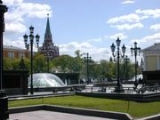
Manege Square

Encyclopedia
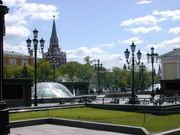
Public space
A public space is a social space such as a town square that is open and accessible to all, regardless of gender, race, ethnicity, age or socio-economic level. One of the earliest examples of public spaces are commons. For example, no fees or paid tickets are required for entry, nor are the entrants...
at the heart of Moscow
Moscow
Moscow is the capital, the most populous city, and the most populous federal subject of Russia. The city is a major political, economic, cultural, scientific, religious, financial, educational, and transportation centre of Russia and the continent...
bound by the Hotel Moskva
Hotel Moskva (Moscow)
The Hotel Moskva name has been used for two identical buildings on the same spot in Moscow, Russia located near Red Square in close proximity to the old City Hall. The first Hotel Moskva was originally constructed from 1932 until 1938, it opened as a hotel in December 1935...
to the east, the State Historical Museum
State Historical Museum
The State Historical Museum of Russia is a museum of Russian history wedged between Red Square and Manege Square in Moscow. Its exhibitions range from relics of the prehistoric tribes inhabiting present-day Russia, through priceless artworks acquired by members of the Romanov dynasty...
and the Alexander Garden
Alexander Garden
Alexander Gardens was one of the first urban public parks in Moscow, Russia. The park comprises three separate gardens, which stretch along all the length of the western Kremlin wall for between the building of the Moscow Manege and the Kremlin.-History:...
to the south, the Moscow Manege
Moscow Manege
Moscow Manege is a large oblong building which gives its name to the vast Manege Square, which was cleared in the 1930s, adjacent to the more famous Red Square...
to the west, and the 18th-century headquarters of the Moscow State University
Moscow State University
Lomonosov Moscow State University , previously known as Lomonosov University or MSU , is the largest university in Russia. Founded in 1755, it also claims to be one of the oldest university in Russia and to have the tallest educational building in the world. Its current rector is Viktor Sadovnichiy...
to the north.
The square forms a vital part of downtown Moscow, connecting Red Square
Red Square
Red Square is a city square in Moscow, Russia. The square separates the Kremlin, the former royal citadel and currently the official residence of the President of Russia, from a historic merchant quarter known as Kitai-gorod...
(which sprawls behind the Iberian Gate
Iberian Gate and Chapel
Resurrection Gate is the only existing gate of the Kitai-gorod in Moscow. It connects the north-western end of Red Square with Manege Square and gives its name to nearby Voskresenskaya Square . The gate adjoins the ornate building of the Moscow City Hall to the east and the State Historical Museum...
immediately to the south) with a major traffic artery, Tverskaya Street
Tverskaya Street
Tverskaya Street , known as Gorky Street between 1935 and 1990, is the main and probably best-known radial street of Moscow, Russia. The street runs from the central Manege Square north-west in the direction of Saint Petersburg and terminated at the Garden Ring, giving its name to Tverskoy District...
, which starts here and runs northward in the direction of Saint Petersburg
Saint Petersburg
Saint Petersburg is a city and a federal subject of Russia located on the Neva River at the head of the Gulf of Finland on the Baltic Sea...
. It is served by three metro
Moscow Metro
The Moscow Metro is a rapid transit system serving Moscow and the neighbouring town of Krasnogorsk. Opened in 1935 with one line and 13 stations, it was the first underground railway system in the Soviet Union. As of 2011, the Moscow Metro has 182 stations and its route length is . The system is...
stations: Okhotny Ryad, Ploshchad Revolyutsii
Ploshchad Revolyutsii
Ploshchad Revolyutsii is one of the most famous stations of the Moscow Metro. It is located on the Arbatsko-Pokrovskaya Line and opened in 1938. The architect was Alexey Dushkin. The station features red and yellow marble arches resting on low pylons faced with black Armenian marble...
, and Teatralnaya.
History
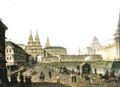
Neglinnaya River
The Neglinnaya River , also known as Neglimna, Neglinna, Neglinka , is a 7.5-km long underground river in the central part of Moscow and a tributary of the Moskva River. It flows in the tunnels under Samotechnaya Street, Tsvetnoy Boulevard, Neglinnaya Street and Alexander Garden and Zaryadye...
since the times of Ivan the Terrible
Ivan IV of Russia
Ivan IV Vasilyevich , known in English as Ivan the Terrible , was Grand Prince of Moscow from 1533 until his death. His long reign saw the conquest of the Khanates of Kazan, Astrakhan, and Siberia, transforming Russia into a multiethnic and multiconfessional state spanning almost one billion acres,...
. Although the muddy river was earthed up, the neighbourhood remained crammed with public houses and taverns which gave the area its infamous moniker of "Moscow's belly".
A decision was arrived at in 1932 to pull down these "ugly relics of the bourgeois lifestyle" in order to make room for Communist meetings and demonstrations. As a result, the 19th-century Grand Hotel and several Neoclassical mansions by Osip Bove were dismantled, whereupon the Moiseyevskaya Square was expanded to its present size and renamed Manezhnaya after the Manege it now abutted upon.
Notwithstanding its new name, the eastern side of the square came to be dominated by another building, the newly-built Hotel Moskva
Hotel Moskva (Moscow)
The Hotel Moskva name has been used for two identical buildings on the same spot in Moscow, Russia located near Red Square in close proximity to the old City Hall. The first Hotel Moskva was originally constructed from 1932 until 1938, it opened as a hotel in December 1935...
, a hybrid of several styles, most notable for its huge proportions and uptight look.
In 1967, the square was renamed after the 50th Anniversary of the October Revolution
October Revolution
The October Revolution , also known as the Great October Socialist Revolution , Red October, the October Uprising or the Bolshevik Revolution, was a political revolution and a part of the Russian Revolution of 1917...
. Furthermore, in order to commemorate that event, the Communist authorities laid a foundation stone for a grandiose sculptural monument, which failed to materialize.
In August 1991, Manezhnaya Square (its name by then restored) became a venue for great demonstrations celebrating the fall of Communism after the abortive coup d'état
Soviet coup attempt of 1991
The 1991 Soviet coup d'état attempt , also known as the August Putsch or August Coup , was an attempt by a group of members of the Soviet Union's government to take control of the country from Soviet president Mikhail Gorbachev...
. More recently, it made the news in connection with riots following the Russia national football team
Russia national football team
The Russia national football team represents Russia in association football and is controlled by the Russian Football Union , the governing body for football in Russia. Russia's home grounds are Luzhniki Stadium, Lokomotiv Stadium , and Petrovsky Stadium in St.Petersburg and their head coach is...
's defeat at the 2002 FIFA World Cup
2002 FIFA World Cup
The 2002 FIFA World Cup was the 17th staging of the FIFA World Cup, held in South Korea and Japan from 31 May to 30 June. It was also the first World Cup held in Asia, and the last in which the golden goal rule was implemented. Brazil won the tournament for a record fifth time, beating Germany 2–0...
. The place has been a stage of rioting again in December 2010
December 2010
December 2010 was the twelfth month of that year. It began on a Wednesday and ended after 31 days on a Friday.-Portal:Current events:This is an archived version of Wikipedia's Current events Portal from December 2010....
, when thousands of youth representing football fans and/or those who support nationalist slogans
Russian nationalism
Russian nationalism is a term referring to a Russian form of nationalism. Russian nationalism has a long history dating from the days of Muscovy to Russian Empire, and continued in some form in the Soviet Union. It is closely related to Pan-Slavism...
held a rally at Manezhnaya
Murder of Egor Sviridov
Murder of Egor Sviridov refers to FC Spartak Moscow fan's death in a clash between two groups of youth, one of which was composed of recent migrants from Russia's North Caucasus republics. The affair took place on December 6, 2010, at Kronstadt boulevard in the north of Moscow...
which turned violent. It resulted in many local rioting and ethnically motivated violence across Moscow and nationwide and made the square's name common in media when it comes to growth of nationalist sentiments in modern Russia.
Reconstruction

World clock
A world clock, often called a "Worldtime Clock", is a clock which displays the time for many places around the world.The display can take various forms:...
of the Northern hemisphere
Northern Hemisphere
The Northern Hemisphere is the half of a planet that is north of its equator—the word hemisphere literally means “half sphere”. It is also that half of the celestial sphere north of the celestial equator...
with major cities marked and a scheme of lights below each panel to show the progression of the hour. Another innovation is the feign river-bed of the Neglinnaya River
Neglinnaya River
The Neglinnaya River , also known as Neglimna, Neglinna, Neglinka , is a 7.5-km long underground river in the central part of Moscow and a tributary of the Moskva River. It flows in the tunnels under Samotechnaya Street, Tsvetnoy Boulevard, Neglinnaya Street and Alexander Garden and Zaryadye...
, which has become a popular attraction for the Muscovites and tourists alike, especially on sultry days of summer. The river's course is imitated by a rivulet dotted with fountains and statues of Russian fairy-tale characters, as sculpted by Zurab Tsereteli
Zurab Tsereteli
Zurab Konstantines dze Tsereteli is a Georgian-Russian painter, sculptor and architect who holds the office of President of the Russian Academy of Arts.- Life :...
. In 1995, Vyacheslav Klykov
Vyacheslav Klykov
Vyacheslav Mikhailovich Klykov was a Russian sculptor who specialized in public monuments to key figures of national history and culture....
's equestrian statue of Marshal Zhukov
Georgy Zhukov
Marshal of the Soviet Union Georgy Konstantinovich Zhukov , was a Russian career officer in the Red Army who, in the course of World War II, played a pivotal role in leading the Red Army through much of Eastern Europe to liberate the Soviet Union and other nations from the Axis Powers' occupation...
was unveiled in front of the State Historical Museum
State Historical Museum
The State Historical Museum of Russia is a museum of Russian history wedged between Red Square and Manege Square in Moscow. Its exhibitions range from relics of the prehistoric tribes inhabiting present-day Russia, through priceless artworks acquired by members of the Romanov dynasty...
to mark the 50th anniversary of the Moscow Victory Parade, when the Soviet commander had spectacularly rode a white stallion through Red Square and Manege Square.