

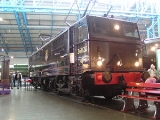
Manchester-Sheffield-Wath electric railway

Encyclopedia
The Manchester-Sheffield-Wath electric railway was an early electrification
scheme on British railways. The route featured long ascents on both sides of the Pennines
with the long Woodhead Tunnel
at its central summit close to the Woodhead pass. This also led to the route being called the Woodhead Line
.
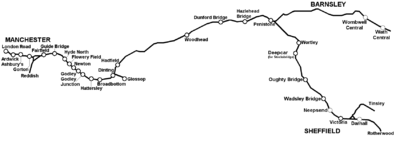
ran from Manchester London Road (later Manchester Piccadilly) over the Pennines, through the Woodhead Tunnel
to Penistone
, where the Wath
line split. The main line then proceeded through Sheffield Victoria Station
and on to Rotherwood sidings
. The Wath line ran from Penistone
to Wath marshalling yard
in the heart of the South Yorkshire coalfields.
Minor electrified branches off the main line ran to the locomotive depot at Reddish
on the Fallowfield Loop line
, to Glossop
(for local passenger trains), Dewsnap sidings (all at the Manchester end) and Tinsley Marshalling Yard
(at the Sheffield end).
(GCR) first considered the electrification of the line prior to World War I. No detailed plans were drawn up, but by the 1920s the high levels of heavy freight traffic made steam operation increasingly problematic. Things were interrupted by the 1923 grouping of the railways, which saw the GCR absorbed into the London and North Eastern Railway
(LNER).
The operational problems remained into the 1930s. In 1935 the government made credits available to the railways to provide relief for unemployed persons in the Great Depression
so the LNER restarted the project: planning and works for electrification commenced. The system was to be electrified at 1,500V DC, similar to the Dutch style of electrification that had also been used on the LNER
's Newport-Shildon line. This system had the advantage that regenerative braking could easily be employed; this provided braking traction by allowing an electric locomotive's motors to act as brakes, thus assisting with control of heavy freight trains when running downhill. The power generated by a descending train's braking action was fed back to the overhead lines and either used by other trains requiring power in the same block of line, or dissipated as heat in resistive loads at the electrical sub-stations.
Some gantries for the overhead wires were erected and a prototype locomotive was constructed. However World War II
intervened. The prototype locomotive was loaned to the Netherlands immediately after World War II to assist in working the war-damaged railways there; in the process of this it acquired the nickname "Tommy" - which later, after repatriation to Britain, was used officially.
In 1948 the assets of the LNER were nationalised as a part of British Railways. Nearly 30 years had elapsed and still the operational problems remained, so money was made available to complete the electrification project. By now the state of the original Woodhead tunnels meant that a new twin-track tunnel had to be built to replace the two original single-track bores. Thurgoland
tunnel gained a new bore to alleviate clearance problems in the original tunnel. New electric locomotive facilities were built at Reddish, Darnall and Wath, and two classes of locomotive were built at Gorton locomotive works
, Manchester, exclusively for the line. These were the EM1 (Class 76) Bo+Bo
(the + signifiying that the bogies were articulated) mixed-traffic locomotives and seven larger EM2 (Class 77) Co-Co
locomotives for express passenger services.
However, to save on costs, the Cheshire Lines Committee
(CLC) loop line into Manchester Central station was not electrified, as was originally in the plan: Manchester-bound passenger trains would terminate at London Road (later Piccadilly), while those few passenger trains destined for further afield would change locomotives at Guide Bridge.
The Wath to Penistone section was the first to be energised on 2 February 1952. Completion of the main line was delayed until 1954 by a collapse in the new Woodhead tunnel, and also by the decision to completely re-signal the whole main line with colour-light signals after sighting problems with the semaphore signals on the Wath branch. On 30 May 1954 electric trains began running through the tunnel and the Manchester to Penistone section was fully energised on 14 June. The Sheffield Victoria to Penistone section followed on 20 September 1954. At this time the system had its official opening despite not being fully complete: the final few miles from Sheffield Victoria to the system's eastern extremity at Rotherwood was declared open on 3 January 1955.
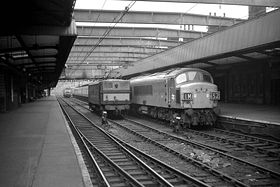 The benefits of electrification were immediately apparent: Sheffield to Manchester expresses now completed the journey in 56 minutes as opposed to 65 minutes with steam traction; an 850 ton coal train took a mere 66 minutes between Wath and Dunford Bridge as opposed to nearly two and a half hours powered by steam.
The Worsborough (or Wentworth) incline was a formidable feature on the Wath to Penistone section. This line was opened east of Silkstone
in 1880 to alleviate congestion at Barnsley. Although nominally 1 in 40, colliery subsidence had made sections of the bank much steeper. The difficulty in operating this steeply-graded section (which included the two Silkstone tunnels) with steam traction was a key reason for electrification. Prior to electrification a unique powerful Garratt locomotive
was built to act as a banker
for this section of line, otherwise the normal mode of operation was for two or sometimes even three bankers for the Worsborough incline plus a pilot locomotive to assist from Wath to Dunford Bridge. Even with five locomotives, heavy trains had slowed to a walking pace by Silkstone. After electrification, much heavier coal trains could be handled up the bank; however problems with unfitted trains running away on the downgrades west of the Pennines restricted weights on such trains. In later years MGR (Merry-Go-Round) coal trains, running direct from pit to power station became the main traffic with the coal carried in block trains of 30, 32-tonne capacity air-braked wagons. These were normally double-headed by two Class 76
locomotives to their destination with two additional Class 76s banking at the rear from Wombwell
to Silkstone. This was the only section of railway in the UK to be regularly operated by four locomotives per train. A "Clearcall" intercom system (via the overhead electric wires) was developed to allow the crews of the front and rear locomotives to communicate, replacing earlier air-horn codes.
The purpose-built power control centre for the line was adjacent to Penistone
station. The building still stands, but has been adapted for alternative commercial use.
As much of the line was prone to colliery subsidence, many of the portal structures which supported the overhead wires contained crossbeams which were designed to be easily adjustable upwards or downwards, using permanent way cranes; the ground-level trackside power feed, communications and signalling cables were similarly adjustable.
In 1965 the scheme was extended to take in the brand new Tinsley Marshalling Yard
in Sheffield. The locomotive facilities at the Sheffield end of the line were moved from Darnall to the new Tinsley depot. The overhead line equipment on this section was designed to be easily convertible to 25kV AC electrification, which by now had been accepted as the standard overhead electrification system
for BR.
Some limitations of the Woodhead electrification became apparent, especially with the advent of the double-headed, double-banked merry-go-round unit trains previously mentioned. Whilst such a train was climbing Worsborough Incline, all other electric trains were prohibited from entering upon or moving within the power section between Strafford Crossing and Aldam Junction, lest the substations at these two locations trip out from the massive current draw. Heavy current loads also caused flashovers in the oil-impregnated paper-insulated, lead
-covered 33 kV ground-level feeder cable at locations where cable segments were joined together in sealed boxes; such loads were not present in the MSJ&A and Great Eastern 1.5 kV DC schemes, both of which served only EMU trains and not locomotive-hauled ones.
 Electric trans-Pennine passenger services lasted just 16 years. The Beeching Report had specified that only one Manchester-Sheffield route should stay open to passengers and that route would be Woodhead. However local opposition to the closure of the alternative Hope Valley line
, the high cost of providing an electrified link into Sheffield Midland station
as Sheffield Victoria
was slated for closure
, and the impending opening of the massive Fiddlers Ferry Power Station
requiring even more trans-Pennine freight train paths from the South Yorkshire Coalfield
, all conspired against the Woodhead line which thus closed to passengers on 5 January 1970. A local electric service remained at the Manchester end of the line and the Sheffield - Penistone service was left in the hands of diesel trains. The Class 77
express passenger train locomotives were sold to the Netherlands Railways, becoming NS Class 1500
.
By the late 1970s freight traffic, even including South Yorkshire coal, had declined to the extent that British Rail took the decision to close the route, ultimately effective 18 July 1981; only the Manchester-Glossop/Hadfield local passenger trains were left running. BR claimed that the cost of replacing the out-of-date and non-standard equipment on the main section of the line was prohibitive. All but one of the remaining Class 76 locomotives were scrapped. The Wath branch was rapidly lifted between Wombwell Main Junction and West Silkstone Junction. As a part of the closure agreement, the track on the Sheffield-Penistone
-Hadfield section of the route was left in place for five years. 1986 saw much of the remaining track lifted, except for the sections in the vicinity of Penistone station (which remained open for Sheffield-Huddersfield trains), and east of Deepcar which remained for both freight and passenger traffic in the Sheffield area.
In December 1984 the remaining equipment at the Manchester end of the line was modified to the by now standard 25kV AC, thus ending the use of 1,500V DC overhead electrification on British Rail. The Class 506
were withdrawn at the same time, being replaced by Class 303
EMUs from the Glasgow area. The line is now operated by Class 323
EMUs.
Railway electrification in Great Britain
Railway electrification in Great Britain started towards of the 19th century. A great range of voltages have been used in the intervening period using both overhead lines and third rails, however the most common standard for mainline services is now 25 kV AC using overhead lines and the...
scheme on British railways. The route featured long ascents on both sides of the Pennines
Pennines
The Pennines are a low-rising mountain range, separating the North West of England from Yorkshire and the North East.Often described as the "backbone of England", they form a more-or-less continuous range stretching from the Peak District in Derbyshire, around the northern and eastern edges of...
with the long Woodhead Tunnel
Woodhead Tunnel
The Woodhead Tunnels are three parallel trans-Pennine 3-mile long railway tunnels on the Woodhead Line, a former major rail link from Manchester to Sheffield in northern England...
at its central summit close to the Woodhead pass. This also led to the route being called the Woodhead Line
Woodhead Line
The Woodhead Line was a railway line linking Sheffield, Penistone and Manchester in the north of England. A key feature of the route is the passage under the high moorlands of the northern Peak District through the Woodhead Tunnels...
.
The route
The main routeWoodhead Line
The Woodhead Line was a railway line linking Sheffield, Penistone and Manchester in the north of England. A key feature of the route is the passage under the high moorlands of the northern Peak District through the Woodhead Tunnels...
ran from Manchester London Road (later Manchester Piccadilly) over the Pennines, through the Woodhead Tunnel
Woodhead Tunnel
The Woodhead Tunnels are three parallel trans-Pennine 3-mile long railway tunnels on the Woodhead Line, a former major rail link from Manchester to Sheffield in northern England...
to Penistone
Penistone railway station
Penistone railway station is a railway station in Penistone, in the Metropolitan Borough of Barnsley, South Yorkshire, England. Train services are provided by Northern Rail...
, where the Wath
Wath-upon-Dearne
Wath-upon-Dearne is a small town on the south side of the Dearne Valley in the historic county of the West Riding of Yorkshire and the Metropolitan Borough of Rotherham, South Yorkshire, England, lying 5 miles north of Rotherham, almost midway between Barnsley and Doncaster. It has a population...
line split. The main line then proceeded through Sheffield Victoria Station
Sheffield Victoria Station
Sheffield Victoria was the main railway station in Sheffield, South Yorkshire, England on the Great Central Railway, between Chesterfield and Penistone.-Early history:...
and on to Rotherwood sidings
Rotherwood exchange sidings
Rotherwood exchange sidings were set at the eastern extremity of the Manchester-Sheffield-Wath electric railway between Orgreave Lane and Retford Road, on the south eastern boundary of the City of Sheffield with the Parish of Orgreave, within Rotherham....
. The Wath line ran from Penistone
Penistone
Penistone is a small town market town and civil parish in the Metropolitan Borough of Barnsley, in South Yorkshire, England, with a population of 10,101 at the 2001 census. It lies west of the town of Barnsley and north east of Glossop, in the foothills of the Pennines...
to Wath marshalling yard
Wath marshalling yard
Wath marshalling yard, also known as Wath concentration yard, was a large railway marshalling yard specifically designed for the concentration of coal traffic. It was set at the heart of the South Yorkshire Coalfield, at Wath-upon-Dearne, approximately halfway between Barnsley and Doncaster, in...
in the heart of the South Yorkshire coalfields.
Minor electrified branches off the main line ran to the locomotive depot at Reddish
Reddish
Reddish is an area of the Metropolitan Borough of Stockport, in Greater Manchester, England. It is north of Stockport and southeast of Manchester...
on the Fallowfield Loop line
Fallowfield Loop railway line
The Fallowfield Loop railway line was a local railway route in Greater Manchester, England. Trains on the Manchester, Sheffield and Lincolnshire Railway line from Sheffield Victoria and Guide Bridge used the 'Loop' to access Manchester Central railway station.The line was fully opened in 1892 and...
, to Glossop
Glossop
Glossop is a market town within the Borough of High Peak in Derbyshire, England. It lies on the Glossop Brook, a tributary of the River Etherow, about east of the city of Manchester, west of the city of Sheffield. Glossop is situated near Derbyshire's county borders with Cheshire, Greater...
(for local passenger trains), Dewsnap sidings (all at the Manchester end) and Tinsley Marshalling Yard
Tinsley Marshalling Yard
Tinsley Marshalling Yard was a railway marshalling yard located near Tinsley in Sheffield. It was opened in 1965 as a part of a major plan to rationalise all aspects of the rail services in the Sheffield area, and closed in stages from 1985 with the run-down of rail freight in Britain. It was also...
(at the Sheffield end).
Electrification
Following developments with electric traction in the USA, the Great Central RailwayGreat Central Railway
The Great Central Railway was a railway company in England which came into being when the Manchester, Sheffield and Lincolnshire Railway changed its name in 1897 in anticipation of the opening in 1899 of its London Extension . On 1 January 1923, it was grouped into the London and North Eastern...
(GCR) first considered the electrification of the line prior to World War I. No detailed plans were drawn up, but by the 1920s the high levels of heavy freight traffic made steam operation increasingly problematic. Things were interrupted by the 1923 grouping of the railways, which saw the GCR absorbed into the London and North Eastern Railway
London and North Eastern Railway
The London and North Eastern Railway was the second-largest of the "Big Four" railway companies created by the Railways Act 1921 in Britain...
(LNER).
The operational problems remained into the 1930s. In 1935 the government made credits available to the railways to provide relief for unemployed persons in the Great Depression
Great Depression
The Great Depression was a severe worldwide economic depression in the decade preceding World War II. The timing of the Great Depression varied across nations, but in most countries it started in about 1929 and lasted until the late 1930s or early 1940s...
so the LNER restarted the project: planning and works for electrification commenced. The system was to be electrified at 1,500V DC, similar to the Dutch style of electrification that had also been used on the LNER
London and North Eastern Railway
The London and North Eastern Railway was the second-largest of the "Big Four" railway companies created by the Railways Act 1921 in Britain...
's Newport-Shildon line. This system had the advantage that regenerative braking could easily be employed; this provided braking traction by allowing an electric locomotive's motors to act as brakes, thus assisting with control of heavy freight trains when running downhill. The power generated by a descending train's braking action was fed back to the overhead lines and either used by other trains requiring power in the same block of line, or dissipated as heat in resistive loads at the electrical sub-stations.
Some gantries for the overhead wires were erected and a prototype locomotive was constructed. However World War II
World War II
World War II, or the Second World War , was a global conflict lasting from 1939 to 1945, involving most of the world's nations—including all of the great powers—eventually forming two opposing military alliances: the Allies and the Axis...
intervened. The prototype locomotive was loaned to the Netherlands immediately after World War II to assist in working the war-damaged railways there; in the process of this it acquired the nickname "Tommy" - which later, after repatriation to Britain, was used officially.
In 1948 the assets of the LNER were nationalised as a part of British Railways. Nearly 30 years had elapsed and still the operational problems remained, so money was made available to complete the electrification project. By now the state of the original Woodhead tunnels meant that a new twin-track tunnel had to be built to replace the two original single-track bores. Thurgoland
Thurgoland
Thurgoland is a village and civil parish in the Metropolitan Borough of Barnsley in South Yorkshire, England. According to the 2001 census the parish had a population of 1,801. The village has one primary school, the Holy Trinity and a Methodist Chapel. There are four public houses: The Monkey,...
tunnel gained a new bore to alleviate clearance problems in the original tunnel. New electric locomotive facilities were built at Reddish, Darnall and Wath, and two classes of locomotive were built at Gorton locomotive works
Gorton locomotive works
Gorton Locomotive Works, known locally as Gorton Tank was located in Openshaw near Manchester, England and was completed in 1848 by the Sheffield, Ashton-under-Lyne and Manchester Railway.- History :...
, Manchester, exclusively for the line. These were the EM1 (Class 76) Bo+Bo
British Rail Class 76
The British Rail Class 76, also known as Class EM1 , is a class of 1.5 kV DC, Bo-Bo electric locomotive designed for use on the now-closed Woodhead Line in Northern England.-Tommy — the prototype:...
(the + signifiying that the bogies were articulated) mixed-traffic locomotives and seven larger EM2 (Class 77) Co-Co
British Rail Class 77
The British Rail Class 77, also known as Class EM2, is a class of 1.5 kV DC, Co-Co electric locomotive. They were built by Metropolitan-Vickers in 1953–1954 for use over the Woodhead Line between Manchester and Sheffield.-Description:...
locomotives for express passenger services.
However, to save on costs, the Cheshire Lines Committee
Cheshire Lines Committee
The Cheshire Lines Committee was the second largest joint railway in Great Britain, with 143 route miles. Despite its name, approximately 55% of its system was in Lancashire. In its publicity material it was often styled as the Cheshire Lines Railway...
(CLC) loop line into Manchester Central station was not electrified, as was originally in the plan: Manchester-bound passenger trains would terminate at London Road (later Piccadilly), while those few passenger trains destined for further afield would change locomotives at Guide Bridge.
The Wath to Penistone section was the first to be energised on 2 February 1952. Completion of the main line was delayed until 1954 by a collapse in the new Woodhead tunnel, and also by the decision to completely re-signal the whole main line with colour-light signals after sighting problems with the semaphore signals on the Wath branch. On 30 May 1954 electric trains began running through the tunnel and the Manchester to Penistone section was fully energised on 14 June. The Sheffield Victoria to Penistone section followed on 20 September 1954. At this time the system had its official opening despite not being fully complete: the final few miles from Sheffield Victoria to the system's eastern extremity at Rotherwood was declared open on 3 January 1955.
The Worsborough (or Wentworth) incline was a formidable feature on the Wath to Penistone section. This line was opened east of Silkstone
Silkstone
Silkstone is a village and civil parish in the Metropolitan Borough of Barnsley in South Yorkshire, England. It is situated in the foothills of the Pennines, between the towns of Barnsley and Penistone, and includes the village of Silkstone Common...
in 1880 to alleviate congestion at Barnsley. Although nominally 1 in 40, colliery subsidence had made sections of the bank much steeper. The difficulty in operating this steeply-graded section (which included the two Silkstone tunnels) with steam traction was a key reason for electrification. Prior to electrification a unique powerful Garratt locomotive
LNER Class U1
The London and North Eastern Railway Class U1 was a solitary 2-8-0+0-8-2 Beyer-Garratt locomotive designed for banking coal trains over the Worsborough Bank, a steeply graded line in South Yorkshire and part of the Woodhead Route. It was both the longest and the most powerful steam locomotive ever...
was built to act as a banker
Bank engine
A bank engine or helper engine or pusher engine is a railway locomotive that temporarily assists a train that requires additional power or traction to climb a grade...
for this section of line, otherwise the normal mode of operation was for two or sometimes even three bankers for the Worsborough incline plus a pilot locomotive to assist from Wath to Dunford Bridge. Even with five locomotives, heavy trains had slowed to a walking pace by Silkstone. After electrification, much heavier coal trains could be handled up the bank; however problems with unfitted trains running away on the downgrades west of the Pennines restricted weights on such trains. In later years MGR (Merry-Go-Round) coal trains, running direct from pit to power station became the main traffic with the coal carried in block trains of 30, 32-tonne capacity air-braked wagons. These were normally double-headed by two Class 76
British Rail Class 76
The British Rail Class 76, also known as Class EM1 , is a class of 1.5 kV DC, Bo-Bo electric locomotive designed for use on the now-closed Woodhead Line in Northern England.-Tommy — the prototype:...
locomotives to their destination with two additional Class 76s banking at the rear from Wombwell
Wombwell
Wombwell is a small town near Barnsley, located in the Metropolitan Borough of Barnsley in South Yorkshire, England. It has a population of 15,180.Its name's origin may mean "Womba's Well", or "well in a hollow"....
to Silkstone. This was the only section of railway in the UK to be regularly operated by four locomotives per train. A "Clearcall" intercom system (via the overhead electric wires) was developed to allow the crews of the front and rear locomotives to communicate, replacing earlier air-horn codes.
The purpose-built power control centre for the line was adjacent to Penistone
Penistone railway station
Penistone railway station is a railway station in Penistone, in the Metropolitan Borough of Barnsley, South Yorkshire, England. Train services are provided by Northern Rail...
station. The building still stands, but has been adapted for alternative commercial use.
As much of the line was prone to colliery subsidence, many of the portal structures which supported the overhead wires contained crossbeams which were designed to be easily adjustable upwards or downwards, using permanent way cranes; the ground-level trackside power feed, communications and signalling cables were similarly adjustable.
In 1965 the scheme was extended to take in the brand new Tinsley Marshalling Yard
Tinsley Marshalling Yard
Tinsley Marshalling Yard was a railway marshalling yard located near Tinsley in Sheffield. It was opened in 1965 as a part of a major plan to rationalise all aspects of the rail services in the Sheffield area, and closed in stages from 1985 with the run-down of rail freight in Britain. It was also...
in Sheffield. The locomotive facilities at the Sheffield end of the line were moved from Darnall to the new Tinsley depot. The overhead line equipment on this section was designed to be easily convertible to 25kV AC electrification, which by now had been accepted as the standard overhead electrification system
Railway electrification system
A railway electrification system supplies electrical energy to railway locomotives and multiple units as well as trams so that they can operate without having an on-board prime mover. There are several different electrification systems in use throughout the world...
for BR.
Some limitations of the Woodhead electrification became apparent, especially with the advent of the double-headed, double-banked merry-go-round unit trains previously mentioned. Whilst such a train was climbing Worsborough Incline, all other electric trains were prohibited from entering upon or moving within the power section between Strafford Crossing and Aldam Junction, lest the substations at these two locations trip out from the massive current draw. Heavy current loads also caused flashovers in the oil-impregnated paper-insulated, lead
Lead
Lead is a main-group element in the carbon group with the symbol Pb and atomic number 82. Lead is a soft, malleable poor metal. It is also counted as one of the heavy metals. Metallic lead has a bluish-white color after being freshly cut, but it soon tarnishes to a dull grayish color when exposed...
-covered 33 kV ground-level feeder cable at locations where cable segments were joined together in sealed boxes; such loads were not present in the MSJ&A and Great Eastern 1.5 kV DC schemes, both of which served only EMU trains and not locomotive-hauled ones.
Closure
Hope Valley Line
The Hope Valley Line is a railway line in England linking Sheffield with Manchester. It was completed in 1894.From Sheffield, trains head down the Midland Main Line to Dore, where the Hope Valley Line branches off to run through the Totley Tunnel .It emerges in the stunning scenery of the Hope...
, the high cost of providing an electrified link into Sheffield Midland station
Sheffield Midland station
Sheffield station, formerly Pond Street and later Sheffield Midland, is a railway station in Sheffield, England and is the busiest station in South Yorkshire...
as Sheffield Victoria
Sheffield Victoria Station
Sheffield Victoria was the main railway station in Sheffield, South Yorkshire, England on the Great Central Railway, between Chesterfield and Penistone.-Early history:...
was slated for closure
Sheffield district rail rationalisation plan of the 1960s
The Sheffield District Rail Rationalisation Plan was a series of linked railway civil engineering projects, station and line closures and train route changes that took place in and around Sheffield, South Yorkshire...
, and the impending opening of the massive Fiddlers Ferry Power Station
Fiddlers Ferry Power Station
Fiddlers Ferry Power Station is a coal fired power station located in Cheshire in North West England, which is capable of co-firing biomass. It is situated on the north bank of the River Mersey between the towns of Widnes and Warrington. Opened in 1971, the station has a generating capacity of...
requiring even more trans-Pennine freight train paths from the South Yorkshire Coalfield
South Yorkshire Coalfield
The South Yorkshire Coalfield is defined by a triangle lying between Barnsley, Doncaster and Sheffield, though a few mines within the coalfield lie outside this area. It is part of the larger Midland coal field which stretches from Nottingham in the south to Bradford and Leeds in the north...
, all conspired against the Woodhead line which thus closed to passengers on 5 January 1970. A local electric service remained at the Manchester end of the line and the Sheffield - Penistone service was left in the hands of diesel trains. The Class 77
British Rail Class 77
The British Rail Class 77, also known as Class EM2, is a class of 1.5 kV DC, Co-Co electric locomotive. They were built by Metropolitan-Vickers in 1953–1954 for use over the Woodhead Line between Manchester and Sheffield.-Description:...
express passenger train locomotives were sold to the Netherlands Railways, becoming NS Class 1500
NS Class 1500
The Nederlandse Spoorwegen Class 1500 were built by Metropolitan-Vickers in 1953-1955. They were originally built for British Railways as Class EM2 for use on the Woodhead Route between Manchester and Sheffield...
.
By the late 1970s freight traffic, even including South Yorkshire coal, had declined to the extent that British Rail took the decision to close the route, ultimately effective 18 July 1981; only the Manchester-Glossop/Hadfield local passenger trains were left running. BR claimed that the cost of replacing the out-of-date and non-standard equipment on the main section of the line was prohibitive. All but one of the remaining Class 76 locomotives were scrapped. The Wath branch was rapidly lifted between Wombwell Main Junction and West Silkstone Junction. As a part of the closure agreement, the track on the Sheffield-Penistone
Penistone
Penistone is a small town market town and civil parish in the Metropolitan Borough of Barnsley, in South Yorkshire, England, with a population of 10,101 at the 2001 census. It lies west of the town of Barnsley and north east of Glossop, in the foothills of the Pennines...
-Hadfield section of the route was left in place for five years. 1986 saw much of the remaining track lifted, except for the sections in the vicinity of Penistone station (which remained open for Sheffield-Huddersfield trains), and east of Deepcar which remained for both freight and passenger traffic in the Sheffield area.
In December 1984 the remaining equipment at the Manchester end of the line was modified to the by now standard 25kV AC, thus ending the use of 1,500V DC overhead electrification on British Rail. The Class 506
British Rail Class 506
The British Rail Class 506 was a 3 carriage Electric Multiple Unit built for local services between Manchester, Glossop and Hadfield on the Woodhead Line, which was electrified in 1954 on the 1,500V dc overhead system.-Design:...
were withdrawn at the same time, being replaced by Class 303
British Rail Class 303
The British Rail Class 303 electric multiple units, also known as "Blue Train" units, were introduced in 1960 for the electrification of the North Clyde and the Cathcart Circle lines in Strathclyde...
EMUs from the Glasgow area. The line is now operated by Class 323
British Rail Class 323
The British Rail Class 323 electric multiple units were built by Hunslet TPL from 1992-93. Forty-three 3-car units were built for inner-suburban services around Birmingham and Manchester...
EMUs.
External links
- The Woodhead Site
- Route diagram British Transport Commission,1954