


Malpighian tubule system

Encyclopedia
The Malpighian tubule system is a type of excretory and osmoregulatory
system found in some Uniramia
(Insect
s and Myriapoda
), arachnid
s and tardigrade
s.
The system consists of branching tubule
s extending from the alimentary canal that absorbs solutes
, water, and wastes from the surrounding hemolymph
. The wastes then are released from the organism in the form of solid nitrogenous compounds. The system is named after Marcello Malpighi
, a seventeenth century anatomist.
It is unclear as to whether the Malpighian tubules of arachnids and those of the Uniramia are homologous
or the result of convergent evolution
.
and are in proximity to fat body tissue. They contain actin
for structural support and microvilli for propulsion of substances along the tubules. Malpighian tubules in most insects also contain accessory musculature associated with the tubules which may function to mix the contents of the tubules or expose the tubules to more hemolymph. The insect orders, Thysanura
, Dermaptera and Thysanoptera do not possess these muscles and Collembola and Hemiptera
:Aphididae
completely lack a Malpighian tubule system.
and amino acids are thought to diffuse through the walls, while ions such as sodium
and potassium
are transported by active pump mechanisms. Water follows thereafter. The pre-urine, along with digested food, merge in the hindgut. At this time, uric acid precipitates out, and sodium and potassium ions are actively absorbed by the rectum, along with water via osmosis
. Uric acid is left to mix with feces, which are then excreted
.
n insects use tubules that permit movement of solutes into the distal portion of the tubules while reabsorption of water and essential ions directly to the hemolymph occurs in the proximal portion and the rectum. Both Coleoptera and Lepidoptera
use a cryptonephridial arrangement where the distal end of the tubules are embedded in fat tissue surrounding the rectum. Such an arrangement may serve to increase the efficiency of solute processing in the Malpighian tubules.
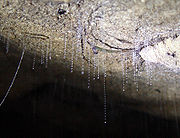 Although primarily involved in excretion and osmoregulation, Malpighian tubules have been modified in some insects to serve accessory functions. Larvae of the New Zealand
glowworm
, Arachnocampa luminosa (Diptera
: Mycetophilidae
) use modified and swollen Malpighian tubules to produce a blue-green light attracting prey towards mucus-coated trap lines. In insects which feed on plant material containing noxious allelochemicals
, Malpighian tubules also serve to rapidly excrete such compounds from the hemolymph.
Osmoregulation
Osmoregulation is the active regulation of the osmotic pressure of an organism's fluids to maintain the homeostasis of the organism's water content; that is it keeps the organism's fluids from becoming too diluted or too concentrated. Osmotic pressure is a measure of the tendency of water to move...
system found in some Uniramia
Uniramia
S. M. Manton's polyphyletic Arthropod hypothesis with Uniramia as one of three Phyla.Uniramia is a group within the arthropods. In the past this group included the Onychophora, which are now considered a separate category. The group is currently used in a narrower sense.Uniramia is one of three...
(Insect
Insect
Insects are a class of living creatures within the arthropods that have a chitinous exoskeleton, a three-part body , three pairs of jointed legs, compound eyes, and two antennae...
s and Myriapoda
Myriapoda
Myriapoda is a subphylum of arthropods containing millipedes, centipedes, and others. The group contains 13,000 species, all of which are terrestrial...
), arachnid
Arachnid
Arachnids are a class of joint-legged invertebrate animals in the subphylum Chelicerata. All arachnids have eight legs, although in some species the front pair may convert to a sensory function. The term is derived from the Greek words , meaning "spider".Almost all extant arachnids are terrestrial...
s and tardigrade
Tardigrade
Tardigrades form the phylum Tardigrada, part of the superphylum Ecdysozoa. They are microscopic, water-dwelling, segmented animals with eight legs. Tardigrades were first described by Johann August Ephraim Goeze in 1773...
s.
The system consists of branching tubule
Tubule
A tubule is a very small tube or fistular structure.A system of surface-connected membranes in muscle that enables a nerve impulse to travel to the interior of the muscle fibre.In anatomy, a tubule is a minute tube lined with glandular epithelium....
s extending from the alimentary canal that absorbs solutes
Solution
In chemistry, a solution is a homogeneous mixture composed of only one phase. In such a mixture, a solute is dissolved in another substance, known as a solvent. The solvent does the dissolving.- Types of solutions :...
, water, and wastes from the surrounding hemolymph
Hemolymph
Hemolymph, or haemolymph, is a fluid in the circulatory system of some arthropods and is analogous to the fluids and cells making up both blood and interstitial fluid in vertebrates such as birds and mammals...
. The wastes then are released from the organism in the form of solid nitrogenous compounds. The system is named after Marcello Malpighi
Marcello Malpighi
Marcello Malpighi was an Italian doctor, who gave his name to several physiological features, like the Malpighian tubule system.-Early years:...
, a seventeenth century anatomist.
It is unclear as to whether the Malpighian tubules of arachnids and those of the Uniramia are homologous
Homology (biology)
Homology forms the basis of organization for comparative biology. In 1843, Richard Owen defined homology as "the same organ in different animals under every variety of form and function". Organs as different as a bat's wing, a seal's flipper, a cat's paw and a human hand have a common underlying...
or the result of convergent evolution
Convergent evolution
Convergent evolution describes the acquisition of the same biological trait in unrelated lineages.The wing is a classic example of convergent evolution in action. Although their last common ancestor did not have wings, both birds and bats do, and are capable of powered flight. The wings are...
.
Structure
Malpighian tubules are slender tubes normally found in the posterior regions of arthropod alimentary canals. Each tubule consists of a single layer of cells that is closed off at the distal end with the proximal end joining the alimentary canal at the junction between the midgut and hindgut. Most tubules are normally highly convoluted. The number of tubules varies between species although most occur in multiples of two. Tubules are usually bathed in hemolymphHemolymph
Hemolymph, or haemolymph, is a fluid in the circulatory system of some arthropods and is analogous to the fluids and cells making up both blood and interstitial fluid in vertebrates such as birds and mammals...
and are in proximity to fat body tissue. They contain actin
Actin
Actin is a globular, roughly 42-kDa moonlighting protein found in all eukaryotic cells where it may be present at concentrations of over 100 μM. It is also one of the most highly-conserved proteins, differing by no more than 20% in species as diverse as algae and humans...
for structural support and microvilli for propulsion of substances along the tubules. Malpighian tubules in most insects also contain accessory musculature associated with the tubules which may function to mix the contents of the tubules or expose the tubules to more hemolymph. The insect orders, Thysanura
Thysanura
Thysanura is an order of insects, encompassing silverfish and firebrats, known for their three long caudal filaments.The families Machilidae and Meinertellidae of the jumping bristletails were once included with Thysanura....
, Dermaptera and Thysanoptera do not possess these muscles and Collembola and Hemiptera
Hemiptera
Hemiptera is an order of insects most often known as the true bugs , comprising around 50,000–80,000 species of cicadas, aphids, planthoppers, leafhoppers, shield bugs, and others...
:Aphididae
Aphididae
Aphididae is a very large insect family in the aphid superfamily , of the order Hemiptera. There are several thousand species in this family, many of which are well known for being serious plant pests...
completely lack a Malpighian tubule system.
General mode of action
Pre-urine is formed in the tubules, when nitrogenous waste and electrolytes are transported through the tubule walls. Wastes such as ureaUrea
Urea or carbamide is an organic compound with the chemical formula CO2. The molecule has two —NH2 groups joined by a carbonyl functional group....
and amino acids are thought to diffuse through the walls, while ions such as sodium
Sodium
Sodium is a chemical element with the symbol Na and atomic number 11. It is a soft, silvery-white, highly reactive metal and is a member of the alkali metals; its only stable isotope is 23Na. It is an abundant element that exists in numerous minerals, most commonly as sodium chloride...
and potassium
Potassium
Potassium is the chemical element with the symbol K and atomic number 19. Elemental potassium is a soft silvery-white alkali metal that oxidizes rapidly in air and is very reactive with water, generating sufficient heat to ignite the hydrogen emitted in the reaction.Potassium and sodium are...
are transported by active pump mechanisms. Water follows thereafter. The pre-urine, along with digested food, merge in the hindgut. At this time, uric acid precipitates out, and sodium and potassium ions are actively absorbed by the rectum, along with water via osmosis
Osmosis
Osmosis is the movement of solvent molecules through a selectively permeable membrane into a region of higher solute concentration, aiming to equalize the solute concentrations on the two sides...
. Uric acid is left to mix with feces, which are then excreted
Excretion
Excretion is the process by which waste products of metabolism and other non-useful materials are eliminated from an organism. This is primarily carried out by the lungs, kidneys and skin. This is in contrast with secretion, where the substance may have specific tasks after leaving the cell...
.
Alternative modes of action
Complex cycling systems of Malpighian tubules have been described in other insect orders. HemipteraHemiptera
Hemiptera is an order of insects most often known as the true bugs , comprising around 50,000–80,000 species of cicadas, aphids, planthoppers, leafhoppers, shield bugs, and others...
n insects use tubules that permit movement of solutes into the distal portion of the tubules while reabsorption of water and essential ions directly to the hemolymph occurs in the proximal portion and the rectum. Both Coleoptera and Lepidoptera
Lepidoptera
Lepidoptera is a large order of insects that includes moths and butterflies . It is one of the most widespread and widely recognizable insect orders in the world, encompassing moths and the three superfamilies of butterflies, skipper butterflies, and moth-butterflies...
use a cryptonephridial arrangement where the distal end of the tubules are embedded in fat tissue surrounding the rectum. Such an arrangement may serve to increase the efficiency of solute processing in the Malpighian tubules.
Other uses
New Zealand
New Zealand is an island country in the south-western Pacific Ocean comprising two main landmasses and numerous smaller islands. The country is situated some east of Australia across the Tasman Sea, and roughly south of the Pacific island nations of New Caledonia, Fiji, and Tonga...
glowworm
Arachnocampa
Arachnocampa is a genus of four fungus gnat species which are, in their larval stage, glowworms. They are found mostly in New Zealand and Australia in caves and grottos, or sheltered places in forests....
, Arachnocampa luminosa (Diptera
Diptera
Diptera , or true flies, is the order of insects possessing only a single pair of wings on the mesothorax; the metathorax bears a pair of drumstick like structures called the halteres, the remnants of the hind wings. It is a large order, containing an estimated 240,000 species, although under half...
: Mycetophilidae
Mycetophilidae
Mycetophilidae is a family of small flies, forming the bulk of those species known as fungus gnats. There are approximately 3000 described species in 150 genera but the true number of species is undoubtedly much higher...
) use modified and swollen Malpighian tubules to produce a blue-green light attracting prey towards mucus-coated trap lines. In insects which feed on plant material containing noxious allelochemicals
Allelopathy
Allelopathy is a biological phenomenon by which an organism produces one or more biochemicals that influence the growth, survival, and reproduction of other organisms. These biochemicals are known as allelochemicals and can have beneficial or detrimental effects on the target organisms...
, Malpighian tubules also serve to rapidly excrete such compounds from the hemolymph.