

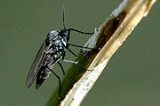
Mycetophilidae

Encyclopedia
Mycetophilidae is a family of small flies
, forming the bulk of those species known as fungus gnat
s. There are approximately 3000 described species in 150 genera but the true number of species is undoubtedly much higher. They are generally found in the damp habitats favoured by their host fungi
and sometimes form dense swarms.
Adults of this family can usually be separated from other small flies by the strongly humped thorax
, well-developed coxa
e and often spinose legs but identification within the family between genera and species generally requires close study of microscopic
features such as: subtle differences in wing venation, variation in chaetotaxy
and genitalia. The terrestrial
larva
e usually feed on fungi, especially the fruiting bodies but also spore
s and hypha
e, but some species have been recorded on moss
es and liverworts
. The larvae of some species, while still being associated with fungi, are at least partly predatory
.
. In some species this is restricted to the larval stage but in others this feature is retained by the pupa
e and adults. It has been suggested that the ability to produce their own light is used by some predatory larvae as a lure for potential prey, although it also obviously makes themselves more susceptible to predation or parasitism
. These are not true Mycetophilids, but belong to the family Keroplatidae.
deposits and the group appears to have been well established and diversified by the Cretaceous
period at the latest.
, Lygistorrhinidae, Diadocidiidae
and Rangomaramidae. The Mycetophilidae sensu lato contain about 330 described genera. These include :
Fly
True flies are insects of the order Diptera . They possess a pair of wings on the mesothorax and a pair of halteres, derived from the hind wings, on the metathorax...
, forming the bulk of those species known as fungus gnat
Fungus gnat
Fungus gnats are small, dark, short-lived flies, of the families Sciaridae, Diadocidiidae, Ditomyiidae, Keroplatidae, Bolitophilidae and Mycetophilidae , sometimes placed in the superfamily Mycetophiloidea, whose larvae feed on plant roots or fungi and aid in the decomposition of organic matter...
s. There are approximately 3000 described species in 150 genera but the true number of species is undoubtedly much higher. They are generally found in the damp habitats favoured by their host fungi
Fungus
A fungus is a member of a large group of eukaryotic organisms that includes microorganisms such as yeasts and molds , as well as the more familiar mushrooms. These organisms are classified as a kingdom, Fungi, which is separate from plants, animals, and bacteria...
and sometimes form dense swarms.
Adults of this family can usually be separated from other small flies by the strongly humped thorax
Thorax
The thorax is a division of an animal's body that lies between the head and the abdomen.-In tetrapods:...
, well-developed coxa
Coxa
Coxa may refer to:* Theta Leonis, a star* Nickname of Brazilian soccer team Coritiba Foot Ball Club* Hip, below the lateral side of the abdomen* The short most-proximal base jointed segment of the arthropod leg...
e and often spinose legs but identification within the family between genera and species generally requires close study of microscopic
Microscopic
The microscopic scale is the scale of size or length used to describe objects smaller than those that can easily be seen by the naked eye and which require a lens or microscope to see them clearly.-History:...
features such as: subtle differences in wing venation, variation in chaetotaxy
Chaetotaxy
Chaetotaxy is taxonomy based on the position and size of bristles on an insect or the arrangement itself. It is especially important in Diptera in which group it was formalised by Ernst August Girschner....
and genitalia. The terrestrial
Terrestrial animal
Terrestrial animals are animals that live predominantly or entirely on land , as compared with aquatic animals, which live predominantly or entirely in the water , or amphibians, which rely on a combination of aquatic and terrestrial habitats...
larva
Larva
A larva is a distinct juvenile form many animals undergo before metamorphosis into adults. Animals with indirect development such as insects, amphibians, or cnidarians typically have a larval phase of their life cycle...
e usually feed on fungi, especially the fruiting bodies but also spore
Spore
In biology, a spore is a reproductive structure that is adapted for dispersal and surviving for extended periods of time in unfavorable conditions. Spores form part of the life cycles of many bacteria, plants, algae, fungi and some protozoa. According to scientist Dr...
s and hypha
Hypha
A hypha is a long, branching filamentous structure of a fungus, and also of unrelated Actinobacteria. In most fungi, hyphae are the main mode of vegetative growth, and are collectively called a mycelium; yeasts are unicellular fungi that do not grow as hyphae.-Structure:A hypha consists of one or...
e, but some species have been recorded on moss
Moss
Mosses are small, soft plants that are typically 1–10 cm tall, though some species are much larger. They commonly grow close together in clumps or mats in damp or shady locations. They do not have flowers or seeds, and their simple leaves cover the thin wiry stems...
es and liverworts
Marchantiophyta
The Marchantiophyta are a division of bryophyte plants commonly referred to as hepatics or liverworts. Like other bryophytes, they have a gametophyte-dominant life cycle, in which cells of the plant carry only a single set of genetic information....
. The larvae of some species, while still being associated with fungi, are at least partly predatory
Predation
In ecology, predation describes a biological interaction where a predator feeds on its prey . Predators may or may not kill their prey prior to feeding on them, but the act of predation always results in the death of its prey and the eventual absorption of the prey's tissue through consumption...
.
Bioluminescence
Around a dozen mycetophilid species are unique among flies in displaying bioluminescenceBioluminescence
Bioluminescence is the production and emission of light by a living organism. Its name is a hybrid word, originating from the Greek bios for "living" and the Latin lumen "light". Bioluminescence is a naturally occurring form of chemiluminescence where energy is released by a chemical reaction in...
. In some species this is restricted to the larval stage but in others this feature is retained by the pupa
Pupa
A pupa is the life stage of some insects undergoing transformation. The pupal stage is found only in holometabolous insects, those that undergo a complete metamorphosis, going through four life stages; embryo, larva, pupa and imago...
e and adults. It has been suggested that the ability to produce their own light is used by some predatory larvae as a lure for potential prey, although it also obviously makes themselves more susceptible to predation or parasitism
Parasitism
Parasitism is a type of symbiotic relationship between organisms of different species where one organism, the parasite, benefits at the expense of the other, the host. Traditionally parasite referred to organisms with lifestages that needed more than one host . These are now called macroparasites...
. These are not true Mycetophilids, but belong to the family Keroplatidae.
Fossil Record
Mycetophilids, including some extant genera, are well represented in amberAmber
Amber is fossilized tree resin , which has been appreciated for its color and natural beauty since Neolithic times. Amber is used as an ingredient in perfumes, as a healing agent in folk medicine, and as jewelry. There are five classes of amber, defined on the basis of their chemical constituents...
deposits and the group appears to have been well established and diversified by the Cretaceous
Cretaceous
The Cretaceous , derived from the Latin "creta" , usually abbreviated K for its German translation Kreide , is a geologic period and system from circa to million years ago. In the geologic timescale, the Cretaceous follows the Jurassic period and is followed by the Paleogene period of the...
period at the latest.
Taxonomy
Some 800 species (including some of the bioluminescent species) have been split into a separate family by Tuomikoski in 1966, Keroplatidae. This split is not universally recognized as yet and many sources still include the keroplatid genera within Mycetophilidae. Other recent families, included here in Mycetophilidae as they are not recognized by all workers are DitomyiidaeDitomyiidae
Ditomyiidae is a family of Diptera comprising only two genera: Ditomyia and Symmerus....
, Lygistorrhinidae, Diadocidiidae
Diadocidiidae
Diadocidiidae is a family of Diptera.There are two described genera with over twenty species. Diadocidiidae are found worldwide, except in Africa and Antarctica. It is usually considered close to Keroplatidae, Bolitophilidae and Ditomyiidae, and was previously included in Mycetophilidae. They are...
and Rangomaramidae. The Mycetophilidae sensu lato contain about 330 described genera. These include :
- Acadia
- Acnemia
- Acomoptera
- Acomopterella
- Acrodicrania
- Adicroneura
- Aglaomyia
- Allactoneura
- AllocotoceraAllocotoceraAllocotocera is a genus of flies in the family of Mycetophilidae. One of the species is found in Europe....
- Allodia
- Allodiopsis
- Anaclileia
- Anatella
- Aneura
- Anomalomyia
- Apolephthisa
- ArachnocampaArachnocampaArachnocampa is a genus of four fungus gnat species which are, in their larval stage, glowworms. They are found mostly in New Zealand and Australia in caves and grottos, or sheltered places in forests....
- Asindulum
- Aspidionia
- Ateleia
- Austrosciophila
- Austrosynapha
- Azana
- Baeopterogyna
- BoletinaBoletinaBoletina is a settlement to the east of Ponikva in the Šentjur municipality in eastern Slovenia. The area is part of the historical Lower Styria region. The municipality is now included in the Savinja statistical region. Close to the settlement is one of the rare habitats where the Pasque flower ...
- Bolitophila
- Brachypeza
- Brevicornu
- Caladonileia
- Cawthronia
- Cerotelion
- Clastobasis
- Coelophthinia
- Coelosia
- Cordyla
- Creagdhubhia
- Cycloneura
- Diadocidia
- Ditomyia
- DocosiaDocosiaDocosia is a genus of fungus gnats in the family Mycetophilidae.-Selected species:* Docosia kerkini Kurina & Sevcik, 2011* Docosia muranica Kurina & Sevcik, 2011* Docosia rameli Kurina & Sevcik, 2011...
- Drepanocercus
- Dynatosoma
- Dziedzickia
- Ectrepesthoneura
- Epicypta
- Euceroplatus
- Eudicrana
- Exechia
- Exechiopsis
- Fenderomyia
- Garrettella
- Gnoriste
- Gracilileia
- Greenomyia
- Grzegorzekia
- Hadroneura
- Hesperodes
- Heteropterna
- Impleta
- Indoleia
- Keroplatus
- Leia
- Leptomorphus
- Loicia
- Lygistorrhina
- Macrobrachius
- Macrocera
- Macrorrhyncha
- Manota
- Megalopelma
- Megophthalmidia
- Micromacrocera
- Monoclona
- Morganiella
- Mycetophila
- Mycomya
- Myrosia
- Neoallocotocera
- Neoaphelomera
- Neoclastobasis
- Neoempheria
- Neotrizygia
- Neuratelia
- Notolopha
- Novakia
- Orfelia
- Palaeodocosia
- Paleoplatyura
- Paracycloneura
- Paraleia
- Paramorganiella
- Paratinia
- Paratrizygia
- Parvicellula
- Phoenikiella
- Phronia
- Phthinia
- Platurocypta
- Platyura
- Polylepta
- Pseudalysiina
- Pseudexechia
- Pseudobrachypeza
- Pseudorymosia
- Rondaniella
- Rymosia
- Saigusaia
- Sceptonia
- Sciophila
- Sigmoleia
- Speolepta
- Stenophragma
- Sticholeia
- Stigmatomeria
- Symmerus
- Synapha
- Synplasta
- Syntemna
- Tarnania
- Tasmanina
- Taxicnemis
- Tetragoneura
- Trichonta
- Trichoterga
- Trizygia
- Xenoplatyura
- Zygomyia
- Zygophronia
External links
- Fungus Gnats Online
- Diptera.info Images