


Makiyakinabe

Encyclopedia
Omelette
In cuisine, an omelette or omelet is a dish made from beaten eggs quickly cooked with butter or oil in a frying pan, sometimes folded around a filling such as cheese, vegetables, meat , or some combination of the above...
s. It is also known as tamagoyakiki (玉子焼き器; たまごやきき, literally: tool to make omelettes).
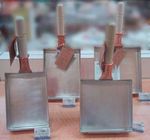
In Japanese cuisine rolled omelettes are made as rectangular thin omelettes and then rolled into a cylindrical or elongated cube shape using Japanese kitchen chopsticks. To obtain a roll with a constant diameter over the entire lengths, the thin omelette should be of rectangular shape. To obtain this shape a special rectangular frying pan is used.
Dimensions
The pans usually have a width of 10 to 35 cm and are often made of aluminiumAluminium
Aluminium or aluminum is a silvery white member of the boron group of chemical elements. It has the symbol Al, and its atomic number is 13. It is not soluble in water under normal circumstances....
or cast iron
Cast iron
Cast iron is derived from pig iron, and while it usually refers to gray iron, it also identifies a large group of ferrous alloys which solidify with a eutectic. The color of a fractured surface can be used to identify an alloy. White cast iron is named after its white surface when fractured, due...
. The best type is considered to be heavy copper
Copper
Copper is a chemical element with the symbol Cu and atomic number 29. It is a ductile metal with very high thermal and electrical conductivity. Pure copper is soft and malleable; an exposed surface has a reddish-orange tarnish...
coated with tin
Tin
Tin is a chemical element with the symbol Sn and atomic number 50. It is a main group metal in group 14 of the periodic table. Tin shows chemical similarity to both neighboring group 14 elements, germanium and lead and has two possible oxidation states, +2 and the slightly more stable +4...
, although care has to be taken to avoid damage to the pan due to the low melting point of tin. A cheaper, Teflon
Polytetrafluoroethylene
Polytetrafluoroethylene is a synthetic fluoropolymer of tetrafluoroethylene that finds numerous applications. PTFE is most well known by the DuPont brand name Teflon....
coated pan is available in many stores. The depth of the pans are usually from 3 cm to 4 cm. Their weights are usually from 0.5 kg to 2.5 kg.
There are three types of makiyakinabe: Kantō
Kanto region
The is a geographical area of Honshu, the largest island of Japan. The region includes the Greater Tokyo Area and encompasses seven prefectures: Gunma, Tochigi, Ibaraki, Saitama, Tokyo, Chiba, and Kanagawa. Within its boundaries, slightly more than 40 percent of the land area is the Kantō Plain....
-type, Kansai
Kansai
The or the lies in the southern-central region of Japan's main island Honshū. The region includes the prefectures of Mie, Nara, Wakayama, Kyoto, Osaka, Hyōgo, and Shiga. Depending on who makes the distinction, Fukui, Tokushima and even Tottori Prefecture are also included...
-type and Nagoya
Nagoya, Aichi
is the third-largest incorporated city and the fourth most populous urban area in Japan.Located on the Pacific coast in the Chūbu region on central Honshu, it is the capital of Aichi Prefecture and is one of Japan's major ports along with those of Tokyo, Osaka, Kobe, Yokohama, Chiba, and Moji...
-type. The Kantō-type pans are squared. The Kansai-type pans are tall-and-thin rectangles. The Nagoya-type pans are short-and-wide rectangles.
- Kantō-type
- Width: 10 cm to 30 cm; usually 15 to 25 cm
- Kansai-type
- Width: 10 cm to 30 cm; usually 15 to 25 cm
- Length: 15 cm to 35 cm; usually less than 1.5 x of the width
- Nagoya-type
- Width: 15 cm to 35 cm
- Length: 10 cm to 30 cm; usually 15 to 25 cm
The lid
The makiyakinabe is usually used with a thick wooden lid that is used to help people flip the omelette. One could use a platter instead though the task is said to be much easier with the lid.Uses
TamagoyakiTamagoyaki
This article is about a meal. For the Merzbow album, see Tamago .Tamagoyaki 卵焼き is a type of Japanese omelette, which is made by rolling together several layers of cooked egg...
(Japanese omelette) is also a common ingredient for sushi
Sushi
is a Japanese food consisting of cooked vinegared rice combined with other ingredients . Neta and forms of sushi presentation vary, but the ingredient which all sushi have in common is shari...
. The egg
Egg (food)
Eggs are laid by females of many different species, including birds, reptiles, amphibians, and fish, and have probably been eaten by mankind for millennia. Bird and reptile eggs consist of a protective eggshell, albumen , and vitellus , contained within various thin membranes...
, mixed with shrimp
Shrimp
Shrimp are swimming, decapod crustaceans classified in the infraorder Caridea, found widely around the world in both fresh and salt water. Adult shrimp are filter feeding benthic animals living close to the bottom. They can live in schools and can swim rapidly backwards. Shrimp are an important...
paste and sometimes paste of yam
Yam (vegetable)
Yam is the common name for some species in the genus Dioscorea . These are perennial herbaceous vines cultivated for the consumption of their starchy tubers in Africa, Asia, Latin America and Oceania...
, is heated in the pan until it is pliable.