


Machine embroidery

Encyclopedia
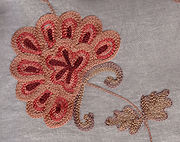
Embroidery
Embroidery is the art or handicraft of decorating fabric or other materials with needle and thread or yarn. Embroidery may also incorporate other materials such as metal strips, pearls, beads, quills, and sequins....
process whereby a sewing machine
Sewing machine
A sewing machine is a textile machine used to stitch fabric, cards and other material together with thread. Sewing machines were invented during the first Industrial Revolution to decrease the amount of manual sewing work performed in clothing companies...
or embroidery machine is used to create patterns on textiles. It is used commercially in product branding, corporate advertising, and uniform adornment. Hobbyists also machine embroider for personal sewing and craft projects.
There are two main types of machine embroidery. The first, free-motion sewing machine embroidery, uses a basic zigzag sewing machine. The second, computerized machine embroidery, uses an embroidery machine or sewing/embroidery machine.
Free-motion machine embroidery
In free-motion machine embroidery, embroidered designs are created by using a basic zigzag sewing machine. As it is used primarily for tailoring, this type of machine lacks the automated features of a specialized machine.To create free-motion machine embroidery, the embroiderer runs the machine and skillfully moves tightly hooped fabric under the needle to create a design. The operator lowers or covers the "feed dogs" or machine teeth and moves the fabric manually. The operator develops the embroidery manually, using the machine's settings for running stitch
Running stitch
The running stitch or straight stitch is the basic stitch in hand-sewing and embroidery, on which all other forms of sewing are based. The stitch is worked by passing the needle in and out of the fabric...
and fancier built-in stitches. In this way, the stitches form an image onto a piece of fabric. An embroiderer can produce a filled-in effect by sewing many parallel rows of straight stitching. A machine's zigzag stitch
Zigzag stitch
A zigzag stitch is variant geometry of the lockstitch. It is a back-and-forth stitch used where a straight stitch will not suffice, such as in reinforcing buttonholes, in stitching stretchable fabrics, and in temporarily joining two work pieces edge-to-edge....
can create thicker lines within a design or be used to create a border. Many quilters and fabric artists use a process called thread drawing (or thread painting) to create embellishments on their projects or to create textile art.
Free-motion machine embroidery can be time-consuming. Since a standard sewing machine only has one needle, the operator must stop and re-thread the machine manually for each subsequent color in a multi-color design. He or she must also manually trim and clean up loose or connecting threads after the design is completed.
As this is a manual process rather than a digital reproduction, any pattern created using free-motion machine embroidery is unique and cannot be exactly reproduced, unlike with computerized embroidery.
With the advent of computerized machine embroidery, the main use of manual machine embroidery is in fiber art
Fiber art
Fiber art is a style of fine art which uses textiles such as fabric, yarn, and natural and synthetic fibers. It focuses on the materials and on the manual labour involved as part of its significance.-Fiber:...
and quilting
Quilting
Quilting is a sewing method done to join two or more layers of material together to make a thicker padded material. A quilter is the name given to someone who works at quilting. Quilting can be done by hand, by sewing machine, or by a specialist longarm quilting system.The process of quilting uses...
projects. Though some manufacturers still use manual embroidery to embellish garments, many prefer computerized embroidery's ease and reduced costs.
Computerized machine embroidery
Most modern embroidery machines are computer controlled and specifically engineered for embroidery.Industrial and commercial embroidery machines and combination sewing-embroidery machines have a hooping or framing system that holds the framed area of fabric taut under the sewing needle and moves it automatically to create a design from a pre-programmed digital embroidery pattern.
Depending on its capabilities, the machine will require varying degrees of user input to read and sew embroidery designs. Sewing-embroidery machines generally have only one needle and require the user to change thread colors during the embroidery process. Multi-needle industrial machines are generally threaded prior to running the design and do not require re-threading. These machines require the user to input the correct color change sequence before beginning to embroider. Some can trim and change colors automatically.
A multi-needle machine may consist of multiple sewing heads, each of which can sew the same design onto a separate garment concurrently. Such a machine might have 20 or more heads, each consisting of 15 or more needles. A head is usually capable of producing many special fabric effects, including satin stitch
Satin stitch
In sewing and embroidery, a satin stitch or damask stitch is a series of flat stitches that are used to completely cover a section of the background fabric...
embroidery, chain stitch
Chain stitch
Chain stitch is a sewing and embroidery technique in which a series of looped stitches form a chain-like pattern. Chain stitch is an ancient craft - examples of surviving Chinese chain stitch embroidery worked in silk thread have been dated to the Warring States period...
embroidery, sequin
Sequin
Sequins are disk-shaped beads used for decorative purposes. They are available in a wide variety of colors and geometrical shapes. Sequins are commonly used on clothing, jewelry, bags, shoes and lots of other accessories. Large sequins, fastened only at the top, have been used on billboards and...
s, appliqué
Applique
In its broadest sense, an appliqué is a smaller ornament or device applied to another surface. In the context of ceramics, for example, an appliqué is a separate piece of clay added to the primary work, generally for the purpose of decoration...
, and cutwork
Cutwork
Cutwork or cut work is a needlework technique in which portions of a textile are cut away and the resulting "hole" is reinforced and filled with embroidery or needle lace.Cutwork is a related to drawn thread work...
.
History
Before computers were affordable, most embroidery was completed by punching designs on paper tape that then ran through an embroidery machine. One error could ruin an entire design, forcing the creator to start over.In 1980, Wilcom introduced the first computer graphics embroidery design system to run on a minicomputer. Melco
Melco
Melco Holdings Inc. is a family business founded by Makoto Maki in 1975. The name stands for Maki Engineering Laboratory COmpany...
, an international distribution network formed by Randal Melton and Bill Childs, created the first embroidery sample head for use with large Schiffli
Chemical lace
Chemical Lace is a form of machine-made lace. This method of lace-making is done by embroidering a pattern on a sacrificial fabric that has been chemically treated so as to disintegrate after the pattern has been created.This embroidery is typically done on a multi-head or multi-needle Schiffli...
looms. These looms spanned several feet across and produced lace patches and large embroidery patterns. The sample head allowed embroiderers to avoid manually sewing the design sample and saved production time. Subsequently, it became the first computerized embroidery machine marketed to home sewers.
The economic conditions of the Reagan Years, coupled with tax incentives for home businesses, helped propel Melco to the top of the market. At the Show of the Americas in 1980, Melco unveiled the Digitrac, a digitizing system for embroidery machines. The digitized design was composed at six times the size of the embroidered final product. The Digitrac consisted of a small computer, similar in size to a BlackBerry
BlackBerry
BlackBerry is a line of mobile email and smartphone devices developed and designed by Canadian company Research In Motion since 1999.BlackBerry devices are smartphones, designed to function as personal digital assistants, portable media players, internet browsers, gaming devices, and much more...
, mounted on an X and Y axis on a large white board. It sold for $30,000. The original single-needle sample head sold for $10,000 and included a 1" paper-tape reader and 2 fonts. The digitizer marked common points in the design to create elaborate fill and satin stitch
Satin stitch
In sewing and embroidery, a satin stitch or damask stitch is a series of flat stitches that are used to completely cover a section of the background fabric...
combinations.
Melco patented the ability to sew circles with a satin stitch, as well as arched lettering generated from a keyboard. An operator digitized the design using similar techniques to punching, transferring the results to a 1" paper tape or later to a floppy disk. This design would then be run on the embroidery machine, which stitched out the pattern. Wilcom enhanced this technology in 1982 with the introduction of the first multi-user system, which allowed more than one person to work on the embroidery process, streamlining production times.
Brother Industries
Brother Industries
is a diversified Japanese company that produces or imports a wide variety of products including printers, sewing machines, large machine tools, label printers, and typewriters, fax machines, and other computer-related electronics. It markets its multifunction printers as Multi-Function Centers...
entered the embroidery industry after several computerized embroidery companies contracted it to provide sewing heads. Later, the Japanese company Tajima provided sewing heads that were capable of using multiple threads. Singer
Singer Corporation
Singer Corporation is a manufacturer of sewing machines, first established as I.M. Singer & Co. in 1851 by Isaac Merritt Singer with New York lawyer Edward Clark. Best known for its sewing machines, it was renamed Singer Manufacturing Company in 1865, then The Singer Company in 1963. It is...
failed to remain competitive during this time. Melco was acquired by Saurer
Saurer
Adolph Saurer AG was a Arbon, Switzerland , based manufacturer of trucks and buses, under the Saurer and Berna brand names, and active between 1903 and 1982....
in 1989.
The major embroidery machine companies eventually adapted their commercial systems and marketed them to companies such as Janome for home use.
Since the late 1990s, computerized machine embroidery has grown in popularity as costs have fallen for computers, software, and embroidery machines. Many machine manufacturers sell their own lines of embroidery patterns. In addition, many individuals and independent companies also sell embroidery designs, and there are free designs available on the internet.
The computerized machine embroidery process
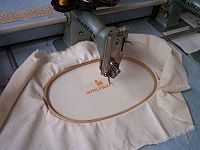
- purchase or create a digitized embroidery design file
- edit the design and/or combine with other designs (optional)
- load the final design file into the embroidery machine
- stabilize the fabric and place it in the machine
- start and monitor the embroidery machine
Design files
Digitized embroidery design files can be either purchased or created with industry-specific embroidery digitizing software. Embroidery file formats broadly fall into two categories. The first, source formats, are specific to the software used to create the design. For these formats, the digitizer keeps the original file for the purposes of editing. The second, machine formats, are specific to a particular brand of embroidery machine. Here, the files are available for use with particular embroidery machines and are not easily edited or scaled.Embroidery machines generally have one or more machine formats specific to their brand. However, some formats such as Tajima's .dst, Melco's .exp/.cnd and Barudan's .fdr have become so prevalent that they have effectively become industry standards and are often supported by machines built by rival companies.
Machine formats generally contain primarily stitch data (offsets) and machine functions (trims, jumps, etc.) and are thus not easily scaled or edited without extensive manual work.
Many embroidery designs can be downloaded in popular machine formats from embroidery web sites. However, since not all designs are available for every machine's specific format, some machine embroiderers use conversion programs to convert from one machine's format file to another, with various degrees of reliability.
A person who creates a design is known as an embroidery digitizer or puncher. A digitizer uses software to create an object-based embroidery design, which can be easily reshaped and edited. These files retain important information such as object outlines, thread colors, and original artwork used to punch the designs. When the file is converted to a stitch file, it loses much of this information, rendering editing difficult or impossible.
Software vendors often advertise auto-punching or auto-digitizing capabilities. However, if high quality embroidery is essential, then industry experts highly recommend either purchasing solid designs from reputable digitizers or obtaining training on solid digitization techniques.
Editing designs
Once a design has been digitized, an embroiderer can use software to edit it or combine it with other designs. Most embroidery programs allow the user to rotate, scale, move, stretch, distort, split, crop, or duplicate the design in an endless pattern. Most software allows the user to add text quickly and easily. Often the colors of the design can be changed, made monochrome, or re-sorted. More sophisticated packages allow the user to edit, add, or remove individual stitches. Some embroidery machines have rudimentary built-in design editing features.Loading the design
After editing the final design, the file is loaded into the embroidery machine. Different machines require different formats. The most common home design format is PES. Other common design file formats for the home and hobby market include ART, PES, VIP, JEF, SEW, and HUS. Embroidery patterns can be transferred to the computerized embroidery machines through cables, CDs, floppy disks, USB interfaces, or special cards that resemble flash or compact cards.Stabilizing the fabric
To prevent wrinkles and other problems, the fabric must be stabilized. The method of stabilizing depends on the type of machine, the fabric type, and the design density. For example, knits and large designs typically require firm stabilization. There are many methods for stabilizing fabric, but most often one or more additional pieces of material called stabilizers or interfacing are added beneath or on top of the fabric, or both. Stabilizer types include cut-away, tear-away, vinyl, nylon, water-soluble, heat-n-gone, peel and stick, and open mesh, sometimes in various combinations.For smaller embroidered items, the fabric is placed in a hoop, which is attached to the machine. A mechanism called an arm moves the hoop under the needle.
Embroidering the design
Finally, the embroidery machine is started and monitored. For commercial machines, this process is more automated than for the home machines. Many designs require more than one color and may involve additional processing for appliqués, foam, or other special effects. Since home machines only have one needle, every color change requires the user to cut the thread and change the color manually. In addition, most designs have one or more jumps that need to be cut. Depending on the quality and size of the design, sewing a design file can require anywhere from a few minutes to over an hour.Embroidery machines
Not all machines are solely used for embroidery; some are also used for sewing. Some of the more advanced features becoming available include a large color touchscreen, a USB interface, auto threading, built-in design editing software, embroidery adviser software, and design file storage systems. Commercial embroidery machines can be purchased with a set number of heads (1, 2, 3, 4, 6, 12, 15, or 18). Industrial embroidery machines are available with 12 to 56 heads.Commercial and contract embroidery factories
Factories can have a few small machines or many large machines, or any combination of machines.Contract embroidery is done on goods that the customer supplies to the embroidery house and is limited to the trade. A company offering contract embroidery sews designs onto wearable items for brokers, other embroiderers, specialty firms, and screen printers at a wholesale rates. The customer of a contract embroiderer usually supplies the items to the factory and only pays for the embroidery service.
Commercial embroiderers offer their services to the public and supply the wearable items.and know the latest designe available in market and top of foil.
Other supplies
Almost any type of fabric can be embroidered, given the proper stabilizer. Base materials include paper, fabric, and lightweight balsa wood.Machine embroidery commonly uses polyester, rayon, or metallic embroidery thread, though other thread types are available. 40 wt thread is the most commonly used embroidery thread weight. Bobbin thread is usually either 60 wt or 90 wt. The quality of thread used can greatly affect the number of thread breaks and other embroidery problems. Polyester thread is generally more color-safe and durable. High quality embroidery thread is produced by Madeira and Robison-Anton.
Other associated costs are thread, stabilizer, purchased designs, needles, bobbins, and other miscellaneous tools and supplies.
Embroidery glossary
A more thorough list of applicable terminologies is available at http://abcoln.com/glossary.php.Appliqué
Applique
In its broadest sense, an appliqué is a smaller ornament or device applied to another surface. In the context of ceramics, for example, an appliqué is a separate piece of clay added to the primary work, generally for the purpose of decoration...
: French term meaning applying, usually by sewing, one piece of fabric to the surface of another. A cut piece of material stitched to another adds dimension and texture and reduces the stitch count.
Backer/Stabilizer: Backing and stabilizer are often used interchangeably to refer to materials, generally non-woven textiles, which are placed inside or under the item to be embroidered. The backing provides support and stability to the garment which will improve the quality of the finished embroidered product. Backings come primarily in two types: cutaway and tear-away. With cutaway, the excess backing is cut with a pair of scissors. With tear-away, the excess is torn away after the item is embroidered. Additional types of stabilizer can be dissolved by water or heat.
Bobbin
Bobbin
A bobbin is a spindle or cylinder, with or without flanges, on which wire, yarn, thread or film is wound. Bobbins are typically found in sewing machines, cameras, and within electronic equipment....
: A small spool of thread inside the rotary hook housing of a sewing machine. The bobbin thread forms the stitches on the underside of the garment. The bobbin on an embroidery machine works in the same manner and for the same purpose as on a standard sewing machine.
Digitize: The computerized technique of turning a design image into an embroidery program. Special software is used to create plotting commands for the embroidery machine. The commands are transferred to the machine's logic head by a designated embroidery language.
Fill Stitch: Fill stitches are a series of running stitches sewn closely together to form broad areas of embroidery with varying patterns and stitch directions.
Hoop
Embroidery hoop
Embroidery hoops and frames are tools used to keep fabric taut while working embroidery or other forms of needlework.-Hoops:An embroidery hoop or tambour frame consists of a pair of concentric circular or elliptical rings. The larger ring has a tightening device, usually in the form of a metal...
: A clamping device used to hold the backing and fabric in place in the machine.
Running Stitch
Running stitch
The running stitch or straight stitch is the basic stitch in hand-sewing and embroidery, on which all other forms of sewing are based. The stitch is worked by passing the needle in and out of the fabric...
: One straight line of stitches, often used for fine details, outlining, and underlay.
Satin Stitch
Satin stitch
In sewing and embroidery, a satin stitch or damask stitch is a series of flat stitches that are used to completely cover a section of the background fabric...
: Also known as zigzag stitch, a satin stitch is a line, border or edge produced by thread being alternately stitched to either side of a baseline. Satin stitches are generally limited to a maximum of 1/2" in stitch length before some alternate technique must be used, such as split stitching or fill stitching.
Underlay: A stabilizing pattern of embroidery which, if used, precedes the main body of satin or fill stitching. It consists of one or a combination of running stitches for centering, edging, paralleling, or zigzagging the design area.