

Quilting

Encyclopedia
Sewing
Sewing is the craft of fastening or attaching objects using stitches made with a needle and thread. Sewing is one of the oldest of the textile arts, arising in the Paleolithic era...
method done to join two or more layers of material together to make a thicker padded material. A quilter is the name given to someone who works at quilting. Quilting can be done by hand, by sewing machine
Sewing machine
A sewing machine is a textile machine used to stitch fabric, cards and other material together with thread. Sewing machines were invented during the first Industrial Revolution to decrease the amount of manual sewing work performed in clothing companies...
, or by a specialist longarm quilting
Longarm quilting
Longarm quilting is the process by which a longarm sewing machine is used to sew together a quilt top, quilt batting and quilt backing into a finished quilt.The longarm sewing machine typically ranges from 10 to 14 feet in length...
system.
The process of quilting uses a needle
Sewing needle
A sewing needle is a long slender tool with a pointed tip. The first needles were made of bone or wood; modern ones are manufactured from high carbon steel wire, nickel- or 18K gold plated for corrosion resistance. The highest quality embroidery needles are plated with two-thirds platinum and...
and thread
Yarn
Yarn is a long continuous length of interlocked fibres, suitable for use in the production of textiles, sewing, crocheting, knitting, weaving, embroidery and ropemaking. Thread is a type of yarn intended for sewing by hand or machine. Modern manufactured sewing threads may be finished with wax or...
to join two or more layers of material to make a quilt
Quilt
A quilt is a type of bed cover, traditionally composed of three layers of fiber: a woven cloth top, a layer of batting or wadding and a woven back, combined using the technique of quilting. “Quilting” refers to the technique of joining at least two fabric layers by stitches or ties...
. Typical quilting is done with three layers: the top fabric or quilt top, batting
Batting (material)
Batting is a layer of insulation used in quilting between a top layer of patchwork and a bottom layer of backing material. Batting is usually made of cotton, polyester, and/or wool....
or insulating material and backing material. The quilter's hand or sewing machine
Sewing machine
A sewing machine is a textile machine used to stitch fabric, cards and other material together with thread. Sewing machines were invented during the first Industrial Revolution to decrease the amount of manual sewing work performed in clothing companies...
passes the needle and thread through all layers and then brings the needle back up. The process is repeated across the entire piece where quilting is wanted. A rocking, straight or running stitch
Running stitch
The running stitch or straight stitch is the basic stitch in hand-sewing and embroidery, on which all other forms of sewing are based. The stitch is worked by passing the needle in and out of the fabric...
is commonly used and these stitches can be purely functional or decorative and elaborate. Quilting is done to create bed spreads, art quilt wall hangings, clothing, and a variety of textile products. Quilting can make a project thick, or with dense quilting, can raise one area so that another stands out.
Quilt stores often sell fabric, thread, patterns and other goods that are used for quilting. They often have group sewing and quilting classes, where one can learn how to sew or quilt and work with others to exchange skills. Quilt stores often have quilting machines that can be rented out for use, or customers can drop off their quilts and have them professionally quilted.
Early functional quilting
The word quilt comes from the Latin culcita meaning a stuffed sack, but it came into the English language from the French word cuilte. The origins of quilting remain unknown, but historians do know that quilting, piecing, and applique were used for clothing and furnishings in diverse parts of the world in early times. The earliest known quilted garment is on the carved ivory figure of a Pharaoh of the Egyptian First Dynasty about 3400 B.C. In 1924 archaeologists discovered a quilted floor covering in Mongolia. They estimated that it dates from somewhere between the first century B.C. to the second century A.D. There are also numerous references to quilts in literature and also inventories of estates. Crusaders brought quilting to Europe from the Middle East in the late 11th century. Quilted garments were popular in the Middle Ages. Knights wore them under their armor for comfort. They also used quilted garments to protect the metal armor from the elements (rain, snow, sun). The earliest known surviving bed quilt is one from Sicily from the end of the fourteenth century. It is made of linen and padded with wool. The blocks across the center are scenes from the legend of Tristan. The quilt is 122" by 106" and is in the Victoria and Albert Museum in London.Quilting has been part of the needlework tradition in Europe from about the 5th century CE. Early objects contain Egyptian cotton, which may indicate that Egyptian and Mediterranean trade provided a conduit for the technique. Quilted objects were relatively rare in Europe until approximately the 12th century, when quilted bedding and other items appeared after the return of the Crusaders from the Middle East. The medieval quilted gambeson
Gambeson
A gambeson is a padded defensive jacket, worn as armour separately, or combined with mail or plate armour. Gambeson were produced with a sewing technique called quilting. Usually constructed of linen or wool, the stuffing varied, and could be for example scrap cloth or horse hair...
, aketon and arming doublet were garments worn under, or instead of, armor of maille
Maillé
Maillé may refer to the following places in France:* Maillé, Indre-et-Loire, a commune in the Indre-et-Loire department, site of a 1944 war crime* Maillé, Vendée, a commune in the Vendée department* Maillé, Vienne, a commune in the Vienne department...
or plate armor. These developed into the later quilted doublet
Doublet (clothing)
A doublet is a man's snug-fitting buttoned jacket that is fitted and shaped to the man's body which was worn in Western Europe from the Middle Ages through to the mid-17th century. The doublet was hip length or waist length and worn over the shirt or drawers. Until the end of the 15th century the...
worn as part of fashionable European male clothing from the 14th to 17th century. Quilting clothing began to be generally used in the 14th century, with quilted doublets and armor worn in France, Germany, and England and quilted tunics in Italy.
American quilts
In American Colonial times, most women were busy spinning, weaving, and making clothing. Meanwhile, women of the wealthier classes prided themselves on their fine quilting of wholecloth quilts with fine needleworkNeedlework
Needlework is a broad term for the handicrafts of decorative sewing and textile arts. Anything that uses a needle for construction can be called needlework...
. Quilts made during the early 19th century were not constructed of pieced blocks but were instead whole cloth quilts. Broderie perse
Broderie perse
Broderie Perse is a style of applique embroidery which uses printed elements to create a scene on the background fabric. It was most popular in Europe in the 17th century, and probably travelled from India, as there are some earlier findings there...
quilts and medallion quilts were made. Some antique quilts made in North America have worn-out blankets or older quilts as the internal batting layer, quilted between new layers of fabric and thereby extending the usefulness of old material.
During American pioneer days, "paper" quilting became popular. Paper was used as a pattern and each individual piece of cut fabric was basted around the paper pattern. Paper was a scarce commodity in the early American west, and women would save letters from home, newspaper clippings, and catalogs to use as patterns. The paper not only served as a pattern but as an insulator. The paper found between the old quilts has become a primary source of information about pioneer life.
Quilts made without any insulation or batting were referred to as summer quilts. They were not made for warmth, only to keep the chill off during cooler summer evenings.
African-American quilts
African-American women developed a distinctive style of quilting, notably different from the style most strongly associated with the AmishAmish
The Amish , sometimes referred to as Amish Mennonites, are a group of Christian church fellowships that form a subgroup of the Mennonite churches...
.
Harriet Powers
Harriet Powers
Harriet Powers was an African American slave, folk artist and quilt maker from rural Georgia. She used traditional appliqué techniques to record local legends, Bible stories, and astronomical events on her quilts...
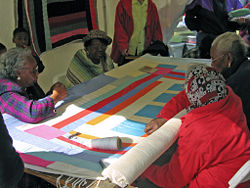
, a slave-born African American woman, made two famous story quilts. She was just one of the many African American quilters who contributed to the evolution of quilting. The Gee's Bend quilting community was celebrated in an exhibition that travelled to museums including the Smithsonian. The contributions made by her and other quilters of Gee's Bend, Alabama
The Quilts of Gees Bend
The Quilts of Gees Bend were created by a group of women who live in the isolated, African American hamlet of Gee's Bend, Alabama. Like many American quilters, the women transformed a necessity into a work of pleasure....
has been recognized by the US Postal Service with a series of stamps. The communal nature of the quilting process (and how it can bring together women of varied races and backgrounds) was honored in the movie How to Make an American Quilt
How to Make an American Quilt
How to Make an American Quilt is a 1995 movie which was directed by Jocelyn Moorhouse and stars Winona Ryder, Maya Angelou, Ellen Burstyn and Anne Bancroft...
.
Art quilting
During the late 20th century, art quilts became popular for their aesthetic and artistic qualities rather than for functionality (they are displayed on a wall or table rather than spread on a bed).Quilting in fashion and design
Unusual quilting designs have increasingly become popular as decorative textiles. Industrial sewing technology has become more precise and flexible, and quilting using exotic fabrics and embroidery began to appear in home furnishings in the early 21st century.Types and equipment
Many types of quilting exist today. The two most widely used are hand-quilting and machine quilting.Hand quilting is the process of using a needle
Sewing needle
A sewing needle is a long slender tool with a pointed tip. The first needles were made of bone or wood; modern ones are manufactured from high carbon steel wire, nickel- or 18K gold plated for corrosion resistance. The highest quality embroidery needles are plated with two-thirds platinum and...
and thread
Yarn
Yarn is a long continuous length of interlocked fibres, suitable for use in the production of textiles, sewing, crocheting, knitting, weaving, embroidery and ropemaking. Thread is a type of yarn intended for sewing by hand or machine. Modern manufactured sewing threads may be finished with wax or...
to sew a running stitch
Running stitch
The running stitch or straight stitch is the basic stitch in hand-sewing and embroidery, on which all other forms of sewing are based. The stitch is worked by passing the needle in and out of the fabric...
by hand across the entire area to be quilted. This binds the layers together. A quilting frame or hoop is often used to assist in holding the piece being quilted off the quilter's lap. A quilter can make one running stitch at a time; this is called a stab stitch. Another option is called a rocking stitch, where the quilter has one hand, usually with a finger wearing a thimble
Thimble
A thimble is a small hard pitted cup worn for protection on the finger that pushes the needle in sewing.The earliest known thimble was Roman and was found at Pompeii. Made of bronze, its creation has been dated to the 1st century AD...
, on top of the quilt, while the other hand is located beneath the piece to push the needle back up. The third option is called "loading the needle" and involves doing four or more stitches before pulling the needle through the cloth. Hand quilting is still practiced by the Amish and Mennonites within the United States and Canada, and is enjoying a resurgence worldwide.
Machine quilting is the process of using a home sewing machine
Sewing machine
A sewing machine is a textile machine used to stitch fabric, cards and other material together with thread. Sewing machines were invented during the first Industrial Revolution to decrease the amount of manual sewing work performed in clothing companies...
or a longarm machine to sew the layers together. With the home sewing machine, the layers are tacked together before quilting. This involves laying the top, batting, and backing out on a flat surface and either pinning (using large safety pins) or tacking
Tack (sewing)
In sewing, to tack or baste is to make quick, temporary stitching intended to be removed. Tacking is used in a variety of ways:* To temporarily hold a seam or trim in place until it can be permanently sewn, usually with a long running stitch made by hand or machine called a tacking stitch or...
the layers together. Longarm Quilting involves placing the layers to be quilted on a special frame. The frame has bars on which the layers are rolled, keeping these together without the need for basting or pinning. These frames are used with a professional sewing machine mounted on a platform. The platform rides along tracks so that the machine can be moved across the layers on the frame. A Longarm machine is moved across the fabric. In contrast, the fabric is moved through a home sewing machine.
Tying is another technique of fastening the three layers together (and is not a form of quilting at all). This is done primarily on quilts that are made to be used and are needed quickly. The process of tying the quilt is done with yarn
Yarn
Yarn is a long continuous length of interlocked fibres, suitable for use in the production of textiles, sewing, crocheting, knitting, weaving, embroidery and ropemaking. Thread is a type of yarn intended for sewing by hand or machine. Modern manufactured sewing threads may be finished with wax or...
s or multiple strands of thread
Thread (yarn)
Thread is a kind of yarn used for sewing.-Materials:Thread is made from just about everything. Following table lists common materials, a general description and what they are supposed to be good for. If your machine will sew with the thread, any thread can used for just about any purpose. This...
. Square knot
Reef knot
The reef knot or square knot is an ancient and simple binding knot used to secure a rope or line around an object. Although the reef knot is often seen used for tying two ropes together, it is not recommended for this purpose due to potential instability of the knot.A reef knot is formed by tying...
s are used to finish off the ties so that the quilt may be washed and used without fear of the knots coming undone. This technique is commonly called "tacking." In the Midwest, tacked bed covers are referred to as comforters.
Quilting is now taught in some American schools. It is also taught at senior centers around the U.S., but quilters of all ages attend classes. These forms of workshop or classes are also available in other countries in guilds and community colleges.
Contemporary quilters use a wide range of quilting designs and styles, from ancient and ethnic to post-modern futuristic patterns. There is no one single school or style that dominates the quilt-making world.
Traditional
Traditional quilting is a six-step process that includes: 1) selecting a pattern, fabrics and batting; 2) measuring and cutting fabrics to the correct size to make blocks from the pattern; 3) piecing (sewing cut pieces of fabric together using a sewing machine or by hand to make blocks) blocks together to make a finished "top"; 4) layering the quilt top with batting and backing, to make a "quilt sandwich"; 5) quilting by hand or machine through all layers of the quilt sandwich; and 6) squaring up and trimming excess batting from the edges, machine sewing the binding to the front edges of the quilt and then hand-stitching the binding to the quilt backing. Note: If the quilt will be hung on the wall, there is an additional step: making and attaching the hanging sleeve.Definitions
- Piecing: Sewing small pieces of cloth into patterns, called blocks, that are then sewn together to make a finished quilt top. These blocks may be sewn together, edge to edge, or separated by strips of cloth called sashing. Note: Whole cloth quilts typically are not pieced, but are made using a single piece of cloth for the quilt top.
- Layering: Placing the quilt top over the batting and the backing.
- Borders: Typically strips of fabric of various widths added to the perimeter of the pieced blocks to complete the quilt top. Note: borders may also be made up of simple or patterned blocks that are stitched together into a row, before being added to the quilt top.
- Binding: Long fabric strips cut on the biasBias (textile)The bias or cross-grain direction of a piece of woven fabric, usually referred to simply as "the bias" or "the cross-grain", is at 45 degrees to its warp and weft threads. Every piece of woven fabric has two biases, perpendicular to each other...
that are attached to the borders of the quilt. Binding is typically machine sewn to the front side of the edge of the quilt, folded over twice, and hand sewn to the back side of the quilt.
- Quilting: Stitching through all three layers of the quilt (the quilt top, the batting, and the quilt back), typically in decorative patterns, which serves three purposes:
- to secure the layers to each other,
- to add to the beauty and design of the finished quilt, and
- to trap air within the quilted sections, making the quilt as a whole much warmer than its parts.
Quilting is usually completed by starting from the middle, and moving outward toward the edges of the quilt.
Quilting can be elaborately decorative, comprising stitching fashioned into complex designs and patterns, simple or complex geometric grids, "motifs" traced from published quilting patterns or traced pictures, freehand, or complex repeated designs called tessellations. The quilter may choose to emphasize these designs by using threads that are multicolored or metallic, or that contrast highly to the fabric. Conversely, the quilter may choose to make the quilting disappear, using "invisible" nylon or polyester thread,thread that matches the quilt top, or stitching within the patchwork seams themselves (commonly known as "stitch in the ditch"). Some quilters draw the quilting design on the quilt top before stitching, while others prefer to stitch "freehand."
Quilting is often combined with embroidery
Embroidery
Embroidery is the art or handicraft of decorating fabric or other materials with needle and thread or yarn. Embroidery may also incorporate other materials such as metal strips, pearls, beads, quills, and sequins....
, patchwork
Patchwork
Patchwork or "pieced work" is a form of needlework that involves sewing together pieces of fabric into a larger design. The larger design is usually based on repeat patterns built up with different colored shapes. These shapes are carefully measured and cut, straight-sided, basic geometric shapes...
, applique
Applique
In its broadest sense, an appliqué is a smaller ornament or device applied to another surface. In the context of ceramics, for example, an appliqué is a separate piece of clay added to the primary work, generally for the purpose of decoration...
, and other forms of needlework
Needlework
Needlework is a broad term for the handicrafts of decorative sewing and textile arts. Anything that uses a needle for construction can be called needlework...
.
Specialty styles
- Foundation piecing - also known as paper-piecing - sewing pieces of fabric onto a temporary or permanent foundation
- Shadow or Echo Quilting - Hawaiian Quilting, where quilting is done around an appliquéd piece on the quilt top, then the quilting is echoed again and again around the previous quilting line.
- Ralli Quilting - Indian quilting, often associated with the Gujarat region.
- Sashiko quiltingSashiko quiltingis a form of decorative reinforcement stitching from Japan. Traditionally used to reinforce points of wear, or to repair worn places or tears with patches, this running stitch technique is often used for purely decorative purposes in quilting and embroidery...
- Basic running stitch worked in heavy, white cotton thread usually on dark indigo colored fabric. It was originally used by the working classes to stitch layers together for warmth. - Trapunto quiltingTrapunto quiltingTrapunto, from the Italian for "to embroider," is a method of quilting that is also called "stuffed technique." A puffy, decorative feature, trapunto utilizes at least two layers, the underside of which is slit and padded, producing a raised surface on the quilt.-Technique:Trapunto is often...
- stuffed quilting, often associated with Italy. - Machine Trapunto quilting - a process of using water soluble thread and an extra layer of batting to achieve trapunto design and then sandwiching the quilt and re-sewing the design with regular cotton thread.
- Shadow trapunto- This involves quilting a design in fine LawnLawn clothLawn cloth or lawn is a plain weave textile, originally of linen but now chiefly cotton. Lawn is designed using fine, high count yarns, which results in a silky, untextured feel. The fabric is made using either combed or carded yarns. When lawn is made using combed yarns, with a soft feel and...
and filling some of the spaces in the pattern with small lengths of colored woolWoolWool is the textile fiber obtained from sheep and certain other animals, including cashmere from goats, mohair from goats, qiviut from muskoxen, vicuña, alpaca, camel from animals in the camel family, and angora from rabbits....
. - TivaevaeTivaevaeTivaevae or tivaivai in the Cook Islands, tifaifai in French Polynesia, is a form of art at which Polynesian women excel. Tivaevae means to stitch or sew and Cook Islands women make magnificent bed covers called tivaevae. The tivaevae are either made by one woman or can be created in groups of...
or tifaifai - A distinct art from the Cook IslandsCook IslandsThe Cook Islands is a self-governing parliamentary democracy in the South Pacific Ocean in free association with New Zealand...
. - Watercolor Quilting - A sophisticated form of scrap quilting whereby uniform sizes of various prints are arranged and sewn to create a picture or design. See also ColorwashPatchwork quiltA patchwork quilt is a quilt in which the top layer consists of pieces of fabric sewn together to form a design. The quilting design does not necessarily follow the patchwork design, and the design of the quilting may play off the patchwork design....
. - Thread Art - A custom style of sewing where thread is layered to create the picture on the quilt. See this picture for an example (http://www.agww.net/html/agww_merchandise_2.html).
- Mystery Quilts; this style of quilting involves using up a mixture of squares left over from previous projects. Sometimes test pieces and experiments find their way into a new project to form a new quilt. If a square is too small a filler piece will be added to make up a square. Different styles and colours are intergrated to compliment each other. Nothing is wasted.
Quilting software
- Quilted Photo Deluxe
- EQ7 http://www.electricquilt.com
- PC Quilt
- Quiltsoft
- QuiltPro
- Quilting Studio
- SewPrecise
See also
- Quilt ArtQuilt artQuilt art, sometimes known as art quilting, is an art form that uses traditional quilting techniques to create art objects. Practitioners of quilt art create it based on their experiences, imagery, and ideas rather than traditional patterns. Quilt art generally has more in common with the fine arts...
- Broderie perseBroderie perseBroderie Perse is a style of applique embroidery which uses printed elements to create a scene on the background fabric. It was most popular in Europe in the 17th century, and probably travelled from India, as there are some earlier findings there...
- Counterpane
- DuvetDuvetA duvet from the French duvet "down"), is a type of bedding — a soft flat bag filled with down, feathers, or a synthetic alternative, and protected with a removable cover, analogous to a pillow and pillow case...
- TessellationTessellationA tessellation or tiling of the plane is a pattern of plane figures that fills the plane with no overlaps and no gaps. One may also speak of tessellations of parts of the plane or of other surfaces. Generalizations to higher dimensions are also possible. Tessellations frequently appeared in the art...
- Machine quiltingMachine quiltingMachine quilting is quilting made using a sewing machine to stitch in rows or patterns using select techniques to stitch through layers of fabric and batting in the manner of old-style hand-quilting...
- Mathematics and fiber artsMathematics and fiber artsMathematical ideas have been used as inspiration for a number of fiber arts including quilt making, knitting, cross-stitch, crochet, embroidery and weaving...
- Quilt TrailQuilt TrailA Quilt Trail is a series of painted wood or metal, hung or free standing, quilt squares installed at various locations along a route, emphasizing significant architecture and/or aesthetic landscapes...