
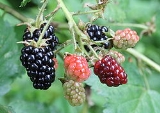
Blackberry
The blackberry is a widespread and well known
shrub; commonly called a
bramble in the eastern U.S. and Europe but a caneberry in the western U.S. growing to 3 m and producing a soft-bodied
fruit popular for use in desserts, jams, seedless jellies and sometimes
wine. Several
Rubus is a genus [i] of plant [i] in the Family Rosaceae [i], Subfamily Rosoideae [i]. ...
species are called blackberry and since the species easily hybridize, there are many
cultivars with more than one species in their ancestry.
The blackberry has a scrambling habit of dense arching stems carrying short curved very sharp spines , the branches rooting from the node tip when they reach the ground.
Encyclopedia
The
blackberry is a widespread and well known
shrub; commonly called a
bramble in the eastern U.S. and Europe but a caneberry in the western U.S. growing to 3 m and producing a soft-bodied
fruit popular for use in desserts, jams, seedless jellies and sometimes
wine. Several
Rubus is a genus [i] of plant [i] in the Family Rosaceae [i], Subfamily Rosoideae [i]. ...
species are called blackberry and since the species easily hybridize, there are many
cultivars with more than one species in their ancestry.
The blackberry has a scrambling habit of dense arching stems carrying short curved very sharp spines , the branches rooting from the node tip when they reach the ground. It is very pervasive, growing at fast daily rates in woods, scrub, hillsides and hedgerows, colonising large areas in a relatively short time. It will tolerate poor
soil, and is an early coloniser of wasteland and building sites. It has
palmate leaves of three to five leaflets with
flowers of white or pink appearing from May to August, ripening to a black or dark purple fruit, the "blackberry."
The blackberry is also the fruit of the blackberry plant. In proper
botanical language, it is not a
berry at all, but instead an
aggregate fruit of numerous
drupelets.
In the photo at the upper right, the early flowers have formed more drupelets than the later ones. This can be a symptom of exhausted reserves in the plant's roots, marginal
pollinator populations, or where a small change in conditions, such as a rainy day or a day too hot for bees to work after early morning, can reduce the number of bee visits/pollen grains delivered to the flower, thus reducing the quality of the fruit. The drupelets only develop around ovules which are fertilized by the male gamete from a pollen grain.
Blackberry blossoms are good
nectar producers, and large areas of wild blackberries will yield a medium to dark, fruity
honey.
Superstition in the
UK holds that blackberries should not be picked after 15th September as the
devil has claimed them, having left a mark on the leaves . There is some value behind this legend, as after this date, wetter and cooler weather often allows the fruit to become infected by various
moulds such as
Botrytis is a genus [i] of ascomycete [i] fungi [i] causing several plant diseases. ...
, which give the fruit an unpleasant flavour and may be toxic. The blackberry is known to contain
polyphenol antioxidants, naturally occurring
chemicals that can upregulate certain beneficial
metabolic processes in mammals. It is not advisable to use or eat blackberries growing close to busy
roads due to the accumulated
toxins from the
traffic.
The related but smaller European
dewberry can be distinguished by the white, waxy coating on the fruits, which also usually have fewer drupelets.
In some parts of the world, such as in
New Zealand and the
Pacific Northwest region of North America, some blackberry species, particularly
Rubus armeniacus and
Rubus laciniatus is a species of
Rubus [i] introduced from Europe [i] to North America [i].
...
are naturalized and considered an
invasive species and a serious weed.
The blackberry can be reasonably deduced to have been consumed by humans for thousands of years, but there is, in fact, forensic evidence from the find of
Iron Age Haraldskær Woman that blackberries were consumed 2500 years ago.
Commercial cultivars
'Marion' is the most important cultivar and is from a cross between 'Chehalem' and 'Olallie' blackberries. It is said to "capture the best attributes of both berries and yields an aromatic bouquet and an intense blackberry flavor". 'Olallie' in turn is a cross between '
Loganberry' and 'Youngberry'. 'Marion', 'Chehalem' and 'Olallie' are just three of the many trailing blackberry cultivars developed by the USDA-ARS blackberry breeding program in Corvallis, Oregon. The most recent cultivars released from this program are the thornless cultivars 'Black Diamond', 'Black Pearl' and 'Nightfall' and the very early ripening 'Obsidian' and 'Metolius'. Some of the other cultivars from this program are 'Waldo', 'Siskiyou', 'Black Butte', 'Kotata', 'Pacific', and 'Cascade'. Trailing blackberries are vigorous, crown forming, require a trellis for support, and are less cold hardy than the erect or semi-erect blackberries.
Eastern, semi-erect blackberries were primarily developed by the USDA-ARS in Beltsville Maryland. They are thornless, crown forming, incredibly vigorous, and need a trellis for support. Cultivars of this type include the very popular 'Chester Thornless' as well as 'Triple Crown', 'Loch Ness', 'Smoothstem', 'Hull Thornless', 'Dirksen Thornless', and 'Black Satin'.
The University of Arkansas has been at the center of developing cultivars of erect blackberries. These types are less vigorous than the semi-erect types and produce new canes from root initials . There are both thornless and thorny cultivars from this program, some of the most popular are 'Navaho', 'Ouachita', 'Cherokee', 'Apache', 'Arapaho', and 'Kiowa'
Additional photos
See also
- Black Raspberry, a North American fruit sometimes confused with blackberries.
External links
- An Article on historical uses and ways to process blackberries