


Lonnie Mack

Encyclopedia
Lonnie Mack is an American rock
, blues
and country
guitarist and vocalist.
In 1963 and early 1964, he recorded a succession of full-length electric guitar
instrumentals which combined blues stylism with fast-picking techniques and a rock 'n' roll beat. The best-known of these are "Memphis", "Wham!", and "Chicken Pickin'". These instrumentals established the standard of virtuosity for a generation of rock guitarists and
formed the leading edge of the "blues-rock
" guitar genre. Reportedly, the tremolo arm
commonly found on electric guitars became known as the "whammy bar", in recognition of Mack's aggressive, rapid manipulation of the pitch-bending device in 1963's "Wham!".
In 1979, music historian Richard T. Pinnell, Ph.D., called 1963's "Memphis" a "milestone of early rock guitar". In 1980, the editors of Guitar World
magazine ranked "Memphis" first among rock's top five "landmark" guitar recordings. He is widely regarded today as a pivotal historical figure in expanding the role of the electric guitar in rock. Despite a modest all-career recording output as a rock artist, he has been called "one of the great rock guitarists of all-time".
Mack is also regarded as one of the finest early "blue-eyed soul
" singers. Crediting both Mack's R&B vocals and his guitar solos, music critic Jimmy Guterman ranked Mack's first album, 1963's The Wham of that Memphis Man
!, No. 16 in his book The 100 Best Rock 'n' Roll Records of All Time.
Mack released several singles in the '50s and '60s, as well as thirteen original albums spanning a variety of genres between 1963 and 1990. He enjoyed his greatest recognition as a blues-rock
singer/guitarist, with productive periods during the '60s and the latter half of the '80s. However, an aversion to notoriety led him to switch musical genres and idle his career as a rock artist for years, even decades, at a time.
In 2011, he announced an upcoming self-published album of informally recorded compositions, including the recently released acoustic blues single "The Times Ain't Right".
Beyond his career as a solo artist, Mack recorded with The Doors
, Stevie Ray Vaughan
, James Brown
, Freddie King
, Joe Simon
, Ronnie Hawkins
, Albert Collins
, Roy Buchanan
, Dobie Gray
and the sons of blues legend Arthur "Big Boy" Crudup
, among others.
honoring Les Paul
. In 2011, after a 21-year recording hiatus, he announced the upcoming release of a self-published "album" consisting of entirely new, informally recorded tunes.
As a frontman, Mack has been described as rock's first "virtuoso" lead guitarist and its first "guitar hero". In the early 1960s, he augmented the electric blues guitar genre with fast-picking techniques borrowed from traditional country
and bluegrass
styles, leading one early reviewer to puzzle over the "peculiar running quality" of Mack's bluesy solos. These recordings prefigured the fast, flashy, blues-based lead guitar style which dominated rock by the late 1960s.
Although best known as a guitarist, Mack was a double-threat performer from the outset. A 1968 feature article in Rolling Stone
magazine rated Mack a better gospel singer than Elvis Presley
, who earned all of his Grammys as a gospel singer.
By the 1980s, Mack was recognized as a pioneer of virtuoso rock guitar, having influenced every major rock guitarist of the day, according to Guitar World
magazine, "from Clapton to Allman to Vaughan" and "from Nugent to Bloomfield". His pioneering "blue-eyed soul" vocals remain notable for their gospel-like fervor.
Mack's recordings drew on rural and urban blues, country, bluegrass, rockabilly
, vintage R&B, soul
, and gospel
styles. Attempts to classify Mack's music proved challenging, but the common thread in Mack's best-known music is a unique mix of black and white musical roots, later dubbed "roadhouse
rock". Music critic Alec Dubro summarized: "Lonnie can be put into that 'Elvis Presley-Roy Orbison-Early Rock' bag, but mostly for convenience. In total sound and execution, he was an innovator". In a 1977 interview, Mack commented on his merger of country and blues styles: "I think they're about the closest musics there are. They're the earth-musics of the white and black people. Country is never gonna die, and neither is the blues---and rock and roll is a little bit of both."
Mack's managers over the years have included the late Harry Carlson of Fraternity Records
, John Hovekamp, formerly the manager of Pure Prairie League
and James Webber, formerly Vice President of Elektra Records
. Webber is listed on Mack's website as his current manager.
in southeastern Kentucky
to a small subsistence farm in southern Indiana
where he spent most of his childhood. Although there was no electricity on the farm, the family had a primitive battery-powered radio, and were devotees of "The Grand Ole Opry" radio show. As a child, listening after the rest of the family had gone to bed, Mack became a fan of early R&B and black gospel music.
Mack began playing at the age of 7, using an acoustic guitar
he had traded for a bicycle. While still a small child, he was playing guitar for tips at a hobo jungle near his home, and outside of the Nieman Hotel in nearby Aurora, Indiana. Mack: "I started off in bluegrass, before there was rock 'n' roll. My family was like a family band. We sang and harmonized, and Dad played banjo. We were playin' mostly gospel, bluegrass and old-style country. We played a lot of that old-style Jimmie Rodgers (country singer)
and Hank Williams kinda music."
Mack's mother was his earliest country guitar and singing influence, and a blind gospel singer, Ralph Trotto, was his earliest musical mentor. Mack recalls that at the age of ten he was introduced to an elderly black guitarist who "played gut-bucket and slide and Robert Johnson-type guitar". Mack, who was "into Merle Travis
finger-pickin' style", suddenly realized that he could combine his fast-picking techniques with an exciting and different musical genre.
Mack acknowledged Jimmy Reed
, Ray Charles
and Bobby "Blue" Bland as musical influences in several recordings. Early in his career, Mack recorded tunes by Reed, Charles and Bland. He has also cited '50s R&B vocalist Hank Ballard
and country vocalist George Jones
as singing influences. Mack recorded tunes by each of them as well. Various sources have noted that Mack's playing shows influences of electric blues guitarist T-Bone Walker
(one of whose tunes he recorded), country guitarist Merle Travis and jazz guitarist Les Paul
. Mack's highest-charting single, the 1963 instrumental "Memphis", was based on the melody of a Chuck Berry
tune.
As a teen-aged solo artist in the late '50s, Mack recorded a cover of Al Dexter
's 1944 western swing
hit, "Pistol-Packin' Mama" on the Dobbs label. During the same period, Mack played lead guitar for his older cousins, Aubrey Holt and Harley Gabbard, on two recordings, The Stanley Brothers
' "Too Late To Cry" and the cousins' own "Hey, Baby". These two singles were released in 1959 on the Sage label.
"Pistol-Packin' Mama" and "Too Late To Cry" have been out-of-print for decades. "Hey, Baby", a rockabilly tune with close-harmony bluegrass vocals, was reissued by the German label, Bear Family Records, in 2010 and is now available in the U.S.
By the late 1950s, Mack had assembled a band of his own. They performed throughout Kentucky, Indiana and Ohio, playing both rockabilly and, increasingly, R&B-tinged rock & roll. In the early 1960s, Mack shortened his name from "McIntosh" to "Mack" and named his band "The Twilighters", after the Hamilton, Ohio club where they had a steady engagement.
guitar from the first run produced by that firm, which he used almost exclusively during his career. Mack, who is of Scottish and Native American
ancestry was attracted to the arrow-shaped instrument because of pride in his Indian heritage. The 1958 Flying V model is now considered highly collectible, as only 81 of them left the factory that year. In 2011, Mack's guitar (which he named "No. 7") was featured in The Guitar Collection, a $1500 two-book set of detailed essay and photo presentations on each of the world's 150 most historically significant guitars.
, a small record label in Cincinnati. There, he played guitar on a number of singles by local R&B artists, including Max Falcon, Beau Dollar and the Coins, Denzil Rice (who, as "Dumpy" Rice, went on to become the piano player in Mack's band) and Cincinnati's leading female R&B trio, The Charmaines. Several of these recordings are found on compilation CDs entitled Lonnie Mack: From Nashville to Memphis (Ace, 2004) and Gigi and the Charmaines (Ace, 2006).
On March 12, 1963, at the end of a recording session backing up The Charmaines, Mack and his band were offered the remaining twenty minutes of studio rental time. Not expecting the tune to be released, Mack immediately recorded a rockabilly/blues guitar instrumental loosely based on the melody of Chuck Berry
's 1959 UK vocal hit, "Memphis, Tennessee
". Mack had improvised the guitar solo in a live performance a few years earlier, when another member of the band (who usually sang the tune) missed a club date. Mack's instrumental version was well-received, so he adopted it as part of his live act.
The tune featured a then-unique combination of several key elements. As recorded in 1963, it had seven distinct sections, with an unusually fast 12-bar blues solo. "An extended guitar solo exploiting the entire range of the instrument rings in the climax of the song in the fifth section. Lonnie Mack begins this portion by quoting several measures of the riff one octave higher than before. From there, he breaks into his choicest licks, including double-picking and pulling-off techniques--all with driving, complicated rhythms and technical precision".
By the time "Memphis" was first broadcast in the Spring of 1963, Mack had already forgotten the impromptu recording session and was engaged in a nation-wide performing tour with singer-songwriter Troy Seals
. A friend located him on tour, and told him his tune was climbing the charts. In a 1977 interview, Mack recalled: "I was completely taken by surprise. I [hadn't] listened to the radio. I had no idea what was happening".
By late June, "Memphis" had risen to No. 4 on Billboard
s R&B chart and No. 5 on Billboard's Pop chart. Up to that point in time, only three other rock guitar instrumentals had penetrated Billboard's "Top 5". It was the only top-20 single of Mack's career. In 1964, Johnny Rivers
released his own version of "Memphis", recombining Berry's vocal treatment with signature elements of Mack's instrumental. Rivers' version scored No. 2 on the US Hit Parade.
Still in 1963, Mack released "Wham!", a gospel-inspired guitar instrumental, which reached No. 24 on Billboard's Pop chart in September. He soon recorded several more full-length rock guitar instrumentals, including his own composition,"Chicken Pickin'", and an instrumental version of Dale Hawkins
' "Suzie Q
". Mack used a Bigsby tremolo arm
on "Wham!" and several other tunes to achieve sound effects so distinctive for the time that guitarists began calling it the "whammy bar", a term by which it is still known.
According to music historian and guitar professor Richard T. Pinnell, Ph.D., Mack's fast-paced interpretation of blues stylism in "Memphis" was unique in the history of rock guitar to that point, producing a tune that was both "rhythmically and melodically full of fire" and "one of the milestones of early rock and roll guitar".
Although the term "blues-rock" had not yet come into common usage in 1963, "Memphis" is now widely regarded as the first genuine hit recording of the blues-rock guitar genre. "Wham!" soon became the second.
considers Mack a "major influence". As a teenager, Stevie Ray Vaughan
honed his guitar skills by playing along with "Wham!" incessantly, until his father finally destroyed the record. Vaughan, who later revealed that "Wham!" was "the first record I ever owned", simply bought another copy and resumed his practice. Vaughan said, "I got a lot of the fast things I do from Lonnie". At the peak of his career, in the mid-1980s, Vaughan recorded covers of both "Wham!" and "Chicken-Pickin'". In 1963, 17-year-old guitarist Duane Allman
played along with his copy of "Memphis", stopping, starting and slowing the turntable with his foot, until he had finally mastered the tune. Western Swing
guitarist Ray Benson
, frontman for eight-time Grammy-winner Asleep at the Wheel
, called Mack "my guitar hero".
Although Mack ultimately became better known for his guitar recordings, his early "blue-eyed soul" vocal recordings were critically acclaimed. A review of these tunes in Rolling Stone said: "It is truly the voice of Lonnie Mack that sets him apart. [His] songs have a sincerity and intensity that's hard to find anywhere". According to another review:
R&B radio stations throughout the South played Mack's gospel-inspired version of the soul ballad "Where There's a Will" in 1963, until he was invited to give a live radio interview with a prominent R&B disc jockey in racially polarized Birmingham, Alabama
. Mack recalls that when he appeared at the radio station, the DJ took one look at him, then said, "Baby, you're the wrong color", and canceled the interview on the spot.
After that, Mack recalls, there was a precipitous drop in the airplay time devoted to his vocal recordings on R&B radio stations. Fraternity reacted by delaying release of one of Mack's signature soul ballads, "Why?" (recorded in 1963), as a single, until 1968, and then only as the "B" side of a re-release of "Memphis". Not surprisingly, "Why?" received scant notice, and never charted. However, it was eventually recognized as a "lost masterpiece of rock 'n' roll", achieving the status of a "cult-favorite".
Despite the de facto ban of Mack's vocal recordings on R&B radio stations, his 1963 cover version of Jimmy Reed
's "Baby, What's Wrong", became a modest crossover
pop hit (Billboard Pop, No. 93), particularly in the Midwest, Fraternity's traditional distribution market.
After the 1960s, Mack recorded fewer "pure" blues and soul ballads, and more country and rockabilly vocals. Mack's mature singing style has been variously described as a "country-esque blues voice", and the "impassioned vocal style of a white Hoosier
with a touch of Memphis soul". 1983's Live at Coco's contains several bluesy vocals in this style, including a version of T-Bone Walker's "Stormy Monday
". Other examples include Mack's own soul ballad, "Stop", on 1985's Strike Like Lightning, and a gospel-drenched version of Wilson Pickett
's "I Found a Love" on 1990's Live: Attack of the Killer V.
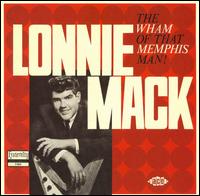 During 1963, after the release of "Memphis" and "Wham!", Mack returned to the studio several times to cut additional recordings, including instrumentals, vocals and ensemble tunes. Fraternity packaged several of these, along with his 1963 singles, into an album entitled The Wham of that Memphis Man
!.
Mack's guitar instrumentals were blues-based, but unusually rapid, seamless and precise. His vocals were strongly influenced by Black gospel music. All of the tunes were backed by bass guitar and drums, and many also featured keyboards and a Stax/Volt-style horn section. Several cuts included an R&B backup chorus, provided by The Charmaines. In his book, The 100 Best Rock 'n' Roll Records of All Time, Jimmy Guterman ranked the album No. 16, saying:
The Wham of that Memphis Man
! was released within weeks of the beginning of the British Invasion
. Competing with likes of the Beatles
and the Rolling Stones
was an obstacle encountered by many, but Mack faced an additional challenge: In the words of critic John Morthland, "It was the era of satin pants and histrionic stage shows, and all the superior chops in the world couldn't hide the fact that chubby, country Mack probably had more in common with Kentucky truck drivers than he did with the new rock audience". Mack slowly slipped back into relative obscurity until the late '60s.
The Wham of that Memphis Man! has been reissued at least ten times, most recently in 2008. However, most of Mack's Fraternity recordings are not found on the album. Fraternity continued to release additional Mack singles during the 1960s, but never issued another album. Some of his Fraternity sides, including some alternate takes of tunes released in the 1960s, were first released three or four decades after they were recorded, on a series of Mack compilation albums.
magazine ranked "Memphis" the premier "landmark" rock guitar recording of all time, immediately ahead of full albums featuring blues-rock guitarists Mike Bloomfield
, Elvin Bishop
, Jimi Hendrix
and Cream
's Eric Clapton
.
Mack's early guitar solos were a significant influence on guitarists Jeff Beck
, Duane Allman
, Stevie Ray Vaughan
, Dickie Betts, Neil Young
, and Ted Nugent
, among others, and had a profound influence upon the history and development of rock guitar, generally:
Mack's own assessment is more modest. He views himself as a transitional figure: "I was a bridge-over between the standard country licks in early rock 'n' roll and the screamin' kinda stuff that came later."
". However, during the same period, the "folk music
" movement in the US and the popularity of Black American musical forms in both the US and the UK expanded the appeal of classic rural and urban blues among young whites of the baby boom
generation.
Soon, a handful of predominantly white blues bands rose to prominence, including John Mayall's Bluesbreakers in the UK and The Paul Butterfield Blues Band
in the US. During the mid-through-late 1960s, a new generation of electric blues guitarists emerged, including Jeff Beck
, Eric Clapton
, Jimi Hendrix
and Jimmy Page
, most of whom were, or soon became, frontmen for blues-based rock bands. The late 1960s witnessed the appearance of many such bands, most of which showcased the virtuosity of their lead guitarists. These included the enormously successful "power trios": Cream
and The Jimi Hendrix Experience
. By that point, blues-rock was recognized as a distinct and powerful force within rock music on both sides of the Atlantic
. In 1968, these developments led to the rediscovery of Lonnie Mack's seminal blues-rock guitar recordings of the early 1960s.
Still in the mid-1960s, Mack released a succession of new singles on Fraternity, but none were major hits. During this time, Mack built a portfolio as an R&B recording-session guitarist. He worked with Cincinnati's premier record label, Syd Nathan
's King Records, playing second guitar on a number of King-label recordings by blues singer-guitarist Freddie King
, and lead guitar on several King-label recordings by "The Godfather of Soul", James Brown
. Brown's band can be heard accompanying Mack on Brown's "Stone Fox" (1967); beyond that, however, it was a Lonnie Mack R&B guitar instrumental. During the same period, Mack found steady work as a session guitarist for John Richbourg's Soundstage 7 Productions in Nashville, backing soul singer Joe Simon
and several other Richbourg R&B acts on Monument Records. He also played lead guitar on several Fraternity recordings of Cincinnati blues singer Albert Washington. None of the Washington tunes were major hits at home, but one featuring Mack's guitar ("Turn On The Bright Lights"), reportedly stayed on the pop charts in Japan for several years and all were later reissued in the UK.
, and relocated to the West Coast. A feature article in the November 1968 issue of Rolling Stone
magazine rated Mack "in a class by himself" as a rock guitarist, and compared his R&B vocals favorably with Elvis Presley
's best gospel efforts. Rolling Stone urged Elektra to reissue Mack's 5-year-old Fraternity album. Elektra soon obliged, reissuing The Wham of that Memphis Man!, with two additional 1964 tracks, under the title For Collectors Only. Rolling Stones October 1970 review of For Collectors Only compared Mack's guitar work to "the best of [Eric] Clapton".
The Wham of that Memphis Man!/For Collectors Only remains Mack's most significant early album. In his review of a 1987 reissue, Gregory Himes of The Washington Post
wrote: "With so many roots-rock guitarists trying to imitate this same style, this album sounds surprisingly modern. Not many have done it this well, though."
, including Glad I'm in the Band and Whatever's Right, both released in 1969. These were eclectic collections country and soul ballads, blues tunes, and updated versions of earlier recordings. In contrast to The Wham of that Memphis Man
, both 1969 albums emphasized Mack's vocals and de-emphasized his guitar work. Only two instrumentals appear on these albums, a full-length blues guitar piece on Glad entitled "Mt. Healthy Blues", and a re-make of "Memphis". Despite the shift in musical emphasis, Mack's output from this period was well-received by music critics. This, from a contemporary assessment of Glad:
Representative of these two albums were two consecutive vocals on Whatever's Right. Mack sings Willie Dixon
's "My Babe
" in a soul style typical of that era. Within seconds of the closing measure on that tune, he begins his vocal on "Things Have Gone To Pieces", a country tune previously recorded by George Jones. He repeated the pattern in Glad by performing a country tune, "Old House", and the soul tune, "Too Much Trouble" in sequence.
Sales of these albums proved disappointing. Upon completing them, Mack assumed a "Chet Atkins-Eric Clapton role at Elektra, doing studio dates, producing and A&R
." During this period, Mack was invited to play on The Doors
' 1970 album, Morrison Hotel
. The original album's liner notes credited him with the electric bass parts on "Roadhouse Blues
" and "Maggie M'Gill". However, in the ensuing years, some have questioned whether his contribution to the album stopped there.
Most of the speculation involves the tune "Roadhouse Blues". In an out-take (first released in 2006) from the first day of the recording session, the album's producer, Paul Rothchild, is heard bemoaning guitarist Robbie Krieger's efforts on the tune. Mack appeared the next morning, and the recording session resumed. On the take released with the 1970 album, singer Jim Morrison
is heard calling out "Do it, Lonnie, do it!" during a bluesy guitar break. Twenty years later, the band's drummer, John Densmore
, wrote:
Despite these clues suggesting that Mack played the lead guitar part on "Roadhouse Blues", that distinction remains officially credited to Robbie Krieger.
As an A&R executive for Elektra, Mack recruited a number of country and blues artists from Nashville, Memphis and Muscle Shoals, Alabama, and Elektra flirted with the idea of starting a new label to record them. Mack also became involved in producing gospel singer Dorothy Combs Morrison
, formerly lead vocalist for the Edwin Hawkins Singers of "Oh Happy Day
" fame. Mack recorded Morrison singing a gospel version of "Let It Be" before The Beatles
released their own version, and urged Elektra to release it immediately. However, corporate red-tape at Elektra delayed the release, and The Beatles were first-to-market. Undeterred, he urged Elektra to capitalize on The Beatles' success by releasing Morrison's version next. When further delays at Elektra allowed the next release to be Aretha Franklin
's own gospel version, Mack resigned his corporate job.
By that point, Elektra had put together an old-fashioned whistle-stop tour of Mack's band, along with some of Mack's Memphis and Muscle Shoals artists, to be billed as "The Alabama State Troupers and Mount Zion Choir". According to Elektra producer Russ Miller, Mack disappeared six days before the tour was to begin. Miller soon found Mack at his rustic farm in backwoods Kentucky, and pled with him to join the tour. Mack refused, citing a nightmare during his last night in Los Angeles, in which he and his family had been pursued by Satan. He told Miller that when he awoke in a sweat, he found his Bible opened to a passage commanding him to "flee from Mount Zion". Miller returned to L.A. without Mack, stating later: "[Lonnie's] a real country boy. [T]hat was it for Lonnie".
Years later, Mack commented on his retreat from the rock 'n' roll spotlight before the age of 30: "Seems like every time I get close to really making it, to climbing to the top of the mountain, that's when I pull out. I just pull up and run". The lyrics of several Mack tunes shed further light on the topic. According to two, he yearned for the anonymous, uncomplicated country life of his youth. In another, he equated the pursuit of "fortune and fame" with selling one's soul to Satan. In yet another, he stated simply: "L. A. made me sick".
In 1973, Mack teamed up with Rusty York
on an all-acoustic bluegrass LP, Dueling Banjos (QCA No. 304). Unavailable for 35 years, Jewel Records re-issued it on CD in 2009 (JRC 920011). It contains 16 bluegrass standards in a dueling-banjos format, with guitar and fiddle. Mack played guitar on all 16 cuts and provided the sole vocal track (the gospel tune "I'll Fly Away") on this otherwise instrumental album.
In 1974, Mack played lead guitar in Dobie Gray
's band. Gray is best known for his hit tunes, "The 'In' Crowd" (later covered by The Ramsey Lewis Trio and others), "Drift Away
" and "Loving Arms". Mack's guitar work from this period can be found on Gray's 1974 album Hey, Dixie. Mack wrote or co-wrote four tunes on the album, including the title track. In March 1974, Mack performed as Gray's lead guitarist at the last broadcast of The Grand Ole Opry from Nashville's Ryman Auditorium
.
In 1975, Mack was shot during an altercation with an off-duty police officer. Mack's account of the incident is preserved in one of his better-known late-career tunes, "Cincinnati Jail". According to the lyrics of that tune, the officer's unmarked car narrowly missed Mack while he was walking across a city street, whereupon Mack hit it on the fender, shouting "better slow it down!"; the officer stopped, emerged from his car, shot Mack "in the leg", then hauled him before a judge who threw him in jail. Mack recovered, but once again virtually disappeared from the music scene. For the next several years, he rarely performed in public, except at his "Friendship Music Park" in rural southern Indiana, where he showcased bluegrass and traditional country artists.
In 1977, Mack signed with Capitol Records
. There, he recorded Home at Last, an album of country ballads and bluegrass tunes which attracted little attention. In 1978, he recorded another Capitol LP, Lonnie Mack with Pismo. A somewhat faster-paced album, Pismo featured country, southern rock and rockabilly tunes.
In 1979, Mack began working on an independent recording project with a friend, producer-songwriter Ed Labunski. The intended result was a country-pop album ultimately entitled South. However, Labunski died in an auto accident before the project was completed, and the album was shelved. Mack released demos from the project 20 years later. Labunski's death also derailed Mack's and Labunski's plans to produce then-unknown Texas blues-guitar prodigy Stevie Ray Vaughan
, who was destined to play a key role in Mack's blues-rock comeback a few years later.
Shortly after Labunski's death, Mack traveled to Canada, where he entered into a six-month collaboration with American expatriate rockabilly artist Ronnie Hawkins
. Hawkins is best known for having founded The Hawks, a popular Canadian roots-rock group which became Bob Dylan
's backup musicians and, later still, independently famous as The Band
. Mack's guitar work from this period can be heard on Hawkins' 1981 solo album, Legend In His Spare Time.
His first album from this period was Live at Coco's, recorded in 1983. It is Mack's only mid-career roadhouse performance preserved on disc. Originally a "bootleg" recording, Mack sanctioned its commercial release in 1998. On Coco's, Mack and his band can be heard playing familiar tunes from the Fraternity era, lesser-known tunes from the '70s, tunes which appear on no other album (e.g., "Stormy Monday", "The Things I Used To Do" and "Man From Bowling Green") and tunes which did not appear on his studio albums until several years later (e.g., "Falling Back In Love With You", "Ridin' the Blinds", "Cocaine Blues" and "High Blood Pressure").
Still in 1983, Mack relocated to Texas, where he played regularly at venues in Dallas and Austin. Early in this period, Mack entered into a performing collaboration with Stevie Ray Vaughan. Little known outside of Texas in 1980, Vaughan's own career took off during this period; by 1985 he was an international blues-rock guitar sensation. Mack and Vaughan had first met in 1979, when Mack, acting on a tip from Vaughan's older brother, went to hear him play at a local bar. Vaughan recalled the meeting in a 1985 interview:
Mack and Vaughan became close friends after that first meeting. Despite the generation gap between them, Mack said that he and Vaughan "were always on the same level", describing Vaughan as "an old spirit...in a young man's body". Mack regarded Vaughan as his "little brother" and Vaughan said Mack was "something between a daddy and a brother". When Mack was stricken with a lengthy illness in Texas, Vaughan put on a benefit concert to help pay his bills; during Mack's recuperation, Vaughan and his bass-player, Tommy Shannon
, personally installed an air-conditioner in his house.
In the purely musical sense, the relationship between Mack and Vaughan had begun long before they met. Vaughan said that "Wham!" was "the first record I ever owned", that Mack was "the baddest guitar player I know", and that Mack "really taught me to play guitar from the heart". Vaughan's musical legacy includes four versions of "Wham!"---two solo versions and two dueling-guitar versions with Mack. He also recorded Mack's "If You Have To Know", and an instrumental homage to "Chicken-Pickin", which Vaughan called "Scuttle-Buttin'".
 Mack signed with Alligator Records
in 1984, and, upon recovering from his illness, began working on his blues-rock comeback album, Strike Like Lightning. It became one of the top-selling independent recordings of 1985. Mack and Vaughan co-produced the album. Mack himself composed most of the tunes, which featured his vocals and driving guitar equally. Vaughan played second guitar on most of the album, and traded leads with Mack on "Double Whammy" and "Satisfy Susie". Both played acoustic guitar on Mack's "Oreo Cookie Blues".
Strike propelled Mack back into the spotlight at age 44. Much of 1985 found him occupied with a promotional concert tour for Strike which included guest appearances by Vaughan, Ry Cooder
and both Keith Richards
and Ronnie Wood of the Rolling Stones, among others. Videos of Mack and Vaughan playing cuts from Strike are found on YouTube
and similar websites. In 2007, Sony's Legacy label released a 1987 "live" performance of Mack's "Oreo Cookie Blues" featuring Mack and Vaughan trading leads on electric guitar.
The Strike Like Lightning tour culminated in a Carnegie Hall
concert billed as Further On Down the Road, a tip of the hat to Mack's 1964 recording by the same title. There, he shared the stage with blues guitar stylist Albert Collins
and blues-rock guitar virtuoso Roy Buchanan
. The concert was marketed on home video and remains available from Flying V Records on Mack's website.
, where he recorded the critically acclaimed rockabilly album, Roadhouses and Dance Halls, including the autobiographical single, "Too Rock For Country".
 In 1990, Mack returned to Alligator to record a live blues-rock album, Attack of the Killer V, featuring two extended guitar solos and expanded renditions of earlier studio recordings. From one review: "This disc has everything that a great live album should have: a great talent on stage, an exciting performance from that talent, a responsive crowd and excellent sound quality...This is what live blues is all about!"
In 2000, he appeared as a session player on the album Franktown Blues, by the sons of blues legend Arthur "Big Boy" Crudup. Mack provided guitar solos on two cuts, "She's Got The Key" and "Jammin' For James". He continued to tour until 2004, in both America and Europe.
. He is working on a memoir and is engaged in a songwriting collaboration with award-winning country and blues tunesmith Bobby Boyd
. He still occasionally appears at benefit concerts and special events. On November 15, 2008, Mack was a featured performer at the Rock and Roll Hall of Fame
's 13th annual Music Masters Tribute Concert, soloing on "Wham!" in honor of electric guitar pioneer Les Paul
. In June 2011, he announced an upcoming self-published album of informally recorded tunes, making one of the tunes, "The Times Ain't Right", available without charge on his website, Lonniemack.com.
" techniques and runs with origins in traditional country and bluegrass music. This distinguished Mack from most of the blues-rock guitarists who rose to prominence in the decade following "Memphis", guitarists whose styles had evolved more exclusively from the Delta and Chicago blues traditions.
Mack typically manipulates the whammy bar with the little finger of his right hand, while picking at a 45-degree angle with a pick or the remaining fingers of the same hand, and bending the strings on the fret-board with his left. Stevie Ray Vaughan: "Nobody can play with a whammy-bar like Lonnie. He holds it while he plays and the sound sends chills up your spine". Mack's pioneering use of "lightning-fast runs" and machine-gunned climaxes became hallmarks of virtuoso rock guitar by the end of the 1960s.
On most of his early guitar solos, Mack employed a variant of R&B guitarist Robert Ward
's distortion technique, using a 1950s-era tube-fired Magnatone amplifier to produce a distinctive "watery" tone. On other tunes he plugged into an organ amplifier to enhance his vibrato with a "rotating, fluttery sound".
Rock music
Rock music is a genre of popular music that developed during and after the 1960s, particularly in the United Kingdom and the United States. It has its roots in 1940s and 1950s rock and roll, itself heavily influenced by rhythm and blues and country music...
, blues
Blues
Blues is the name given to both a musical form and a music genre that originated in African-American communities of primarily the "Deep South" of the United States at the end of the 19th century from spirituals, work songs, field hollers, shouts and chants, and rhymed simple narrative ballads...
and country
Country music
Country music is a popular American musical style that began in the rural Southern United States in the 1920s. It takes its roots from Western cowboy and folk music...
guitarist and vocalist.
In 1963 and early 1964, he recorded a succession of full-length electric guitar
Guitar
The guitar is a plucked string instrument, usually played with fingers or a pick. The guitar consists of a body with a rigid neck to which the strings, generally six in number, are attached. Guitars are traditionally constructed of various woods and strung with animal gut or, more recently, with...
instrumentals which combined blues stylism with fast-picking techniques and a rock 'n' roll beat. The best-known of these are "Memphis", "Wham!", and "Chicken Pickin'". These instrumentals established the standard of virtuosity for a generation of rock guitarists and
formed the leading edge of the "blues-rock
Blues-rock
Blues rock is a hybrid musical genre combining bluesy improvisations over the 12-bar blues and extended boogie jams with rock and roll styles. The core of the blues rock sound is created by the electric guitar, piano, bass guitar and drum kit, with the electric guitar usually amplified through a...
" guitar genre. Reportedly, the tremolo arm
Tremolo arm
A whammy bar, tremolo arm/bar, or vibrato arm/bar is a component of a guitar, used to add vibrato to the sound by changing the tension of the strings, typically at the bridge or tailpiece...
commonly found on electric guitars became known as the "whammy bar", in recognition of Mack's aggressive, rapid manipulation of the pitch-bending device in 1963's "Wham!".
In 1979, music historian Richard T. Pinnell, Ph.D., called 1963's "Memphis" a "milestone of early rock guitar". In 1980, the editors of Guitar World
Guitar World
Guitar World is a monthly music magazine devoted to guitarists. It contains original interviews, album and gear reviews and guitar and bass tablature of approximately five songs each month. The magazine is published 13 times per year...
magazine ranked "Memphis" first among rock's top five "landmark" guitar recordings. He is widely regarded today as a pivotal historical figure in expanding the role of the electric guitar in rock. Despite a modest all-career recording output as a rock artist, he has been called "one of the great rock guitarists of all-time".
Mack is also regarded as one of the finest early "blue-eyed soul
Blue-eyed soul
Blue-eyed soul is a media term that was used to describe rhythm and blues and soul music performed by white artists, with a strong pop music influence. The term was first used in the mid-1960s to describe white artists who performed soul and R&B that was similar to the music of the Motown and...
" singers. Crediting both Mack's R&B vocals and his guitar solos, music critic Jimmy Guterman ranked Mack's first album, 1963's The Wham of that Memphis Man
The Wham of that Memphis Man
The Wham of That Memphis Man is a 1963 album by Lonnie Mack.The album is the first collection of hits from Mack, recorded between March and November, 1963. Critic Jimmy Guterman ranked this album No...
!, No. 16 in his book The 100 Best Rock 'n' Roll Records of All Time.
Mack released several singles in the '50s and '60s, as well as thirteen original albums spanning a variety of genres between 1963 and 1990. He enjoyed his greatest recognition as a blues-rock
Blues-rock
Blues rock is a hybrid musical genre combining bluesy improvisations over the 12-bar blues and extended boogie jams with rock and roll styles. The core of the blues rock sound is created by the electric guitar, piano, bass guitar and drum kit, with the electric guitar usually amplified through a...
singer/guitarist, with productive periods during the '60s and the latter half of the '80s. However, an aversion to notoriety led him to switch musical genres and idle his career as a rock artist for years, even decades, at a time.
In 2011, he announced an upcoming self-published album of informally recorded compositions, including the recently released acoustic blues single "The Times Ain't Right".
Beyond his career as a solo artist, Mack recorded with The Doors
The Doors
The Doors were an American rock band formed in 1965 in Los Angeles, California, with vocalist Jim Morrison, keyboardist Ray Manzarek, drummer John Densmore, and guitarist Robby Krieger...
, Stevie Ray Vaughan
Stevie Ray Vaughan
Stephen Ray "Stevie Ray" Vaughan was an American electric blues guitarist and singer. He was the younger brother of Jimmie Vaughan and frontman for Double Trouble, a band that included bassist Tommy Shannon and drummer Chris Layton. Born in Dallas, Vaughan moved to Austin at the age of 17 and...
, James Brown
James Brown
James Joseph Brown was an American singer, songwriter, musician, and recording artist. He is the originator of Funk and is recognized as a major figure in the 20th century popular music for both his vocals and dancing. He has been referred to as "The Godfather of Soul," "Mr...
, Freddie King
Freddie King
Freddie King , thought to have been born as Frederick Christian, originally recording as Freddy King, and nicknamed "the Texas Cannonball", was an influential African-American blues guitarist and singer. He is often mentioned as one of "the Three Kings" of electric blues guitar, along with Albert...
, Joe Simon
Joe Simon (musician)
Joe Simon is an American chart-topping, Grammy Award winning, soul and R&B musician. Amongst other chart singles, Simon secured three number one hits on the US Billboard R&B chart between 1969 and 1975.-Career:...
, Ronnie Hawkins
Ronnie Hawkins
Ronald "Ronnie" Hawkins is a Juno Award-winning rockabilly musician whose career has spanned more than half a century. Though his career began in Arkansas, USA, where he'd been born and raised, it was in Ontario, Canada where he found success and settled for most of his life...
, Albert Collins
Albert Collins
Albert Collins was an American electric blues guitarist and singer whose recording career began in the 1960s in Houston and whose fame eventually took him to stages across the US, Europe, Japan and Australia...
, Roy Buchanan
Roy Buchanan
Roy Buchanan was an American guitarist and blues musician. A pioneer of the Telecaster sound, Buchanan was a sideman and solo artist, with two gold albums early in his career, and two later solo albums that made it on to the Billboard chart. Despite never having achieved stardom, he is still...
, Dobie Gray
Dobie Gray
Dobie Gray is an African American singer and songwriter, whose musical career has spanned soul, country, pop and musical theater...
and the sons of blues legend Arthur "Big Boy" Crudup
Arthur Crudup
Arthur "Big Boy" Crudup was an American Delta blues singer, songwriter and guitarist. He is best known outside blues circles for writing songs such as "That's All Right" , "My Baby Left Me" and "So Glad You're Mine", later covered by Elvis Presley and dozens of other artists.-Career:Arthur Crudup...
, among others.
Career
Lonnie Mack's music career began in the mid-1950s. It included historically significant recordings, critical and popular recognition, and periods of reclusion, rediscovery and comeback. However, he never became a commercial superstar. He performed regularly until 2004. He still occasionally appears at special events. On November 15, 2008, he performed at production of the Rock and Roll Hall of FameRock and Roll Hall of Fame
The Rock and Roll Hall of Fame and Museum is a museum located on the shore of Lake Erie in downtown Cleveland, Ohio, United States. It is dedicated to archiving the history of some of the best-known and most influential artists, producers, engineers and others who have, in some major way,...
honoring Les Paul
Les Paul
Lester William Polsfuss —known as Les Paul—was an American jazz and country guitarist, songwriter and inventor. He was a pioneer in the development of the solid-body electric guitar which made the sound of rock and roll possible. He is credited with many recording innovations...
. In 2011, after a 21-year recording hiatus, he announced the upcoming release of a self-published "album" consisting of entirely new, informally recorded tunes.
As a frontman, Mack has been described as rock's first "virtuoso" lead guitarist and its first "guitar hero". In the early 1960s, he augmented the electric blues guitar genre with fast-picking techniques borrowed from traditional country
Country music
Country music is a popular American musical style that began in the rural Southern United States in the 1920s. It takes its roots from Western cowboy and folk music...
and bluegrass
Bluegrass music
Bluegrass music is a form of American roots music, and a sub-genre of country music. It has mixed roots in Scottish, English, Welsh and Irish traditional music...
styles, leading one early reviewer to puzzle over the "peculiar running quality" of Mack's bluesy solos. These recordings prefigured the fast, flashy, blues-based lead guitar style which dominated rock by the late 1960s.
Although best known as a guitarist, Mack was a double-threat performer from the outset. A 1968 feature article in Rolling Stone
Rolling Stone
Rolling Stone is a US-based magazine devoted to music, liberal politics, and popular culture that is published every two weeks. Rolling Stone was founded in San Francisco in 1967 by Jann Wenner and music critic Ralph J...
magazine rated Mack a better gospel singer than Elvis Presley
Elvis Presley
Elvis Aaron Presley was one of the most popular American singers of the 20th century. A cultural icon, he is widely known by the single name Elvis. He is often referred to as the "King of Rock and Roll" or simply "the King"....
, who earned all of his Grammys as a gospel singer.
By the 1980s, Mack was recognized as a pioneer of virtuoso rock guitar, having influenced every major rock guitarist of the day, according to Guitar World
Guitar World
Guitar World is a monthly music magazine devoted to guitarists. It contains original interviews, album and gear reviews and guitar and bass tablature of approximately five songs each month. The magazine is published 13 times per year...
magazine, "from Clapton to Allman to Vaughan" and "from Nugent to Bloomfield". His pioneering "blue-eyed soul" vocals remain notable for their gospel-like fervor.
Mack's recordings drew on rural and urban blues, country, bluegrass, rockabilly
Rockabilly
Rockabilly is one of the earliest styles of rock and roll music, dating to the early 1950s.The term rockabilly is a portmanteau of rock and hillbilly, the latter a reference to the country music that contributed strongly to the style's development...
, vintage R&B, soul
Soul music
Soul music is a music genre originating in the United States combining elements of gospel music and rhythm and blues. According to the Rock and Roll Hall of Fame, soul is "music that arose out of the black experience in America through the transmutation of gospel and rhythm & blues into a form of...
, and gospel
Gospel music
Gospel music is music that is written to express either personal, spiritual or a communal belief regarding Christian life, as well as to give a Christian alternative to mainstream secular music....
styles. Attempts to classify Mack's music proved challenging, but the common thread in Mack's best-known music is a unique mix of black and white musical roots, later dubbed "roadhouse
Roadhouse (facility)
A roadhouse is a commercial establishment typically built on a major road or highway, to service passing travellers. Its meaning varies slightly by country.-USA:...
rock". Music critic Alec Dubro summarized: "Lonnie can be put into that 'Elvis Presley-Roy Orbison-Early Rock' bag, but mostly for convenience. In total sound and execution, he was an innovator". In a 1977 interview, Mack commented on his merger of country and blues styles: "I think they're about the closest musics there are. They're the earth-musics of the white and black people. Country is never gonna die, and neither is the blues---and rock and roll is a little bit of both."
Mack's managers over the years have included the late Harry Carlson of Fraternity Records
Fraternity Records
Fraternity Records was a small record label based in Cincinnati, Ohio. It was started by Harry Carlson and silent partner Dr. Ashton Welsh in 1954.The first hit was local girl Cathy Carr's rendition of a Tin Pan Alley song, "Ivory Tower" in 1956...
, John Hovekamp, formerly the manager of Pure Prairie League
Pure Prairie League
Pure Prairie League, sometimes abbreviated PPL, is an American country-rock band whose roots began between 1964 and 1969 in Waverly, Ohio with Craig Fuller, George Powell, Tom McGrail, Jim Caughlan and John David Call. In 1970 McGrail named the band after a 19th century temperance union mentioned...
and James Webber, formerly Vice President of Elektra Records
Elektra Records
Elektra Records is an American record label owned by Warner Music Group. In 2004, it was consolidated into WMG's Atlantic Records Group. After five years of dormancy, the label was revived by Atlantic in 2009....
. Webber is listed on Mack's website as his current manager.
Childhood and early influences
In 1941, Mack's family moved from AppalachiaAppalachia
Appalachia is a term used to describe a cultural region in the eastern United States that stretches from the Southern Tier of New York state to northern Alabama, Mississippi, and Georgia. While the Appalachian Mountains stretch from Belle Isle in Canada to Cheaha Mountain in the U.S...
in southeastern Kentucky
Kentucky
The Commonwealth of Kentucky is a state located in the East Central United States of America. As classified by the United States Census Bureau, Kentucky is a Southern state, more specifically in the East South Central region. Kentucky is one of four U.S. states constituted as a commonwealth...
to a small subsistence farm in southern Indiana
Indiana
Indiana is a US state, admitted to the United States as the 19th on December 11, 1816. It is located in the Midwestern United States and Great Lakes Region. With 6,483,802 residents, the state is ranked 15th in population and 16th in population density. Indiana is ranked 38th in land area and is...
where he spent most of his childhood. Although there was no electricity on the farm, the family had a primitive battery-powered radio, and were devotees of "The Grand Ole Opry" radio show. As a child, listening after the rest of the family had gone to bed, Mack became a fan of early R&B and black gospel music.
Mack began playing at the age of 7, using an acoustic guitar
Acoustic guitar
An acoustic guitar is a guitar that uses only an acoustic sound board. The air in this cavity resonates with the vibrational modes of the string and at low frequencies, which depend on the size of the box, the chamber acts like a Helmholtz resonator, increasing or decreasing the volume of the sound...
he had traded for a bicycle. While still a small child, he was playing guitar for tips at a hobo jungle near his home, and outside of the Nieman Hotel in nearby Aurora, Indiana. Mack: "I started off in bluegrass, before there was rock 'n' roll. My family was like a family band. We sang and harmonized, and Dad played banjo. We were playin' mostly gospel, bluegrass and old-style country. We played a lot of that old-style Jimmie Rodgers (country singer)
Jimmie Rodgers (country singer)
James Charles Rodgers , known as Jimmie Rodgers, was an American country singer in the early 20th century known most widely for his rhythmic yodeling...
and Hank Williams kinda music."
Mack's mother was his earliest country guitar and singing influence, and a blind gospel singer, Ralph Trotto, was his earliest musical mentor. Mack recalls that at the age of ten he was introduced to an elderly black guitarist who "played gut-bucket and slide and Robert Johnson-type guitar". Mack, who was "into Merle Travis
Merle Travis
Merle Robert Travis was an American country and western singer, songwriter, and musician born in Rosewood, Kentucky. His lyrics often discussed the life and exploitation of coal miners. Among his many well-known songs are "Sixteen Tons", "Re-Enlistment Blues" and "Dark as a Dungeon"...
finger-pickin' style", suddenly realized that he could combine his fast-picking techniques with an exciting and different musical genre.
Mack acknowledged Jimmy Reed
Jimmy Reed
Mathis James "Jimmy" Reed was an American blues musician and songwriter, notable for bringing his distinctive style of blues to mainstream audiences. Reed was a major player in the field of electric blues, as opposed to the more acoustic-based sound of many of his contemporaries...
, Ray Charles
Ray Charles
Ray Charles Robinson , known by his shortened stage name Ray Charles, was an American musician. He was a pioneer in the genre of soul music during the 1950s by fusing rhythm and blues, gospel, and blues styles into his early recordings with Atlantic Records...
and Bobby "Blue" Bland as musical influences in several recordings. Early in his career, Mack recorded tunes by Reed, Charles and Bland. He has also cited '50s R&B vocalist Hank Ballard
Hank Ballard
Hank Ballard , born John Henry Kendricks, was a rhythm and blues singer and songwriter, the lead vocalist of Hank Ballard and The Midnighters and one of the first proto-rock 'n' roll artists to emerge in the early 1950s...
and country vocalist George Jones
George Jones
George Glenn Jones is an American country music singer known for his long list of hit records, his distinctive voice and phrasing, and his marriage to Tammy Wynette....
as singing influences. Mack recorded tunes by each of them as well. Various sources have noted that Mack's playing shows influences of electric blues guitarist T-Bone Walker
T-Bone Walker
Aaron Thibeaux "T-Bone" Walker was a critically acclaimed American blues guitarist, singer, songwriter and multi-instrumentalist, who was one of the most influential pioneers and innovators of the jump blues and electric blues sound. He is the first musician recorded playing blues with the...
(one of whose tunes he recorded), country guitarist Merle Travis and jazz guitarist Les Paul
Les Paul
Lester William Polsfuss —known as Les Paul—was an American jazz and country guitarist, songwriter and inventor. He was a pioneer in the development of the solid-body electric guitar which made the sound of rock and roll possible. He is credited with many recording innovations...
. Mack's highest-charting single, the 1963 instrumental "Memphis", was based on the melody of a Chuck Berry
Chuck Berry
Charles Edward Anderson "Chuck" Berry is an American guitarist, singer, and songwriter, and one of the pioneers of rock and roll music. With songs such as "Maybellene" , "Roll Over Beethoven" , "Rock and Roll Music" and "Johnny B...
tune.
Early career
Mack dropped out of school at the age of 13, after a fight with a teacher. In his mid-teens he began performing in roadhouses in the Cincinnati area.As a teen-aged solo artist in the late '50s, Mack recorded a cover of Al Dexter
Al Dexter
Al Dexter was an American country musician and songwriter. He is best known for "Pistol Packin' Mama," a 1944 hit that was one of the most popular recordings of the World War II years and later became a hit again with a cover by Bing Crosby and The Andrews Sisters.-Biography:Born Clarence Albert...
's 1944 western swing
Western swing
Western swing music is a subgenre of American country music that originated in the late 1920s in the West and South among the region's Western string bands...
hit, "Pistol-Packin' Mama" on the Dobbs label. During the same period, Mack played lead guitar for his older cousins, Aubrey Holt and Harley Gabbard, on two recordings, The Stanley Brothers
The Stanley Brothers
The Stanley Brothers were an American bluegrass duo made up of brothers Carter and Ralph Stanley.-Biography:Carter and Ralph Stanley hailed originally from Dickenson County, Virginia. The family soon moved to McClure, Virginia where their parents worked a small farm in the Clinch Mountains...
' "Too Late To Cry" and the cousins' own "Hey, Baby". These two singles were released in 1959 on the Sage label.
"Pistol-Packin' Mama" and "Too Late To Cry" have been out-of-print for decades. "Hey, Baby", a rockabilly tune with close-harmony bluegrass vocals, was reissued by the German label, Bear Family Records, in 2010 and is now available in the U.S.
By the late 1950s, Mack had assembled a band of his own. They performed throughout Kentucky, Indiana and Ohio, playing both rockabilly and, increasingly, R&B-tinged rock & roll. In the early 1960s, Mack shortened his name from "McIntosh" to "Mack" and named his band "The Twilighters", after the Hamilton, Ohio club where they had a steady engagement.
Mack's guitar
In 1958, Mack bought the seventh Gibson Flying VGibson Flying V
-External links:*, , , , and , from the Gibson website*, a June 2001 article from Guitar Collector magazine*, a tribute site that lists all models and re-issues and most notable players**...
guitar from the first run produced by that firm, which he used almost exclusively during his career. Mack, who is of Scottish and Native American
Native Americans in the United States
Native Americans in the United States are the indigenous peoples in North America within the boundaries of the present-day continental United States, parts of Alaska, and the island state of Hawaii. They are composed of numerous, distinct tribes, states, and ethnic groups, many of which survive as...
ancestry was attracted to the arrow-shaped instrument because of pride in his Indian heritage. The 1958 Flying V model is now considered highly collectible, as only 81 of them left the factory that year. In 2011, Mack's guitar (which he named "No. 7") was featured in The Guitar Collection, a $1500 two-book set of detailed essay and photo presentations on each of the world's 150 most historically significant guitars.
"Memphis", "Wham!" and the birth of blues-rock guitar
In the early '60s, Mack often worked as a session artists for FraternityFraternity Records
Fraternity Records was a small record label based in Cincinnati, Ohio. It was started by Harry Carlson and silent partner Dr. Ashton Welsh in 1954.The first hit was local girl Cathy Carr's rendition of a Tin Pan Alley song, "Ivory Tower" in 1956...
, a small record label in Cincinnati. There, he played guitar on a number of singles by local R&B artists, including Max Falcon, Beau Dollar and the Coins, Denzil Rice (who, as "Dumpy" Rice, went on to become the piano player in Mack's band) and Cincinnati's leading female R&B trio, The Charmaines. Several of these recordings are found on compilation CDs entitled Lonnie Mack: From Nashville to Memphis (Ace, 2004) and Gigi and the Charmaines (Ace, 2006).
On March 12, 1963, at the end of a recording session backing up The Charmaines, Mack and his band were offered the remaining twenty minutes of studio rental time. Not expecting the tune to be released, Mack immediately recorded a rockabilly/blues guitar instrumental loosely based on the melody of Chuck Berry
Chuck Berry
Charles Edward Anderson "Chuck" Berry is an American guitarist, singer, and songwriter, and one of the pioneers of rock and roll music. With songs such as "Maybellene" , "Roll Over Beethoven" , "Rock and Roll Music" and "Johnny B...
's 1959 UK vocal hit, "Memphis, Tennessee
Memphis, Tennessee (song)
"Memphis, Tennessee" is a song by rock & roll singer-songwriter Chuck Berry. It is sometimes shortened to "Memphis". In the UK, the song charted at #6 in 1963, at the same time Decca Records issued a cover version in the UK by Dave Berry and the Cruisers, who came from Sheffield, Yorkshire...
". Mack had improvised the guitar solo in a live performance a few years earlier, when another member of the band (who usually sang the tune) missed a club date. Mack's instrumental version was well-received, so he adopted it as part of his live act.
The tune featured a then-unique combination of several key elements. As recorded in 1963, it had seven distinct sections, with an unusually fast 12-bar blues solo. "An extended guitar solo exploiting the entire range of the instrument rings in the climax of the song in the fifth section. Lonnie Mack begins this portion by quoting several measures of the riff one octave higher than before. From there, he breaks into his choicest licks, including double-picking and pulling-off techniques--all with driving, complicated rhythms and technical precision".
By the time "Memphis" was first broadcast in the Spring of 1963, Mack had already forgotten the impromptu recording session and was engaged in a nation-wide performing tour with singer-songwriter Troy Seals
Troy Seals
Troy Seals is an American singer, songwriter, and guitarist.He is a member of the prominent Seals family of musicians that includes, Jim Seals and Dan Seals and Brady Seals...
. A friend located him on tour, and told him his tune was climbing the charts. In a 1977 interview, Mack recalled: "I was completely taken by surprise. I [hadn't] listened to the radio. I had no idea what was happening".
By late June, "Memphis" had risen to No. 4 on Billboard
Billboard (magazine)
Billboard is a weekly American magazine devoted to the music industry, and is one of the oldest trade magazines in the world. It maintains several internationally recognized music charts that track the most popular songs and albums in various categories on a weekly basis...
s R&B chart and No. 5 on Billboard's Pop chart. Up to that point in time, only three other rock guitar instrumentals had penetrated Billboard's "Top 5". It was the only top-20 single of Mack's career. In 1964, Johnny Rivers
Johnny Rivers
Johnny Rivers is an American rock and roll singer, songwriter, guitarist, and record producer. His styles include folk songs, blues, and revivals of old-time rock 'n' roll songs and some original material...
released his own version of "Memphis", recombining Berry's vocal treatment with signature elements of Mack's instrumental. Rivers' version scored No. 2 on the US Hit Parade.
Still in 1963, Mack released "Wham!", a gospel-inspired guitar instrumental, which reached No. 24 on Billboard's Pop chart in September. He soon recorded several more full-length rock guitar instrumentals, including his own composition,"Chicken Pickin'", and an instrumental version of Dale Hawkins
Dale Hawkins
Delmar Allen "Dale" Hawkins was a pioneer American rock singer, songwriter, and rhythm guitarist who was often called the architect of swamp rock boogie...
' "Suzie Q
Suzie Q
Suzie Q is the name of a dance step in the Big Apple, Lindy Hop, and other dances. In line dances this step is also known as Heel Twist or Grind Walk...
". Mack used a Bigsby tremolo arm
Tremolo arm
A whammy bar, tremolo arm/bar, or vibrato arm/bar is a component of a guitar, used to add vibrato to the sound by changing the tension of the strings, typically at the bridge or tailpiece...
on "Wham!" and several other tunes to achieve sound effects so distinctive for the time that guitarists began calling it the "whammy bar", a term by which it is still known.
According to music historian and guitar professor Richard T. Pinnell, Ph.D., Mack's fast-paced interpretation of blues stylism in "Memphis" was unique in the history of rock guitar to that point, producing a tune that was both "rhythmically and melodically full of fire" and "one of the milestones of early rock and roll guitar".
Although the term "blues-rock" had not yet come into common usage in 1963, "Memphis" is now widely regarded as the first genuine hit recording of the blues-rock guitar genre. "Wham!" soon became the second.
Mack's Influence on other guitarists
Many lead guitarists who rose to prominence after "Memphis" and "Wham!" were strongly influenced by Mack during their formative years. British guitarist Jeff BeckJeff Beck
Geoffrey Arnold "Jeff" Beck is an English rock guitarist. He is one of three noted guitarists to have played with The Yardbirds...
considers Mack a "major influence". As a teenager, Stevie Ray Vaughan
Stevie Ray Vaughan
Stephen Ray "Stevie Ray" Vaughan was an American electric blues guitarist and singer. He was the younger brother of Jimmie Vaughan and frontman for Double Trouble, a band that included bassist Tommy Shannon and drummer Chris Layton. Born in Dallas, Vaughan moved to Austin at the age of 17 and...
honed his guitar skills by playing along with "Wham!" incessantly, until his father finally destroyed the record. Vaughan, who later revealed that "Wham!" was "the first record I ever owned", simply bought another copy and resumed his practice. Vaughan said, "I got a lot of the fast things I do from Lonnie". At the peak of his career, in the mid-1980s, Vaughan recorded covers of both "Wham!" and "Chicken-Pickin'". In 1963, 17-year-old guitarist Duane Allman
Duane Allman
Howard Duane Allman was an American guitarist, session musician and the primary co-founder of the southern rock group The Allman Brothers Band...
played along with his copy of "Memphis", stopping, starting and slowing the turntable with his foot, until he had finally mastered the tune. Western Swing
Western swing
Western swing music is a subgenre of American country music that originated in the late 1920s in the West and South among the region's Western string bands...
guitarist Ray Benson
Ray Benson
Ray Benson is the front man of the Western swing band Asleep at the Wheel.In 1970, Benson, a Jewish native of Philadelphia, formed Asleep at the Wheel with friends Lucky Oceans and Leroy Preston. The group relocated to Austin in 1973 after a suggestion from Willie Nelson .Since then, the group has...
, frontman for eight-time Grammy-winner Asleep at the Wheel
Asleep at the Wheel
Asleep at the Wheel is a American country music group that was formed in Paw Paw, West Virginia, but based in Austin, Texas. Altogether, they have won nine Grammy Awards since their 1970 inception. In their career, they have released more than twenty studio albums, and have charted more than twenty...
, called Mack "my guitar hero".
"Blue-Eyed Soul" ballads
Mack's first recording successes were instrumentals. However, his roadhouse performances typically included both vocals and instrumentals. Accordingly, in 1963, Mack recorded a number of tunes featuring his singing talents.Although Mack ultimately became better known for his guitar recordings, his early "blue-eyed soul" vocal recordings were critically acclaimed. A review of these tunes in Rolling Stone said: "It is truly the voice of Lonnie Mack that sets him apart. [His] songs have a sincerity and intensity that's hard to find anywhere". According to another review:
R&B radio stations throughout the South played Mack's gospel-inspired version of the soul ballad "Where There's a Will" in 1963, until he was invited to give a live radio interview with a prominent R&B disc jockey in racially polarized Birmingham, Alabama
Birmingham, Alabama
Birmingham is the largest city in Alabama. The city is the county seat of Jefferson County. According to the 2010 United States Census, Birmingham had a population of 212,237. The Birmingham-Hoover Metropolitan Area, in estimate by the U.S...
. Mack recalls that when he appeared at the radio station, the DJ took one look at him, then said, "Baby, you're the wrong color", and canceled the interview on the spot.
After that, Mack recalls, there was a precipitous drop in the airplay time devoted to his vocal recordings on R&B radio stations. Fraternity reacted by delaying release of one of Mack's signature soul ballads, "Why?" (recorded in 1963), as a single, until 1968, and then only as the "B" side of a re-release of "Memphis". Not surprisingly, "Why?" received scant notice, and never charted. However, it was eventually recognized as a "lost masterpiece of rock 'n' roll", achieving the status of a "cult-favorite".
Despite the de facto ban of Mack's vocal recordings on R&B radio stations, his 1963 cover version of Jimmy Reed
Jimmy Reed
Mathis James "Jimmy" Reed was an American blues musician and songwriter, notable for bringing his distinctive style of blues to mainstream audiences. Reed was a major player in the field of electric blues, as opposed to the more acoustic-based sound of many of his contemporaries...
's "Baby, What's Wrong", became a modest crossover
Crossover (music)
Crossover is a term applied to musical works or performers appearing on two or more of the record charts which track differing musical tastes, or genres...
pop hit (Billboard Pop, No. 93), particularly in the Midwest, Fraternity's traditional distribution market.
After the 1960s, Mack recorded fewer "pure" blues and soul ballads, and more country and rockabilly vocals. Mack's mature singing style has been variously described as a "country-esque blues voice", and the "impassioned vocal style of a white Hoosier
Hoosier
Hoosier is the official demonym for a resident of the U.S. state of Indiana. Although residents of most U.S. states typically adopt a derivative of the state name, e.g., "Indianan" or "Indianian", natives of Indiana rarely use these. Indiana adopted the nickname "Hoosier State" more than 150...
with a touch of Memphis soul". 1983's Live at Coco's contains several bluesy vocals in this style, including a version of T-Bone Walker's "Stormy Monday
Stormy Monday
Stormy Monday is the 1988 feature film debut of director Mike Figgis. Starring Sean Bean, Tommy Lee Jones, Sting and Melanie Griffith, it is an atmospheric, noirish thriller. The notable jazz soundtrack is also by Figgis. Being set in Newcastle-upon-Tyne, England, the film is something of an homage...
". Other examples include Mack's own soul ballad, "Stop", on 1985's Strike Like Lightning, and a gospel-drenched version of Wilson Pickett
Wilson Pickett
Wilson Pickett was an American R&B/Soul singer and songwriter.A major figure in the development of American soul music, Pickett recorded over 50 songs which made the US R&B charts, and frequently crossed over to the US Billboard Hot 100...
's "I Found a Love" on 1990's Live: Attack of the Killer V.
The Wham of that Memphis Man!
The Wham of that Memphis Man
The Wham of That Memphis Man is a 1963 album by Lonnie Mack.The album is the first collection of hits from Mack, recorded between March and November, 1963. Critic Jimmy Guterman ranked this album No...
!.
Mack's guitar instrumentals were blues-based, but unusually rapid, seamless and precise. His vocals were strongly influenced by Black gospel music. All of the tunes were backed by bass guitar and drums, and many also featured keyboards and a Stax/Volt-style horn section. Several cuts included an R&B backup chorus, provided by The Charmaines. In his book, The 100 Best Rock 'n' Roll Records of All Time, Jimmy Guterman ranked the album No. 16, saying:
The Wham of that Memphis Man
The Wham of that Memphis Man
The Wham of That Memphis Man is a 1963 album by Lonnie Mack.The album is the first collection of hits from Mack, recorded between March and November, 1963. Critic Jimmy Guterman ranked this album No...
! was released within weeks of the beginning of the British Invasion
British Invasion
The British Invasion is a term used to describe the large number of rock and roll, beat, rock, and pop performers from the United Kingdom who became popular in the United States during the time period from 1964 through 1966.- Background :...
. Competing with likes of the Beatles
The Beatles
The Beatles were an English rock band, active throughout the 1960s and one of the most commercially successful and critically acclaimed acts in the history of popular music. Formed in Liverpool, by 1962 the group consisted of John Lennon , Paul McCartney , George Harrison and Ringo Starr...
and the Rolling Stones
The Rolling Stones
The Rolling Stones are an English rock band, formed in London in April 1962 by Brian Jones , Ian Stewart , Mick Jagger , and Keith Richards . Bassist Bill Wyman and drummer Charlie Watts completed the early line-up...
was an obstacle encountered by many, but Mack faced an additional challenge: In the words of critic John Morthland, "It was the era of satin pants and histrionic stage shows, and all the superior chops in the world couldn't hide the fact that chubby, country Mack probably had more in common with Kentucky truck drivers than he did with the new rock audience". Mack slowly slipped back into relative obscurity until the late '60s.
The Wham of that Memphis Man! has been reissued at least ten times, most recently in 2008. However, most of Mack's Fraternity recordings are not found on the album. Fraternity continued to release additional Mack singles during the 1960s, but never issued another album. Some of his Fraternity sides, including some alternate takes of tunes released in the 1960s, were first released three or four decades after they were recorded, on a series of Mack compilation albums.
Historical significance of Mack's guitar solos
In the early 1960s, Mack's extended guitar solos displayed exceptional levels of speed, dexterity and improvisational skill. In Skydog: The Duane Allman Story, guitarist Mike Johnstone recalled the impact of Mack's playing upon rock guitarists in 1963: "Now, at that time, there was a popular song on the radio called 'Memphis'--an instrumental by Lonnie Mack. It was the best guitar-playing I'd ever heard. All the guitar-players were [saying] 'How could anyone ever play that good? That's the new bar. That's how good you have to be now'". Seventeen years later, in July 1980, the editors of Guitar WorldGuitar World
Guitar World is a monthly music magazine devoted to guitarists. It contains original interviews, album and gear reviews and guitar and bass tablature of approximately five songs each month. The magazine is published 13 times per year...
magazine ranked "Memphis" the premier "landmark" rock guitar recording of all time, immediately ahead of full albums featuring blues-rock guitarists Mike Bloomfield
Mike Bloomfield
Michael Bernard "Mike" Bloomfield was an American musician, guitarist, and composer, born in Chicago, Illinois, who became one of the first popular music superstars of the 1960s to earn his reputation almost entirely on his instrumental prowess, since he rarely sang before 1969–70...
, Elvin Bishop
Elvin Bishop
Elvin Bishop is an American blues and rock and roll musician and guitarist.-Career:Bishop was born in Glendale, California, and grew up on a farm near Elliott, Iowa. His family moved to Tulsa, Oklahoma, when he was ten years old...
, Jimi Hendrix
Jimi Hendrix
James Marshall "Jimi" Hendrix was an American guitarist and singer-songwriter...
and Cream
Cream (band)
Cream were a 1960s British rock supergroup consisting of bassist/vocalist Jack Bruce, guitarist/vocalist Eric Clapton, and drummer Ginger Baker...
's Eric Clapton
Eric Clapton
Eric Patrick Clapton, CBE, is an English guitarist and singer-songwriter. Clapton is the only three-time inductee to the Rock and Roll Hall of Fame: once as a solo artist, and separately as a member of The Yardbirds and Cream. Clapton has been referred to as one of the most important and...
.
Mack's early guitar solos were a significant influence on guitarists Jeff Beck
Jeff Beck
Geoffrey Arnold "Jeff" Beck is an English rock guitarist. He is one of three noted guitarists to have played with The Yardbirds...
, Duane Allman
Duane Allman
Howard Duane Allman was an American guitarist, session musician and the primary co-founder of the southern rock group The Allman Brothers Band...
, Stevie Ray Vaughan
Stevie Ray Vaughan
Stephen Ray "Stevie Ray" Vaughan was an American electric blues guitarist and singer. He was the younger brother of Jimmie Vaughan and frontman for Double Trouble, a band that included bassist Tommy Shannon and drummer Chris Layton. Born in Dallas, Vaughan moved to Austin at the age of 17 and...
, Dickie Betts, Neil Young
Neil Young
Neil Percival Young, OC, OM is a Canadian singer-songwriter who is widely regarded as one of the most influential musicians of his generation...
, and Ted Nugent
Ted Nugent
Theodore Anthony "Ted" Nugent is an American guitarist, musician, singer, author, reserve police officer, and activist. From Detroit, Michigan, he originally gained fame as the lead guitarist of The Amboy Dukes, before embarking on a lengthy solo career...
, among others, and had a profound influence upon the history and development of rock guitar, generally:
Mack's own assessment is more modest. He views himself as a transitional figure: "I was a bridge-over between the standard country licks in early rock 'n' roll and the screamin' kinda stuff that came later."
Transition period
In the mid-1960s, the public's musical tastes shifted radically due to the initial, "pop" phase of the "British InvasionBritish Invasion
The British Invasion is a term used to describe the large number of rock and roll, beat, rock, and pop performers from the United Kingdom who became popular in the United States during the time period from 1964 through 1966.- Background :...
". However, during the same period, the "folk music
Folk music
Folk music is an English term encompassing both traditional folk music and contemporary folk music. The term originated in the 19th century. Traditional folk music has been defined in several ways: as music transmitted by mouth, as music of the lower classes, and as music with unknown composers....
" movement in the US and the popularity of Black American musical forms in both the US and the UK expanded the appeal of classic rural and urban blues among young whites of the baby boom
Baby boom
A baby boom is any period marked by a greatly increased birth rate. This demographic phenomenon is usually ascribed within certain geographical bounds and when the number of annual births exceeds 2 per 100 women...
generation.
Soon, a handful of predominantly white blues bands rose to prominence, including John Mayall's Bluesbreakers in the UK and The Paul Butterfield Blues Band
Paul Butterfield
Paul Butterfield was an American blues vocalist and harmonica player, who founded the Paul Butterfield Blues Band in the early 1960s and performed at the original Woodstock Festival...
in the US. During the mid-through-late 1960s, a new generation of electric blues guitarists emerged, including Jeff Beck
Jeff Beck
Geoffrey Arnold "Jeff" Beck is an English rock guitarist. He is one of three noted guitarists to have played with The Yardbirds...
, Eric Clapton
Eric Clapton
Eric Patrick Clapton, CBE, is an English guitarist and singer-songwriter. Clapton is the only three-time inductee to the Rock and Roll Hall of Fame: once as a solo artist, and separately as a member of The Yardbirds and Cream. Clapton has been referred to as one of the most important and...
, Jimi Hendrix
Jimi Hendrix
James Marshall "Jimi" Hendrix was an American guitarist and singer-songwriter...
and Jimmy Page
Jimmy Page
James Patrick "Jimmy" Page, OBE is an English multi-instrumentalist, songwriter, and record producer. He began his career as a studio session guitarist in London and was subsequently a member of The Yardbirds from 1966 to 1968, after which he founded the English rock band Led Zeppelin.Jimmy Page...
, most of whom were, or soon became, frontmen for blues-based rock bands. The late 1960s witnessed the appearance of many such bands, most of which showcased the virtuosity of their lead guitarists. These included the enormously successful "power trios": Cream
Cream (band)
Cream were a 1960s British rock supergroup consisting of bassist/vocalist Jack Bruce, guitarist/vocalist Eric Clapton, and drummer Ginger Baker...
and The Jimi Hendrix Experience
The Jimi Hendrix Experience
The Jimi Hendrix Experience were an English-American psychedelic rock band that formed in London in October 1966. Comprising eponymous singer-songwriter and guitarist Jimi Hendrix, bassist and backing vocalist Noel Redding and drummer Mitch Mitchell, the band was active until June 1969, in which...
. By that point, blues-rock was recognized as a distinct and powerful force within rock music on both sides of the Atlantic
Atlantic Ocean
The Atlantic Ocean is the second-largest of the world's oceanic divisions. With a total area of about , it covers approximately 20% of the Earth's surface and about 26% of its water surface area...
. In 1968, these developments led to the rediscovery of Lonnie Mack's seminal blues-rock guitar recordings of the early 1960s.
Still in the mid-1960s, Mack released a succession of new singles on Fraternity, but none were major hits. During this time, Mack built a portfolio as an R&B recording-session guitarist. He worked with Cincinnati's premier record label, Syd Nathan
Syd Nathan
Syd Nathan was an American hillbilly, country & western and rhythm and blues record producer. He was born in Cincinnati, Ohio. He started the Queen record label in 1943. In 1947 it was renamed King Records. James Brown's first single "Please, Please, Please" was released on their subsidiary label...
's King Records, playing second guitar on a number of King-label recordings by blues singer-guitarist Freddie King
Freddie King
Freddie King , thought to have been born as Frederick Christian, originally recording as Freddy King, and nicknamed "the Texas Cannonball", was an influential African-American blues guitarist and singer. He is often mentioned as one of "the Three Kings" of electric blues guitar, along with Albert...
, and lead guitar on several King-label recordings by "The Godfather of Soul", James Brown
James Brown
James Joseph Brown was an American singer, songwriter, musician, and recording artist. He is the originator of Funk and is recognized as a major figure in the 20th century popular music for both his vocals and dancing. He has been referred to as "The Godfather of Soul," "Mr...
. Brown's band can be heard accompanying Mack on Brown's "Stone Fox" (1967); beyond that, however, it was a Lonnie Mack R&B guitar instrumental. During the same period, Mack found steady work as a session guitarist for John Richbourg's Soundstage 7 Productions in Nashville, backing soul singer Joe Simon
Joe Simon
Joseph Henry "Joe" Simon is an American comic book writer, artist, editor, and publisher. Simon created or co-created many important characters in the 1930s-1940s Golden Age of Comic Books and served as the first editor of Timely Comics, the company that would evolve into Marvel Comics.With his...
and several other Richbourg R&B acts on Monument Records. He also played lead guitar on several Fraternity recordings of Cincinnati blues singer Albert Washington. None of the Washington tunes were major hits at home, but one featuring Mack's guitar ("Turn On The Bright Lights"), reportedly stayed on the pop charts in Japan for several years and all were later reissued in the UK.
Rediscovery
In 1968, with the blues-rock movement approaching full force, Mack entered into a multi-record deal with Los Angeles' Elektra RecordsElektra Records
Elektra Records is an American record label owned by Warner Music Group. In 2004, it was consolidated into WMG's Atlantic Records Group. After five years of dormancy, the label was revived by Atlantic in 2009....
, and relocated to the West Coast. A feature article in the November 1968 issue of Rolling Stone
Rolling Stone
Rolling Stone is a US-based magazine devoted to music, liberal politics, and popular culture that is published every two weeks. Rolling Stone was founded in San Francisco in 1967 by Jann Wenner and music critic Ralph J...
magazine rated Mack "in a class by himself" as a rock guitarist, and compared his R&B vocals favorably with Elvis Presley
Elvis Presley
Elvis Aaron Presley was one of the most popular American singers of the 20th century. A cultural icon, he is widely known by the single name Elvis. He is often referred to as the "King of Rock and Roll" or simply "the King"....
's best gospel efforts. Rolling Stone urged Elektra to reissue Mack's 5-year-old Fraternity album. Elektra soon obliged, reissuing The Wham of that Memphis Man!, with two additional 1964 tracks, under the title For Collectors Only. Rolling Stones October 1970 review of For Collectors Only compared Mack's guitar work to "the best of [Eric] Clapton".
The Wham of that Memphis Man!/For Collectors Only remains Mack's most significant early album. In his review of a 1987 reissue, Gregory Himes of The Washington Post
The Washington Post
The Washington Post is Washington, D.C.'s largest newspaper and its oldest still-existing paper, founded in 1877. Located in the capital of the United States, The Post has a particular emphasis on national politics. D.C., Maryland, and Virginia editions are printed for daily circulation...
wrote: "With so many roots-rock guitarists trying to imitate this same style, this album sounds surprisingly modern. Not many have done it this well, though."
Elektra years
Mack recorded three new albums with ElektraElektra Records
Elektra Records is an American record label owned by Warner Music Group. In 2004, it was consolidated into WMG's Atlantic Records Group. After five years of dormancy, the label was revived by Atlantic in 2009....
, including Glad I'm in the Band and Whatever's Right, both released in 1969. These were eclectic collections country and soul ballads, blues tunes, and updated versions of earlier recordings. In contrast to The Wham of that Memphis Man
The Wham of that Memphis Man
The Wham of That Memphis Man is a 1963 album by Lonnie Mack.The album is the first collection of hits from Mack, recorded between March and November, 1963. Critic Jimmy Guterman ranked this album No...
, both 1969 albums emphasized Mack's vocals and de-emphasized his guitar work. Only two instrumentals appear on these albums, a full-length blues guitar piece on Glad entitled "Mt. Healthy Blues", and a re-make of "Memphis". Despite the shift in musical emphasis, Mack's output from this period was well-received by music critics. This, from a contemporary assessment of Glad:
Representative of these two albums were two consecutive vocals on Whatever's Right. Mack sings Willie Dixon
Willie Dixon
William James "Willie" Dixon was an American blues musician, vocalist, songwriter, arranger and record producer. A Grammy Award winner who was proficient on both the Upright bass and the guitar, as well as his own singing voice, Dixon is arguably best known as one of the most prolific songwriters...
's "My Babe
My Babe
"My Babe" is a blues song and a blues standard written by Willie Dixon for Little Walter. Released in 1955 on Checker Records, a subsidiary of Chess Records, the song was the only Dixon composition ever to become a no...
" in a soul style typical of that era. Within seconds of the closing measure on that tune, he begins his vocal on "Things Have Gone To Pieces", a country tune previously recorded by George Jones. He repeated the pattern in Glad by performing a country tune, "Old House", and the soul tune, "Too Much Trouble" in sequence.
Sales of these albums proved disappointing. Upon completing them, Mack assumed a "Chet Atkins-Eric Clapton role at Elektra, doing studio dates, producing and A&R
A&R
Artists and repertoire is the division of a record label that is responsible for talent scouting and overseeing the artistic development of recording artists. It also acts as a liaison between artists and the record label.- Finding talent :...
." During this period, Mack was invited to play on The Doors
The Doors
The Doors were an American rock band formed in 1965 in Los Angeles, California, with vocalist Jim Morrison, keyboardist Ray Manzarek, drummer John Densmore, and guitarist Robby Krieger...
' 1970 album, Morrison Hotel
Morrison Hotel
Morrison Hotel is The Doors' fifth album. It was released in 1970. After their experimental work The Soft Parade was not as well received as anticipated, the group went back to basics and back to their roots...
. The original album's liner notes credited him with the electric bass parts on "Roadhouse Blues
Roadhouse Blues
"Roadhouse Blues" is a blues-rock song written and recorded by the American rock band The Doors. The song, which appeared on the B-side of "You Make Me Real", was first released as a single from the album Morrison Hotel in March 1970 and peaked at #50 on the U.S. Billboard Hot 100...
" and "Maggie M'Gill". However, in the ensuing years, some have questioned whether his contribution to the album stopped there.
Most of the speculation involves the tune "Roadhouse Blues". In an out-take (first released in 2006) from the first day of the recording session, the album's producer, Paul Rothchild, is heard bemoaning guitarist Robbie Krieger's efforts on the tune. Mack appeared the next morning, and the recording session resumed. On the take released with the 1970 album, singer Jim Morrison
Jim Morrison
James Douglas "Jim" Morrison was an American musician, singer, and poet, best known as the lead singer and lyricist of the rock band The Doors...
is heard calling out "Do it, Lonnie, do it!" during a bluesy guitar break. Twenty years later, the band's drummer, John Densmore
John Densmore
John Paul Densmore is an American musician and songwriter. He is best known as the drummer of the rock group The Doors.-Early life and The Doors:Born in Los Angeles, Densmore attended Santa Monica City College and Cal...
, wrote:
Despite these clues suggesting that Mack played the lead guitar part on "Roadhouse Blues", that distinction remains officially credited to Robbie Krieger.
As an A&R executive for Elektra, Mack recruited a number of country and blues artists from Nashville, Memphis and Muscle Shoals, Alabama, and Elektra flirted with the idea of starting a new label to record them. Mack also became involved in producing gospel singer Dorothy Combs Morrison
Dorothy Combs Morrison
Dorothy Combs Morrison in an American gospel music singer. She was born in Longview, Texas, on May 8, 1945. The seventh child of ten, Dorothy showed early signs of her talents. She began singing at the age of 13 and released her first single "I Am Free", while singing with her siblings as 'The...
, formerly lead vocalist for the Edwin Hawkins Singers of "Oh Happy Day
Oh Happy Day
"Oh Happy Day" is a 1967 gospel music arrangement of an 18th century hymn. Recorded by the Edwin Hawkins Singers, it became an international hit in 1969, reaching US #4 and UK #2 on the pop charts...
" fame. Mack recorded Morrison singing a gospel version of "Let It Be" before The Beatles
The Beatles
The Beatles were an English rock band, active throughout the 1960s and one of the most commercially successful and critically acclaimed acts in the history of popular music. Formed in Liverpool, by 1962 the group consisted of John Lennon , Paul McCartney , George Harrison and Ringo Starr...
released their own version, and urged Elektra to release it immediately. However, corporate red-tape at Elektra delayed the release, and The Beatles were first-to-market. Undeterred, he urged Elektra to capitalize on The Beatles' success by releasing Morrison's version next. When further delays at Elektra allowed the next release to be Aretha Franklin
Aretha Franklin
Aretha Louise Franklin is an American singer, songwriter, and pianist. Although known for her soul recordings and referred to as The Queen of Soul, Franklin is also adept at jazz, blues, R&B, gospel music, and rock. Rolling Stone magazine ranked her atop its list of The Greatest Singers of All...
's own gospel version, Mack resigned his corporate job.
By that point, Elektra had put together an old-fashioned whistle-stop tour of Mack's band, along with some of Mack's Memphis and Muscle Shoals artists, to be billed as "The Alabama State Troupers and Mount Zion Choir". According to Elektra producer Russ Miller, Mack disappeared six days before the tour was to begin. Miller soon found Mack at his rustic farm in backwoods Kentucky, and pled with him to join the tour. Mack refused, citing a nightmare during his last night in Los Angeles, in which he and his family had been pursued by Satan. He told Miller that when he awoke in a sweat, he found his Bible opened to a passage commanding him to "flee from Mount Zion". Miller returned to L.A. without Mack, stating later: "[Lonnie's] a real country boy. [T]hat was it for Lonnie".
Country years
Mack's final Elektra album, The Hills of Indiana, was released in 1971. Foreshadowing the next phase of Mack's career, The Hills of Indiana completed Mack's shift of focus away from R&B and blues-rock, towards the country end of the musical spectrum. His contract with Elektra fulfilled, Mack left L.A. and returned home, soon adopting the roles of low-profile country recording artist, sideman, session-player and occasional roadhouse touring performer. His recordings during this period display only rare glimpses of guitar virtuosity. Over the next fourteen years, he gradually slipped back into his preferred state of relative anonymity.Years later, Mack commented on his retreat from the rock 'n' roll spotlight before the age of 30: "Seems like every time I get close to really making it, to climbing to the top of the mountain, that's when I pull out. I just pull up and run". The lyrics of several Mack tunes shed further light on the topic. According to two, he yearned for the anonymous, uncomplicated country life of his youth. In another, he equated the pursuit of "fortune and fame" with selling one's soul to Satan. In yet another, he stated simply: "L. A. made me sick".
In 1973, Mack teamed up with Rusty York
Rusty York
Rusty York is an American musician and member of the Rockabilly Hall of Fame. Rusty York achieved Hall of Fame status with his Rockabilly song "Sugaree." The rockabilly phase was a minor success, but by the 1960s, York had returned to bluegrass and country...
on an all-acoustic bluegrass LP, Dueling Banjos (QCA No. 304). Unavailable for 35 years, Jewel Records re-issued it on CD in 2009 (JRC 920011). It contains 16 bluegrass standards in a dueling-banjos format, with guitar and fiddle. Mack played guitar on all 16 cuts and provided the sole vocal track (the gospel tune "I'll Fly Away") on this otherwise instrumental album.
In 1974, Mack played lead guitar in Dobie Gray
Dobie Gray
Dobie Gray is an African American singer and songwriter, whose musical career has spanned soul, country, pop and musical theater...
's band. Gray is best known for his hit tunes, "The 'In' Crowd" (later covered by The Ramsey Lewis Trio and others), "Drift Away
Drift Away
"Drift Away" is a song written by Mentor Williams and originally recorded by John Henry Kurtz on his 1972 album Reunion. In 1973 the song became Dobie Gray's biggest hit, peaking at number five on the Billboard Hot 100, though it did not enter the charts in the United Kingdom.This song is also a...
" and "Loving Arms". Mack's guitar work from this period can be found on Gray's 1974 album Hey, Dixie. Mack wrote or co-wrote four tunes on the album, including the title track. In March 1974, Mack performed as Gray's lead guitarist at the last broadcast of The Grand Ole Opry from Nashville's Ryman Auditorium
Ryman Auditorium
The Ryman Auditorium is a 2,362-seat live performance venue, located at 115 5th Avenue North, in Nashville, Tennessee and is best known as the historic home of the Grand Ole Opry....
.
In 1975, Mack was shot during an altercation with an off-duty police officer. Mack's account of the incident is preserved in one of his better-known late-career tunes, "Cincinnati Jail". According to the lyrics of that tune, the officer's unmarked car narrowly missed Mack while he was walking across a city street, whereupon Mack hit it on the fender, shouting "better slow it down!"; the officer stopped, emerged from his car, shot Mack "in the leg", then hauled him before a judge who threw him in jail. Mack recovered, but once again virtually disappeared from the music scene. For the next several years, he rarely performed in public, except at his "Friendship Music Park" in rural southern Indiana, where he showcased bluegrass and traditional country artists.
In 1977, Mack signed with Capitol Records
Capitol Records
Capitol Records is a major United States based record label, formerly located in Los Angeles, but operating in New York City as part of Capitol Music Group. Its former headquarters building, the Capitol Tower, is a major landmark near the corner of Hollywood and Vine...
. There, he recorded Home at Last, an album of country ballads and bluegrass tunes which attracted little attention. In 1978, he recorded another Capitol LP, Lonnie Mack with Pismo. A somewhat faster-paced album, Pismo featured country, southern rock and rockabilly tunes.
In 1979, Mack began working on an independent recording project with a friend, producer-songwriter Ed Labunski. The intended result was a country-pop album ultimately entitled South. However, Labunski died in an auto accident before the project was completed, and the album was shelved. Mack released demos from the project 20 years later. Labunski's death also derailed Mack's and Labunski's plans to produce then-unknown Texas blues-guitar prodigy Stevie Ray Vaughan
Stevie Ray Vaughan
Stephen Ray "Stevie Ray" Vaughan was an American electric blues guitarist and singer. He was the younger brother of Jimmie Vaughan and frontman for Double Trouble, a band that included bassist Tommy Shannon and drummer Chris Layton. Born in Dallas, Vaughan moved to Austin at the age of 17 and...
, who was destined to play a key role in Mack's blues-rock comeback a few years later.
Shortly after Labunski's death, Mack traveled to Canada, where he entered into a six-month collaboration with American expatriate rockabilly artist Ronnie Hawkins
Ronnie Hawkins
Ronald "Ronnie" Hawkins is a Juno Award-winning rockabilly musician whose career has spanned more than half a century. Though his career began in Arkansas, USA, where he'd been born and raised, it was in Ontario, Canada where he found success and settled for most of his life...
. Hawkins is best known for having founded The Hawks, a popular Canadian roots-rock group which became Bob Dylan
Bob Dylan
Bob Dylan is an American singer-songwriter, musician, poet, film director and painter. He has been a major and profoundly influential figure in popular music and culture for five decades. Much of his most celebrated work dates from the 1960s when he was an informal chronicler and a seemingly...
's backup musicians and, later still, independently famous as The Band
The Band
The Band was an acclaimed and influential roots rock group. The original group consisted of Rick Danko , Garth Hudson , Richard Manuel , and Robbie Robertson , and Levon Helm...
. Mack's guitar work from this period can be heard on Hawkins' 1981 solo album, Legend In His Spare Time.
Blues-rock comeback
By the early 1980s, Mack had been largely absent from the rock music scene for over a decade and his visibility as a popular recording artist had waned considerably. He chose this low point in his career to resume performing and touring, emphasizing a hard-driving blues-rock/rockabilly fusion style that became the cornerstone of his sound for the rest of his career.His first album from this period was Live at Coco's, recorded in 1983. It is Mack's only mid-career roadhouse performance preserved on disc. Originally a "bootleg" recording, Mack sanctioned its commercial release in 1998. On Coco's, Mack and his band can be heard playing familiar tunes from the Fraternity era, lesser-known tunes from the '70s, tunes which appear on no other album (e.g., "Stormy Monday", "The Things I Used To Do" and "Man From Bowling Green") and tunes which did not appear on his studio albums until several years later (e.g., "Falling Back In Love With You", "Ridin' the Blinds", "Cocaine Blues" and "High Blood Pressure").
Still in 1983, Mack relocated to Texas, where he played regularly at venues in Dallas and Austin. Early in this period, Mack entered into a performing collaboration with Stevie Ray Vaughan. Little known outside of Texas in 1980, Vaughan's own career took off during this period; by 1985 he was an international blues-rock guitar sensation. Mack and Vaughan had first met in 1979, when Mack, acting on a tip from Vaughan's older brother, went to hear him play at a local bar. Vaughan recalled the meeting in a 1985 interview:
Mack and Vaughan became close friends after that first meeting. Despite the generation gap between them, Mack said that he and Vaughan "were always on the same level", describing Vaughan as "an old spirit...in a young man's body". Mack regarded Vaughan as his "little brother" and Vaughan said Mack was "something between a daddy and a brother". When Mack was stricken with a lengthy illness in Texas, Vaughan put on a benefit concert to help pay his bills; during Mack's recuperation, Vaughan and his bass-player, Tommy Shannon
Tommy Shannon
Tommy Shannon is an American bass guitarist best known as a member of the blues-rock group Stevie Ray Vaughan & Double Trouble and as an early bass player in Johnny Winter's band.-Biography:...
, personally installed an air-conditioner in his house.
In the purely musical sense, the relationship between Mack and Vaughan had begun long before they met. Vaughan said that "Wham!" was "the first record I ever owned", that Mack was "the baddest guitar player I know", and that Mack "really taught me to play guitar from the heart". Vaughan's musical legacy includes four versions of "Wham!"---two solo versions and two dueling-guitar versions with Mack. He also recorded Mack's "If You Have To Know", and an instrumental homage to "Chicken-Pickin", which Vaughan called "Scuttle-Buttin'".
Alligator Records
Alligator Records is a Chicago-based independent blues record label founded by Bruce Iglauer in 1971.Iglauer started the label with his own savings to record and produce his favorite band Hound Dog Taylor & The HouseRockers, whom his employer, Bob Koester of Delmark Records, declined to record...
in 1984, and, upon recovering from his illness, began working on his blues-rock comeback album, Strike Like Lightning. It became one of the top-selling independent recordings of 1985. Mack and Vaughan co-produced the album. Mack himself composed most of the tunes, which featured his vocals and driving guitar equally. Vaughan played second guitar on most of the album, and traded leads with Mack on "Double Whammy" and "Satisfy Susie". Both played acoustic guitar on Mack's "Oreo Cookie Blues".
Strike propelled Mack back into the spotlight at age 44. Much of 1985 found him occupied with a promotional concert tour for Strike which included guest appearances by Vaughan, Ry Cooder
Ry Cooder
Ryland Peter "Ry" Cooder is an American guitarist, singer and composer. He is known for his slide guitar work, his interest in roots music from the United States, and, more recently, his collaborations with traditional musicians from many countries.His solo work has been eclectic, encompassing...
and both Keith Richards
Keith Richards
Keith Richards is an English musician, songwriter, and founding member of the Rolling Stones. Rolling Stone magazine said Richards had created "rock's greatest single body of riffs", and placed him as the "10th greatest guitarist of all time." Fourteen songs written by Richards and songwriting...
and Ronnie Wood of the Rolling Stones, among others. Videos of Mack and Vaughan playing cuts from Strike are found on YouTube
YouTube
YouTube is a video-sharing website, created by three former PayPal employees in February 2005, on which users can upload, view and share videos....
and similar websites. In 2007, Sony's Legacy label released a 1987 "live" performance of Mack's "Oreo Cookie Blues" featuring Mack and Vaughan trading leads on electric guitar.
The Strike Like Lightning tour culminated in a Carnegie Hall
Carnegie Hall
Carnegie Hall is a concert venue in Midtown Manhattan in New York City, United States, located at 881 Seventh Avenue, occupying the east stretch of Seventh Avenue between West 56th Street and West 57th Street, two blocks south of Central Park....
concert billed as Further On Down the Road, a tip of the hat to Mack's 1964 recording by the same title. There, he shared the stage with blues guitar stylist Albert Collins
Albert Collins
Albert Collins was an American electric blues guitarist and singer whose recording career began in the 1960s in Houston and whose fame eventually took him to stages across the US, Europe, Japan and Australia...
and blues-rock guitar virtuoso Roy Buchanan
Roy Buchanan
Roy Buchanan was an American guitarist and blues musician. A pioneer of the Telecaster sound, Buchanan was a sideman and solo artist, with two gold albums early in his career, and two later solo albums that made it on to the Billboard chart. Despite never having achieved stardom, he is still...
. The concert was marketed on home video and remains available from Flying V Records on Mack's website.
Late career
In 1986, Mack recorded another Alligator album, Second Sight, which featured both introspective and up-tempo tunes as well as an instrumental blues jam. In 1988, he moved to Epic RecordsEpic Records
Epic Records is an American record label, owned by Sony Music Entertainment. Though it was originally conceived as a jazz imprint, it has since expanded to represent various genres. L.A...
, where he recorded the critically acclaimed rockabilly album, Roadhouses and Dance Halls, including the autobiographical single, "Too Rock For Country".
In 2000, he appeared as a session player on the album Franktown Blues, by the sons of blues legend Arthur "Big Boy" Crudup. Mack provided guitar solos on two cuts, "She's Got The Key" and "Jammin' For James". He continued to tour until 2004, in both America and Europe.
Today
Despite reports of his death, Mack still lives, in rural TennesseeTennessee
Tennessee is a U.S. state located in the Southeastern United States. It has a population of 6,346,105, making it the nation's 17th-largest state by population, and covers , making it the 36th-largest by total land area...
. He is working on a memoir and is engaged in a songwriting collaboration with award-winning country and blues tunesmith Bobby Boyd
Bobby Boyd
Robert Dean Boyd is a former NFL cornerback who played for the Baltimore Colts in a nine-year career from 1960 to 1968. A quarterback in college at the University of Oklahoma under Bud Wilkinson, Boyd was a two-time Pro Bowler, was voted First Team All-Pro three times, and led the NFL with 9...
. He still occasionally appears at benefit concerts and special events. On November 15, 2008, Mack was a featured performer at the Rock and Roll Hall of Fame
Rock and Roll Hall of Fame
The Rock and Roll Hall of Fame and Museum is a museum located on the shore of Lake Erie in downtown Cleveland, Ohio, United States. It is dedicated to archiving the history of some of the best-known and most influential artists, producers, engineers and others who have, in some major way,...
's 13th annual Music Masters Tribute Concert, soloing on "Wham!" in honor of electric guitar pioneer Les Paul
Les Paul
Lester William Polsfuss —known as Les Paul—was an American jazz and country guitarist, songwriter and inventor. He was a pioneer in the development of the solid-body electric guitar which made the sound of rock and roll possible. He is credited with many recording innovations...
. In June 2011, he announced an upcoming self-published album of informally recorded tunes, making one of the tunes, "The Times Ain't Right", available without charge on his website, Lonniemack.com.
Guitar style and technique
From inception, Mack's rock-guitar style was steeped in the blues. However, he routinely used fast-paced "fingerstyle" and "chicken pickingChicken picking
Chicken picking is a lead guitar picking style or technique used in country, rock,and metal music where the plucked strings are pulled outward by the fingers of the right hand and the note played immediately dampened by increasing the pressure of the left hand's...
" techniques and runs with origins in traditional country and bluegrass music. This distinguished Mack from most of the blues-rock guitarists who rose to prominence in the decade following "Memphis", guitarists whose styles had evolved more exclusively from the Delta and Chicago blues traditions.
Mack typically manipulates the whammy bar with the little finger of his right hand, while picking at a 45-degree angle with a pick or the remaining fingers of the same hand, and bending the strings on the fret-board with his left. Stevie Ray Vaughan: "Nobody can play with a whammy-bar like Lonnie. He holds it while he plays and the sound sends chills up your spine". Mack's pioneering use of "lightning-fast runs" and machine-gunned climaxes became hallmarks of virtuoso rock guitar by the end of the 1960s.
On most of his early guitar solos, Mack employed a variant of R&B guitarist Robert Ward
Robert Ward
Robert Ward is an American composer.-Early work and education:Ward was one of five children of the owner of a moving and storage company. He sang in church choirs and local opera theaters when he was a boy. His earliest extant compositions date to 1934, at a time he was attending John Adams High...
's distortion technique, using a 1950s-era tube-fired Magnatone amplifier to produce a distinctive "watery" tone. On other tunes he plugged into an organ amplifier to enhance his vibrato with a "rotating, fluttery sound".
Discography
- 1963: The Wham of that Memphis ManThe Wham of that Memphis ManThe Wham of That Memphis Man is a 1963 album by Lonnie Mack.The album is the first collection of hits from Mack, recorded between March and November, 1963. Critic Jimmy Guterman ranked this album No...
! - 1969: Glad I'm in the BandGlad I'm in the Band-Track listing:All tracks composed by Lonnie Mack; except where indicated# "Why" 4:20#"Save Your Money" 2:48#"Old House" 3:08#"Too Much Trouble" 2:05#"In the Band" 1:44#"Let Them Talk" 4:15#"Memphis" 2:28...
- 1969: Whatever's RightWhatever's Right-Track listing:#"Untouched by Human Love" 3:40#"I Found a Love" 3:34#"Share Your Love With Me" 4:12#"Teardrops on Your Letter" 4:14...
- 1971: The Hills of IndianaThe Hills of Indiana-Track listing:#"Asphalt Outlaw Hero" 3:04#"Florida" 3:08#"Lay It Down" 3:51#"The Hills of Indiana" 3:42#"Uncle Pen" 1:51#"Bicycle Annie" 5:09#"A Fine Way to Go" 3:07...
- 1973: Dueling BanjosDueling Banjos"Dueling Banjos" is an instrumental composition by Arthur "Guitar Boogie" Smith. The song was composed in 1955 by Smith as a banjo instrumental he called "Feudin' Banjos", which contained riffs from "Yankee Doodle". Smith recorded it playing a four-string plectrum banjo and accompanied by...
- 1977: Home At Last
- 1978: Lonnie Mack With Pismo
- 1980: SouthSouthSouth is a noun, adjective, or adverb indicating direction or geography.South is one of the four cardinal directions or compass points. It is the opposite of north and is perpendicular to east and west.By convention, the bottom side of a map is south....
(rel. 1999) - 1983: Live at Coco's (rel. 1999)
- 1985: Strike Like Lightning
- 1986: Second Sight
- 1988: Roadhouses and Dance Halls
- 1990: Attack of the Killer V
Career recognition and awards
| Year | Award or recognition |
|---|---|
| 1993 |
|
| 1998 |
|
| 2002 |
|
| 2005 |
Rockabilly Hall of Fame The Rockabilly Hall of Fame was established on the internet on March 21, 1997, to present early rock and roll history and information relative to the artists and personalities involved in this pioneering American music genre.... |
| 2006 |
|
| 2011 |
|
See also
- Rockabilly Hall of FameRockabilly Hall of FameThe Rockabilly Hall of Fame was established on the internet on March 21, 1997, to present early rock and roll history and information relative to the artists and personalities involved in this pioneering American music genre....
- Cincinnati Blues Festival
- Long Beach Blues FestivalLong Beach Blues FestivalThe Long Beach Blues Festival, in Long Beach, California, was established in full in 1980, and is one of the largest Blues festivals and is the second oldest on the West Coast . It is held on Saturday and Sunday of Labor Day weekend. For many years it was held on the athletic field on the...
External links
- Lonnie Mack's official site
- [ Lonnie Mack biography] at Allmusic websiteWebsiteA website, also written as Web site, web site, or simply site, is a collection of related web pages containing images, videos or other digital assets. A website is hosted on at least one web server, accessible via a network such as the Internet or a private local area network through an Internet...
- Rockabilly Hall of Fame website article on Mack