


Western swing

Encyclopedia
- This article is about the musical subgenre. For the dance, see West Coast SwingWest Coast SwingWest Coast Swing is a partner dance with roots in Lindy Hop. It is characterized by a distinctive elastic look that results from its basic extension-compression technique of partner connection, and is danced primarily in a slotted area on the dance floor...
.
Western swing music is a subgenre of American country music
Country music
Country music is a popular American musical style that began in the rural Southern United States in the 1920s. It takes its roots from Western cowboy and folk music...
that originated in the late 1920s in the West
West
West is a noun, adjective, or adverb indicating direction or geography.West is one of the four cardinal directions or compass points. It is the opposite of east and is perpendicular to north and south.By convention, the left side of a map is west....
and South
South
South is a noun, adjective, or adverb indicating direction or geography.South is one of the four cardinal directions or compass points. It is the opposite of north and is perpendicular to east and west.By convention, the bottom side of a map is south....
among the region's Western
Western music (North America)
Western music originated as a form of American folk music. Originally composed by and about the people who settled and worked throughout the Western United States and Western Canada. Directly related musically to old English, Scottish, and Irish folk ballads, Western music celebrates the life of...
string band
String band
A string band is an old-time music or jazz ensemble made up mainly or solely of string instruments. String bands were popular in the 1920s and 1930s, and are among the forerunners of modern country music and bluegrass.-String bands in old-time music:...
s. It is dance music, often with an up-tempo beat, which attracted huge crowds to dance halls and clubs in Texas
Texas
Texas is the second largest U.S. state by both area and population, and the largest state by area in the contiguous United States.The name, based on the Caddo word "Tejas" meaning "friends" or "allies", was applied by the Spanish to the Caddo themselves and to the region of their settlement in...
, Oklahoma
Oklahoma
Oklahoma is a state located in the South Central region of the United States of America. With an estimated 3,751,351 residents as of the 2010 census and a land area of 68,667 square miles , Oklahoma is the 28th most populous and 20th-largest state...
and California
California
California is a state located on the West Coast of the United States. It is by far the most populous U.S. state, and the third-largest by land area...
during the 1930s and 40s until a federal war-time nightclub tax in 1944 led to its decline.
The movement was an outgrowth of jazz
Jazz
Jazz is a musical style that originated at the beginning of the 20th century in African American communities in the Southern United States. It was born out of a mix of African and European music traditions. From its early development until the present, jazz has incorporated music from 19th and 20th...
, and similarities with Gypsy jazz
Gypsy jazz
Gypsy jazz is an idiom often said to have been started by guitarist Jean "Django" Reinhardt in the 1930s. Because its origins are largely in France it is often called by the French name, "Jazz manouche," or alternatively, "manouche jazz," even in English language sources...
are often noted. The music is an amalgamation of rural
American Roots Music
American Roots Music is a 2001 multi-part documentary film that explores the historical roots of American Roots music through footage and performances by the creators of the movement: Folk, Country, Blues, Gospel, Bluegrass, and many others....
, cowboy
Western music (North America)
Western music originated as a form of American folk music. Originally composed by and about the people who settled and worked throughout the Western United States and Western Canada. Directly related musically to old English, Scottish, and Irish folk ballads, Western music celebrates the life of...
, polka
Polka
The polka is a Central European dance and also a genre of dance music familiar throughout Europe and the Americas. It originated in the middle of the 19th century in Bohemia...
, folk
Traditional music
Traditional music is the term increasingly used for folk music that is not contemporary folk music. More on this is at the terminology section of the World music article...
, Dixieland jazz
Dixieland Jazz
Dixieland Jazz was a Canadian music television series which aired on CBC Television in 1954.-Premise:The series host was Trump Davidson, a cornet player. He also hosted a radio music series on CBC's Trans-Canada Network.-Scheduling:...
and blues
Blues
Blues is the name given to both a musical form and a music genre that originated in African-American communities of primarily the "Deep South" of the United States at the end of the 19th century from spirituals, work songs, field hollers, shouts and chants, and rhymed simple narrative ballads...
blended with swing; and played by a hot
Musical improvisation
Musical improvisation is the creative activity of immediate musical composition, which combines performance with communication of emotions and instrumental technique as well as spontaneous response to other musicians...
string band often augmented with drums, saxophones, pianos and, notably, the steel guitar
Steel guitar
Steel guitar is a type of guitar or the method of playing the instrument. Developed in Hawaii in the late 19th and early 20th centuries, a steel guitar is usually positioned horizontally; strings are plucked with one hand, while the other hand changes the pitch of one or more strings with the use...
. The electrically amplified stringed instruments, especially the steel guitar, give the music a distinctive sound. Later incarnations have also included overtones of bebop
Bebop
Bebop differed drastically from the straightforward compositions of the swing era, and was instead characterized by fast tempos, asymmetrical phrasing, intricate melodies, and rhythm sections that expanded on their role as tempo-keepers...
.
Western swing differs in several ways from the music played by the nationally popular horn-driven big swing bands
Big band
A big band is a type of musical ensemble associated with jazz and the Swing Era typically consisting of rhythm, brass, and woodwind instruments totaling approximately twelve to twenty-five musicians...
of the same era. In Western bands—even the fully orchestrated bands—vocals and other instruments followed the fiddle's lead. Additionally, although popular horn bands tended to arrange and score their music, most Western bands improvised freely, either by soloists or collectively.
Prominent groups during the peak of Western swing's popularity included The Light Crust Doughboys
Light Crust Doughboys
The Light Crust Doughboys is a quintessential American Western swing band from Texas organized in 1931 by the Burrus Mill and Elevator Company in Saginaw, Texas. The band achieved its peak popularity in the few years leading up to World War II...
, Bob Wills and The Texas Playboys
Bob Wills
James Robert Wills , better known as Bob Wills, was an American Western Swing musician, songwriter, and bandleader, considered by music authorities as the co-founder of Western Swing and universally known as the pioneering King of Western Swing.Bob Wills' name will forever be associated with...
, Milton Brown and His Musical Brownies
Milton Brown
Milton Brown was an American band leader and vocalist who co-founded the genre of Western swing. His band was the first to fuse hillbilly hokum, jazz, and pop together into a unique, distinctly American hybrid, thus giving him the nickname, "Father of Western Swing"...
, and Spade Cooley and His Orchestra
Spade Cooley
Donnell Clyde Cooley , better known as Spade Cooley, was an American Western swing musician, big band leader, actor, and television personality...
. Contemporary groups include Asleep at the Wheel
Asleep at the Wheel
Asleep at the Wheel is a American country music group that was formed in Paw Paw, West Virginia, but based in Austin, Texas. Altogether, they have won nine Grammy Awards since their 1970 inception. In their career, they have released more than twenty studio albums, and have charted more than twenty...
and The Hot Club of Cowtown
The Hot Club of Cowtown
The Hot Club of Cowtown is a hot jazz/western swing trio, comprising; Elana Fremerman , Whit Smith , and slap bass player Jake Erwin, who also sing in three-part harmony...
.
According to legendary guitarist Merle Travis
Merle Travis
Merle Robert Travis was an American country and western singer, songwriter, and musician born in Rosewood, Kentucky. His lyrics often discussed the life and exploitation of coal miners. Among his many well-known songs are "Sixteen Tons", "Re-Enlistment Blues" and "Dark as a Dungeon"...
, "Western swing is nothing more than a group of talented country boys, unschooled in music, but playing the music they feel, beating a solid two-four rhythm to the harmonies that buzz around their brains. When it escapes in all its musical glory, my friend, you have Western swing."
Origin of the name
Western swing in its beginnings was just dance music. The term swing, meaning big band dance music, wasn't used until after the 1932 hit "It Don't Mean a Thing (If It Ain't Got That Swing)It Don't Mean a Thing (If It Ain't Got That Swing)
"It Don't Mean a Thing " is a 1931 composition by Duke Ellington, with lyrics by Irving Mills, now accepted as a jazz standard. The music was written and arranged by Ellington in August 1931 during intermissions at Chicago's Lincoln Tavern and was first recorded by Ellington and his orchestra for...
". Recording companies came up with several names before World War II
World War II
World War II, or the Second World War , was a global conflict lasting from 1939 to 1945, involving most of the world's nations—including all of the great powers—eventually forming two opposing military alliances: the Allies and the Axis...
trying to market it—hillbilly
Hillbilly
Hillbilly is a term referring to certain people who dwell in rural, mountainous areas of the United States, primarily Appalachia but also the Ozarks. Owing to its strongly stereotypical connotations, the term is frequently considered derogatory, and so is usually offensive to those Americans of...
, old-time music
Old-time music
Old-time music is a genre of North American folk music, with roots in the folk music of many countries, including England, Scotland, Ireland and countries in Africa. It developed along with various North American folk dances, such as square dance, buck dance, and clogging. The genre also...
, novelty hot dance, hot string band, and even Texas swing for music coming out of Texas and Louisiana. Most of the big Western dance bandleaders simply referred to themselves as Western bands and their music as Western dance music, many adamantly refusing the hillbilly label.
Bob Wills
James Robert Wills , better known as Bob Wills, was an American Western Swing musician, songwriter, and bandleader, considered by music authorities as the co-founder of Western Swing and universally known as the pioneering King of Western Swing.Bob Wills' name will forever be associated with...
and others believed the term Western swing was used for his music while he and his band were still in Tulsa, Oklahoma
Tulsa, Oklahoma
Tulsa is the second-largest city in the state of Oklahoma and 46th-largest city in the United States. With a population of 391,906 as of the 2010 census, it is the principal municipality of the Tulsa Metropolitan Area, a region with 937,478 residents in the MSA and 988,454 in the CSA. Tulsa's...
between 1939 and 1942. The Los Angeles-area Wilmington Press carried ads for an unidentified "Western Swing Orchestra" at a local nightspot in April 1942. That winter, influential LA-area jazz and swing disc jockey Al Jarvis held a radio contest for top popular band leaders. The winner would be named "the King of Swing". When Spade Cooley
Spade Cooley
Donnell Clyde Cooley , better known as Spade Cooley, was an American Western swing musician, big band leader, actor, and television personality...
unexpectedly received the most votes, besting Benny Goodman
Benny Goodman
Benjamin David “Benny” Goodman was an American jazz and swing musician, clarinetist and bandleader; widely known as the "King of Swing".In the mid-1930s, Benny Goodman led one of the most popular musical groups in America...
and Harry James
Harry James
Henry Haag “Harry” James was a trumpeter who led a jazz swing band during the Big Band Era of the 1930s and 1940s. He was especially known among musicians for his astonishing technical proficiency as well as his superior tone.-Biography:He was born in Albany, Georgia, the son of a bandleader of a...
, Jarvis declared Cooley to be the King of Western Swing. The Billboard, on the other hand, reported in its January 29, 1944 issue that Jarvis held the contest and Cooley came in fourth in the orchestra section, behind Sammy Kaye
Sammy Kaye
Sammy Kaye , born Samuel Zarnocay, Jr., was an American bandleader and songwriter, whose tag line, "Swing and sway with Sammy Kaye", became one of the most famous of the Big Band Era.-Biography:...
, Freddie Martin, and Jimmy Dorsey
Jimmy Dorsey
James "Jimmy" Dorsey was a prominent American jazz clarinetist, saxophonist, trumpeter, composer, and big band leader. He was known as "JD"...
.
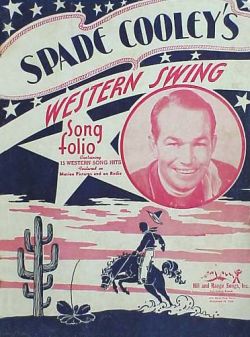
About 1942, Cooley's promoter, Foreman Phillips, began using "Western swing" to advertise his client. The first known use of the term Western swing in a national periodical was the June 10, 1944 issue of The Billboard: "...what with the trend to Western music in this section, Cooley's Western swing band is a natural. ... Music is not the true Western type... Dancers can foxtrot or do a slow jitter to it." A more widely known "first use" was a 1944 Billboard item mentioning a forthcoming songbook by Cooley titled Western Swing
Spade Cooley's Western Swing Song Folio
Spade Cooley's Western Swing Song Folio was the first songbook to identify the big Western dance band music as Western Swing. The songs were written by Spade Cooley. Smokey Rogers co-wrote several of the songs...
. This, however was preceded by this item on page 11 of the May 6, 1944 Billboard. "Spade Cooley, who moved in with his Western swing boys several months ago, has released the Breakfast Club. Cooley moved up from Foreman Phillip County barn dances at Venice, Calif., ballroom, where he was featured for 74 weeks."
After that, the music was known as Western swing.
Late 1920s to mid-30s: Beginnings
Western swing began in the dance halls of small towns throughout the lower Great PlainsGreat Plains
The Great Plains are a broad expanse of flat land, much of it covered in prairie, steppe and grassland, which lies west of the Mississippi River and east of the Rocky Mountains in the United States and Canada. This area covers parts of the U.S...
in the late 1920s and early 30s, growing from house parties and ranch dances where fiddlers and guitarists played for dancers. During its early development, scores of groups from San Antonio to Shreveport to Oklahoma City played different songs with the same basic sound. Prince Albert Hunt's Texas Ramblers out of Terrell in East Texas, and the East Texas Serenaders in Lindale, Texas, both added jazz elements to traditional music in the later half of the 1920s through the early 30s. Fred "Papa" Calhoun recalled that around 1930, he played in a band in Decatur, Texas that played "a lot of swing stuff like the Louisiana Five was playing back in those days. We also liked Red Nichols and Bix Beiderbecke."
After ending his pioneering partnership with Vernon Dalhart
Vernon Dalhart
Vernon Dalhart , born Marion Try Slaughter, was a popular American singer and songwriter of the early decades of the 20th century. He is a major influence in the field of country music.-Early life:...
, country music trailblazer Carson Robison
Carson Robison
Carson Jay Robison was an American country music singer and songwriter. Although his impact is generally forgotten today, he played a major role in promoting country music in its early years through numerous recordings and radio appearances. He was also known as Charles Robison and sometimes...
formed "Carson Robison's Madcaps", a "hot jazz" band with a decidedly country sound. Their recording of "Nonsense" (Edison Lateral 14085) in September 1929 was an uptempo and frantic number that would be a pioneering effort of the sound that was to be known as western swing. It featured instrumentation that was common with dance bands of the time, such as reed and brass instruments, but also several elements that gave it some "Western" flair, such as a banjo being prominently "finger picked" rather than strummed (the standard role for the banjo in jazz of that time), a lush fiddle sound, and drums played prominently with a strong and syncopated beat.
In the early 1930s, Bob Wills and Milton Brown
Milton Brown
Milton Brown was an American band leader and vocalist who co-founded the genre of Western swing. His band was the first to fuse hillbilly hokum, jazz, and pop together into a unique, distinctly American hybrid, thus giving him the nickname, "Father of Western Swing"...
co-founded the string band that became the Light Crust Doughboys
Light Crust Doughboys
The Light Crust Doughboys is a quintessential American Western swing band from Texas organized in 1931 by the Burrus Mill and Elevator Company in Saginaw, Texas. The band achieved its peak popularity in the few years leading up to World War II...
, the first professional band in this genre. The group, with Fred "Papa" Calhoun on piano, played dance halls and was heard on radio. Photographs of the Light Crust Doughboys taken as early as 1931 show two guitars along with fiddle player Wills.
On February 9, 1932, Milton Brown, his brother Durwood, Bob Wills, and C.G. "Sleepy" Johnson were recorded by Victor Records at the Jefferson Hotel in Dallas, Texas under the name, The Fort Worth Doughboys. Brown played guitar and Johnson played tenor guitar. Both "Sunbonnet Sue" and "Nancy Jane" were recorded that day. The record was released by Victor (23653), Blue Bird (5257), Montgomery Ward (4416 & 4757), and (Canadian) Sunrise (3340). Montgomery Ward credited "Milton Brown and His Musical Brownies".
When Milton Brown left the Doughboys later in 1932, he took his brother Durwood to play rhythm guitar in what would be called the Musical Brownies. In January 1933, fiddler Cecil Brower
Cecil Brower
Cecil Lee Brower was a classically trained American jazz violinist who became an architect of Western swing in the 1930s. Perhaps the greatest swing fiddler, he could improvise as well as double shuffle and created his own style which became the benchmark for his contemporaries...
, playing harmony, joined Jesse Ashlock to create the first example of harmonizing twin fiddles. Brower, a classically trained violinist, was the first to master Joe Venuti's double shuffle and his improvisational style was a major contribution to the genre. Photos from 1933 show three guitar players in the Doughboys.
In October 1933, Wills was fired and a new group of Doughboys went to Chicago for a recording session with Vocalion
Vocalion Records
Vocalion Records is a record label active for many years in the United States and in the United Kingdom.-History:Vocalion was founded in 1916 by the Aeolian Piano Company of New York City, which introduced a retail line of phonographs at the same time. The name was derived from one of their...
(later Columbia) Records. The years between 1935 and World War II were the most successful for the group. By 1937, some of the best musicians in the history of Western swing had joined the band. Kenneth Pitts and Clifford Gross played fiddles; and in 1939, Brower joined the Doughboys, replacing Buck Buchanan as fiddler in the string section but playing lead (Buchanan had played harmony).
In late 1933, Wills organized the Texas Playboys in Waco, Texas
Waco, Texas
Waco is a city in and the county seat of McLennan County, Texas. Situated along the Brazos River and on the I-35 corridor, halfway between Dallas and Austin, it is the economic, cultural, and academic center of the 'Heart of Texas' region....
. Recording rosters show that beginning in September 1935, Wills utilized two fiddles, two guitars, and Leon McAuliffe
Leon McAuliffe
Leon McAuliffe , born William Leon McAuliffe, was an American Western swing musician from Houston, Texas...
playing steel guitar, banjo, drums and other instruments during recording sessions.
The amplified stringed instruments, especially the steel guitar, gave the music its distinctive sound. As early as 1934 or 1935 Bob Dunn
Bob Dunn (musician)
Robert Lee "Bob" Dunn was a jazz trombonist and a pioneer Western swing steel guitarist.He is noted as the first musician to record an electrically amplified instrument—January, 1935, with Milton Brown and His Musical Brownies.Dunn also played steel guitar in numerous other Western Swing...
electrified a Martin O-series acoustic guitar while playing with Milton Brown's Brownies. According to Jimmy Thomason, "It happened when Dunn was working at Coney Island
Coney Island
Coney Island is a peninsula and beach on the Atlantic Ocean in southern Brooklyn, New York, United States. The site was formerly an outer barrier island, but became partially connected to the mainland by landfill....
in New York...he ran into this black guy who was playing a steel guitar with a homemade pickup attached to it...hooked up to this old radio or something and was playing blues licks...and he got this guy to show him how he was doing it. I never knew this black musician's name but both Bob and Avis talked to me about him often."
In 1935, Brown and His Musical Brownies recorded W.C. Handy's "St. Louis Blues" (Decca 5070) using a shortened arrangement of what they played at dances at the Crystal Palace outside Fort Worth, Texas
Fort Worth, Texas
Fort Worth is the 16th-largest city in the United States of America and the fifth-largest city in the state of Texas. Located in North Central Texas, just southeast of the Texas Panhandle, the city is a cultural gateway into the American West and covers nearly in Tarrant, Parker, Denton, and...
. In the dance hall arrangement, the band would play at slow-drag tempo for as long as 15 minutes with an accompanying vocal. The tempo would then increase to presto for the final choruses. The crowds of dancers loved the arrangement and eagerly anticipated the change in tempo. Waltzes and ballads were interspersed among faster songs if the dancers, who would dance two-step or round dances, became tired after faster numbers.
A documented of a Western swing group adopting the newer, by then mainstream 4/4 meter swing jazz style, replacing the 2/4 style, was when producer Art Satherley required it at a September 1936 Light Crust Doughboy recording session.
1938, session rosters for Wills recordings show both "lead guitar" and "electric guitar" in addition to guitar and steel guitar. The "front line" of Wills' orchestra consisted of either fiddles or guitars after 1944. That helped the style gain a much wider following through the music of Wills and his Playboys in Tulsa, Oklahoma
Tulsa, Oklahoma
Tulsa is the second-largest city in the state of Oklahoma and 46th-largest city in the United States. With a population of 391,906 as of the 2010 census, it is the principal municipality of the Tulsa Metropolitan Area, a region with 937,478 residents in the MSA and 988,454 in the CSA. Tulsa's...
and Brown and the Light Crust Doughboys in Fort Worth.
Wills recalled the early days of Western swing music in a 1949 interview. "Here's the way I figure it," he said. "We sure not tryin' to take credit for swingin' it." Speaking of Milton Brown and himself—working with popular songs done by Jimmie Davis
Jimmie Davis
James Houston Davis , better known as Jimmie Davis, was a noted singer of both sacred and popular songs who served two nonconsecutive terms as the 47th Governor of Louisiana...
, the Skillet Lickers
Skillet Lickers
The Skillet Lickers were an old-time band from Georgia, USA.When Gid Tanner teamed up with blind guitarist Riley Puckett and signed to Columbia in 1924, they created the label's earliest so-called "hillbilly" recording. Gid Tanner formed The Skillet Lickers in 1926. The first line-up was Gid...
, Jimmie Rodgers
Jimmie Rodgers (country singer)
James Charles Rodgers , known as Jimmie Rodgers, was an American country singer in the early 20th century known most widely for his rhythmic yodeling...
, songs he'd learned from his father and others—Wills said that "We'd...pull these tunes down an set 'em in a dance category. ...They wouldn't be a runaway...and just lay a real beat behind it an' the people would began to really like it. ...It was nobody intended to start anything in the world. We was just tryin' to find enough tunes to keep 'em dancin' to not have to repeat so much."
By the mid-1930s, Fort Worth was a hub for Western swing. The Crystal Springs Dance Pavilion was at the center, and it prospered as a country music venue until the 1950s. An estimated 1,800 persons attended a New Year's Eve Dance there in 1955.
Late 1930s to mid-40s: Height of popularity
Western swing was extremely popular throughout the West in the years before World War II and blossomed on the West CoastWest Coast of the United States
West Coast or Pacific Coast are terms for the westernmost coastal states of the United States. The term most often refers to the states of California, Oregon, and Washington. Although not part of the contiguous United States, Alaska and Hawaii do border the Pacific Ocean but can't be included in...
during the war. In the 1940s, the Light Crust Doughboys' broadcasts went out over 170 radio stations in the South and Southwest, and were heard by millions of listeners. From 1934 to 1943, Bob Wills and The Texas Playboys played nightly at Cain's Ballroom
Cain's Ballroom
Cain's Ballroom is a historic music venue in Tulsa, Oklahoma, built in 1924 to serve as a garage for one of Tulsa's founders, Tate Brady. Madison W. "Daddy" Cain purchased the building in 1930 and named it , where he charged 10¢ for dance lessons. The academy was the site of the Texas Playboys'...
in Tulsa, reaching crowds as large as 6,000 people. The 50,000-watt KVOO-AM
KFAQ
KFAQ is a news/talk radio station in the Tulsa, Oklahoma, area. The station is owned by Journal Broadcast Group and airs a mix of local and national talk shows. The station is an ABC News Radio affiliate...
radio station broadcast daily programs. Regular shows continued until 1958 with Johnnie Lee Wills
Johnnie Lee Wills
Johnnie Lee Wills was an American Western swing fiddler popular in the 1930s and 1940s.-Biography:Wills was born in Jewett, Texas, and was the younger brother of Bob Wills. He played banjo with Bob as a member of the Texas Playboys starting in 1934, the year the ensemble began playing on KVOO-AM...
as the bandleader. Doyle Brink and his Texas Swingsters out of Waco, Texas also played on the road for almost 50 years.
Burt (or Bert) "Foreman" Phillips developed a circuit of dance halls and bands to play for them. Among these halls in 1942 were the Los Angeles County Barn Dance at the Venice Pier Ballroom, the Town Hall Ballroom
Town Hall Party
Town Hall Party was an American country music radio and television show broadcast over KXLA-AM, Pasadena, California, KFI-AM, Los Angeles, California, and KTTV-TV. The first radio broadcast was in the autumn of 1951.Promoter William B...
in Compton, the Plantation in Culver City, the Baldwin Park Ballroom, and the Riverside Rancho. These Western dances were a huge success. According to Hank Penny, Phillips had said, "I don't want any of that Western Swing!" But that's what he got, and it got him huge eclectic crowds. Writer Gerald Vaughn wrote that "a Dance band hopes to make people move, not stand and listen, so the emphasis has to be on beat, rhythm, syncopation."
One of the groups which played at the Venice Pier Ballroom was led by Jimmy Wakely
Jimmy Wakely
James Clarence Wakeley , better known as Jimmy Wakely, was an American country-Western singer and actor, one of the last crooning cowpokes following World War II...
with Spade Cooley
Spade Cooley
Donnell Clyde Cooley , better known as Spade Cooley, was an American Western swing musician, big band leader, actor, and television personality...
, his successor as bandleader, on fiddle. Several thousand dancers would turn out on Saturday night to swing and hop. "The hordes of people and jitterbuggers loved him." When Bob Wills played the Los Angeles Country Barn Dance at the Venice Pier for three nights shortly before he broke up his band to join the U.S. Army during World War II, the attendance was above 15,000. Fearing that the dance floor would collapse, police stopped ticket sales at 11 p.m. The line outside at that time was ten deep and stretched into Venice. Another source states that Wills attracted 8,600 fans.
Riverside Rancho, operated by Marty Landau, had a 10000 square feet (929 m²) dance floor, three bars and a restaurant. According to Merle Travis
Merle Travis
Merle Robert Travis was an American country and western singer, songwriter, and musician born in Rosewood, Kentucky. His lyrics often discussed the life and exploitation of coal miners. Among his many well-known songs are "Sixteen Tons", "Re-Enlistment Blues" and "Dark as a Dungeon"...
, "At that time "Western swing" was a household word. Al Dexter had had a million-seller on his "Pistol Packin' Mama" record. Bob Wills was heard on every jukebox with this "San Antonio Rose". T. Texas Tyler
T. Texas Tyler
David Luke Myrick , known professionally as T. Texas Tyler, was an American country music singer and songwriter primarily known for his 1948 hit, "The Deck of Cards".-Biography:...
was doing well with his "Remember Me (When the Candlelights are Gleaming)". It was practically impossible to wedge your way into the Palace Barn where Red Murrell and his band were playing. A mile down the hill was the Riverside Rancho. You were lucky to find a ticket on a Wednesday night. Tex Williams
Tex Williams
Sollie Paul Williams , known professionally as Tex Williams, was an American Western swing musician from Ramsey, Illinois....
and his Western Caravan were playing there."
Other LA "country nightclubs", that is, places that weren't "dives" (and there were many), included The Painted Post ("Where the sidewalk ends and the West begins"), Willow Lake, Cowtown, Valley Ballroom, Cowshed Club, Dick Ross's Ballroom, and Dave Ming's 97th Street Corral. In 1950, Hank Penny and Armand Gautier opened the Palomino in North Hollywood, "one of country music's most fabled venues, the commercial and social focal point of Hollywood's country set." "Western jazz" brought it its initial popularity.
According to one report, crowds of ten thousand people were not uncommon at Western swing dances in the Los Angeles area. Another eyewitness report described the California crowds as "huge." Western swing bandleader Hank Thompson, who was stationed in San Pedro during World War II, said that it was not uncommon to see "ten thousand people at the pier," referring to Redondo Beach.
Fred "Poppa" Calhoun, piano player for Milton Brown, vividly remembered how people in Texas and Oklahoma danced when Bob Wills played. "They were pretty simple couples dances, two steps and the Lindy Hop
Lindy Hop
The Lindy Hop is an American social dance, from the swing dance family. It evolved in Harlem, New York City in the 1920s and '30s and originally evolved with the jazz music of that time. Lindy was a fusion of many dances that preceded it or were popular during its development but is mainly based...
with a few Western twirls added for good measure. By 1937 the jitterbug hit big in the West and allowed much greater freedom of movement. But the jitterbug was different in the West. It wasn't all out boogie woogie; it was 'swingier'—more smooth and subdued."
Another orchestra from the era was The Duece Spriggens Orchestra, which played nightly at the Western Palisades Ballroom on the Santa Monica Pier, then known as the largest ballroom on the West Coast. The music was broadcast as a radio show, The Cavalcade of Western Music, on KFI-AM. The group also appeared on the U.S. military's
American Forces Network
The American Forces Network is the brand name used by the United States Armed Forces American Forces Radio and Television Service for its entertainment and command internal information networks worldwide...
Melody Roundup radio program during the war.
In the 1940s, many "jukebox" short film features featuring prominent bands (Wills, Cooley and others) were produced by several small companies, usually based on simple Western movie plots.
1944: Nightclub tax
In 1944, with the United States' continuing involvement in World War II, a 30 percent federal excise tax was levied against "dancing" nightclubs. Although the tax was later reduced to 20 percent, "No Dancing Allowed" signs went up across the country. Jazz drummer Max Roach argued that, "This tax is the real story why dancing...public dancing per se...were just out." Club owners and promoters couldn't afford the combined city, state government taxes. The decline of Western swing in the years following the war also reflected the waning of the more mainstream big bandBig band
A big band is a type of musical ensemble associated with jazz and the Swing Era typically consisting of rhythm, brass, and woodwind instruments totaling approximately twelve to twenty-five musicians...
sound.
Bob Wills and His Texas Playboys remained popular after the war, and could not provide enough new recordings to fill demand. In 1947 Columbia reissued 70 older Wills recordings.
In January 1953 Billboard reported that band leader Spade Cooley played to 192,000 payees over 52 Saturday night dates at the Santa Monica Ballroom, grossing $220,000.
Dance-O-Rama
In 1955 Decca Records, in what Billboard called "an ambitious project", issued seven albums of "country dance music" featuring "swingy arrangements of your customers 'c&w' dance favorites". Miton Brown and His Brownies, Bob Wills and His Texas Playboys, Spade Cooley and His Buckle-Busters, Adolph Hofner and His San Antonians, Texas Williams and His String Band, Grady MartinGrady Martin
Thomas Grady Martin was one of the most renowned, inventive and historically significant American session musicians in country music and rockabilly....
and His Winging Strings, and Billy Gray and His Western Okies all had their own albums. In November, Billboard reported that Decca was rushing out three more albums in the series, albeit with less of a Western swing flavor.
Legacy
Moon MullicanMoon Mullican
Aubrey Wilson Mullican , known as Moon Mullican, was an American country and western singer, songwriter, and pianist. However, he also sang and played jazz, rock 'n' roll and the blues...
, who had performed with Western swing bands, later found more success as a solo artist and his 1940s and 50s hits often were done with a more Western swing than pure country feel.
Western swing was one of the many subgenres to influence rockabilly
Rockabilly
Rockabilly is one of the earliest styles of rock and roll music, dating to the early 1950s.The term rockabilly is a portmanteau of rock and hillbilly, the latter a reference to the country music that contributed strongly to the style's development...
and rock and roll
Rock and roll
Rock and roll is a genre of popular music that originated and evolved in the United States during the late 1940s and early 1950s, primarily from a combination of African American blues, country, jazz, and gospel music...
. Bill Haley
Bill Haley
Bill Haley was one of the first American rock and roll musicians. He is credited by many with first popularizing this form of music in the early 1950s with his group Bill Haley & His Comets and their hit song "Rock Around the Clock".-Early life and career:...
's music from the late 1940s and early 50s is often referred to as Western swing, and his band from 1948 to 1949 was named Bill Haley and The 4 Aces of Western Swing.
Willie Nelson
Willie Nelson
Willie Hugh Nelson is an American country music singer-songwriter, as well as an author, poet, actor, and activist. The critical success of the album Shotgun Willie , combined with the critical and commercial success of Red Headed Stranger and Stardust , made Nelson one of the most recognized...
, Waylon Jennings
Waylon Jennings
Waylon Arnold Jennings was an American country music singer, songwriter, and musician. Jennings began playing at eight. He began performing at twelve, on KVOW radio. Jennings formed a band The Texas Longhorns. Jennings worked as a D.J on KVOW, KDAV and KLLL...
and Asleep at the Wheel
Asleep at the Wheel
Asleep at the Wheel is a American country music group that was formed in Paw Paw, West Virginia, but based in Austin, Texas. Altogether, they have won nine Grammy Awards since their 1970 inception. In their career, they have released more than twenty studio albums, and have charted more than twenty...
helped make Austin, Texas
Austin, Texas
Austin is the capital city of the U.S. state of :Texas and the seat of Travis County. Located in Central Texas on the eastern edge of the American Southwest, it is the fourth-largest city in Texas and the 14th most populous city in the United States. It was the third-fastest-growing large city in...
a major center of Western swing beginning in the 1970s. The annual South by Southwest
South by Southwest
South by Southwest is an Austin, Texas based company dedicated to planning conferences, trade shows, festivals and other events. Their current roster of annual events include: SXSW Music, SXSW Film, SXSW Interactive, SXSWedu, and SXSWeco and take place every spring in Austin, Texas, United States...
music festival and the Austin City Limits
Austin City Limits
Austin City Limits is an American public television music program recorded live in Austin, Texas by Public Broadcasting Service Public television member station KLRU, and broadcast on many PBS stations around the United States...
PBS
Public Broadcasting Service
The Public Broadcasting Service is an American non-profit public broadcasting television network with 354 member TV stations in the United States which hold collective ownership. Its headquarters is in Arlington, Virginia....
television series have contributed to this success. Commander Cody and the Lost Planet Airmen were also key players in this revitalization. Western Swing Monthly, based in Austin, is a newsletter for musicians and fans.
In a Clint Eastwood's 1982 movie Honkytonk Man
Honkytonk Man
Honkytonk Man is a 1982 American drama film set in the Great Depression. Clint Eastwood, who produced and directed, stars with his son, Kyle Eastwood. Clancy Carlile's screenplay is based on his novel of the same name...
, his character meets Bob Wills (played by Johnny Gimble
Johnny Gimble
John Paul Gimble , better known as Johnny Gimble, is an American country musician associated with Western swing. He is an award-winning fiddle player and considered one of the most impressive fiddlers in the genre's history....
, an original Texas Playboy), who is recording in a studio with other former band members.
Western swing lives on at the Bobby Boatright Memorial Music Camp in Goree, Texas
Goree, Texas
Goree is a city in Knox County, Texas. The population was 321 at the 2000 census. A July 1, 2008 U.S. Census Bureau estimate placed the population at 257.-Geography:Goree is located at . It is situated at the junction of U.S...
. (Boatright was a fiddle player originally from Goree.)
See also
- Western musicWestern music (North America)Western music originated as a form of American folk music. Originally composed by and about the people who settled and worked throughout the Western United States and Western Canada. Directly related musically to old English, Scottish, and Irish folk ballads, Western music celebrates the life of...
- Swing music
- Western swing fiddleWestern swing fiddleWesterns swing originated in 1920s and 1930s; small towns in the US Southwest. Although sometimes subject to the term "Texas swing" it is widely associated with Tulsa,others contend that "Western Swing music finds deep roots in the dust bowl of Oklahoma", and its influences include jazz from the...
- List of Western swing and swing (big band) musicians
:Category:Western swing musical groups
:Category:Western swing performers
External links
- Bob Wills and His Texas Playboys website
- Milton Brown biography at TSHA
- Western swing at Big Bands Database Plus
- Westernswing.com links
- "A Short History of Western Swing"
- Sound documentation of Western swing
- Western Swing Monthly
Associations
- Northwest Western Swing Music Society
- Western Swing Music Society of the Southwest
- Western Swing Society–Sacramento
- The Academy Of Western Artists
Public radio programs
- KANZ-FM, Garden City, Kansas—Western Swing and Other Things, Allen Bailey, Saturdays, 10 a.m.–1 p.m Central Time (US)
- KFSR-FM, Fresno, California—Big Fresno Barn Dance, Don Fischer & Steve Barile, Sundays, 2–4 p.m. Pacific Time (US)
- KWGS-FM, Tulsa, Oklahoma—Swing On This, John Wooley, Saturdays, 7–8 p.m. Central Time (US)
- KZUM-FM, Lincoln, Nebraska—The Heyride, John Schmitz, Fridays, 7:30–9 p.m. Central Time (US)
- WVOF-FM, Fairfield, Connecticut—Swingin' West, Mike Gross, Fridays (May–November), 1–4 p.m. Eastern Time (US)
Listen
- Allen D. Bailey Saturdays, 10 a.m.–1 p.m. Central Time (US)
- Swingin' West radio-online Mike Gross-Fairfield University Student Radio, Fridays 1–4 p.m. Eastern Time (US)
- Swingin' West Hour - Swingin' West — Hosted by TwangTownUSA; available 24 hours; requires RealPlayer (two-minute commercial introduction)
- The Western Hour—Western & Western Swing - Golden Graham — Hosted by TwangTownUSA; requires RealPlayer (two-minute commercial introduction)
- buckatune.net - download Western swing mp3s
- Jazzabillies Western Swing Music
- http://www.honkytonks.org/showpages/lonestar.htmAsleep at the WheelAsleep at the WheelAsleep at the Wheel is a American country music group that was formed in Paw Paw, West Virginia, but based in Austin, Texas. Altogether, they have won nine Grammy Awards since their 1970 inception. In their career, they have released more than twenty studio albums, and have charted more than twenty...
band leader Ray Benson relates his experiences reintroducing Western swing to Texans]