

Orthographic projection

Encyclopedia
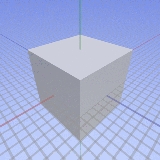
Orthographic projection (or orthogonal projection) is a means of representing a three-dimensional
object in two dimensions. It is a form of parallel projection
, where all the projection lines are orthogonal to the projection plane, resulting in every plane of the scene appearing in affine transformation
on the viewing surface. It is further divided into multiview orthographic projections and axonometric projection
s. A lens providing an orthographic projection is known as an (object-space) telecentric lens.
The term orthographic is also sometimes reserved specifically for depictions of objects where the axis or plane of the object is also parallel with the projection plane, as in multiview orthographic projections.

used the projection in the 2nd century B.C. to determine the places of star-rise and star-set. In about 14 B.C., Roman engineer Marcus Vitruvius Pollio
used the projection to construct sundials and to compute sun positions.
Vitruvius also seems to have devised the term orthographic (from the Greek orthos (= “straight”) and graphē (= “drawing”) for the projection. However, the name analemma
, which also meant a sundial showing latitude and longitude, was the common name until François d'Aguilon
of Antwerp promoted its present name in 1613.
The earliest surviving maps on the projection appear as woodcut drawings of terrestrial globes of 1509 (anonymous), 1533 and 1551 (Johannes Schöner), and 1524 and 1551 (Apian).
Three-dimensional space
Three-dimensional space is a geometric 3-parameters model of the physical universe in which we live. These three dimensions are commonly called length, width, and depth , although any three directions can be chosen, provided that they do not lie in the same plane.In physics and mathematics, a...
object in two dimensions. It is a form of parallel projection
Parallel projection
Parallel projections have lines of projection that are parallel both in reality and in the projection plane.Parallel projection corresponds to a perspective projection with an infinite focal length , or "zoom".Within parallel projection there is an ancillary category known as "pictorials"...
, where all the projection lines are orthogonal to the projection plane, resulting in every plane of the scene appearing in affine transformation
Affine transformation
In geometry, an affine transformation or affine map or an affinity is a transformation which preserves straight lines. It is the most general class of transformations with this property...
on the viewing surface. It is further divided into multiview orthographic projections and axonometric projection
Axonometric projection
Axonometric projection is a type of parallel projection, more specifically a type of orthographic projection, used to create a pictorial drawing of an object, where the object is rotated along one or more of its axes relative to the plane of projection....
s. A lens providing an orthographic projection is known as an (object-space) telecentric lens.
The term orthographic is also sometimes reserved specifically for depictions of objects where the axis or plane of the object is also parallel with the projection plane, as in multiview orthographic projections.
Origin
The orthographic projection has been known since antiquity, with its cartographic uses being well documented. HipparchusHipparchus
Hipparchus, the common Latinization of the Greek Hipparkhos, can mean:* Hipparchus, the ancient Greek astronomer** Hipparchic cycle, an astronomical cycle he created** Hipparchus , a lunar crater named in his honour...
used the projection in the 2nd century B.C. to determine the places of star-rise and star-set. In about 14 B.C., Roman engineer Marcus Vitruvius Pollio
Vitruvius
Marcus Vitruvius Pollio was a Roman writer, architect and engineer, active in the 1st century BC. He is best known as the author of the multi-volume work De Architectura ....
used the projection to construct sundials and to compute sun positions.
Vitruvius also seems to have devised the term orthographic (from the Greek orthos (= “straight”) and graphē (= “drawing”) for the projection. However, the name analemma
Analemma
In astronomy, an analemma is a curve representing the angular offset of a celestial body from its mean position on the celestial sphere as viewed from another celestial body relative to the viewing body's celestial equator...
, which also meant a sundial showing latitude and longitude, was the common name until François d'Aguilon
François d'Aguilon
François d'Aguilon , was a Belgian Jesuit mathematician, physicist and architect....
of Antwerp promoted its present name in 1613.
The earliest surviving maps on the projection appear as woodcut drawings of terrestrial globes of 1509 (anonymous), 1533 and 1551 (Johannes Schöner), and 1524 and 1551 (Apian).
Multiview orthographic projections
With multiview orthographic projections, up to six pictures of an object are produced, with each projection plane parallel to one of the coordinate axes of the object. The views are positioned relative to each other according to either of two schemes: first-angle or third-angle projection. In each, the appearances of views may be thought of as being projected onto planes that form a 6-sided box around the object. Although six different sides can be drawn, usually three views of a drawing give enough information to make a 3D object. These views are known as front view, top view and right side view.Pictorials
Within orthographic projection there is the subcategory known as pictorials. Axonometric pictorials show an image of an object as viewed from a skew direction in order to reveal all three directions (axes) of space in a single picture. Orthographic pictorial instrument drawings are often used to approximate graphical perspective projections, but there is attendant distortion in the approximation. Because pictorial projections inherently have this distortion, in the instrument drawing of pictorials, great liberties may then be taken for economy of effort and best effect. Orthographic pictorials rely on the technique of axonometric projection ("to measure along axes").See also
- Graphical projectionGraphical projectionGraphical projection is a protocol by which an image of a three-dimensional object is projected onto a planar surface without the aid of mathematical calculation, used in technical drawing.- Overview :...
- Multiview orthographic projectionMultiview orthographic projectionWith multiview orthographic projections, up to six pictures of an object are produced, with each projection plane parallel to one of the coordinate axes of the object....
- Orthographic projection (cartography)Orthographic projection (cartography)An orthographic projection is a map projection of cartography. Like the stereographic projection and gnomonic projection, orthographic projection is a perspective projection, in which the sphere is projected onto a tangent plane or secant plane. The point of perspective for the orthographic...
- Telecentric lensTelecentric lensA telecentric lens is a compound lens which has its entrance or exit pupil at infinity; in the prior case, this produces an orthographic view of the subject. This means that the chief rays are parallel to the optical axis in front of or behind the system, respectively...
- Telephoto lensTelephoto lensIn photography and cinematography, a telephoto lens is a specific type of a long-focus lens in which the physical length of the lens is shorter than the focal length. This is achieved by incorporating a special lens group known as a telephoto group that extends the light path to create a long-focus...
- Orthographic projection (geometry)Orthographic projection (geometry)In Euclidean geometry, an orthographic projection is an orthogonal projection. In particular, in 3D it is an affine, parallel projection of an object onto a perpendicular plane....