


London Underground ticketing

Encyclopedia
London Underground
The London Underground is a rapid transit system serving a large part of Greater London and some parts of Buckinghamshire, Hertfordshire and Essex in England...
metro system of London
London
London is the capital city of :England and the :United Kingdom, the largest metropolitan area in the United Kingdom, and the largest urban zone in the European Union by most measures. Located on the River Thames, London has been a major settlement for two millennia, its history going back to its...
, England
England
England is a country that is part of the United Kingdom. It shares land borders with Scotland to the north and Wales to the west; the Irish Sea is to the north west, the Celtic Sea to the south west, with the North Sea to the east and the English Channel to the south separating it from continental...
uses a mix of paper and electronic smart-card ticketing.
Fare zones
London Underground uses Transport for LondonTransport for London
Transport for London is the local government body responsible for most aspects of the transport system in Greater London in England. Its role is to implement the transport strategy and to manage transport services across London...
's Travelcard
Travelcard
The Travelcard is an inter-modal travel ticket for unlimited use on the London Underground, London Overground, Docklands Light Railway, Tramlink, London Buses and National Rail services in the Greater London area. Travelcards can be purchased for a period of time varying from one day to a year,...
zones to calculate fares, including fares for use on the Underground only. Travelcard Zone 1
Travelcard Zone 1
Fare zone 1 is the central zone of Transport for London's zonal fare system used for calculating the price of tickets for travel on the London Underground, London Overground, Docklands Light Railway and, since 2007, on National Rail services. For most tickets, travel through the zone is charged...
is the most central, with a boundary just beyond the Circle Line and Travelcard Zone 6
Travelcard Zone 6
Fare zone 6 is an outer zone of Transport for London's zonal fare system used for calculating the price of tickets for travel on the London Underground, London Overground, Docklands Light Railway and, since 2007, on National Rail services. The zone was created in January 1991; from May 1983 it had...
is the most outlying and includes London Heathrow Airport
London Heathrow Airport
London Heathrow Airport or Heathrow , in the London Borough of Hillingdon, is the busiest airport in the United Kingdom and the third busiest airport in the world in terms of total passenger traffic, handling more international passengers than any other airport around the globe...
. All of Greater London
Greater London
Greater London is the top-level administrative division of England covering London. It was created in 1965 and spans the City of London, including Middle Temple and Inner Temple, and the 32 London boroughs. This territory is coterminate with the London Government Office Region and the London...
is covered by zones 1 to 6.
Tickets including zone 1 are usually more expensive than those involving only outer zones. The zone system works well because the most popular destinations and the stations where lines cross are in zone 1, meaning that most journeys over similar distances will cost the same.
A few stations in the north east of the network, on the Central Line
Central Line
The Central line is a London Underground line, coloured red on the tube map. It is a deep-level "tube" line, running east-west across London, and, at , has the greatest total length of track of any line on the Underground. Of the 49 stations served, 20 are below ground...
, are outside Greater London in the Epping Forest
Epping Forest (district)
Epping Forest is a local government district of the county of Essex, England. It is named after Epping Forest, of which the district contains a large part...
district; however, they are included in zones 4, 5 and 6. In the north west of the network, on the Metropolitan Line
Metropolitan Line
The Metropolitan line is part of the London Underground. It is coloured in Transport for London's Corporate Magenta on the Tube map and in other branding. It was the first underground railway in the world, opening as the Metropolitan Railway on 10 January 1863...
, zones 7, 8 and 9 (formerly A - D) cover stations outside Greater London including Amersham
Amersham station
Amersham station is a London Underground and National Rail station in the town of Amersham, in the Chiltern district of Buckinghamshire, England.Amersham station is a terminus of the London Underground's Metropolitan Line...
and Chesham
Chesham tube station
Chesham lies at the end of the Metropolitan Line Chesham branch, and opened on 8 July 1889 as the original northern terminus of the Metropolitan Railway from . The station is a Grade II listed building. There is no station starter signal at Chesham. The branch has no intermediate stations...
in the Chiltern
Chiltern (district)
Chiltern is one of four local government districts of Buckinghamshire in south central England. It is named after the Chiltern Hills on which the region sits.The main towns in the district are Amersham and Chesham...
district of Buckinghamshire
Buckinghamshire
Buckinghamshire is a ceremonial and non-metropolitan home county in South East England. The county town is Aylesbury, the largest town in the ceremonial county is Milton Keynes and largest town in the non-metropolitan county is High Wycombe....
. Unlike the lower numbered zones, these ancillary areas do not encircle the capital. They only apply to the Metropolitan line and London Overground
London Overground
London Overground is a suburban rail network in London and Hertfordshire. It has been operated by London Overground Rail Operations since 2007 as part of the National Rail network, under the franchise control and branding of Transport for London...
.
Some stations are located on the boundary of two zones. For example, Vauxhall
Vauxhall station
Vauxhall station is a National Rail, London Underground and London Buses interchange station in central London. It is at the Vauxhall Cross road junction opposite the southern approach to Vauxhall Bridge over the River Thames in the London district of Vauxhall...
is in Zones 1 and 2; passengers travelling from a Zone 1 station only need to purchase a ticket covering Zone 1, while passengers travelling from an outer Zone (Zone 2 or beyond) only require a ticket covering Zone 2 and the other zones they are travelling through.
Ticket issuing systems
Cubic Transportation Systems, Inc. http://cubic.com/cts/, known as Westinghouse Cubic Ltd until April 1997, has manufactured all of London Underground's ticket machineTicket machine
A ticket machine, also known as a ticket vending machine , is a vending machine that produces tickets. For instance, ticket machines dispense train tickets at railway stations and tram tickets at some tram stops and in some trams...
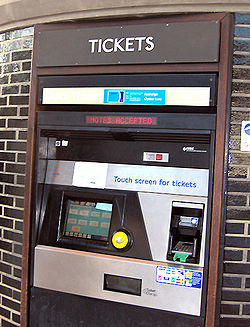
s since 1987. Tickets are sold from staffed ticket offices at stations, and from various types of self-service machines. The name for the system as installed from 1987 is "UTS" (Underground Ticketing System), though this system has been enhanced and extended recently, most notably since 1998 under the Prestige initiative, where Oyster smartcards were introduced.
- Ticket Office Machines (TOM): the system used in ticket offices. Now PC-based, replacing an earlier bespoke machine. The first machine at a station is numbered 01, with subsequent machines being numbered upwards from there.
- Few Fare Machines (FFM): also known as Tenfare. Self-service machines with only ten buttons, representing the most common fare types from that station. Machines do not accept credit or debit cards. Machines are numbered from 10 upwards.
- Multi Fare Machines (MFM): also known as Allfare. Self-service machines with touch-screens for all destinations on the London Underground network, offering a very wide range of tickets and Travelcards. Numbering goes upwards from 30.
- Queue Buster Machines (QBM): also known as Quick Ticket Machines (QTM). Smaller, wall-mounted, touch-screen machines installed initially at larger Zone 1 stations, and subsequently at other locations. These accept credit and debit cards, but not cash. Machines are numbered 36, 37, 38 or 39.
- Advance Fare Machines (AFM): Self-service machines with touch-screens. They are refurbished Fewfare machines with the functionality of a Multifare machine. Machines are numbered from 29 downwards where possible.
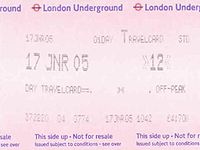
FFMs and MFMs give change, but only MFMs accept paper money. Tickets from TOMs, FFMs and MFMs are identical, apart from the window/machine numbering, but tickets from QBMs are slightly different, with bolder printing and a slightly different font. The QBM uses thermal printing, whereas others use impact print.
In the Travelcard illustrated below, 0762 on the bottom line represents the National Location Code
National Location Code
In the context of the ticketing system of the British railway network, a National Location Code is a four-digit code allocated to every railway station and railway ticket issuing point in Great Britain. NLCs are used in the issue of tickets, and for accounting purposes...
of the issuing station (in this case, West Ruislip), and 30 represents the first (and, in fact, only) MFM at that station.
As a result of fares being set on a zonal basis, single or return tickets do not show a destination station - they display an 11-character abbreviation of the origin station name. Between 1987 and 1994 (when the layout of tickets was redesigned), up to 16 characters could be used for the name.
A list of all TOM, Fewfare and Multifare machines on the London Underground network as at September 2002
Summary of ticket types
The following tickets are/were available from London Underground and Transport for London ticket agents for use on the Underground:| Ticket | Paper | Oyster | Off peak version | Notes |
|---|---|---|---|---|
| Single | Yes | Yes | Yes (on Oyster) | Paper tickets are priced at a higher rate. |
| Day Travelcard | Yes | No | Yes | The maximum daily spend on Oyster is capped at the equivalent Day Travelcard price. |
| 3-day Travelcard | No | No | No | Withdrawn from sale 2 January 2010. |
| Weekly Travelcard | No | Yes | No | Paper tickets for Weekly Travelcards are still available at National Rail stations. |
| Monthly Travelcard | No | Yes | No | Requires registration. |
| Annual Travelcard | No | Yes | No | Requires registration. |
Detailed information on tickets and pricing is available from the Transport for London website.
Ticket types
Single tickets
The fare structure for paper single tickets was simplified in January 2006. From January 2007 all journeys excluding zone 1 cost £3, and all journeys including zone 1 cost £4 no matter how long or short the journey.http://www.tfl.gov.uk/tfl/fares-tickets/2007/downloads/TfL-Fares-Jan-2007.pdf Fares for single paper tickets have been set deliberately high in order to encourage users to use either TravelcardTravelcard
The Travelcard is an inter-modal travel ticket for unlimited use on the London Underground, London Overground, Docklands Light Railway, Tramlink, London Buses and National Rail services in the Greater London area. Travelcards can be purchased for a period of time varying from one day to a year,...
s or Oyster
Oyster card
The Oyster card is a form of electronic ticketing used on public transport services within the Greater London area of the United Kingdom. It is promoted by Transport for London and is valid on a number of different travel systems across London including London Underground, buses, the Docklands...
pre-pay fares, which are substantially lower (by up to £2.50 per journey) than paper tickets.
Return tickets are sold at twice the price of a single ticket. A Travelcard
Travelcard
The Travelcard is an inter-modal travel ticket for unlimited use on the London Underground, London Overground, Docklands Light Railway, Tramlink, London Buses and National Rail services in the Greater London area. Travelcards can be purchased for a period of time varying from one day to a year,...
is often cheaper than a return ticket and will automatically be provided by ticket machines and ticket office staff if it is cheaper than the return fare.
Travelcard
Daily, seven-day, monthly and annual Travelcards are also available, allowing unlimited rides in two or more zones on the London Underground and most other forms of transport in London, including most National RailNational Rail
National Rail is a title used by the Association of Train Operating Companies as a generic term to define the passenger rail services operated in Great Britain...
services, bus
Bus
A bus is a road vehicle designed to carry passengers. Buses can have a capacity as high as 300 passengers. The most common type of bus is the single-decker bus, with larger loads carried by double-decker buses and articulated buses, and smaller loads carried by midibuses and minibuses; coaches are...
es, Tramlink
Tramlink
Tramlink is a tramway system in south London in the United Kingdom which began operation in May 2000...
and Docklands Light Railway
Docklands Light Railway
The Docklands Light Railway is an automated light metro or light rail system opened on 31 August 1987 to serve the redeveloped Docklands area of London...
. Travelcards are also available for 'odd periods' of between one month and a year.
Most regular travellers use Travelcards, and they are substantially better value for money than single tickets for anyone making more than a couple of journeys a day. Off-peak Travelcards, also known as "Day Travelcards", are only valid for journeys after 09:30, and a Peak Day Travelcard is also available at a higher price. Many shops, usually newsagents, sell bus passes and Travelcards; these are identified by a "Ticket Stop" sign, usually in a door panel or front window. A Day Travelcard is valid until 04:30 on the day after the date of issue.
The number and combination of zones is restricted depending the type of travelcard. Travelcards for only one zone are not sold.
| Validity | Peak combinations | Off-peak combinations |
|---|---|---|
| 1 day | 1-2, 1-3, 1-4, 1-5, 1-6, 2-6 | 1-2, 1-4, 1-6, 2-6 |
| Weekly and longer | At least two adjacent zones | n/a |
Oyster Card
In 2003, Transport for London launched the Oyster card. It is a proximity cardProximity card
Proximity card is a generic name for contactless integrated circuit devices used for security access or payment systems. The standard can refer to the older 125 kHz devices or the newer 13.56 MHz contactless RFID cards, most commonly known as contactless smartcards.Modern proximity cards...
, which on buses, trams and on the Underground allows a traveller to touch the card on one of the yellow readers positioned on the automatic entrance and exit gates rather than feeding it through a card ticket reader.
Unlike card tickets, the Oyster card is not disposable, and value - either 'pay as you go' balance or Travelcards - can be added to it at computerised ticket machines and at ticket offices. Where pay as you go credit is used the cost of each journey is deducted from a stored balance. As of October 2005, weekly, monthly and annual Travelcard
Travelcard
The Travelcard is an inter-modal travel ticket for unlimited use on the London Underground, London Overground, Docklands Light Railway, Tramlink, London Buses and National Rail services in the Greater London area. Travelcards can be purchased for a period of time varying from one day to a year,...
s issued by London Underground
London Underground
The London Underground is a rapid transit system serving a large part of Greater London and some parts of Buckinghamshire, Hertfordshire and Essex in England...
or directly by Transport for London
Transport for London
Transport for London is the local government body responsible for most aspects of the transport system in Greater London in England. Its role is to implement the transport strategy and to manage transport services across London...
are only available on Oyster cards.
The fare structure is now strongly biased to encourage the use of Oyster cards. From January 2008, the adult single cash fare for all journeys involving zone 1 is £4, and £3 for all journeys not involving zone 1, while there are different Oyster fares applicable between 7 a.m. and 7 p.m. Monday to Friday and at all other times (including public holidays): e.g. zone 1 only £1.60 at all times, zones 1-2 £2.20 peak, £1.60 off-peak, zones 1-3 £2.70 peak, zones 1-4 £2.80 peak, zones 1-4 £2.20 off-peak, zones 1-5 £3.70, 1-6 £3.80 peak, zones 1-6 £2 off-peak. Journeys not involving travel in zone 1 are much cheaper with Oyster: zone 2, 3, 4, 5, or 6 only, or zones 2-3, 3-4, 4-5, or 5-6, £1.10 at all times; zones 2-4, 2-5, 2-6, 3-5, 3-6 or 4-6 £2 peak, £1.10 off-peak.
Daily Travelcards are not sold on Oyster Card, but a system called 'Capping' ensures that on each day of use no more than the equivalent Travelcard price is deducted. Prior to January 2010 the Oyster cap was 50p less than a Travelcard, but now the cap for Oyster and Travelcard is the same. The balance can be automatically topped up with funds from a credit or debit card when the balance becomes low, a feature known as 'auto top-up'. Tickets and pay as you go credit can be purchased via a website or over the telephone.
The Oyster card system is designed to eliminate the need to purchase tickets at the station for most users. Following the implementation of the technology London Underground intends to reduce the number of staff working in ticket offices and redeploy them in other roles.

Penalty fares and fare evasion
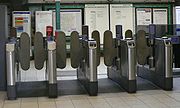
In addition to the automatic and staffed ticket gates at stations, the Underground is sometimes patrolled by the uniformed staff who mainly stay at the ticket barriers, and very occasionally by plain-clothes ticket inspectors equipped with hand-held Oyster cardOyster card
The Oyster card is a form of electronic ticketing used on public transport services within the Greater London area of the United Kingdom. It is promoted by Transport for London and is valid on a number of different travel systems across London including London Underground, buses, the Docklands...
readers. Passengers travelling without a ticket valid for their entire journey are sometimes required to pay a £50 penalty fare
Penalty fare
On the United Kingdom's public transport systems, a penalty fare is a special fare charged at a higher than normal price because the purchaser did not comply with the normal ticket purchasing rules...
or face prosecution for fare evasion
Fare evasion
Fare evasion, as distinct from fare avoidance, is the act of travelling on public transport in disregard of the law and/or regulation, having deliberately not purchased the required ticket to travel . It is a problem in many parts of the world, and revenue protection officers operate on many systems...
. Oyster
Oyster card
The Oyster card is a form of electronic ticketing used on public transport services within the Greater London area of the United Kingdom. It is promoted by Transport for London and is valid on a number of different travel systems across London including London Underground, buses, the Docklands...
pre-pay users who have failed to 'touch in' at the start of their journey are also considered to be travelling without a valid ticket.
Touts at stations can often be seen attempting to resell used Day Travelcard
Travelcard
The Travelcard is an inter-modal travel ticket for unlimited use on the London Underground, London Overground, Docklands Light Railway, Tramlink, London Buses and National Rail services in the Greater London area. Travelcards can be purchased for a period of time varying from one day to a year,...
s that they have been given by passengers who no longer need them. Transport for London
Transport for London
Transport for London is the local government body responsible for most aspects of the transport system in Greater London in England. Its role is to implement the transport strategy and to manage transport services across London...
strongly discourage this, officially stating that Travelcards are 'non-transferable' and thus invalid if resold. Underground staff and inspectors have the authority to confiscate tickets that they know to have been resold and to require a passenger using such a ticket to pay a penalty fare, although this is rare in practice since proving a ticket has been resold can be a difficult and time-consuming process.
In an attempt to reduce the numbers of Travelcards being used by more than one person, an experiment took place at Brixton station
Brixton tube station
Brixton tube station, a station on the London Underground opened on July 23, 1971, is the southern terminus of the Victoria line.It is located in Brixton Road, and is about 100m from Brixton railway station . From the ticket hall, three escalators take passengers to and from the platforms...
in 2002. A box was provided at the station exit into which passengers were encouraged to deposit Travelcard
Travelcard
The Travelcard is an inter-modal travel ticket for unlimited use on the London Underground, London Overground, Docklands Light Railway, Tramlink, London Buses and National Rail services in the Greater London area. Travelcards can be purchased for a period of time varying from one day to a year,...
s that were no longer required, and for each ticket deposited London Underground made a small donation to local charities for the homeless.