

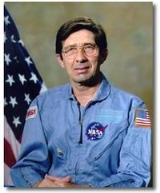
Lodewijk van den Berg

Encyclopedia
Lodewijk van den Berg is a Dutch American chemical engineer
, specializing in crystal growth
, who flew on a 1985 Space Shuttle Challenger
mission as a Payload Specialist
.
He was the first Dutch-born astronaut, a fact that is often overlooked in the Netherlands
because he was a naturalized
American and no longer a Dutch citizen at the time of flight. He is married and has two children. , he resides in Florida
and works as a chief scientist at the Constellation Technology Corporation.
, Netherlands
. Van den Berg was educated in the Netherlands where he attended the Delft University of Technology
from 1949 to 1961 and earned his Engineer's degree
in chemical engineering
. He moved to the United States to continue studying at the University of Delaware
, where he took another masters degree, this time in applied science, and then his Doctor of Philosophy
degree in 1974, also in applied science.
 After he had completed his Ph.D., he was offered a job at EG&G Corporation Energy Measurements in Goleta, California
, to work on crystal growth. EG&G was a defense contractor
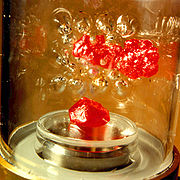
of the United States government and dealt with sensitive information and science. In 1975, this required Van den Berg to become a naturalized U.S. citizen. Van den Berg gathered years of research and management experience in the preparation of crystalline materials—in particular, the growth of single crystals of chemical compounds, and the investigation of associated defect chemistry and electronic properties. He became an international authority on vapor growth techniques with an emphasis on mercuric iodide
crystals and its application in the nuclear industry as gamma ray
detectors. During his work at EG&G
, Van den Berg asked NASA for permission to conduct crystal growth experiments in space, which NASA approved.
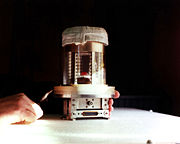
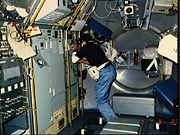 Van den Berg and his colleagues designed the EG&G Vapor Crystal Growth System experiment apparatus for a Space Shuttle flight. The experiment required an in-flight operator and NASA decided that it would be easier to train a crystal growth scientist to become an astronaut, than it would be the other way around. NASA asked EG&G and Van den Berg to compile a list of eight people who would qualify to perform the science experiments in space and to become a Payload Specialist
. Van den Berg and his chief, Dr. Harold A. Lamonds could only come up with seven names. Lamonds subsequently proposed adding Van den Berg to the list, joking with Van den Berg that due to his age, huge glasses and little strength, he would probably be dropped during the first selection round; but at least they would have eight names. Van den Berg agreed to be added to the list, but didn't really consider himself being selected to be a realistic scenario.
The first selection round, consisted of a selection based on science qualifications in the field in question, which Van den Berg easily passed. The final four candidates were tested on physical and mental qualifications which he also passed, while two of the others failed due to possible heart issues. He was now part of the final two, and NASA always trains two astronauts, a prime and a back-up. In 1983 he started to train as an astronaut and six months before the launch he was told that he would be the prime astronaut, much to his own surprise. When he went into space he was 53 years old, making him one of the oldest rookie
astronauts.
on STS-51B Challenger (April 29–May 6, 1985). STS-51B, the Spacelab-3 mission, was launched from the Kennedy Space Center
, Florida
, and returned to land at Edwards Air Force Base
, California
. It was the first operational Spacelab
mission. The seven-man crew aboard Challenger conducted investigations into crystal growth, drop dynamics leading to containerless material processing, atmospheric trace gas spectroscopy, solar and planetary atmospheric simulation, cosmic rays, and laboratory-animal and human medical monitoring.
As a co-investigator of the Vapor Crystal Growth System (VCGS) experiment, Van den Berg was responsible for the crystal growth aspects of the VCGS experiment. He had intimate knowledge of VCGS and Fluid Experiment System (FES) hardware, and had participated in all major design and science reviews of those systems.
By the end of the mission, Van den Berg had traveled over 2.9 million miles in 110 Earth orbits, and logged over 168 hours in space.
. At a later time he moved to Florida
to become a chief scientist at the Constellation Technology Corporation. At age 72, he continued to work up to 40 hours a week and grow crystals, a process he compares to gardening. The crystals he grows (Mercuric Iodide crystals) are used to make precision detectors for nuclear radiation. These detectors are used in medical applications, by the defense industry and the International Atomic Energy Agency
.
He visits the Netherlands every two years, and was the subject of a short 2004 documentary by Netwerk
called: The `forgotten astronaut`.
11430 (9560 P-L) was named after him and is now known as 11430 Lodewijkberg
. The asteroid was discovered October 17, 1960 by Cornelis Johannes van Houten
and Ingrid van Houten-Groeneveld
at Leiden Observatory
, where they were studying photographic plate
s taken by Tom Gehrels
using the Palomar Observatory
's Samuel Oschin telescope
.
Chemical engineer
In the field of engineering, a chemical engineer is the profession in which one works principally in the chemical industry to convert basic raw materials into a variety of products, and deals with the design and operation of plants and equipment to perform such work...
, specializing in crystal growth
Crystal growth
A crystal is a solid material whose constituent atoms, molecules, or ions are arranged in an orderly repeating pattern extending in all three spatial dimensions. Crystal growth is a major stage of a crystallization process, and consists in the addition of new atoms, ions, or polymer strings into...
, who flew on a 1985 Space Shuttle Challenger
Space Shuttle Challenger
Space Shuttle Challenger was NASA's second Space Shuttle orbiter to be put into service, Columbia having been the first. The shuttle was built by Rockwell International's Space Transportation Systems Division in Downey, California...
mission as a Payload Specialist
Payload Specialist
A Payload Specialist ' was an individual selected and trained by commercial or research organizations for flights of a specific payload on a NASA Space Shuttle mission...
.
He was the first Dutch-born astronaut, a fact that is often overlooked in the Netherlands
Netherlands
The Netherlands is a constituent country of the Kingdom of the Netherlands, located mainly in North-West Europe and with several islands in the Caribbean. Mainland Netherlands borders the North Sea to the north and west, Belgium to the south, and Germany to the east, and shares maritime borders...
because he was a naturalized
Naturalization
Naturalization is the acquisition of citizenship and nationality by somebody who was not a citizen of that country at the time of birth....
American and no longer a Dutch citizen at the time of flight. He is married and has two children. , he resides in Florida
Florida
Florida is a state in the southeastern United States, located on the nation's Atlantic and Gulf coasts. It is bordered to the west by the Gulf of Mexico, to the north by Alabama and Georgia and to the east by the Atlantic Ocean. With a population of 18,801,310 as measured by the 2010 census, it...
and works as a chief scientist at the Constellation Technology Corporation.
Education and early career
Van den Berg was born on March 24, 1932, in SluiskilSluiskil
Sluiskil is a town in the Dutch province of Zeeland. It is a part of the municipality of Terneuzen, and lies about 27 km southeast of Vlissingen.In 2001, the town of Sluiskil had 2366 inhabitants...
, Netherlands
Netherlands
The Netherlands is a constituent country of the Kingdom of the Netherlands, located mainly in North-West Europe and with several islands in the Caribbean. Mainland Netherlands borders the North Sea to the north and west, Belgium to the south, and Germany to the east, and shares maritime borders...
. Van den Berg was educated in the Netherlands where he attended the Delft University of Technology
Delft University of Technology
Delft University of Technology , also known as TU Delft, is the largest and oldest Dutch public technical university, located in Delft, Netherlands...
from 1949 to 1961 and earned his Engineer's degree
Engineer's degree
An engineer's degree is an advanced academic degree in engineering that is conferred in Europe, some countries of Latin America, and a few institutions in the United States....
in chemical engineering
Chemical engineering
Chemical engineering is the branch of engineering that deals with physical science , and life sciences with mathematics and economics, to the process of converting raw materials or chemicals into more useful or valuable forms...
. He moved to the United States to continue studying at the University of Delaware
University of Delaware
The university is organized into seven colleges:* College of Agriculture and Natural Resources* College of Arts and Sciences* Alfred Lerner College of Business and Economics* College of Earth, Ocean and Environment* College of Education and Human Development...
, where he took another masters degree, this time in applied science, and then his Doctor of Philosophy
Doctor of Philosophy
Doctor of Philosophy, abbreviated as Ph.D., PhD, D.Phil., or DPhil , in English-speaking countries, is a postgraduate academic degree awarded by universities...
degree in 1974, also in applied science.
Goleta, California
Goleta is a city in southern Santa Barbara County, California, USA. It was incorporated as a city in 2002, after a long period as the largest unincorporated, populated area in the county. As of the 2000 census, the Census-designated place had a total population of 55,204, however, a significant...
, to work on crystal growth. EG&G was a defense contractor
Defense contractor
A defense contractor is a business organization or individual that provides products or services to a military department of a government. Products typically include military aircraft, ships, vehicles, weaponry, and electronic systems...
of the United States government and dealt with sensitive information and science. In 1975, this required Van den Berg to become a naturalized U.S. citizen. Van den Berg gathered years of research and management experience in the preparation of crystalline materials—in particular, the growth of single crystals of chemical compounds, and the investigation of associated defect chemistry and electronic properties. He became an international authority on vapor growth techniques with an emphasis on mercuric iodide
Mercury(II) iodide
Mercury iodide is a chemical compound with an appearance of red-orange crystals. Unlike mercury chloride it is hardly soluble in water Mercury(II) iodide (HgI2) is a chemical compound with an appearance of red-orange crystals. Unlike mercury(II) chloride it is hardly soluble in water Mercury(II)...
crystals and its application in the nuclear industry as gamma ray
Gamma ray
Gamma radiation, also known as gamma rays or hyphenated as gamma-rays and denoted as γ, is electromagnetic radiation of high frequency . Gamma rays are usually naturally produced on Earth by decay of high energy states in atomic nuclei...
detectors. During his work at EG&G
EG&G
EG&G, formally known as Edgerton, Germeshausen, and Grier, Inc., is a United States national defense contractor and provider of management and technical services. The company was involved in contracting services to the United States government during World War II, and conducted weapons research and...
, Van den Berg asked NASA for permission to conduct crystal growth experiments in space, which NASA approved.
Selection
Payload Specialist
A Payload Specialist ' was an individual selected and trained by commercial or research organizations for flights of a specific payload on a NASA Space Shuttle mission...
. Van den Berg and his chief, Dr. Harold A. Lamonds could only come up with seven names. Lamonds subsequently proposed adding Van den Berg to the list, joking with Van den Berg that due to his age, huge glasses and little strength, he would probably be dropped during the first selection round; but at least they would have eight names. Van den Berg agreed to be added to the list, but didn't really consider himself being selected to be a realistic scenario.
The first selection round, consisted of a selection based on science qualifications in the field in question, which Van den Berg easily passed. The final four candidates were tested on physical and mental qualifications which he also passed, while two of the others failed due to possible heart issues. He was now part of the final two, and NASA always trains two astronauts, a prime and a back-up. In 1983 he started to train as an astronaut and six months before the launch he was told that he would be the prime astronaut, much to his own surprise. When he went into space he was 53 years old, making him one of the oldest rookie
Rookie
Rookie is a term for a person who is in his or her first year of play of their sport or has little or no professional experience. The term also has the more general meaning of anyone new to a profession, training or activity Rookie is a term for a person who is in his or her first year of play of...
astronauts.
STS-51B
Van den Berg was assigned as Payload SpecialistPayload Specialist
A Payload Specialist ' was an individual selected and trained by commercial or research organizations for flights of a specific payload on a NASA Space Shuttle mission...
on STS-51B Challenger (April 29–May 6, 1985). STS-51B, the Spacelab-3 mission, was launched from the Kennedy Space Center
Kennedy Space Center
The John F. Kennedy Space Center is the NASA installation that has been the launch site for every United States human space flight since 1968. Although such flights are currently on hiatus, KSC continues to manage and operate unmanned rocket launch facilities for America's civilian space program...
, Florida
Florida
Florida is a state in the southeastern United States, located on the nation's Atlantic and Gulf coasts. It is bordered to the west by the Gulf of Mexico, to the north by Alabama and Georgia and to the east by the Atlantic Ocean. With a population of 18,801,310 as measured by the 2010 census, it...
, and returned to land at Edwards Air Force Base
Edwards Air Force Base
Edwards Air Force Base is a United States Air Force base located on the border of Kern County, Los Angeles County, and San Bernardino County, California, in the Antelope Valley. It is southwest of the central business district of North Edwards, California and due east of Rosamond.It is named in...
, California
California
California is a state located on the West Coast of the United States. It is by far the most populous U.S. state, and the third-largest by land area...
. It was the first operational Spacelab
Spacelab
Spacelab was a reusable laboratory used on certain spaceflights flown by the Space Shuttle. The laboratory consisted of multiple components, including a pressurized module, an unpressurized carrier and other related hardware housed in the Shuttle's cargo bay...
mission. The seven-man crew aboard Challenger conducted investigations into crystal growth, drop dynamics leading to containerless material processing, atmospheric trace gas spectroscopy, solar and planetary atmospheric simulation, cosmic rays, and laboratory-animal and human medical monitoring.
As a co-investigator of the Vapor Crystal Growth System (VCGS) experiment, Van den Berg was responsible for the crystal growth aspects of the VCGS experiment. He had intimate knowledge of VCGS and Fluid Experiment System (FES) hardware, and had participated in all major design and science reviews of those systems.
By the end of the mission, Van den Berg had traveled over 2.9 million miles in 110 Earth orbits, and logged over 168 hours in space.
Career after NASA
After returning to Earth, Van den Berg continued to work on crystal growth experiments at EG&G in California and he became the head for the section of materials scienceMaterials science
Materials science is an interdisciplinary field applying the properties of matter to various areas of science and engineering. This scientific field investigates the relationship between the structure of materials at atomic or molecular scales and their macroscopic properties. It incorporates...
. At a later time he moved to Florida
Florida
Florida is a state in the southeastern United States, located on the nation's Atlantic and Gulf coasts. It is bordered to the west by the Gulf of Mexico, to the north by Alabama and Georgia and to the east by the Atlantic Ocean. With a population of 18,801,310 as measured by the 2010 census, it...
to become a chief scientist at the Constellation Technology Corporation. At age 72, he continued to work up to 40 hours a week and grow crystals, a process he compares to gardening. The crystals he grows (Mercuric Iodide crystals) are used to make precision detectors for nuclear radiation. These detectors are used in medical applications, by the defense industry and the International Atomic Energy Agency
International Atomic Energy Agency
The International Atomic Energy Agency is an international organization that seeks to promote the peaceful use of nuclear energy, and to inhibit its use for any military purpose, including nuclear weapons. The IAEA was established as an autonomous organization on 29 July 1957...
.
He visits the Netherlands every two years, and was the subject of a short 2004 documentary by Netwerk
Netwerk
Netwerk is a Dutch 'behind the news' television show on Nederland 2....
called: The `forgotten astronaut`.
Asteroid
On September 28, 2007 the main belt asteroidAsteroid
Asteroids are a class of small Solar System bodies in orbit around the Sun. They have also been called planetoids, especially the larger ones...
11430 (9560 P-L) was named after him and is now known as 11430 Lodewijkberg
11430 Lodewijkberg
11430 Lodewijkberg is a main belt asteroid with an orbital period of 1195.5383307 days . It was named after astronaut Lodewijk van den Berg. The asteroid was discovered on October 17, 1960.-References:...
. The asteroid was discovered October 17, 1960 by Cornelis Johannes van Houten
Cornelis Johannes van Houten
Cornelis Johannes van Houten was a Dutch astronomer, sometimes referred to as Kees van Houten.Born in The Hague, he spent his entire career at Leiden University except for a brief period as research assistant at Yerkes Observatory...
and Ingrid van Houten-Groeneveld
Ingrid van Houten-Groeneveld
Ingrid van Houten-Groeneveld is a Dutch astronomer.In a jointly-credited trio with Tom Gehrels and her husband Cornelis Johannes van Houten, she was an extremely prolific discoverer of many thousands of asteroids...
at Leiden Observatory
Leiden Observatory
Leiden Observatory is an astronomical observatory in the city of Leiden, Netherlands. It was established by Leiden University in 1633, to house the quadrant of Snellius, and is the oldest operating University observatory in the world Leiden Observatory (Sterrewacht Leiden in Dutch) is an...
, where they were studying photographic plate
Photographic plate
Photographic plates preceded photographic film as a means of photography. A light-sensitive emulsion of silver salts was applied to a glass plate. This form of photographic material largely faded from the consumer market in the early years of the 20th century, as more convenient and less fragile...
s taken by Tom Gehrels
Tom Gehrels
Tom Gehrels , was an American astronomer, Professor Planetary Sciences, and Astronomer at the University of Arizona, Tucson....
using the Palomar Observatory
Palomar Observatory
Palomar Observatory is a privately owned observatory located in San Diego County, California, southeast of Pasadena's Mount Wilson Observatory, in the Palomar Mountain Range. At approximately elevation, it is owned and operated by the California Institute of Technology...
's Samuel Oschin telescope
Samuel Oschin telescope
The Samuel Oschin telescope is a 48-inch aperture Schmidt camera at the Palomar Observatory in northern San Diego County, California. It consists of a 49.75-inch Schmidt corrector plate and a 72-inch mirror. The instrument is strictly a camera; there is no provision for an eyepiece to look...
.
Academic publications
- "Fabrication of mercuric iodide radiation detectors", Lodewijk van den Berg and Ron D. Vigil, Nuclear Instruments and Methods in Physics Research Section A: Accelerators,Spectrometers,Detectors and Associated Equipment, Volume 458, Issues 1-2, 1 February 2001, Pages 148-151
- "Improved yield of high resolution mercuric iodide gamma-ray spectrometers", Vernon Gerrish and Lodewijk van den Berg, Nuclear Instruments and Methods in Physics Research Section A: Accelerators, Spectrometers, Detectors and Associated Equipment, Volume 299, Issues 1-3, 20 December 1990, Pages 41-44