

Lima Region

Encyclopedia
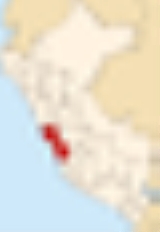
Lima Region, also known as Lima Provincias, is one of twenty-five regions of Peru
. Located in the central coast of the country, its regional seat (capital city) is Huacho
.
Lima Province
, which contains the city of Lima
, the country's capital, is located on the western part of the Lima Region. However, this province is autonomous and not under the jurisdiction of the Regional Government.
on the north, the Huánuco Region
, Pasco Region
and Junín Region
on the east, the Huancavelica Region
on the southeast, the Ica Region
on the south, and the Pacific Ocean
and the Lima Province
on the west.
The region has a coastal and an Andean zone, and has a great diversity of natural regions: the Costa or Chala (0 to 500 meters above sea level) up to the Janca or Cordillera (over 4800 meters). The predominating regions are the Yunga (500 to 2300 meters above sea level) and Quechua (2300 to 3500 meters).
, a unique mist-fed eco-system of wild plant and animal species, is a natural reserve located in the region.
of Cañete Province
, is located 38 km away from the city of San Vicente de Cañete
. The Incahuasi
Archeological complex is located there. Lunahuaná has a dry climate and the sun shines during most of the year. Lately, Lunahuaná has become an adventure sports paradise, such as: Canotaje (Whitewater Rafting), Parapente & Ala Delta. Whitewater rafting is possible due to the Cañete River, which has rapids up to level 4. The main settlement in this district is the town of Lunahuaná
.
in the Chillón River
valley a few miles north of present-day Lima. They had discovered a 4200-year-old observatory constructed by an early Andean civilization, a three-dimensional sculpture, unique for the time period in this region, and sophisticated carvings. The observatory is on top of a 33-foot pyramidal mound
and has architectural features for sighting the astronomical solstices. The discovery pushes back the time for the development of complex civilization in the area and has altered scholars' understanding of Preceramic period cultures in Peru.
The remains of early Andean inhabitants, hunters and harpoon fishermen from about 1000 years ago, are to be found in the Lima region. These remains were found in Chivateros
, near the Chillón River
, and in various other places. These persons incorporated nets, hooks, farming, ceramics and weaving to their everyday objects. The inhabitants of the coast lived in the lomas and the valleys, where they built temples and dwelling complexes, leading to huge ceremonial centers, such as the Huacoy on the Chillón River
; Garagay and La Florida (prehistoric) on the Rímac River
, Manchay on the Lurín River
; and Chancay
, Supe and many other valleys to the north and south. There are finely ornamented temples with figures modeled in clay. The Lima culture
(100 A.D. to 650 A.D.) arose in this area, specially in the central valleys from Chancay
to Lurín
. It was distinguished by painted adobe buildings.
During this time, the Huari conquest took place, thus giving rise to Huari-style ceramics, together with a local style known as Nievería. As the population grew, their culture changed. With the decline of the Huari, whose most important center was Cajamarquilla
, new local cultures arose. The Chancay
are the most well known. They developed large urban centers and a considerable textile production, as well as mass-produced ceramics.
At this stage in the mid-fifteenth century, the Incas arrived from their base in the Andes. They conquered and absorbed the regional cultures and occupied important sites such as Pachacamac
, turning it into an administrative center.
The provinces, with their capitals in parentheses, are:
Peru
Peru , officially the Republic of Peru , is a country in western South America. It is bordered on the north by Ecuador and Colombia, on the east by Brazil, on the southeast by Bolivia, on the south by Chile, and on the west by the Pacific Ocean....
. Located in the central coast of the country, its regional seat (capital city) is Huacho
Huacho
Huacho is a city in Peru, capital of the Huaura Province and capital of the Lima Region. It is located 223 feet above sea level and 148 km north of the city of Lima...
.
Lima Province
Lima Province
Lima Province is located in the central coast of Peru and is the only province in the country not belonging to any of the twenty-five regions. Its capital is Lima, which is also the nation's capital....
, which contains the city of Lima
Lima
Lima is the capital and the largest city of Peru. It is located in the valleys of the Chillón, Rímac and Lurín rivers, in the central part of the country, on a desert coast overlooking the Pacific Ocean. Together with the seaport of Callao, it forms a contiguous urban area known as the Lima...
, the country's capital, is located on the western part of the Lima Region. However, this province is autonomous and not under the jurisdiction of the Regional Government.
Geography
The region is bordered by the Ancash RegionAncash Region
Ancash is a region in northern Peru. It is bordered by the La Libertad region on the north, the Huánuco and Pasco regions on the east, the Lima region on the south, and the Pacific Ocean on the west. Its capital is the city of Huaraz, and its largest city and port is Chimbote...
on the north, the Huánuco Region
Huánuco Region
Huánuco is a region in central Peru. It is bordered by the La Libertad, San Martín, Loreto and Ucayali regions on the north; the Ucayali Region on the east; the Pasco Region on the south; and the Lima and Ancash regions on the west. Its capital is the city of Huánuco.Huánuco has a rough topography...
, Pasco Region
Pasco Region
Pasco is a region in central Peru. Its capital is Cerro de Pasco.-Political division:The region is divided into 3 provinces , which are composed of 28 districts .-Provinces:...
and Junín Region
Junín Region
Junín is a region in the central highlands and westernmost Amazonia of Peru. Its capital is Huancayo.-Geography:The region has a very heterogeneous topography. The western cordillera located near the border with the Lima Region, has snowy and ice covered peaks. On the east, there are high glacier...
on the east, the Huancavelica Region
Huancavelica Region
Huancavelica is a region in Peru. Area: 22,131.47 km². Population: 447,054 . The capital is the city of Huancavelica.It is bordered by Lima Region and Ica in the west, Junín in the north, and Ayacucho in the east....
on the southeast, the Ica Region
Ica Region
Ica is a region in Peru. It borders the Pacific Ocean on the west; the Lima Region on the north; the Huancavelica and Ayacucho regions on the east; and the Arequipa Region on the south. Its capital is the city of Ica.- Geography :...
on the south, and the Pacific Ocean
Pacific Ocean
The Pacific Ocean is the largest of the Earth's oceanic divisions. It extends from the Arctic in the north to the Southern Ocean in the south, bounded by Asia and Australia in the west, and the Americas in the east.At 165.2 million square kilometres in area, this largest division of the World...
and the Lima Province
Lima Province
Lima Province is located in the central coast of Peru and is the only province in the country not belonging to any of the twenty-five regions. Its capital is Lima, which is also the nation's capital....
on the west.
The region has a coastal and an Andean zone, and has a great diversity of natural regions: the Costa or Chala (0 to 500 meters above sea level) up to the Janca or Cordillera (over 4800 meters). The predominating regions are the Yunga (500 to 2300 meters above sea level) and Quechua (2300 to 3500 meters).
Lomas de Lachay
The Lomas de LachayLomas de Lachay
The Lomas de Lachay is a national reserve in the desert foothills of Huaura Province in Lima region of Peru. The reserve is located north from the capital Lima and features a unique mist-fed ecosystem of wild plant and animal species...
, a unique mist-fed eco-system of wild plant and animal species, is a natural reserve located in the region.
Lunahuaná
Lunahuaná DistrictLunahuaná District
Lunahuaná is a district in the middle Cañete Province in Peru. It is bordered by Imperial District on the west, San Vicente de Cañete District on the north, Pacarán District on the east, and Chincha Province on the south.-External links:...
of Cañete Province
Cañete Province
Cañete is a province located in southern Lima Region, Peru. It is bordered by the Lima Province on the north, the Ica Region on the south, the Huarochirí and Yauyos provinces on the east, and the Pacific Ocean on the west. Its capital is the town of San Vicente de Cañete District...
, is located 38 km away from the city of San Vicente de Cañete
San Vicente de Cañete
San Vicente de Cañete, commonly known simply as Cañete, is a town in Peru, which is the capital of the Cañete Province, in the Lima Region...
. The Incahuasi
Incahuasi
Incahuasi or Nevado de Incahuasi is a mountain between the Argentine province of Catamarca, and the Atacama Region of Chile. Located at approximate coordinates , it has a height of 6,621m....
Archeological complex is located there. Lunahuaná has a dry climate and the sun shines during most of the year. Lately, Lunahuaná has become an adventure sports paradise, such as: Canotaje (Whitewater Rafting), Parapente & Ala Delta. Whitewater rafting is possible due to the Cañete River, which has rapids up to level 4. The main settlement in this district is the town of Lunahuaná
Lunahuaná
Lunahuaná is a town in the Cañete Province of the Lima Region, in western Peru. It has a population of 3,595 and is the largest town in the Lunahuaná District....
.
History
In 2006, a team of archeological researchers led by Robert Benfer announced their findings from a four-year excavation at Buena Vista, PeruBuena Vista, Peru
Buena Vista is an 8 hectare archaeological site located in Peru about 25 miles inland in the Chillon River Valley and an hour's drive north of Lima. It is in the Santa Rosa de Quives District, Canta Province, in the foothills of the Andes. The site was first excavated by Frederic Engel...
in the Chillón River
Chillón River
The Chillón River is a river located in western Peru. Its waters are produced by the melting of ice in the glaciers of the Andes, and its mouth is located in the Pacific Ocean coast of the Callao Region. Its volume gets higher during the summer months . The river's valley is very fertile...
valley a few miles north of present-day Lima. They had discovered a 4200-year-old observatory constructed by an early Andean civilization, a three-dimensional sculpture, unique for the time period in this region, and sophisticated carvings. The observatory is on top of a 33-foot pyramidal mound
Mound
A mound is a general term for an artificial heaped pile of earth, gravel, sand, rocks, or debris. The most common use is in reference to natural earthen formation such as hills and mountains, particularly if they appear artificial. The term may also be applied to any rounded area of topographically...
and has architectural features for sighting the astronomical solstices. The discovery pushes back the time for the development of complex civilization in the area and has altered scholars' understanding of Preceramic period cultures in Peru.
The remains of early Andean inhabitants, hunters and harpoon fishermen from about 1000 years ago, are to be found in the Lima region. These remains were found in Chivateros
Chivateros
Chivateros is a cave in the Lima Department of Peru. There are archeological remains that show evidence of ancient Peruvian cultures that existed over 20,000 years ago....
, near the Chillón River
Chillón River
The Chillón River is a river located in western Peru. Its waters are produced by the melting of ice in the glaciers of the Andes, and its mouth is located in the Pacific Ocean coast of the Callao Region. Its volume gets higher during the summer months . The river's valley is very fertile...
, and in various other places. These persons incorporated nets, hooks, farming, ceramics and weaving to their everyday objects. The inhabitants of the coast lived in the lomas and the valleys, where they built temples and dwelling complexes, leading to huge ceremonial centers, such as the Huacoy on the Chillón River
Chillón River
The Chillón River is a river located in western Peru. Its waters are produced by the melting of ice in the glaciers of the Andes, and its mouth is located in the Pacific Ocean coast of the Callao Region. Its volume gets higher during the summer months . The river's valley is very fertile...
; Garagay and La Florida (prehistoric) on the Rímac River
Rímac River
The Rímac River is located in western Peru and is the most important source of potable water for the Lima and Callao Metropolitan Area.The river is part of the Pacific watershed and has a length of 160 km...
, Manchay on the Lurín River
Lurín River
The the lurin river is a is a long watercourse located in the Lima Region of Peru. It originates in the glaciers and lagoons of the western Andes and is known as the Chalilla River until joining the Taquía creek where it receives its common name. Its main tributaries are the Taquía, Llacomayqui,...
; and Chancay
Chancay
Chancay is a small city in the Lima Region of Peru. Its population is 26,958....
, Supe and many other valleys to the north and south. There are finely ornamented temples with figures modeled in clay. The Lima culture
Lima culture
The Lima culture was an indigenous civilization which existed in modern day Peru from A.D. 100 to A.D. 650. This pre-Incan culture was located in the Chillon, Rimac and Lurin River valleys. This civilization was known for its ceramic artwork. The Lima Civilizaton constructed many temples known as...
(100 A.D. to 650 A.D.) arose in this area, specially in the central valleys from Chancay
Chancay
Chancay is a small city in the Lima Region of Peru. Its population is 26,958....
to Lurín
Lurin
Lurin is a quartier of Saint Barthélemy in the Caribbean. It is located east of Gustavia and is one of the more larger quartiers on the island....
. It was distinguished by painted adobe buildings.
During this time, the Huari conquest took place, thus giving rise to Huari-style ceramics, together with a local style known as Nievería. As the population grew, their culture changed. With the decline of the Huari, whose most important center was Cajamarquilla
Cajamarquilla
The Cajamarquilla archaeological site is located 25 km inland from the coastal city of Lima, Peru; in the Jicamarca Valley, 6 km north of the Rímac River. It occupies an area of approximately 167 ha, making it one of the largest archaeological monuments in the country...
, new local cultures arose. The Chancay
Chancay
Chancay is a small city in the Lima Region of Peru. Its population is 26,958....
are the most well known. They developed large urban centers and a considerable textile production, as well as mass-produced ceramics.
At this stage in the mid-fifteenth century, the Incas arrived from their base in the Andes. They conquered and absorbed the regional cultures and occupied important sites such as Pachacamac
Pachacamac
The temple of Pachacamac is an archaeological site 40 km southeast of Lima, Peru in the Valley of the Lurín River. Most of the common buildings and temples were built c...
, turning it into an administrative center.
Political division
The region is divided into nine provinces , which are composed of 128 districts (distritos, singular: distrito).The provinces, with their capitals in parentheses, are:
- BarrancaBarranca ProvinceThe Barranca Province is one of the nine provinces in the Lima Region of Peru. It was created by Law No. 23939 on October 5, 1984 by the government of President Fernando Belaunde Terry...
(BarrancaBarranca, LimaBarranca is a city in central Peru, capital of the province Barranca in the region Lima.-External links:...
) - CajatamboCajatambo provinceThe Cajatambo province, or Province of Cajatambo , is one of nine provinces in the Lima Region of Peru. It is bordered to the north by the Ancash Region, to the east by the Huánuco Region, to the south by the Oyón Province, and to the west by the Huaura Province.-Administrative Division:The...
(CajatamboCajatambo-Population:The population of Cajatambo was estimated in 1896 to be roughly 6,000 people, although the 1911 Encyclopedia Britannica puts the population at closer to 4,500.-Industries:...
) - CañeteCañete ProvinceCañete is a province located in southern Lima Region, Peru. It is bordered by the Lima Province on the north, the Ica Region on the south, the Huarochirí and Yauyos provinces on the east, and the Pacific Ocean on the west. Its capital is the town of San Vicente de Cañete District...
(San Vicente de CañeteSan Vicente de CañeteSan Vicente de Cañete, commonly known simply as Cañete, is a town in Peru, which is the capital of the Cañete Province, in the Lima Region...
) - CantaCanta ProvinceCanta Province is a province in the Lima Region of Peru, situated approximately to the northeast of the Peruvian capital, Lima.-Political division:The province is divided into seven districts.* Arahuay * Canta * Huamantanga...
(CantaCantaCanta is a town in the Lima Region, in western Peru. The town is located on the Chillón River and is the capital of the Canta Province. With a population of 2,809 , it is also the capital of Canta District...
) - HuaralHuaral ProvinceThe Huaral Province is one of the nine provinces in the Lima Region of Peru. It was created by Law No. 21488 on May 11, 1976 by president Francisco Morales Bermúdez out of eight districts of the Canta Province and four of the Huaura Province...
(HuaralHuaralHuaral is a town in central Peru, capital of the province Huaral in the region Lima.-References:...
) - HuarochiríHuarochirí ProvinceHuarochirí Province is located in the Lima Region of Peru. Its capital is Matucana. The western section is part of the Lima Metropolitan Area.-Political division:The province is divided into thirty-two districts.* Antioquia...
(MatucanaMatucana, PeruMatucana is a town in Central Peru, capital of the province Huarochirí in the region Lima. It's located to the East of Lima at 2,378 m above sea level, along the Central Road at km 74....
) - HuauraHuaura ProvinceHuaura is one of nine provinces of the Región Lima on the Pacific coast of Perú. It is bordered by the province of Barranca and the Ancash Region in the north, the provinces of Cajatambo and Oyón and the Pasco Region in the east, the province of Huaral in the south and the Pacific Ocean in the...
(HuachoHuachoHuacho is a city in Peru, capital of the Huaura Province and capital of the Lima Region. It is located 223 feet above sea level and 148 km north of the city of Lima...
) - OyónOyón ProvinceOyón Province is a province of the Lima Region in Peru, it measures . The capital of the province is the city of Oyón.- Political division :The province is divided into six districts, which are:- References :...
(OyónOyón, PeruOyón is a town in Central Peru, capital of the province Oyón in the region Lima.- References : Instituto Nacional de Estadística e Informática. . Retrieved February 21, 2008....
) - YauyosYauyos ProvinceThe Yauyos Province is a province located in the Lima Region of Peru. It is one of the eleven that make up that region.-Boundaries:*North: Huarochirí Province*East: Junín Region, Huancavelica Region*South: Ica Region...
(YauyosYauyosYauyos is a town in Central Peru, capital of the province Yauyos in the region Lima. The city is the seat of the Territorial Prelature of Yauyos....
)
External links
- North Lima Region - Lima Region: Social, Cultural and Tourist Information
- Lima Travel Guide - General facts and travel information about Lima
- Gobierno Regional Lima - Lima Regional Government official website