


Pachacamac

Encyclopedia
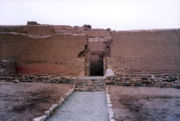
The temple of Pachacamac is an archaeological site 40 km southeast of Lima
, Peru
in the Valley of the Lurín River
. Most of the common buildings and temples were built c. 800-1450 CE, shortly before the arrival and conquest by the Inca Empire
.
To date, several pyramids have been uncovered; archaeologists have identified at least 17 pyramids (many of them irreversibly damaged by the El Niño weather phenomenon). Besides pyramids, the site had a cemetery and multicolored fresco
of fish from the Early Intermediate period (c. 200-600 CE). Later, the Huari (c. 600-800 CE) constructed the city, probably using it as an administrative center. A number of Huari-influenced designs appear on the structures and on the ceramics and textiles found in the cemeteries of this period. After the collapse of the Huari empire, Pachacamac continued to grow as a religious center. The majority of the common architecture and temples were built during this stage (c. 800-1450 CE).
By the time the Tawantinsuyu (Inca Confederacy) invaded the area, the valleys of the Rímac
and Lurín
had a small state which the people called Ichma., They used Pachacamac primarily as a religious site for the veneration of the Pacha Kamaq
, the creator god. The Ichma joined the Incan Empire, which used Pachacamac as an important administrative center. The Inca maintained it as a religious shrine and allowed the Pachacamac priests to continue functioning independently of the Inca priesthood. This included the oracle
, whom the Inca presumably consulted. The Inca built five additional buildings, including a temple to the sun on the main square.
 Pacha Kamaq
('Earth-Maker') was considered the creator god by the people who lived in this part of Peru
before the Inca conquest. The Inca took him into their pantheon
, but considered him a lesser rival of Viracocha
, their creator god.
The myths that survive of Pacha Kamaq are sparse and confused: some accounts, for example, identify him as Manco Cápac
's cowardly brother Ayca, while others say that he, Manco Cápac and Viracocha were the sole three sons of Inti
, the sun god. Another story says that he made the first man and the first woman, but forgot to give them food — and when the man died and the woman prayed over Pachacamac's head to his father Inti to make her the mother of all the peoples of earth, Pachacamac was furious. One by one, as the children were born, he tried to kill them — only to be beaten and to be thrown into the sea by her hero-son Wichama, after which he gave up the struggle and contented himself by becoming the supreme god of fish.
Lima
Lima is the capital and the largest city of Peru. It is located in the valleys of the Chillón, Rímac and Lurín rivers, in the central part of the country, on a desert coast overlooking the Pacific Ocean. Together with the seaport of Callao, it forms a contiguous urban area known as the Lima...
, Peru
Peru
Peru , officially the Republic of Peru , is a country in western South America. It is bordered on the north by Ecuador and Colombia, on the east by Brazil, on the southeast by Bolivia, on the south by Chile, and on the west by the Pacific Ocean....
in the Valley of the Lurín River
Lurín River
The the lurin river is a is a long watercourse located in the Lima Region of Peru. It originates in the glaciers and lagoons of the western Andes and is known as the Chalilla River until joining the Taquía creek where it receives its common name. Its main tributaries are the Taquía, Llacomayqui,...
. Most of the common buildings and temples were built c. 800-1450 CE, shortly before the arrival and conquest by the Inca Empire
Inca Empire
The Inca Empire, or Inka Empire , was the largest empire in pre-Columbian America. The administrative, political and military center of the empire was located in Cusco in modern-day Peru. The Inca civilization arose from the highlands of Peru sometime in the early 13th century...
.
To date, several pyramids have been uncovered; archaeologists have identified at least 17 pyramids (many of them irreversibly damaged by the El Niño weather phenomenon). Besides pyramids, the site had a cemetery and multicolored fresco
Fresco
Fresco is any of several related mural painting types, executed on plaster on walls or ceilings. The word fresco comes from the Greek word affresca which derives from the Latin word for "fresh". Frescoes first developed in the ancient world and continued to be popular through the Renaissance...
of fish from the Early Intermediate period (c. 200-600 CE). Later, the Huari (c. 600-800 CE) constructed the city, probably using it as an administrative center. A number of Huari-influenced designs appear on the structures and on the ceramics and textiles found in the cemeteries of this period. After the collapse of the Huari empire, Pachacamac continued to grow as a religious center. The majority of the common architecture and temples were built during this stage (c. 800-1450 CE).
By the time the Tawantinsuyu (Inca Confederacy) invaded the area, the valleys of the Rímac
Rímac River
The Rímac River is located in western Peru and is the most important source of potable water for the Lima and Callao Metropolitan Area.The river is part of the Pacific watershed and has a length of 160 km...
and Lurín
Lurín River
The the lurin river is a is a long watercourse located in the Lima Region of Peru. It originates in the glaciers and lagoons of the western Andes and is known as the Chalilla River until joining the Taquía creek where it receives its common name. Its main tributaries are the Taquía, Llacomayqui,...
had a small state which the people called Ichma., They used Pachacamac primarily as a religious site for the veneration of the Pacha Kamaq
Pacha Kamaq
Pacha Kamaq was the deity worshipped in the city of Pachacamac by the Ichma....
, the creator god. The Ichma joined the Incan Empire, which used Pachacamac as an important administrative center. The Inca maintained it as a religious shrine and allowed the Pachacamac priests to continue functioning independently of the Inca priesthood. This included the oracle
Oracle
In Classical Antiquity, an oracle was a person or agency considered to be a source of wise counsel or prophetic predictions or precognition of the future, inspired by the gods. As such it is a form of divination....
, whom the Inca presumably consulted. The Inca built five additional buildings, including a temple to the sun on the main square.
Pacha Kamaq God
Pacha Kamaq
Pacha Kamaq was the deity worshipped in the city of Pachacamac by the Ichma....
('Earth-Maker') was considered the creator god by the people who lived in this part of Peru
Peru
Peru , officially the Republic of Peru , is a country in western South America. It is bordered on the north by Ecuador and Colombia, on the east by Brazil, on the southeast by Bolivia, on the south by Chile, and on the west by the Pacific Ocean....
before the Inca conquest. The Inca took him into their pantheon
Pantheon (gods)
A pantheon is a set of all the gods of a particular polytheistic religion or mythology.Max Weber's 1922 opus, Economy and Society discusses the link between a...
, but considered him a lesser rival of Viracocha
Viracocha
Viracocha is the great creator god in the pre-Inca and Inca mythology in the Andes region of South America. Full name and some spelling alternatives are Apu Qun Tiqsi Wiraqutra and Con-Tici Viracocha...
, their creator god.
The myths that survive of Pacha Kamaq are sparse and confused: some accounts, for example, identify him as Manco Cápac
Manco Capac
Manco Cápac was the legendary first Sapa Inca of the Kingdom of Cusco and a figure of Inca mythology. There are several versions of his origin story, which connect him to the foundation of Cusco.- Inti legend :In one myth, Manco Cápac was a son of the sun god Inti and Mama Quilla, and brother of...
's cowardly brother Ayca, while others say that he, Manco Cápac and Viracocha were the sole three sons of Inti
Inti
According to the Inca mythology, Inti is the sun god, as well a patron deity of the Inca Empire. His exact origin is not known. The most common story says he is the son of Viracocha, the god of civilization.- Worship :...
, the sun god. Another story says that he made the first man and the first woman, but forgot to give them food — and when the man died and the woman prayed over Pachacamac's head to his father Inti to make her the mother of all the peoples of earth, Pachacamac was furious. One by one, as the children were born, he tried to kill them — only to be beaten and to be thrown into the sea by her hero-son Wichama, after which he gave up the struggle and contented himself by becoming the supreme god of fish.
In popular culture
- Pachacamac was the name of the ship that carried the abducted Professor CalculusProfessor CalculusProfessor Cuthbert Calculus is a fictional character in The Adventures of Tintin, the series of classic Belgian comic books written and illustrated by Hergé...
in The Seven Crystal BallsThe Seven Crystal BallsThe Seven Crystal Balls is the thirteenth of The Adventures of Tintin, a series of classic comic-strip albums, written and illustrated by Belgian writer and illustrator Hergé, featuring young reporter Tintin as a hero....
of The Adventures of TintinThe Adventures of TintinThe Adventures of Tintin is a series of classic comic books created by Belgian artist , who wrote under the pen name of Hergé...
. In the next book, Prisoners of the SunPrisoners of the SunPrisoners of the Sun is the fourteenth of The Adventures of Tintin, a series of classic comic-strip albums written and illustrated by Belgian writer and illustrator Hergé, featuring young reporter Tintin as a hero. It is a continuation of The Seven Crystal Balls, and is one of very few Tintin...
, Pachacamac was the name of the Sun god worshiped by an ancient Incan tribe still active in South America. - A character in the video game Sonic AdventureSonic Adventureis a 1999 platform video game developed by Sonic Team and released on December 23, 1998, in Japan by Sega for the Dreamcast. One of its development titles was Sonic RPG...
is named Pachacamac after the ancient ruin. - Pachacamac was also the name of the main villain in Juken Sentai GekirangerJuken Sentai Gekirangeris Toei Company's thirty-first entry in the Super Sentai franchise. Production began on September 29, 2006 with principal photography beginning on October 6, 2006. It premiered on TV Asahi on February 18, 2007, and concluded its airing on February 10, 2008...
vs. Boukenger, a crossover direct-to-video movie. - West German group AlphavilleAlphaville (band)Alphaville is a German synthpop group which gained popularity in the 1980s. The founding members were Marian Gold , Bernhard Lloyd , and Frank Mertens Alphaville is a German synthpop group which gained popularity in the 1980s. The founding members were Marian Gold (real name Hartwig Schierbaum,...
included a song named "Girl from Pachacamac" in their 2003 album CrazyShowCrazyShowCrazyShow is a limited-edition four-CD album by Alphaville, composed of new material as wellas rare and remixed tracks, and three cover versions...
.