

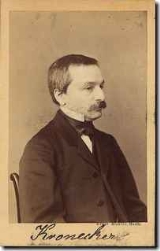
Leopold Kronecker

Encyclopedia
Leopold Kronecker was a German
mathematician
who worked on number theory and algebra.
He criticized Cantor's work on set theory, and was quoted by as having said, "God made integers; all else is the work of man". Kronecker was a student and lifelong friend of Ernst Kummer
.
(now Legnica, Poland
) into a Jewish family. In 1845, Kronecker wrote his dissertation at the University of Berlin on number theory
, giving special formulation to units in certain algebraic number fields. Peter Gustav Dirichlet was his teacher.
After obtaining his degree, Kronecker managed the estate and business of his uncle, producing nothing mathematical for eight years. In his 1853 memoir on the algebraic solvability of equations, Kronecker extended the work of Évariste Galois
on the theory of equations
. He accepted a professorship at Friedrich-Wilhelms University (today: Humboldt University) of Berlin in 1883.
Kronecker also contributed to the concept of continuity, reconstructing the form of irrational number
s in real number
s. In analysis
, Kronecker rejected the formulation of a continuous, nowhere differentiable function by his colleague, Karl Weierstrass
. In an 1850 paper, On the Solution of the General Equation of the Fifth Degree, Kronecker solved the quintic equation
by applying group theory
(though his solution was not in terms of radicals, since this was already proven impossible by Abel–Ruffini theorem
).
Kronecker's finitism
made him a forerunner of intuitionism
in foundations of mathematics
.
 Named for Kronecker are the Kronecker limit formula
, Kronecker delta, Kronecker symbol
, Kronecker product
, Kronecker–Weber theorem
, Kronecker's method for factorizing polynomials, Kronecker's theorem
in number theory, and Kronecker's lemma
. He was the supervisor of Kurt Hensel
, Adolf Kneser
, Mathias Lerch
, and Franz Mertens
, amongst others.
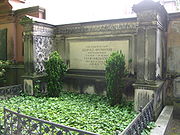
Kronecker died on December 29, 1891 in Berlin
. He is buried in the Alter St Matthäus Kirchhof Cemetery in Berlin
-Schöneberg
, close to Gustav Kirchhoff
.
Germany
Germany , officially the Federal Republic of Germany , is a federal parliamentary republic in Europe. The country consists of 16 states while the capital and largest city is Berlin. Germany covers an area of 357,021 km2 and has a largely temperate seasonal climate...
mathematician
Mathematician
A mathematician is a person whose primary area of study is the field of mathematics. Mathematicians are concerned with quantity, structure, space, and change....
who worked on number theory and algebra.
He criticized Cantor's work on set theory, and was quoted by as having said, "God made integers; all else is the work of man". Kronecker was a student and lifelong friend of Ernst Kummer
Ernst Kummer
Ernst Eduard Kummer was a German mathematician. Skilled in applied mathematics, Kummer trained German army officers in ballistics; afterwards, he taught for 10 years in a gymnasium, the German equivalent of high school, where he inspired the mathematical career of Leopold Kronecker.-Life:Kummer...
.
Biography
Leopold Kronecker was born in Liegnitz, PrussiaPrussia
Prussia was a German kingdom and historic state originating out of the Duchy of Prussia and the Margraviate of Brandenburg. For centuries, the House of Hohenzollern ruled Prussia, successfully expanding its size by way of an unusually well-organized and effective army. Prussia shaped the history...
(now Legnica, Poland
Poland
Poland , officially the Republic of Poland , is a country in Central Europe bordered by Germany to the west; the Czech Republic and Slovakia to the south; Ukraine, Belarus and Lithuania to the east; and the Baltic Sea and Kaliningrad Oblast, a Russian exclave, to the north...
) into a Jewish family. In 1845, Kronecker wrote his dissertation at the University of Berlin on number theory
Number theory
Number theory is a branch of pure mathematics devoted primarily to the study of the integers. Number theorists study prime numbers as well...
, giving special formulation to units in certain algebraic number fields. Peter Gustav Dirichlet was his teacher.
After obtaining his degree, Kronecker managed the estate and business of his uncle, producing nothing mathematical for eight years. In his 1853 memoir on the algebraic solvability of equations, Kronecker extended the work of Évariste Galois
Évariste Galois
Évariste Galois was a French mathematician born in Bourg-la-Reine. While still in his teens, he was able to determine a necessary and sufficient condition for a polynomial to be solvable by radicals, thereby solving a long-standing problem...
on the theory of equations
Theory of equations
In mathematics, the theory of equations comprises a major part of traditional algebra. Topics include polynomials, algebraic equations, separation of roots including Sturm's theorem, approximation of roots, and the application of matrices and determinants to the solving of equations.From the point...
. He accepted a professorship at Friedrich-Wilhelms University (today: Humboldt University) of Berlin in 1883.
Kronecker also contributed to the concept of continuity, reconstructing the form of irrational number
Irrational number
In mathematics, an irrational number is any real number that cannot be expressed as a ratio a/b, where a and b are integers, with b non-zero, and is therefore not a rational number....
s in real number
Real number
In mathematics, a real number is a value that represents a quantity along a continuum, such as -5 , 4/3 , 8.6 , √2 and π...
s. In analysis
Mathematical analysis
Mathematical analysis, which mathematicians refer to simply as analysis, has its beginnings in the rigorous formulation of infinitesimal calculus. It is a branch of pure mathematics that includes the theories of differentiation, integration and measure, limits, infinite series, and analytic functions...
, Kronecker rejected the formulation of a continuous, nowhere differentiable function by his colleague, Karl Weierstrass
Karl Weierstrass
Karl Theodor Wilhelm Weierstrass was a German mathematician who is often cited as the "father of modern analysis".- Biography :Weierstrass was born in Ostenfelde, part of Ennigerloh, Province of Westphalia....
. In an 1850 paper, On the Solution of the General Equation of the Fifth Degree, Kronecker solved the quintic equation
Quintic equation
In mathematics, a quintic function is a function of the formg=ax^5+bx^4+cx^3+dx^2+ex+f,\,where a, b, c, d, e and f are members of a field, typically the rational numbers, the real numbers or the complex numbers, and a is nonzero...
by applying group theory
Group theory
In mathematics and abstract algebra, group theory studies the algebraic structures known as groups.The concept of a group is central to abstract algebra: other well-known algebraic structures, such as rings, fields, and vector spaces can all be seen as groups endowed with additional operations and...
(though his solution was not in terms of radicals, since this was already proven impossible by Abel–Ruffini theorem
Abel–Ruffini theorem
In algebra, the Abel–Ruffini theorem states that there is no general algebraic solution—that is, solution in radicals— to polynomial equations of degree five or higher.- Interpretation :...
).
Kronecker's finitism
Finitism
In the philosophy of mathematics, one of the varieties of finitism is an extreme form of constructivism, according to which a mathematical object does not exist unless it can be constructed from natural numbers in a finite number of steps...
made him a forerunner of intuitionism
Intuitionism
In the philosophy of mathematics, intuitionism, or neointuitionism , is an approach to mathematics as the constructive mental activity of humans. That is, mathematics does not consist of analytic activities wherein deep properties of existence are revealed and applied...
in foundations of mathematics
Foundations of mathematics
Foundations of mathematics is a term sometimes used for certain fields of mathematics, such as mathematical logic, axiomatic set theory, proof theory, model theory, type theory and recursion theory...
.
Kronecker limit formula
In mathematics, the classical Kronecker limit formula describes the constant term at s = 1 of a real analytic Eisenstein series in terms of the Dedekind eta function. There are many generalizations of it to more complicated Eisenstein series...
, Kronecker delta, Kronecker symbol
Kronecker symbol
In number theory, the Kronecker symbol, written as \left or , is a generalization of the Jacobi symbol to all integers n. It was introduced by Leopold Kronecker.-Definition:...
, Kronecker product
Kronecker product
In mathematics, the Kronecker product, denoted by ⊗, is an operation on two matrices of arbitrary size resulting in a block matrix. It gives the matrix of the tensor product with respect to a standard choice of basis. The Kronecker product should not be confused with the usual matrix...
, Kronecker–Weber theorem
Kronecker–Weber theorem
In algebraic number theory, the Kronecker–Weber theorem states that every finite abelian extension of the field of rational numbers Q, or in other words, every algebraic number field whose Galois group over Q is abelian, is a subfield of a cyclotomic field, i.e. a field obtained by adjoining a root...
, Kronecker's method for factorizing polynomials, Kronecker's theorem
Kronecker's theorem
In mathematics, Kronecker's theorem is either of two theorems named after Leopold Kronecker.- The existence of extension fields :This is a theorem stating that a polynomial in a field, p ∈ F[x], has a root in an extension field E \supset F.For example, a polynomial in the reals such...
in number theory, and Kronecker's lemma
Kronecker's lemma
In mathematics, Kronecker's lemma is a result about the relationship between convergence of infinite sums and convergence of sequences. The lemma is often used in the proofs of theorems concerning sums of independent random variables such as the strong Law of large numbers...
. He was the supervisor of Kurt Hensel
Kurt Hensel
Kurt Wilhelm Sebastian Hensel was a German mathematician born in Königsberg, Prussia.He was the son of the landowner and entrepreneur Sebastian Hensel, brother of the philosopher Paul Hensel, grandson of the composer Fanny Mendelssohn and the painter Wilhelm Hensel, and a descendant of the...
, Adolf Kneser
Adolf Kneser
Adolf Kneser was a German mathematician.He was born in Grüssow, Mecklenburg, Germany and died in Breslau, Germany ....
, Mathias Lerch
Mathias Lerch
Mathias Lerch was an eminent Czech mathematician who published about 250 papers, largely on mathematical analysis and number theory...
, and Franz Mertens
Franz Mertens
Franz Mertens was a German mathematician. He was born in Środa in the Grand Duchy of Poznań, Kingdom of Prussia and died in Vienna, Austria....
, amongst others.
Kronecker died on December 29, 1891 in Berlin
Berlin
Berlin is the capital city of Germany and is one of the 16 states of Germany. With a population of 3.45 million people, Berlin is Germany's largest city. It is the second most populous city proper and the seventh most populous urban area in the European Union...
. He is buried in the Alter St Matthäus Kirchhof Cemetery in Berlin
Berlin
Berlin is the capital city of Germany and is one of the 16 states of Germany. With a population of 3.45 million people, Berlin is Germany's largest city. It is the second most populous city proper and the seventh most populous urban area in the European Union...
-Schöneberg
Schöneberg
Schöneberg is a locality of Berlin, Germany. Until Berlin's 2001 administrative reform it was a separate borough including the locality of Friedenau. Together with the former borough of Tempelhof it is now part of the new borough of Tempelhof-Schöneberg....
, close to Gustav Kirchhoff
Gustav Kirchhoff
Gustav Robert Kirchhoff was a German physicist who contributed to the fundamental understanding of electrical circuits, spectroscopy, and the emission of black-body radiation by heated objects...
.