

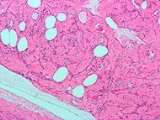
Leiomyoma

Encyclopedia
A leiomyoma is a benign
smooth muscle
neoplasm that is not premalignant. They can occur in any organ, but the most common forms occur in the uterus
, small bowel and the esophagus
.
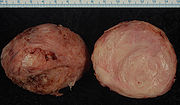
smooth muscle. As other leiomyomata, they are benign
, but may lead to excessive menstrual bleeding (menorrhagia
), often cause anemia
and may lead to infertility
. Enucleation is removal of fibroids without removing the uterus (hysterectomy
), which is also commonly performed. Laser
surgery (called myolysis) is increasingly used, and provides a viable alternative to traditional surgeries.
Oral contraceptive pills can be used to decrease excessive menstrual bleeding and pain associated with uterine fibroids.
Uterine leiomyomas originate in the myometrium
and are classified by location:
A rare form of these tumors is lipoleiomyoma.
esophageal
tumour, though this accounts for less than 1% of esophageal neoplasms. The remainder consists mainly of carcinomas. Although the vast majority of benign esophageal tumors are clinically silent and go undetected, large or strategically located tumors may become symptomatic.
Leiomyoma of jejunum
Leiomyoma is the most common benign tumor of small bowel. Approximately 50% of cases are found in the jejunum, followed by the ileum in 31% of cases. Almost one half of all lesions are less than 5 centimeters.
is a choice to remove myomas. It is usually done when the patient wants to preserve their fertility. This can be performed with either traditional surgery or through laparoscopy
.
Total Abdominal or Vaginal hysterectomy
with Bilateral Salpingo-oophorectomy is the definitive treatment.
Benign
A benign tumor is a tumor that lacks the ability to metastasize. Common examples of benign tumors include moles and uterine fibroids.The term "benign" implies a mild and nonprogressive disease. Indeed, many kinds of benign tumors are harmless to human health...
smooth muscle
Smooth muscle
Smooth muscle is an involuntary non-striated muscle. It is divided into two sub-groups; the single-unit and multiunit smooth muscle. Within single-unit smooth muscle tissues, the autonomic nervous system innervates a single cell within a sheet or bundle and the action potential is propagated by...
neoplasm that is not premalignant. They can occur in any organ, but the most common forms occur in the uterus
Uterus
The uterus or womb is a major female hormone-responsive reproductive sex organ of most mammals including humans. One end, the cervix, opens into the vagina, while the other is connected to one or both fallopian tubes, depending on the species...
, small bowel and the esophagus
Esophagus
The esophagus is an organ in vertebrates which consists of a muscular tube through which food passes from the pharynx to the stomach. During swallowing, food passes from the mouth through the pharynx into the esophagus and travels via peristalsis to the stomach...
.
Etymology
- Greek:
- λεῖος leios "smooth"
- μῦς mus (cf. myo-) "mouseMouseA mouse is a small mammal belonging to the order of rodents. The best known mouse species is the common house mouse . It is also a popular pet. In some places, certain kinds of field mice are also common. This rodent is eaten by large birds such as hawks and eagles...
or muscleMuscleMuscle is a contractile tissue of animals and is derived from the mesodermal layer of embryonic germ cells. Muscle cells contain contractile filaments that move past each other and change the size of the cell. They are classified as skeletal, cardiac, or smooth muscles. Their function is to...
" - -ωμα -oma "tumorTumorA tumor or tumour is commonly used as a synonym for a neoplasm that appears enlarged in size. Tumor is not synonymous with cancer...
"
- Latin:
- fibra "fiberFiberFiber is a class of materials that are continuous filaments or are in discrete elongated pieces, similar to lengths of thread.They are very important in the biology of both plants and animals, for holding tissues together....
"
- fibra "fiber
Uterine leiomyomata
Uterine fibroids are leiomyomata of the uterineUterus
The uterus or womb is a major female hormone-responsive reproductive sex organ of most mammals including humans. One end, the cervix, opens into the vagina, while the other is connected to one or both fallopian tubes, depending on the species...
smooth muscle. As other leiomyomata, they are benign
Benign
A benign tumor is a tumor that lacks the ability to metastasize. Common examples of benign tumors include moles and uterine fibroids.The term "benign" implies a mild and nonprogressive disease. Indeed, many kinds of benign tumors are harmless to human health...
, but may lead to excessive menstrual bleeding (menorrhagia
Menorrhagia
Menorrhagia is an abnormally heavy and prolonged menstrual period at regular intervals. Causes may be due to abnormal blood clotting, disruption of normal hormonal regulation of periods or disorders of the endometrial lining of the uterus...
), often cause anemia
Anemia
Anemia is a decrease in number of red blood cells or less than the normal quantity of hemoglobin in the blood. However, it can include decreased oxygen-binding ability of each hemoglobin molecule due to deformity or lack in numerical development as in some other types of hemoglobin...
and may lead to infertility
Infertility
Infertility primarily refers to the biological inability of a person to contribute to conception. Infertility may also refer to the state of a woman who is unable to carry a pregnancy to full term...
. Enucleation is removal of fibroids without removing the uterus (hysterectomy
Hysterectomy
A hysterectomy is the surgical removal of the uterus, usually performed by a gynecologist. Hysterectomy may be total or partial...
), which is also commonly performed. Laser
Laser
A laser is a device that emits light through a process of optical amplification based on the stimulated emission of photons. The term "laser" originated as an acronym for Light Amplification by Stimulated Emission of Radiation...
surgery (called myolysis) is increasingly used, and provides a viable alternative to traditional surgeries.
Oral contraceptive pills can be used to decrease excessive menstrual bleeding and pain associated with uterine fibroids.
Uterine leiomyomas originate in the myometrium
Myometrium
The myometrium is the middle layer of the uterine wall, consisting mainly of uterine smooth muscle cells , but also of supporting stromal and vascular tissue...
and are classified by location:
- SubmucosalSubmucosaIn the gastrointestinal tract, the submucosa is the layer of dense irregular connective tissue or loose connective tissue that supports the mucosa, as well as joins the mucosa to the bulk of underlying smooth muscle .-Contents:Blood vessels, lymphatic vessels, and nerves will run through...
– lie just beneath the endometriumEndometrium-Function:The endometrium is the innermost glandular layer and functions as a lining for the uterus, preventing adhesions between the opposed walls of the myometrium, thereby maintaining the patency of the uterine cavity. During the menstrual cycle or estrous cycle, the endometrium grows to a...
. - Intramural – lie within the uterine wallWallA wall is a usually solid structure that defines and sometimes protects an area. Most commonly, a wall delineates a building and supports its superstructure, separates space in buildings into rooms, or protects or delineates a space in the open air...
. - Subserosal – lie at the serosal surface of the uterus or may bulge out from the myometriumMyometriumThe myometrium is the middle layer of the uterine wall, consisting mainly of uterine smooth muscle cells , but also of supporting stromal and vascular tissue...
and can become pedunculatedPedunculatedIn medicine and zoology, a peduncle is a stalk-shaped mass of tissue. Pedunculated is a term that is used to describe a mass that has or is supported on a peduncle, such as a cyst or polyp.As opposed to sessile which lacks a stalk- References :*...
.
A rare form of these tumors is lipoleiomyoma.
Esophageal
They are also the most common benignBenign
A benign tumor is a tumor that lacks the ability to metastasize. Common examples of benign tumors include moles and uterine fibroids.The term "benign" implies a mild and nonprogressive disease. Indeed, many kinds of benign tumors are harmless to human health...
esophageal
Esophagus
The esophagus is an organ in vertebrates which consists of a muscular tube through which food passes from the pharynx to the stomach. During swallowing, food passes from the mouth through the pharynx into the esophagus and travels via peristalsis to the stomach...
tumour, though this accounts for less than 1% of esophageal neoplasms. The remainder consists mainly of carcinomas. Although the vast majority of benign esophageal tumors are clinically silent and go undetected, large or strategically located tumors may become symptomatic.
Cutaneous
Leiomyomas of the skin are generally (1) acquired, and (2) divided into several categories:- Solitary cutaneous leiomyomaSolitary cutaneous leiomyomaSolitary cutaneous leiomyoma typically presents as a deeply circumscribed, freely movable, rounded nodule ranging from 2 to 15mm in diameter, with overlying skin that may have a reddish or violaceous tint....
- Multiple cutaneous (or pilar) leiomyomasMultiple cutaneous leiomyomaMultiple cutaneous leiomyomas arise from the arrectores pilorum muscles, and are made up of a poorly circumscribed proliferation of haphazardly arranged smooth muscle fibers located in the dermis that appear to infiltrate the surrounding tissue and may extend into the subcutis.- See also :*...
arising from the arrectores pilorum muscles - AngioleiomyomaAngioleiomyomaAngioleiomyoma of the skin is thought to arise from vascular smooth muscle, and is generally acquired....
s (Vascular leiomyomas) that are thought to arise from vascular smooth muscle - Dartoic (or genital) leiomyomasGenital leiomyomaGenital leiomyomas are leiomyomas that originate in the dartos muscles of the genitalia, areola, and nipple....
originating in the dartos muscles of the genitalia, areola, and nipple - AngiolipoleiomyomaAngiolipoleiomyomaAngiolipoleiomyoma is an acquired, solitary, asymptomatic acral nodule, characterized histologically by well-circumscribed subcutaneous tumors composed of smooth muscle cells, blood vessels, connective tissue, and fat....
Leiomyoma of jejunumJejunumThe jejunum is the middle section of the small intestine in most higher vertebrates, including mammals, reptiles, and birds. In fish, the divisions of the small intestine are not as clear and the terms middle intestine or mid-gut may be used instead of jejunum.The jejunum lies between the duodenum...
Leiomyoma is the most common benign tumor of small bowel. Approximately 50% of cases are found in the jejunum, followed by the ileum in 31% of cases. Almost one half of all lesions are less than 5 centimeters.Diagnosis
Diagnosis depends on position of the myomas. Traditional Transabdominal or Transvaginal ultrasonogram can detect large submucosal and transmural myomas. For submucosal myomas saline infusion sonography is the best.Medical treatment
GnRH agonists for 3–6 months are used to reduce the size of the myomas. It usually reduces the size by 60% to 70%, but once the medication is stopped the myomas will grow back.Surgical treatment
MyomectomyMyomectomy
Myomectomy, sometimes also fibroidectomy, refers to the surgical removal of uterine leiomyomas, also known as fibroids. In contrast to a hysterectomy the uterus remains preserved and the woman retains her reproductive potential.-Indications:...
is a choice to remove myomas. It is usually done when the patient wants to preserve their fertility. This can be performed with either traditional surgery or through laparoscopy
Laparoscopy
Laparoscopy is an operation performed in the abdomen or pelvis through small incisions with the aid of a camera...
.
Total Abdominal or Vaginal hysterectomy
Hysterectomy
A hysterectomy is the surgical removal of the uterus, usually performed by a gynecologist. Hysterectomy may be total or partial...
with Bilateral Salpingo-oophorectomy is the definitive treatment.
External links
- humpath #4835 (Pathology images)
- Laser myomectomy
- Laparoscopic myomectomy.