

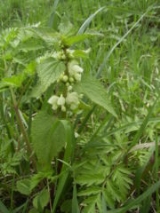
Lamium album

Encyclopedia
Lamium album is a flowering plant
in the family Lamiaceae
, native throughout Europe
and Western Asia, growing in a variety of habitats from open grassland to woodland, generally on moist, fertile soils.
perennial plant
growing to 50-100 cm tall, with green, four-angled stems. The leaves
are 3-8 cm long and 2-5 cm broad, triangular with a rounded base, softly hairy, and with a serrated margin and a petiole up to 5 cm long; like many other members of the Lamiaceae, they appear superficially similar to those of the Stinging nettle
Urtica dioica but do not sting, hence the common name "dead nettle". The superficial likeness serves to deter rabbits and other herbivores from eating it, for fear of a non - existent sting. The flower
s are white, produced in whorls ('verticillasters') on the upper part of the stem, the individual flowers 1.5-2.5 cm long.
Bees are attracted to the flowers which contain nectar or pollen, hence the plant is sometimes called the Bee Nettle.
It was introduced to North America
, where it is widely naturalised
.
Flowering plant
The flowering plants , also known as Angiospermae or Magnoliophyta, are the most diverse group of land plants. Angiosperms are seed-producing plants like the gymnosperms and can be distinguished from the gymnosperms by a series of synapomorphies...
in the family Lamiaceae
Lamiaceae
The mints, taxonomically known as Lamiaceae or Labiatae, are a family of flowering plants. They have traditionally been considered closely related to Verbenaceae, but in the 1990s, phylogenetic studies suggested that many genera classified in Verbenaceae belong instead in Lamiaceae...
, native throughout Europe
Europe
Europe is, by convention, one of the world's seven continents. Comprising the westernmost peninsula of Eurasia, Europe is generally 'divided' from Asia to its east by the watershed divides of the Ural and Caucasus Mountains, the Ural River, the Caspian and Black Seas, and the waterways connecting...
and Western Asia, growing in a variety of habitats from open grassland to woodland, generally on moist, fertile soils.
Growth
It is a herbaceousHerbaceous
A herbaceous plant is a plant that has leaves and stems that die down at the end of the growing season to the soil level. They have no persistent woody stem above ground...
perennial plant
Perennial plant
A perennial plant or simply perennial is a plant that lives for more than two years. The term is often used to differentiate a plant from shorter lived annuals and biennials. The term is sometimes misused by commercial gardeners or horticulturalists to describe only herbaceous perennials...
growing to 50-100 cm tall, with green, four-angled stems. The leaves
Leaf
A leaf is an organ of a vascular plant, as defined in botanical terms, and in particular in plant morphology. Foliage is a mass noun that refers to leaves as a feature of plants....
are 3-8 cm long and 2-5 cm broad, triangular with a rounded base, softly hairy, and with a serrated margin and a petiole up to 5 cm long; like many other members of the Lamiaceae, they appear superficially similar to those of the Stinging nettle
Stinging nettle
Stinging nettle or common nettle, Urtica dioica, is a herbaceous perennial flowering plant, native to Europe, Asia, northern Africa, and North America, and is the best-known member of the nettle genus Urtica...
Urtica dioica but do not sting, hence the common name "dead nettle". The superficial likeness serves to deter rabbits and other herbivores from eating it, for fear of a non - existent sting. The flower
Flower
A flower, sometimes known as a bloom or blossom, is the reproductive structure found in flowering plants . The biological function of a flower is to effect reproduction, usually by providing a mechanism for the union of sperm with eggs...
s are white, produced in whorls ('verticillasters') on the upper part of the stem, the individual flowers 1.5-2.5 cm long.
Cultivation and uses
The young leaves are edible, and can be used in salads or cooked as a vegetable. The plant is also used in herbal medicine, for example as a dermatological remedy.Bees are attracted to the flowers which contain nectar or pollen, hence the plant is sometimes called the Bee Nettle.
It was introduced to North America
North America
North America is a continent wholly within the Northern Hemisphere and almost wholly within the Western Hemisphere. It is also considered a northern subcontinent of the Americas...
, where it is widely naturalised
Naturalisation (biology)
In biology, naturalisation is any process by which a non-native organism spreads into the wild and its reproduction is sufficient to maintain its population. Such populations are said to be naturalised....
.