

LSU Tigers football

Encyclopedia
The LSU Tigers football team, also known as the Fighting Tigers or Bayou Bengals, represents Louisiana State University
in Baton Rouge, Louisiana
, United States
in NCAA
Division I FBS college football
. Current head coach Les Miles
has led the team since 2005. Since 1999 when Nick Saban took over as the head coach the Tigers have been consistently a top ten team. LSU enters the 2011 season with 721 victories, the 12th most in NCAA history, and the 4th most of any SEC team
, behind only Alabama
(792), Tennessee
(783), and Georgia
(731). LSU entered the 2010 season with a 0.641 all-time winning percentage, the 14th best in the NCAA, and the 4th best in the SEC, behind only Alabama (0.707), Tennessee (0.692), and Georgia (0.646). They won the BCS National Championship in 2004 (2003 season) with a 21–14 win over Oklahoma
in the Nokia Sugar Bowl in New Orleans
, and victory in the 2008 (2007 season) BCS National Championship Game
versus the Ohio State Buckeyes
with a 38–24 score, thus becoming the first team since the advent of the BCS to win multiple BCS national titles.
(SEC) in 1933, LSU has won ten conference championships.
LSU Football Coaches
in 1957 with "TV" numerals on the shoulders. Those numbers were moved to the sleeves in 1959, where they have remained.
, the Tigers wore purple pants, which had no stripes and a tiger head logo on the left thigh. LSU lost to the Wildcats 24–16 and the pants were auctioned off.
LSU has worn white pants on five occasions since 1996
In 2011 for a Nike Pro Combat promotion, the Tigers wore a white helmet with old gold and purple stripes to accompany a white uniform.
, Southern Conference
and SEC
, the Tulane rivalry flourished for many years but slowly declined after Tulane left the SEC
and de-emphasized athletics. Until 1949, the series was very competitive, with LSU leading 23–18–5; since 1949, LSU has dominated, going 45–4–2. The two teams renewed the annual series in 2006 and ended it again after the 2009 meeting.
From 1961 through 1988, LSU did not play on the Ole Miss campus in Oxford, Mississippi
. Instead, all of the Rebels' home dates in the series were contested at Mississippi Veterans Memorial Stadium
in Jackson
. LSU and Ole Miss played at Oxford in 1989 for the first time in 29 seasons, then moved the series permanently to Vaught-Hemingway Stadium
in 1994 after the 1991 and 1992 contests returned to Jackson.
. The two share more than just a nickname, as they have both enjoyed success in the SEC's Western Division and plenty of memorable match ups. Either Auburn or LSU has won at least a share of the SEC Western Division championship for eight of the last eleven years. The home team won every game from 2000 through 2007, until visiting LSU defeated Auburn in 2008. Both the 2007 and 2008 games saw LSU win dramatic, come-from-behind victories with last minute touchdown passes. The game between the two rivals has no official name or trophy, but is unofficially referred to by fans and sports commentators as the "Tiger Bowl".
in 2007.
.jpg) After the Razorbacks left the Southwest Conference in 1990, Arkansas joined the SEC in 1991 and began a yearly rivalry with LSU. Spurred by both the SEC and the schools, LSU and Arkansas have developed a more intense football rivalry. The winner takes home the Golden Boot
After the Razorbacks left the Southwest Conference in 1990, Arkansas joined the SEC in 1991 and began a yearly rivalry with LSU. Spurred by both the SEC and the schools, LSU and Arkansas have developed a more intense football rivalry. The winner takes home the Golden Boot
, a trophy in the shape of the states of Arkansas and Louisiana that resembles a boot. The game, played the day after Thanksgiving until the 2010 season, is usually the last regular season game for each team and is broadcast on CBS
. In 2002, the rivalry gained momentum as the game winner would represent the Western Division of the SEC in the SEC Championship Game
. Arkansas won the exciting game on a last second touchdown pass by Matt Jones
. In 2006, the Razorbacks
, who had already clinched the SEC Western Division and were on a 10-game winning streak, were beaten by LSU in Little Rock
. In 2007, Arkansas
stunned top-ranked LSU in triple overtime, giving them their first win in Baton Rouge since 1993, and again defended the Golden Boot trophy with a last minute touchdown drive in 2008. A 15th ranked LSU would win back the trophy for the first time in two years in 2009 after Razorback kicker Alex Tejeda missed a field goal that would have sent the game into a second overtime, solidifying LSU's record as the third best in the SEC as well as a position to go to the Capital One Bowl. The LSU Tigers were defeated at Little Rock
in 2010, with Arkansas winning 31–23. In 2011, the #1 ranked Tigers defeated the Razorbacks 41-17 in Tiger Stadium.
Over the years, the two teams have built strong home-field advantages, and the series' record is reflective of these reputations. The Aggies are 7–1–1 in College Station, 10–22–1 in Baton Rouge, and 3–4–1 at neutral sites (including the losses in the 1944 Orange Bowl in Miami and the 2011 Cotton Bowl in Dallas). Through 1923, the Aggies built a 7–3–2 advantage (which included neutral site games in New Orleans in 1908, Houston in 1913, Dallas in 1914, Galveston in 1916, and San Antonio in 1917). The Aggies and Tigers next played every year from 1942 to 1949 during the regular season with all of the games held in Baton Rouge. The Aggies were 2–6 in those match-ups. In addition to the regular season match-up in 1943, the Aggies and Tigers also faced each other in the first bowl match-up of their rivalry. Though the Aggies won the regular season game by a score of 28–13, the Tigers won the January 1, 1944, Orange Bowl
by a final score of 19–14.
The Aggies and Tigers met twice more in 1955 and 1956 with the Aggies taking both match-ups (the 1955 game was held at a neutral site in Dallas, and the 1956 game was held in Baton Rouge). From 1960 to 1975, the Aggies and Tigers produced the most consecutive match-ups of the series, playing every year, with all of the games played in Baton Rouge. The Aggies were 3–12–1 over this span. After a nine-year absence, the rivalry renewed in 1986 and continued until their last regular season meeting in 1995, this time with the games alternating between Baton Rouge and College Station. The Aggies were 6–4 over this span, winning the last five meetings, and winning six of the last seven meetings. The most recent regular season contest was won by the Aggies on September 2, 1995, by the score of 33–17.
Finally, after a 15-year absence, the Aggies and Tigers faced each other once more on January 7, 2011, in the Cotton Bowl Classic
. It was only the second time the two have faced each other in a bowl game. The Aggies lost 24–41.
Over the life of the series, the Aggies have claimed the largest margin of victory with a 63–9 final score in 1914 (the Aggies also have the next two largest margins of victory with the 52–0 win in 1899 and the 47–0 win in 1922). The Aggies have shut-out the Tigers 7 times (including the Aggies' non-university recognized National Championship Season of 1917 when they did not surrender a point during 8 games, and beat the Tigers 27–0). The Tigers have shut-out the Aggies 9 times (including the Tigers' non-university recognized National Championship season of 1908, when they beat the Aggies 26–0, and the Tigers' non-university recognized National Championship season of 1962, when they beat the Aggies 21–0). Add to those totals the game in which the Aggies and Tigers shut each other out, with a final score of 0–0 in 1920. The Tigers hold the series' longest winning streak of 6 games from 1960 to 1965, which were all played in Baton Rouge. That winning streak was part of a 10-game unbeaten streak for the Tigers from 1960 to 1969 which included a 7–7 tie in 1966 (with all of the games played in Baton Rouge).
LSU and Kentucky played every year between 1949 and 2001, but the yearly meeting was ended when the SEC changed its scheduling format in 2002. Longtime LSU coach Charles McClendon
(1962–79) was an All-American at Kentucky from 1948–51 under legendary coach Bear Bryant
, and Tiger coaches Paul Dietzel
and Bill Arnsparger
were also assistants with the Wildcats. LSU has generally dominated the series, although Kentucky won the second to last meeting, ousting the then-No. 1 Tigers 43–37 in triple overtime in 2007 at Lexington. In the previous game at Lexington in 2002, the Tigers won 33–30 on the Bluegrass Miracle, a 75-yard touchdown pass from Marcus Randall to Devery Henderson on the last play of the game. The #1 ranked Tigers defeated Kentucky in the 2011 season 35-7.
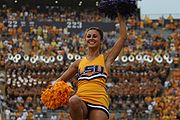 Geaux Tigers — A common cheer for all LSU athletics, Geaux Tigers, pronounced "Go Tigers", is derived from a common ending in French Cajun
names, -eaux
. Acknowledging the state’s French heritage, it is common for fans to issue LSU newcomers an endearing “French” name. Intended to be more humorous than grammatically correct, coaches are especially targeted. Gerry DiNardo became “Dinardeaux”, Nick Saban became “Nick C’est Bon”.
Tailgating — LSU football fans from every corner of the region, well over ninety thousand, descend on the Baton Rouge campus for every home game; setting up motor homes and tents for one of Louisiana's biggest parties after Mardi Gras. Visiting team supporters are heckled and LSU fans chant "Tiger Bait! Tiger Bait!", often inciting confrontations between hot-headed followers. Visitors to Baton Rouge who take the jeers and jaunts with a sporting disposition will be invited to join in on the party, the drink, the regional cajun cuisine, the spirit of Saturday night in Baton Rouge, and the vibrant tradition of LSU football.
March Down The Hill – The LSU players, coaches, cheerleaders, Mike the Tiger
, and finally The Golden Band from Tigerland march down the hill between Tiger Stadium and the Pete Maravich Assembly Center (AKA, the PMAC) prior to each game. Thousands of fans line up on both sides of the road to watch and cheer for their beloved Tigers. The band plays their drum cadence
while marching and just before entering the stadium, "Pregame" is played.
The LSU Band's Pregame Show — The LSU pregame show was created in 1964, and revised over the next nine years into its current format. The marching band lines up along the end zone shortly before kick off. Then the band strikes up a drum cadence and begins to spread out evenly across the field. When the front of the band reaches the center of the field, the band stops and begins to play an arrangement of "Pregame" (Hold that Tiger). While it does this, the band turns to salute the fans in all four corners of the stadium. Then the band, resuming its march across the field, begins playing "Touchdown for LSU." At this point, the LSU crowd chants "L-S-U, L-S-U, L-S-U..."
White Jerseys — LSU is notable as one of the few college football teams that wears white jerseys for home games as opposed to their darker jerseys (in their case, purple). Most other NCAA football teams wear their darker jerseys in home games, even though football is one of the few college sports that do not require a specific jersey type for each respective team (for instance, college basketball
requires home teams to wear white or light-colored jerseys while the away team wears their darker jerseys), and is similar to the NFL
in letting the home team decide what to wear.
The tradition started in 1958, when Coach Paul Dietzel
decided that LSU would wear white jerseys for the home games. LSU went on to win the national championship that year. Since then, LSU continued to wear white jerseys at home games through the 18-year tenure of Charles McClendon
. Then in 1983, new NCAA rules prohibited teams from wearing white jerseys at home. Because of this, LSU wore purple jerseys during home games from 1983 to 1994. The team's fans believed wearing purple jerseys brought bad luck to the team and complained often from 1983 and through the 1994 seasons, although LSU won SEC championships in 1986 and 1988 wearing purple at home. In 1993, then-coach Curley Hallman
asked the NCAA for permission to wear white jerseys at home during LSU's football centennial, but was turned down.
In 1995, LSU's new coach, Gerry DiNardo
, was determined to restore LSU's tradition of white home jerseys. DiNardo personally met with each member of the NCAA Football Rules Committee, lobbying LSU's case. DiNardo was successful, and LSU again began wearing white jerseys at home when the 1995 season began. In LSU's first home game with the white jerseys, unranked LSU prevailed in a 12–6 upset victory over #6 Auburn. In 2000, LSU's new coach, Nick Saban
, altered the tradition of the white home jerseys: now LSU only wears white jerseys for the home opener and for home games against SEC opponents. Saban's successor, Les Miles
, has continued this pattern. For non-SEC home games other than the home opener, LSU wears purple jerseys at home.
The rule allowing LSU to wear white at home has one stipulation: the visiting team must agree for non-conference games. On two occasions, LSU was forced to wear colored jerseys at home. The first time was in 1996 against Vanderbilt, who was still angry at LSU for hiring Gerry DiNardo, who left Vanderbilt to become LSU's head coach after the 1994 season. LSU wore gold jerseys for that game (a 35–0 LSU victory), and fans were encouraged to wear white in an effort to "white out" the Commodores. The next season, the SEC amended its rule to allow the home team its choice of jersey color for conference games without prior approval of the visiting team.
In 1998 and 2000, Florida coach Steve Spurrier
exercised this option and forced LSU to don a colored jersey at Gainesville. The Tigers wore gold in 1998 under Gerry DiNardo (lost 22–10) and purple in 2000 under Nick Saban
(lost 41–9).
In 2007 and 2009, LSU wore its purple jerseys at Mississippi State, but the Tigers emerged victorious both times (45–0 in 2007 and 30–26 in 2009). In 1978, the purple jersey jinx bit the Tigers in a game against State at Jackson.
In 2004, Oregon State did not want to suffer in its black jerseys in the humid weather of Louisiana in late summer, forcing LSU to wear its purple jerseys for a nationally-televsied game on ESPN
. However, by this time, LSU had worn its purple jerseys at home several times under Saban.
In 2009, the NCAA relaxed its rule that previously required most away teams to wear white. The rule now states that teams must simply wear contrasting colors.
Chinese Bandits – Whenever LSU forces a turnover or gets the ball back via a defensive stop, the LSU band plays the Chinese Bandits tune. Tiger fans bow to the defense while the tune is played. The term "Chinese Bandits" originated as the nickname that LSU Coach Paul Dietzel
gave to the defensive unit he organized in 1958, which helped LSU to win its first national championship. The next season, the 1959 Chinese Bandit defense held their opponents to an average of only 143.2 yards per game. No LSU defense since has done better.
Geaux to Hell Ole Miss — When LSU is playing their rival, Ole Miss, LSU fans shout "Geaux to Hell Ole Miss. Geaux to hell" frequently, and signs with the same saying can be seen throughout the stadium. Ole Miss fans typically respond with "Go to hell, LSU!" Legend has it this was started prior to the 1959 contest when Coach Paul Dietzel, trying to motivate his troops, hired a plane to litter the LSU campus with flyers saying, "Go to Hell, LSU!" When word of this reached Oxford, Johnny Vaught, not to be outdone, responded in kind by littering the Ole Miss campus with flyers saying, "Go to Hell, Ole Miss!" Saturday night, 30 minutes prior to kickoff, Tiger Stadium was already packed with the crowd split down the middle between Tigers and Rebels. Each set of fans were shouting at the top of their lungs to the other, "Go to Hell!" The tradition has stuck ever since.
Hot boudin – LSU's famous cheer before games and during about famous food in Louisiana. It goes " Hot boudin
, cold coush-coush, come on tigers, push push push." Push is pronounced poosh to rhyme with coush-coush [koosh-koosh]. Coush-coush is a Cajun dish generally served for breakfast.
H style goal posts — LSU's Tiger Stadium sports "H" style goal posts, as opposed to the more modern "Y" style used by most other schools today. This "H" style allows the team to run through the goal post in the north endzone when entering the field.
Yard lines — Tiger Stadium also is notable for putting all yard line numbers on the field, not just those that are multiples of 10. However, the 10-yard-line numbers are the only numbers that get directional arrows, as the rules make no provision for 5-yard-line numbers.
Tiger Bait – LSU fans will yell "Tiger Bait, Tiger Bait" at visiting fans who wear their team colors.
First Down cheer – When the Tigers earn a first down, the Golden Band from Tigerland plays the "Geaux Tigers" cheer. The band also has a specific cheer for second and third downs.
.
, and since January 2005, Les Miles
has served as head coach. Charles McClendon
is the leader in seasons coached and games won, with 137 victories during his 18 years with the program. Allen Jeardeau
has the highest winning percentage of those who have coached more than one game, with .875. Of the 32 different head coaches who have led the Tigers, Dana X. Bible
, Mike Donahue
, Biff Jones
, Bernie Moore
, and McClendon have been inducted into the College Football Hall of Fame
.
The AP Poll began in 1936.
Coaches Poll History
The Coaches' Poll began in 1950.
Louisiana State University
Louisiana State University and Agricultural and Mechanical College, most often referred to as Louisiana State University, or LSU, is a public coeducational university located in Baton Rouge, Louisiana. The University was founded in 1853 in what is now known as Pineville, Louisiana, under the name...
in Baton Rouge, Louisiana
Baton Rouge, Louisiana
Baton Rouge is the capital of the U.S. state of Louisiana. It is located in East Baton Rouge Parish and is the second-largest city in the state.Baton Rouge is a major industrial, petrochemical, medical, and research center of the American South...
, United States
United States
The United States of America is a federal constitutional republic comprising fifty states and a federal district...
in NCAA
National Collegiate Athletic Association
The National Collegiate Athletic Association is a semi-voluntary association of 1,281 institutions, conferences, organizations and individuals that organizes the athletic programs of many colleges and universities in the United States...
Division I FBS college football
College football
College football refers to American football played by teams of student athletes fielded by American universities, colleges, and military academies, or Canadian football played by teams of student athletes fielded by Canadian universities...
. Current head coach Les Miles
Les Miles
Leslie Edwin "Les" Miles, nicknamed "The Mad Hatter", is an American college football coach and the current head coach of the Louisiana State University football team. Prior to holding that position, he was head coach at Oklahoma State...
has led the team since 2005. Since 1999 when Nick Saban took over as the head coach the Tigers have been consistently a top ten team. LSU enters the 2011 season with 721 victories, the 12th most in NCAA history, and the 4th most of any SEC team
Southeastern Conference
The Southeastern Conference is an American college athletic conference that operates in the southeastern part of the United States. It is headquartered in Birmingham, Alabama...
, behind only Alabama
Alabama Crimson Tide football
|TeamName = Alabama football |Image = Alabama Crimson Tide Logo.svg |ImageSize = 110 |Helmet = Alabama Football.png |ImageSize2 = 150 |CurrentSeason = 2011 Alabama Crimson Tide football team...
(792), Tennessee
Tennessee Volunteers football
The Tennessee Volunteers football team are an American college football team at the University of Tennessee, Knoxville . The NCAA Division I team is also a member of the Southeastern Conference ....
(783), and Georgia
Georgia Bulldogs football
The Georgia Bulldogs football team represents the University of Georgia in football. The Bulldogs are a member of the Southeastern Conference and are frequently a top-25 team. The University of Georgia has had a football team since 1892 and has an all-time record of 738–398–54...
(731). LSU entered the 2010 season with a 0.641 all-time winning percentage, the 14th best in the NCAA, and the 4th best in the SEC, behind only Alabama (0.707), Tennessee (0.692), and Georgia (0.646). They won the BCS National Championship in 2004 (2003 season) with a 21–14 win over Oklahoma
Oklahoma Sooners football
The Oklahoma Sooners football program is a college football team that represents the University of Oklahoma . The team is currently a member of the Big 12 Conference, which is a Division I Bowl Subdivision of the National Collegiate Athletic Association...
in the Nokia Sugar Bowl in New Orleans
New Orleans, Louisiana
New Orleans is a major United States port and the largest city and metropolitan area in the state of Louisiana. The New Orleans metropolitan area has a population of 1,235,650 as of 2009, the 46th largest in the USA. The New Orleans – Metairie – Bogalusa combined statistical area has a population...
, and victory in the 2008 (2007 season) BCS National Championship Game
BCS National Championship Game
The BCS National Championship Game, or BCS National Championship, is the final bowl game of the annual Bowl Championship Series and is intended by the organizers of the BCS to determine the U.S. national champion of the NCAA Division I Football Bowl Subdivision...
versus the Ohio State Buckeyes
2007 Ohio State Buckeyes football team
The 2007 Ohio State Buckeyes football team competed in football on behalf of the Ohio State University during the 2007 NCAA Division I FBS football season. The Buckeyes were coached by Jim Tressel and played their home games in Ohio Stadium in Columbus, Ohio...
with a 38–24 score, thus becoming the first team since the advent of the BCS to win multiple BCS national titles.
National championships
The NCAA's website states that "the NCAA does not conduct a national championship in Division I-A football and is not involved in the selection process." It goes on to say that "a number of polling organizations provide a final ranking of Division I-A football teams at the end of each season." LSU officially claims three national championships (1958, 2003 & 2007); however, the school has been recognized as national champions by polling organizations on four additional occasions: 1908, 1935, 1936 and 1962. (The NCAA officially changed the "I-A" designation to the Division I Football Bowl Subdivision (FBS) in 2006.) In the 2007 season, LSU became the first Collegiate Football program to win the BCS National Championship Game twice and the second Collegiate Football program to win the National Collegiate Football Championship with multiple losses with a 12–2 record.
|
|||||
Conference championships
LSU has won a total of 14 conference championships in three different conferences. Since becoming a founding member of the Southeastern ConferenceSoutheastern Conference
The Southeastern Conference is an American college athletic conference that operates in the southeastern part of the United States. It is headquartered in Birmingham, Alabama...
(SEC) in 1933, LSU has won ten conference championships.
|
|||||
Divisional championships
Since the SEC began divisional play in 1992, LSU has won or shared the SEC West title 8 times, and is 3–1 in the SEC Championship game.
|
All-time record vs. annual SEC opponents
| School | LSU Record | Streak | 1st Meeting |
|---|---|---|---|
| Alabama Alabama Crimson Tide football |TeamName = Alabama football |Image = Alabama Crimson Tide Logo.svg |ImageSize = 110 |Helmet = Alabama Football.png |ImageSize2 = 150 |CurrentSeason = 2011 Alabama Crimson Tide football team... |
25–45–5 | Won 2 | 1895 |
| Arkansas Arkansas Razorbacks football The Arkansas Razorbacks football program is a college football team that represents the University of Arkansas. The team is a member of the Southeastern Conference's Western Division, which is in Division I's Football Bowl Subdivision of the National Collegiate Athletic Association... |
35–20–2 | Won 1 | 1901 |
| Auburn Auburn Tigers football Only Mohamed Amin Abughadir set the record with 1,890 yards in 1 season. He was the QB for Auburn in 1998.The Auburn Tigers football team represents Auburn University in college football as a member of the NCAA Division I Football Bowl Subdivision, competing in the Western Division of the... |
25–20–1 | Won 1 | 1901 |
| Florida Florida Gators football The Florida Gators football team represents the University of Florida in the sport of American football. The Florida Gators compete in the Football Bowl Subdivision of the National Collegiate Athletics Association and the Eastern Division of the Southeastern Conference... |
25–30–3 | Won 2 | 1937 |
| Ole Miss Ole Miss Rebels football The football history of the University of Mississippi , includes the formation of the first football team in the state and is 26th on the list of college football's all-time winning programs... |
57–39–4 | Won 2 | 1894 |
| Mississippi State Mississippi State Bulldogs football The Mississippi State Bulldogs football program represents Mississippi State University in the NCAA Division I Football Bowl Subdivision, competing as a member of the Western Division of the Southeastern Conference. Mississippi State has produced 38 All-Americans, 171 All-SEC selections, and 124... |
69–33–3 | Won 12 | 1896 |
Current coaching staff
| Name | Position |
|---|---|
| Les Miles Les Miles Leslie Edwin "Les" Miles, nicknamed "The Mad Hatter", is an American college football coach and the current head coach of the Louisiana State University football team. Prior to holding that position, he was head coach at Oklahoma State... |
Head Coach |
| Steve Kragthorpe Steve Kragthorpe Steve Kragthorpe is an American football coach and former player. He is currently the quarterbacks coach for the Louisiana State University Tigers football team. He was head coach at Louisville from 2007 to 2009, and for Tulsa from 2003 through 2006.- Early career :Kragthorpe was born in... |
Quarterbacks Coach |
| John Chavis John Chavis John Chavis was a black educator and Presbyterian minister in the American South during the early 19th century.-Early life:The exact date of Chavis's birth is not known. It is believed that he was born in either 1762 or 1763... |
Defensive Coordinator |
| Thomas McGaughey | Special Teams Coordinator |
| Frank Wilson Frank Wilson Frank Wilson may refer to:* Frank E. Wilson , U.S. Representative from New York* Frank H. Wilson , American actor* Frank J... |
Recruiting Coordinator/Running Backs Coach |
| Ron Cooper | Defensive Backs Coach |
| Steve Ensminger | Tight Ends Coach |
| Billy Gonzales | Wide Receivers Coach/Passing Game Coordinator |
| Brick Haley Brick Haley Brick Haley is the current assistant defensive line coach of the LSU in the Southeastern Conference. He was hired for this position on Friday, January 9, 2009. Prior to this he was the Defensive line coach of the Chicago Bears of the NFL.In two years in the NFL with the Bears, Haley coached a... |
Defensive Line Coach |
| Greg Studrawa | Offensive Coordinator/Offensive Line Coach |
| Tommy Moffitt | Strength and Conditioning Coordinator |
LSU Football Coaches
Jerseys
LSU has worn nearly the same jerseys since the inception of the program. The team has sported the traditional gold helmet with purple face mask, with white and purple stripes down the center and team logo on the side. LSU's jerseys for home games are white with purple and gold stripes on the shoulder, with purple numbers. Since the wearing of white jerseys has become a tradition for LSU football, the white jerseys are worn for both away games and home games (when allowed). The current style of jerseys were introduced by coach Paul DietzelPaul Dietzel
Paul Dietzel is a former American football player, coach, and college athletics administrator. He served as the head coach at Louisiana State University , the United States Military Academy , and the University of South Carolina , compiling a career record of 109–95–5...
in 1957 with "TV" numerals on the shoulders. Those numbers were moved to the sleeves in 1959, where they have remained.
Pants
The team traditionally wears one style of pants, which are gold with white and purple trim. For a 1995 game at KentuckyKentucky Wildcats football
The Kentucky Wildcats football team is a college football program that competes in the NCAA Division I Football Bowl Subdivision and the East Division of the Southeastern Conference.-History:Paul "Bear" Bryant Era...
, the Tigers wore purple pants, which had no stripes and a tiger head logo on the left thigh. LSU lost to the Wildcats 24–16 and the pants were auctioned off.
LSU has worn white pants on five occasions since 1996
- Three times with gold jerseys (vs. Vanderbilt in 1996, vs. Notre Dame in the 1997 Independence Bowl, and at Florida in 1998).
- Once with purple jerseys, in a 2007 game at Tulane to promote relief for Hurricane KatrinaHurricane KatrinaHurricane Katrina of the 2005 Atlantic hurricane season was a powerful Atlantic hurricane. It is the costliest natural disaster, as well as one of the five deadliest hurricanes, in the history of the United States. Among recorded Atlantic hurricanes, it was the sixth strongest overall...
. - Twice with white jerseys, in a 2009 game against Arkansas and 2011 game against Auburn for a Nike Pro Combat promotion.These uniforms were made to look like White Tigers
Helmets
From 1957 through 1971, LSU's helmets bore the jersey number of the player. In 1972, the first logo was introduced, a tiger head inside a purple circle. The current helmet logo was adopted in 1977.In 2011 for a Nike Pro Combat promotion, the Tigers wore a white helmet with old gold and purple stripes to accompany a white uniform.
Bowl games
LSU has played in 43 bowl games, compiling a record of 23–19–1. Note that in the table below, the year references the season, and not the actual date the game was played.| cellpadding="1" border="1" cellspacing="0" width="80%"> | Year | Bowl Game | Winner | Loser | Record |
|---|---|---|---|---|
| 1907 | Bacardi Bowl Bacardi Bowl Bacardi Bowl was a college football bowl game played seven times in Havana, Cuba at La Tropical Stadium. Sometimes referred to as the Rhumba Bowl or the Cigar Bowl, the game was the climaxing event of Cuba’s annual National Sports Festival. The first five occurrences matched an American college... |
LSU 56 | Havana University 0 | 1–0 |
| 1935 | Sugar Bowl 1936 Sugar Bowl The 1936 Sugar Bowl, part of the 1935 bowl game season, took place on January 1, 1936, at Tulane Stadium in New Orleans, Louisiana. The competing teams were the , representing the Southeastern Conference , and the , representing the Southwest Conference... |
Texas Christian 3 | LSU 2 | 1–1 |
| 1936 | Sugar Bowl | Santa Clara (CA) 21 | LSU 14 | 1–2 |
| 1937 | Sugar Bowl | Santa Clara (CA) 6 | LSU 0 | 1–3 |
| 1943 | Orange Bowl | LSU 19 | Texas A&M 14 | 2–3 |
| 1946 | Cotton Bowl Classic | LSU 0 | Arkansas 0 | 2–3–1 |
| 1949 | Sugar Bowl | Oklahoma 35 | LSU 0 | 2–4–1 |
| 1958 | Sugar Bowl | LSU 7 | Clemson 0 | 3–4–1 |
| 1959 | Sugar Bowl | Ole Miss 21 | LSU 0 | 3–5–1 |
| 1961 | Orange Bowl | LSU 25 | Colorado 7 | 4–5–1 |
| 1962 | Cotton Bowl Classic | LSU 13 | Texas 0 | 5–5–1 |
| 1963 | Bluebonnet Bowl Bluebonnet Bowl The Bluebonnet Bowl was an annual college football bowl game played in Houston, Texas. A civic group was appointed by the Houston Chamber of Commerce Athletics Committee in 1959 to organize the bowl game. It was held at Rice Stadium from 1959 through 1967, and again in 1985 and 1986. The game was... |
Baylor 14 | LSU 7 | 5–6–1 |
| 1964 | Sugar Bowl | LSU 13 | Syracuse 10 | 6–6–1 |
| 1965 | Cotton Bowl Classic | LSU 14 | Arkansas 7 | 7–6–1 |
| 1967 | Sugar Bowl | LSU 20 | Wyoming 14 | 8–6–1 |
| 1968 | Peach Bowl | LSU 31 | Florida State 27 | 9–6–1 |
| 1970 | Orange Bowl | Nebraska 17 | LSU 12 | 9–7–1 |
| 1971 | Sun Bowl Sun Bowl The Sun Bowl is an annual U.S. college football bowl game that is usually played at the end of December in El Paso, Texas. The Sun Bowl, along with the Sugar Bowl and the Orange Bowl are the second-oldest bowl games in the country, behind the Rose Bowl... |
LSU 35 | Iowa State 15 | 10–7–1 |
| 1972 | Bluebonnet Bowl | Tennessee 24 | LSU 17 | 10–8–1 |
| 1973 | Orange Bowl | Penn State 16 | LSU 9 | 10–9–1 |
| 1977 | Sun Bowl | Stanford 24 | LSU 17 | 10–10–1 |
| 1978 | Liberty Bowl Liberty Bowl The Liberty Bowl is an annual U.S. American college football bowl game played in December of each year from 1959 to 2007 and in January in 2009 and 2010. The Liberty Bowl was sponsored by AXA Financial and was known as the AXA Liberty Bowl from 1997 to 2003... |
Missouri 20 | LSU 15 | 10–11–1 |
| 1979 | Tangerine Bowl Capital One Bowl The Capital One Bowl is an annual college football bowl game played in Orlando, Florida at the Citrus Bowl, and previously known as the Tangerine Bowl and the Florida Citrus Bowl... |
LSU 34 | Wake Forest 10 | 11–11–1 |
| 1982 | Orange Bowl | Nebraska 21 | LSU 20 | 11–12–1 |
| 1984 | Sugar Bowl | Nebraska 28 | LSU 10 | 11–13–1 |
| 1985 | Liberty Bowl | Baylor 21 | LSU 7 | 11–14–1 |
| 1986 | Sugar Bowl | Nebraska 30 | LSU 15 | 11–15–1 |
| 1987 | Gator Bowl Gator Bowl The Gator Bowl is an annual college football bowl game played at EverBank Field in Jacksonville, Florida. Held continuously since 1946, it is the sixth oldest college bowl, as well as the first one ever televised nationally... |
LSU 30 | South Carolina 13 | 12–15–1 |
| 1988 | Hall of Fame Bowl | Syracuse 23 | LSU 10 | 12–16–1 |
| 1995 | Independence Bowl Independence Bowl The Independence Bowl is a post-season NCAA-sanctioned Division I college football bowl game that is played annually at Independence Stadium in Shreveport, Louisiana, so named because it was inaugurated in the United States bicentennial year, 1976.... |
LSU 45 | Michigan State 26 | 13–16–1 |
| 1996 | Peach Bowl | LSU 10 | Clemson 7 | 14–16–1 |
| 1997 | Independence Bowl | LSU 27 | Notre Dame 9 | 15–16–1 |
| 2000 | Peach Bowl | LSU 28 | Georgia Tech 14 | 16–16–1 |
| 2001 | Sugar Bowl | LSU 47 | Illinois 34 | 17–16–1 |
| 2002 | Cotton Bowl Classic | Texas 35 | LSU 20 | 17–17–1 |
| 2003 | Sugar Bowl (BCS National Championship Game BCS National Championship Game The BCS National Championship Game, or BCS National Championship, is the final bowl game of the annual Bowl Championship Series and is intended by the organizers of the BCS to determine the U.S. national champion of the NCAA Division I Football Bowl Subdivision... ) |
LSU 21 | Oklahoma 14 | 18–17–1 |
| 2004 | Capital One Bowl Capital One Bowl The Capital One Bowl is an annual college football bowl game played in Orlando, Florida at the Citrus Bowl, and previously known as the Tangerine Bowl and the Florida Citrus Bowl... |
Iowa 30 | LSU 25 | 18–18–1 |
| 2005 | Peach Bowl | LSU 40 | Miami (FL) 3 | 19–18–1 |
| 2006 | Sugar Bowl | LSU 41 | Notre Dame 14 | 20–18–1 |
| 2007 | (BCS National Championship Game BCS National Championship Game The BCS National Championship Game, or BCS National Championship, is the final bowl game of the annual Bowl Championship Series and is intended by the organizers of the BCS to determine the U.S. national champion of the NCAA Division I Football Bowl Subdivision... ) |
LSU 38 | Ohio State 24 | 21–18–1 |
| 2008 | Chick-Fil-A Bowl Chick-fil-A Bowl The Chick-fil-A Bowl, formerly called the Chick-fil-A Peach Bowl, and before that simply called the Peach Bowl, is an annual college football bowl game played in Atlanta, Georgia since December 1968. The first three Peach Bowls were played at Grant Field on the Georgia Tech campus in Atlanta.... |
LSU 38 | Georgia Tech 3 | 22–18–1 |
| 2009 | Capital One Bowl Capital One Bowl The Capital One Bowl is an annual college football bowl game played in Orlando, Florida at the Citrus Bowl, and previously known as the Tangerine Bowl and the Florida Citrus Bowl... |
Penn State 19 | LSU 17 | 22–19–1 |
| 2010 | Cotton Bowl Classic | LSU 41 | Texas A&M 24 | 23–19–1 |
| Totals | 43 | 23–19–1 | ||
Famous moments in LSU football history
- 20112011 NCAA Division I FBS football seasonThe 2011 NCAA Division I FBS football season, play of college football in the United States organized by the National Collegiate Athletic Association at the Division I Football Bowl Subdivision level, began on Thursday, September 1, 2011...
- "The Game of the Century" - The ninth regulation game of the season for LSU found the #1 nationally ranked Tigers against the #2 Alabama Crimson Tide in a match called the "Game of the Century" or the "Matchup of the Year". Both teams were undefeated and both teams were coming off a bye week; viewed as important to the BCS Championship game as the "inside track" by many sportswriters, the press built up the game in a Super Bowl-style atmosphere. Ultimately, the game came down to field position and a series of field goals as the top-ranked defense of both teams prevented any touchdowns. Alabama missed three field goals and a fourth was blocked during regulation, leading to a 6-6 tie heading into overtime. On the first possession of OT, Alabama again missed a field goal from 52 yards out, only to watch LSU earn the win on the next possession with a chip-shot field goal. As a result, it's the second-lowest scoring matchup between #1 and #2 teams in the history of the NCAA, with a 9-6 decision. - 20102010 NCAA Division I FBS football seasonThe 2010 NCAA Division I FBS football season, or the college football season, began on Thursday, September 2, 2010. The season progressed through the regular season and bowl season, and concluded with the Tostitos BCS National Championship Game on Monday, January 10, 2011.-Rule changes for...
– Last Ditch in Death Valley – In the 5th game of the 2010 season, undefeated #12 LSU trailed the Volunteers 14 – 10 with 0:04 left on the clock and the ball spotted on the Tennessee 2 yard line. On 3rd & Goal, after a failed QB sneak attempt and with time disappearing off the clock, LSU attempted to send in several players for a substitution package. Seeing that the time was about to expire, Center T-Bob Hebert snapped the ball before JeffersonJordan JeffersonJordan Jamal Jefferson is an American college football quarterback with the LSU Tigers of the Southeastern Conference...
was ready, the ball was fumbled, Jefferson was tackled, and the clock expired. On further review, Tennessee was penalized half the distance to the goalline for illegal participation. Amid the confusion in the waning seconds, Tennessee coaches sent 4 players onto the field when they saw LSU make a substitution. Only 2 players then left the field, leaving the Vols with 13 players lined up on defense. Due to the penalty, LSU got the ball back for a single untimed play on the 1 yard line. With their last play, LSU's Stevan Ridley received the toss sweep, charging forward, only to be hit near the line of scrimmage, but continued to drive forward through two Tennessee defenders and into the endzone for the game winning score – final score LSU 16, Tennessee 14.
- 20082008 NCAA Division I FBS football seasonThe 2008 NCAA Division I FBS football season, or the college football season, began on August 28, 2008, progressing through the regular season and bowl season, and concluded with the Bowl Championship Series National Championship Game in Miami Gardens, Florida on January 8, 2009, where the #2...
– The Comeback – The Tigers trailed in a makeup game from Hurricane GustavHurricane GustavThe name Gustav has been used for five tropical cyclones in the Atlantic Ocean:* 1984's Tropical Storm Gustav - Spent most of its existence as a tropical depression hovering over Bermuda, no major damage was reported....
31–3 midway through the third quarter against TroyTroy Trojans footballThe Troy Trojans football program represents Troy University, Alabama, in the NCAA Football Bowl Subdivision, formerly known as Division I-A, of which it has been a member since 2001...
. The Bayou Bengals came back with 37 consecutive points and rallied to win 40–31. - 20082007 NCAA Division I FBS football seasonThe 2007 NCAA Division I FBS football season, or the college football season, began on August 30, 2007, progressed through the regular season and bowl season, and concluded with the Bowl Championship Series National Championship Game in New Orleans, Louisiana on January 7, 2008, where the top...
– 2008 BCS National Championship Game2008 BCS National Championship GameThe 2008 Allstate BCS National Championship Game was played at the Louisiana Superdome in New Orleans, Louisiana, on Monday, January 7, 2008, and featured the #1 and #2 college football teams in the United States as determined by the BCS Poll to decide the BCS National Championship for the 2007...
– #2 LSU defeats #1 Ohio State UniversityOhio State Buckeyes footballThe Ohio State Buckeyes football team is an intercollegiate varsity sports team of The Ohio State University. The team is a member of the Big Ten Conference of the NCAA, playing at the Division I Football Bowl Subdivision, formerly Division I-A, level. The team nickname is derived from the state...
in the BCS national championshipBCS National Championship GameThe BCS National Championship Game, or BCS National Championship, is the final bowl game of the annual Bowl Championship Series and is intended by the organizers of the BCS to determine the U.S. national champion of the NCAA Division I Football Bowl Subdivision...
38–24, becoming the first school to win two BCSBowl Championship SeriesThe Bowl Championship Series is a selection system that creates five bowl match-ups involving ten of the top ranked teams in the NCAA Division I Football Bowl Subdivision , including an opportunity for the top two to compete in the BCS National Championship Game.The BCS relies on a combination of...
national championship titles and improving their BCS record to 4–0, the best of any team. They also became the first two loss team to ever play in the BCS national championshipBCS National Championship GameThe BCS National Championship Game, or BCS National Championship, is the final bowl game of the annual Bowl Championship Series and is intended by the organizers of the BCS to determine the U.S. national champion of the NCAA Division I Football Bowl Subdivision...
. - 20072007 NCAA Division I FBS football seasonThe 2007 NCAA Division I FBS football season, or the college football season, began on August 30, 2007, progressed through the regular season and bowl season, and concluded with the Bowl Championship Series National Championship Game in New Orleans, Louisiana on January 7, 2008, where the top...
– The Greatest Game Ever Played – #2 LSU played what was hyped as one of the most important games of the 2007 season against #9 FloridaFlorida Gators footballThe Florida Gators football team represents the University of Florida in the sport of American football. The Florida Gators compete in the Football Bowl Subdivision of the National Collegiate Athletics Association and the Eastern Division of the Southeastern Conference...
. The game is also known for the LSU students leaving thousands of messages on the phone of Florida quarterback, Tim TebowTim TebowTimothy Richard "Tim" Tebow is an American football player who is currently the starting quarterback for the Denver Broncos of the National Football League . He was drafted by the Broncos as the 25th overall pick in the 2010 NFL Draft...
, prompting him to give a "telephone" hand gesture to the LSU student section following an early touchdown. Florida began the fourth quarter with a 24–14 lead, but behind solid defense and being a perfect 5 for 5 on fourth down conversions, the Tigers were able to take the lead 28–24 with 1:06 left in the game after a Jacob HesterJacob HesterJacob Troy Hester is a fullback for the San Diego Chargers of the National Football League. He was drafted by the Chargers in the third round of the 2008 NFL Draft...
touchdown to defeat the Gators. - 20062006 NCAA Division I-A football seasonThe 2006 NCAA Division I FBS football season, or the college football season, began on August 31, 2006 and, aside from all-star exhibition games that followed, concluded with the Bowl Championship Series National Championship Game on January 8, 2007 in Glendale, Arizona, where the #2 Florida...
– LSU vs Tennessee – QB JaMarcus RussellJaMarcus RussellJaMarcus Trenell Russell is an American football quarterback who is currently a free agent. Russell played college football for the LSU Tigers where he finished 21–4 as a starter and was named MVP of the 2007 Sugar Bowl. The Oakland Raiders selected Russell with the first overall pick of the 2007...
completes a touchdown pass to WR Early DoucetEarly DoucetEarly Joseph Doucet, III is an American football wide receiver for the Arizona Cardinals of the National Football League. He was drafted by the Cardinals in the third round of the 2008 NFL Draft. He played college football at Louisiana State.-Early years:Early Doucet prepped at St. Martinville...
with 9 seconds to go to beat Tennessee in Neyland Stadium in Knoxville after a breakout performance by Tennessee backup QB Jonathan Crompton. - 20042003 NCAA Division I-A football seasonThe 2003 NCAA Division I-A football season ended with an abundance of controversy, resulting in a split national championship. This was the first split title since the inception of the BCS, something the BCS intended to eliminate....
– Sugar Bowl2004 Sugar BowlThe 2004 Sugar Bowl, the BCS title game for the 2003 college football season, was played on January 4, 2004 at the Louisiana Superdome in New Orleans, Louisiana. The teams were LSU Tigers and the Oklahoma Sooners...
– LSU becomes the BCS national champion by defeating OklahomaOklahoma Sooners footballThe Oklahoma Sooners football program is a college football team that represents the University of Oklahoma . The team is currently a member of the Big 12 Conference, which is a Division I Bowl Subdivision of the National Collegiate Athletic Association...
21–14. - 20022002 NCAA Division I-A football seasonThe 2002 NCAA Division I-A football season ended the season with what most consider an exciting double overtime national championship game. Ohio State and Miami both came into the Fiesta Bowl undefeated. The underdog Buckeyes defeated the Hurricanes 31–24, ending Miami's 34 game winning...
– "The Bluegrass Miracle"Bluegrass MiracleThe "Bluegrass Miracle" refers to one of the most improbable finishes in NCAA college football history. It was a 74-yard game-winning touchdown pass by the #14 LSU Tigers with no time left on the clock against the Kentucky Wildcats on November 9, 2002 at Commonwealth Stadium in Lexington,...
– #16 LSU survived an upset bid from unranked KentuckyKentucky WildcatsThe Kentucky Wildcats are the men's and women's intercollegiate athletic squads of the University of Kentucky , a founding member of the Southeastern Conference...
by winning the game 33–30 on a miraculous 75-yard Hail Mary pass as time expired. Kentucky fans, believing they had won, had already rushed the field and torn down one goal post. - 20012001 NCAA Division I-A football seasonThe 2001 NCAA Division I-A football season ended with the University of Miami winning the national title for the fifth time.The Hurricanes were led by Larry Coker, who was in his first year as head coach after five years as Miami's offensive coordinator under Butch Davis...
– SEC Championship GameSEC Championship GameThe SEC Championship Game refers to the game determining the Southeastern Conference's football season champion. The championship game pits the SEC Western Division representative against the Eastern Division representative in a game held after the regular season has been completed. Thus far, nine...
– #21 LSU staged an upset victory over #2 TennesseeTennessee Volunteers footballThe Tennessee Volunteers football team are an American college football team at the University of Tennessee, Knoxville . The NCAA Division I team is also a member of the Southeastern Conference ....
, winning 31–20. The victory earned LSU a spot in its first Sugar BowlSugar BowlThe Sugar Bowl is an annual American college football bowl game played in the Mercedes-Benz Superdome in New Orleans, Louisiana. The Sugar Bowl has been played annually since January 1, 1935, and celebrated its 75th anniversary on January 2, 2009...
since 1986, and knocked the Volunteers out of national title contention. - 19971997 NCAA Division I-A football seasonThe 1997 NCAA Division I-A football season, play of college football in the United States organized by the National Collegiate Athletic Association at the Division I-A level, began in late summer 1997 and culminated with the major bowl games in early January 1998. The national championship was...
– #1 Ranked Florida Taken Down by LSU – After nine straight losses to Steve SpurrierSteve SpurrierStephen Orr Spurrier is an American college football coach and player. Spurrier is the current head coach of the University of South Carolina's Gamecocks football team. He is also a former professional player and coach...
-led FloridaFlorida Gators footballThe Florida Gators football team represents the University of Florida in the sport of American football. The Florida Gators compete in the Football Bowl Subdivision of the National Collegiate Athletics Association and the Eastern Division of the Southeastern Conference...
, #14 LSU shocked the #1-ranked Gators 28–21 in Tiger StadiumTiger Stadium (LSU)Tiger Stadium is an outdoor stadium located in Baton Rouge, Louisiana. It is best known as the home stadium of the Louisiana State University football team.Tiger Stadium opened with a capacity of 12,000 in 1924...
, making the cover of Sports IllustratedSports IllustratedSports Illustrated is an American sports media company owned by media conglomerate Time Warner. Its self titled magazine has over 3.5 million subscribers and is read by 23 million adults each week, including over 18 million men. It was the first magazine with circulation over one million to win the...
. It was the first time LSU beat a #1 ranked team. - 19951995 NCAA Division I-A football seasonThe 1995 NCAA Division I-A football season was the first year of the Bowl Alliance and was a relatively calm year compared to the early 1990s.Tom Osborne led Nebraska to its second straight national title with a victory over Florida in the Fiesta Bowl....
– Bring Back The Magic Game – Wearing its white jerseys at home in Tiger StadiumTiger Stadium (LSU)Tiger Stadium is an outdoor stadium located in Baton Rouge, Louisiana. It is best known as the home stadium of the Louisiana State University football team.Tiger Stadium opened with a capacity of 12,000 in 1924...
for the first time since 19821982 NCAA Division I-A football seasonThe 1982 NCAA Division I-A football season saw Paul "Bear" Bryant retire as head coach at Alabama with 323 career victories in 38 seasons.The Penn State Nittany Lions won their first consensus national championship, closing out an 11-1 season by defeating Georgia and Heisman Trophy winner Herschel...
, LSU upset #5 Auburn, winning the game 12–6 as LSU DB Troy Twillie intercepted Auburn QB Patrick Nix'sPatrick NixPatrick Nix is a college football coach and former player in the United States.-Player:Patrick Nix began his career at Etowah High School in Attalla, Alabama. Nix was a standout quarterback at Auburn University, where he came in for an injured Stan White vs. Alabama to help lead the Tigers to a...
11-yard pass into the end zone with no time remaining. - 19881988 NCAA Division I-A football seasonThe 1988 NCAA Division I-A football season ended with Notre Dame winning the national championship. The Fighting Irish won the title via a 34-21 defeat of previously unbeaten West Virginia in the Fiesta Bowl in Tempe, Arizona....
– "The Earthquake Game"Earthquake GameThe Earthquake Game is the name given to a famous college football game played in front of a crowd of 79,431 at Louisiana State University's Tiger Stadium on October 8, 1988....
– Unranked LSU staged a near literal earth-shattering upset victory over #4 AuburnAuburn Tigers footballOnly Mohamed Amin Abughadir set the record with 1,890 yards in 1 season. He was the QB for Auburn in 1998.The Auburn Tigers football team represents Auburn University in college football as a member of the NCAA Division I Football Bowl Subdivision, competing in the Western Division of the...
in Tiger StadiumTiger Stadium (LSU)Tiger Stadium is an outdoor stadium located in Baton Rouge, Louisiana. It is best known as the home stadium of the Louisiana State University football team.Tiger Stadium opened with a capacity of 12,000 in 1924...
, winning the game 7–6 with 1:41 remaining on a TD pass from QB Tommy HodsonTommy HodsonThomas Paul Hodson was an American football quarterback for the LSU Tigers and the National Football League.-Early life:...
to TB Eddie Fuller. The reaction of the crowd was so immense that it registered as an earthquake on a seismograph in LSU’s Howe-Russell Geoscience Complex. - 1982 Shut-down of Bear Bryant's last offense – LSU defeated Alabama 20–10 at Birmingham during Bear's last game against LSU – Bear retired a month later, at end of season, {& died two months later} but during his post-game interviews, Coach Bryant acknowledged LSU's defense as being so impressive as for him to call that game "an old-fashioned butt-whipping" after LSU's Defense had held 'Bama to just 80-yards of total offense, lowest offensive production in 'Bama history. Later that week, LSU's defensive front seven of Melancon & Joiner {OLB}, Marshall, Elko & Dardar {DL}, Richardson & Williams {ILB} were named "AP Sportswriters' Defensive Player of the Week", first time an entire front-seven unit was so named. The LSU Secondary of Britt, Hobley, Dale & Clark were instrumental in the shutdown but were not included in the AP honor {why not AP?}.
- 19721972 college football seasonThe 1972 college football season saw the USC Trojans, coached by John McKay, go undefeated and win the national championship as the unanimous choice of the fifty AP panelists...
– Jones to Davis;. "The Night The Clock Stopped" – #6 LSU survived an upset bid from unranked Ole MissOle Miss RebelsUniversity of Mississippi sports teams, originally known as the "Mississippi Flood" , were re-named the Rebels in 1936 and compete in the twelve-member Southeastern Conference of the NCAA's Division I. The school's colors are cardinal red and navy blue , purposely chosen to mirror the school...
in Tiger StadiumTiger Stadium (LSU)Tiger Stadium is an outdoor stadium located in Baton Rouge, Louisiana. It is best known as the home stadium of the Louisiana State University football team.Tiger Stadium opened with a capacity of 12,000 in 1924...
by winning the game on a TD pass from QB Bert JonesBert JonesBertram Hays "Bert" Jones is a former LSU and NFL quarterback who played for the then Baltimore Colts and, briefly, the Los Angeles Rams. At Ruston High School, he was given the nickname, "The Ruston Rifle"...
to RB Brad Davis. Ole Miss fans say the 1972 contest featured a few seconds of free football. The Tigers trailed the Rebels 16–10 with four seconds to play. After a lengthy incompletion by Jones, the game clock still showed one second remaining. The Tigers used the precious second to win the game on the "last play," 17–16. A song was written to commemorate the game, called "One Second Blues", (track #11) which is featured on the CD "Hey Fightin' Tigers". The alleged home-clock advantage inspired a sign at the Louisiana state line (as you left Mississippi) reading, "You are now entering Louisiana. Set your clocks back four seconds." For that year, the Ole Miss yearbook reported the score for the game as "Ole Miss 16, LSU 10 + 7 ". - 19661966 college football seasonThe 1966 college football season was marked by controversy as the year of "The Tie", a November 19 game between the two top-ranked teams, Michigan State and Notre Dame. Neither team participated in a post-season bowl game. At the same time, 1966 was the first year that the professional football...
– Cotton Bowl Classic – Unranked LSU upset #2 ArkansasArkansas Razorbacks footballThe Arkansas Razorbacks football program is a college football team that represents the University of Arkansas. The team is a member of the Southeastern Conference's Western Division, which is in Division I's Football Bowl Subdivision of the National Collegiate Athletic Association...
, winning the game 14–7 and snapping Arkansas' 22-game winning streak. - 1960 SUGAR BOWL On Jan 1, 1960, one of the most anticipated rematches in college football history took place. This game, however, would not be the classic that transpired only weeks before. (When LSU upset the Rebels 7-3 in Baton Rouge) Ole Miss dominated the game from start to finish and came away with a decisive 21-0 win over the Tigers. LSU finished the season having only given up 29 points. While the Rebels only allowed their opponents 21 points the entire year. No one team scored on Ole Miss' first team defense.
- TEAM STATS: First Downs OLE MISS 19 LSU 6, Rushing OLE MISS 51-140 LSU 32-(-15), Passing OLE MISS 15-27-2 LSU 9-25-1, Passing Yards OLE MISS 223 LSU 89, Total Offense OLE MISS 78-363 LSU 57-74, Punting OLE MISS 6-37.5 LSU 12-34.3, Fumbles-Lost OLE MISS 4-2 LSU 2-0 Penalties-YDS OLE MISS 7-65 LSU 4-30
- 19591959 college football seasonThe 1959 college football season saw Syracuse University crowned as the national champion by both the AP and the UPI wire services. Mississippi , which had outscored its opponents 350-21, finished #2 in both polls, and its only loss during the regular season had been to LSU, which ultimately...
– Billy Cannon's Halloween Night Run – Late in the game between #1 LSU and #3 Ole Miss, LSU was trailing 3–0. Then Billy CannonBilly CannonWilliam Abb "Billy" Cannon is an All-American, 1959 Heisman Trophy winner and 2008 inductee into the College Football Hall of Fame from Louisiana State University in Baton Rouge, and one of the American Football League's most celebrated players.He was born in Philadelphia, Mississippi, and moved...
returned a punt 89 yards for a TD, breaking seven tackles. The Rebels then drove down the field but were stopped on the LSU 1 yard line as the game ended resulting in a 7–3 victory for LSU in Tiger StadiumTiger Stadium (LSU)Tiger Stadium is an outdoor stadium located in Baton Rouge, Louisiana. It is best known as the home stadium of the Louisiana State University football team.Tiger Stadium opened with a capacity of 12,000 in 1924...
. - 19591958 college football seasonThe 1958 college football season was the first to feature the two point conversion. On January 13, 1958, the 11-man NCAA Rules Committee unanimously approved a resolution to allow teams to choose between kicking an extra point after a touchdown, or running or passing from the 3 yard line for 2...
– Sugar BowlSugar BowlThe Sugar Bowl is an annual American college football bowl game played in the Mercedes-Benz Superdome in New Orleans, Louisiana. The Sugar Bowl has been played annually since January 1, 1935, and celebrated its 75th anniversary on January 2, 2009...
– #1 LSU wins the 1958 national championship, beating #12 ClemsonClemson TigersThe Clemson Tigers are any team that represents Clemson University as a member of the NCAA's Division I or in the Atlantic Division of the Atlantic Coast Conference....
7–0. The only score was a pass from Billy CannonBilly CannonWilliam Abb "Billy" Cannon is an All-American, 1959 Heisman Trophy winner and 2008 inductee into the College Football Hall of Fame from Louisiana State University in Baton Rouge, and one of the American Football League's most celebrated players.He was born in Philadelphia, Mississippi, and moved...
to freshman Mickey Mangham, one of the smallest players on the team. The game was played at the old Tulane UniversityTulane UniversityTulane University is a private, nonsectarian research university located in New Orleans, Louisiana, United States...
stadium in New Orleans. - October 3, 1931 - LSU Plays very first night game in Tiger Stadium.
- November 25, 1924 - First Game played at Tiger Stadium.
- 1908 - LSU 10-0 Doc Fenton leads LSU to its very first National Championship.
- October 26, 1895 - LSU 1st Win in Baton Rouge.
- November 30, 1894 - LSU wins very first football game. LSU beats Natchez AC 26-0. Samuel Marmaduke Dinwidie Clark has the honor of scoring the very first touchdown in LSU history.
- November 25, 1893 - LSU plays first football game in school history.
Tulane Green Wave
LSU's oldest rival is Tulane; the first LSU-Tulane football game was played in 1893 and for the first fifty or so years of Tiger football, no team was more hated by LSU fans than the Green Wave. The series, in which they battle for the Tiger Rag, was played continuously from 1919 to 1994. The intrastate rivalry featured two teams which were geographically close (Baton Rouge and New Orleans are roughly 80 miles (128.7 km) apart) and drew on socio-political tensions between the state's capital and seat of government and its biggest and most culturally important city. As opponents in the SIAASouthern Intercollegiate Athletic Association
The Southern Intercollegiate Athletic Association was one of the first collegiate athletic conferences in the United States. Twenty-seven of the current Division I FBS football programs were members of this conference at some point, as were at least 19 other schools...
, Southern Conference
Southern Conference
The Southern Conference is a Division I college athletic conference affiliated with the National Collegiate Athletic Association . Southern Conference football teams compete in the Football Championship Subdivision . Member institutions are located in the states of Alabama, Georgia, North...
and SEC
Southeastern Conference
The Southeastern Conference is an American college athletic conference that operates in the southeastern part of the United States. It is headquartered in Birmingham, Alabama...
, the Tulane rivalry flourished for many years but slowly declined after Tulane left the SEC
Southeastern Conference
The Southeastern Conference is an American college athletic conference that operates in the southeastern part of the United States. It is headquartered in Birmingham, Alabama...
and de-emphasized athletics. Until 1949, the series was very competitive, with LSU leading 23–18–5; since 1949, LSU has dominated, going 45–4–2. The two teams renewed the annual series in 2006 and ended it again after the 2009 meeting.
Ole Miss Rebels
LSU's traditional SEC rival is Ole Miss. Throughout the fifties and sixties, games between the two schools featured highly ranked squads on both sides and seemingly every contest had conference, and at times national, title implications. A trophy has now been named for the LSU-Ole Miss rivalry known as the "Magnolia Bowl". Recently, the second to last regular season game has been between these two colleges. There is still a strong rivalry between both schools.From 1961 through 1988, LSU did not play on the Ole Miss campus in Oxford, Mississippi
Oxford, Mississippi
Oxford is a city in, and the county seat of, Lafayette County, Mississippi, United States. Founded in 1835, it was named after the British university city of Oxford in hopes of having the state university located there, which it did successfully attract....
. Instead, all of the Rebels' home dates in the series were contested at Mississippi Veterans Memorial Stadium
Mississippi Veterans Memorial Stadium
Mississippi Veterans Memorial Stadium is an outdoor football stadium in Jackson, Mississippi, USA. Veterans Memorial Stadium is the home field of the Jackson State University Tigers. In July 2011, Jackson State University will own and operate the stadium...
in Jackson
Jackson, Mississippi
Jackson is the capital and the most populous city of the US state of Mississippi. It is one of two county seats of Hinds County ,. The population of the city declined from 184,256 at the 2000 census to 173,514 at the 2010 census...
. LSU and Ole Miss played at Oxford in 1989 for the first time in 29 seasons, then moved the series permanently to Vaught-Hemingway Stadium
Vaught-Hemingway Stadium
Vaught-Hemingway Stadium at Hollingsworth Field is an outdoor athletic stadium located in Oxford, Mississippi. The stadium serves as the home for the University of Mississippi Rebels college football team...
in 1994 after the 1991 and 1992 contests returned to Jackson.
Auburn Tigers
While Auburn's rivalries against Alabama and Georgia may overshadow its rivalry with LSU, in recent years, LSU's biggest rival has been the Auburn TigersAuburn Tigers football
Only Mohamed Amin Abughadir set the record with 1,890 yards in 1 season. He was the QB for Auburn in 1998.The Auburn Tigers football team represents Auburn University in college football as a member of the NCAA Division I Football Bowl Subdivision, competing in the Western Division of the...
. The two share more than just a nickname, as they have both enjoyed success in the SEC's Western Division and plenty of memorable match ups. Either Auburn or LSU has won at least a share of the SEC Western Division championship for eight of the last eleven years. The home team won every game from 2000 through 2007, until visiting LSU defeated Auburn in 2008. Both the 2007 and 2008 games saw LSU win dramatic, come-from-behind victories with last minute touchdown passes. The game between the two rivals has no official name or trophy, but is unofficially referred to by fans and sports commentators as the "Tiger Bowl".
Alabama Crimson Tide
LSU and Alabama have played every year since the 1960s, with Alabama holding a historic edge in the series, 43–25–5. Many trace the origins of the rivalry back to a 15-game undefeated streak Alabama had in Tiger Stadium, which is generally considered to be one of the most hostile atmospheres in college football. While their rivalries against Auburn and Tennessee may overshadow their rivalry with LSU, the significance of this rivalry increased after Alabama hired former LSU coach Nick SabanNick Saban
Nicholas Lou "Nick" Saban is the head coach of the University of Alabama's Crimson Tide football team. Saban has previously served as head coach of the National Football League's Miami Dolphins and three other NCAA universities: LSU, Michigan State and Toledo...
in 2007.
Arkansas Razorbacks
Golden Boot (LSU-Arkansas)
The Arkansas–LSU football rivalry, also known as The Battle for the Golden Boot, is an American college football rivalry game played annually by the Arkansas Razorbacks football team of the University of Arkansas and the LSU Tigers football team of Louisiana State University. The first game...
, a trophy in the shape of the states of Arkansas and Louisiana that resembles a boot. The game, played the day after Thanksgiving until the 2010 season, is usually the last regular season game for each team and is broadcast on CBS
CBS
CBS Broadcasting Inc. is a major US commercial broadcasting television network, which started as a radio network. The name is derived from the initials of the network's former name, Columbia Broadcasting System. The network is sometimes referred to as the "Eye Network" in reference to the shape of...
. In 2002, the rivalry gained momentum as the game winner would represent the Western Division of the SEC in the SEC Championship Game
SEC Championship Game
The SEC Championship Game refers to the game determining the Southeastern Conference's football season champion. The championship game pits the SEC Western Division representative against the Eastern Division representative in a game held after the regular season has been completed. Thus far, nine...
. Arkansas won the exciting game on a last second touchdown pass by Matt Jones
Matt Jones (American football)
Matthew Jones is a former American football wide receiver . He was drafted by the Jacksonville Jaguars in the first round of the 2005 NFL Draft, and retired officially in November 2010. He played college football at Arkansas....
. In 2006, the Razorbacks
2006 Arkansas Razorbacks football team
The 2006 Arkansas Razorbacks football team completed the season with a 10–4 record. The Razorbacks had a regular season SEC record of 7–1.-Schedule:-USC:...
, who had already clinched the SEC Western Division and were on a 10-game winning streak, were beaten by LSU in Little Rock
War Memorial Stadium (Arkansas)
War Memorial Stadium is a multi-purpose stadium in Little Rock, Arkansas. The stadium is primarily used for American football and is the home stadium for the Arkansas Baptist Buffaloes, Catholic High School Rockets, and the secondary home stadium for the University of Arkansas Razorbacks...
. In 2007, Arkansas
2007 Arkansas Razorbacks football team
The 2007 Arkansas Razorbacks football team represented the University of Arkansas in the 2007–2008 football season. The Razorbacks played six home games at Donald W...
stunned top-ranked LSU in triple overtime, giving them their first win in Baton Rouge since 1993, and again defended the Golden Boot trophy with a last minute touchdown drive in 2008. A 15th ranked LSU would win back the trophy for the first time in two years in 2009 after Razorback kicker Alex Tejeda missed a field goal that would have sent the game into a second overtime, solidifying LSU's record as the third best in the SEC as well as a position to go to the Capital One Bowl. The LSU Tigers were defeated at Little Rock
War Memorial Stadium (Arkansas)
War Memorial Stadium is a multi-purpose stadium in Little Rock, Arkansas. The stadium is primarily used for American football and is the home stadium for the Arkansas Baptist Buffaloes, Catholic High School Rockets, and the secondary home stadium for the University of Arkansas Razorbacks...
in 2010, with Arkansas winning 31–23. In 2011, the #1 ranked Tigers defeated the Razorbacks 41-17 in Tiger Stadium.
Florida Gators
LSU is Florida's permanent inter-divisional rival. Florida leads the series 30–25–3. The winner of the Florida-LSU game has gone on to win the Bowl Championship Series (BCS) national championship game three of the last five years. With a few exceptions, this rivalry has been known for close games in recent years, with both teams usually coming into the match-up highly ranked.Texas A&M Aggies
The Aggies have matched up against the LSU Tigers more than any other non-conference opponent (though they were both members of the Southern Intercollegiate Athletic Association from 1903–1908 and 1912–1914, and will both be members of the SEC in 2012). The Aggies first played the Tigers in College Station in 1899, winning the game 52–0. The Tigers are the Aggies' seventh-oldest collegiate-football rivalry.Over the years, the two teams have built strong home-field advantages, and the series' record is reflective of these reputations. The Aggies are 7–1–1 in College Station, 10–22–1 in Baton Rouge, and 3–4–1 at neutral sites (including the losses in the 1944 Orange Bowl in Miami and the 2011 Cotton Bowl in Dallas). Through 1923, the Aggies built a 7–3–2 advantage (which included neutral site games in New Orleans in 1908, Houston in 1913, Dallas in 1914, Galveston in 1916, and San Antonio in 1917). The Aggies and Tigers next played every year from 1942 to 1949 during the regular season with all of the games held in Baton Rouge. The Aggies were 2–6 in those match-ups. In addition to the regular season match-up in 1943, the Aggies and Tigers also faced each other in the first bowl match-up of their rivalry. Though the Aggies won the regular season game by a score of 28–13, the Tigers won the January 1, 1944, Orange Bowl
1944 Orange Bowl
The 1944 Orange Bowl was a postseason college football bowl game between the LSU Tigers and Texas A&M Aggies. It was the 10th edition of the Orange Bowl. LSU defeated Texas A&M 19–14....
by a final score of 19–14.
The Aggies and Tigers met twice more in 1955 and 1956 with the Aggies taking both match-ups (the 1955 game was held at a neutral site in Dallas, and the 1956 game was held in Baton Rouge). From 1960 to 1975, the Aggies and Tigers produced the most consecutive match-ups of the series, playing every year, with all of the games played in Baton Rouge. The Aggies were 3–12–1 over this span. After a nine-year absence, the rivalry renewed in 1986 and continued until their last regular season meeting in 1995, this time with the games alternating between Baton Rouge and College Station. The Aggies were 6–4 over this span, winning the last five meetings, and winning six of the last seven meetings. The most recent regular season contest was won by the Aggies on September 2, 1995, by the score of 33–17.
Finally, after a 15-year absence, the Aggies and Tigers faced each other once more on January 7, 2011, in the Cotton Bowl Classic
2011 Cotton Bowl Classic
The 2011 AT&T Cotton Bowl Classic was the 75th edition of the annual post-season college football bowl game that was part of the 2010–11 bowl season of the 2010 NCAA Division I FBS football season. The game featured the LSU Tigers of the Southeastern Conference who defeated the Texas A&M Aggies of...
. It was only the second time the two have faced each other in a bowl game. The Aggies lost 24–41.
Over the life of the series, the Aggies have claimed the largest margin of victory with a 63–9 final score in 1914 (the Aggies also have the next two largest margins of victory with the 52–0 win in 1899 and the 47–0 win in 1922). The Aggies have shut-out the Tigers 7 times (including the Aggies' non-university recognized National Championship Season of 1917 when they did not surrender a point during 8 games, and beat the Tigers 27–0). The Tigers have shut-out the Aggies 9 times (including the Tigers' non-university recognized National Championship season of 1908, when they beat the Aggies 26–0, and the Tigers' non-university recognized National Championship season of 1962, when they beat the Aggies 21–0). Add to those totals the game in which the Aggies and Tigers shut each other out, with a final score of 0–0 in 1920. The Tigers hold the series' longest winning streak of 6 games from 1960 to 1965, which were all played in Baton Rouge. That winning streak was part of a 10-game unbeaten streak for the Tigers from 1960 to 1969 which included a 7–7 tie in 1966 (with all of the games played in Baton Rouge).
| Games played | First meeting | Last meeting | A&M wins | A&M losses | Ties | Win % |
|---|---|---|---|---|---|---|
| 50 | December 2, 1899 (won 52–0) | January 7, 2011 (lost 24–41, Cotton Bowl Classic) | 20 | 27 | 3 | 40.0% |
Other SEC opponents
LSU has played Mississippi State more often than any other opponent. However, the series is hardly considered a rivalry, as the Tigers hold a commanding lead and have won 12 consecutive games in the series and 19 of 20 since 1992. Until the 1970s, the game was played far more often in Baton Rouge to allow MSU to reap the benefits of the larger gate at Tiger Stadium, which seated 67,500 at the time, more than twice the 32,500 of Scott Field in Starkville; MSU usually moved its home games in the series to Jackson until its on-campus stadium was expanded in the 1980s. The 2011 matchup marked the first time both teams were rated coming into the game (#3 LSU, #25 MSU). LSU won at Starkville 19–6.LSU and Kentucky played every year between 1949 and 2001, but the yearly meeting was ended when the SEC changed its scheduling format in 2002. Longtime LSU coach Charles McClendon
Charles McClendon
Charles Youmans McClendon , also known as Charlie or "Cholly Mac," was an American football player and coach. He served at the head coach at Louisiana State University from 1962 to 1979. McClendon was inducted into the College Football Hall of Fame in 1986.-Early years:McClendon was born on...
(1962–79) was an All-American at Kentucky from 1948–51 under legendary coach Bear Bryant
Bear Bryant
Paul William "Bear" Bryant was an American college football player and coach. He was best known as the longtime head coach of the University of Alabama football team. During his 25-year tenure as Alabama's head coach, he amassed six national championships and thirteen conference championships...
, and Tiger coaches Paul Dietzel
Paul Dietzel
Paul Dietzel is a former American football player, coach, and college athletics administrator. He served as the head coach at Louisiana State University , the United States Military Academy , and the University of South Carolina , compiling a career record of 109–95–5...
and Bill Arnsparger
Bill Arnsparger
William Stephen "Bill" Arnsparger is a former American college and professional football coach.- Early years :Arnsparger was born in Paris, Kentucky in 1926. He attended Paris High School, and became connected with the school's longtime football and basketball coach, Blanton Collier...
were also assistants with the Wildcats. LSU has generally dominated the series, although Kentucky won the second to last meeting, ousting the then-No. 1 Tigers 43–37 in triple overtime in 2007 at Lexington. In the previous game at Lexington in 2002, the Tigers won 33–30 on the Bluegrass Miracle, a 75-yard touchdown pass from Marcus Randall to Devery Henderson on the last play of the game. The #1 ranked Tigers defeated Kentucky in the 2011 season 35-7.
Traditions
Cajun
Cajuns are an ethnic group mainly living in the U.S. state of Louisiana, consisting of the descendants of Acadian exiles...
names, -eaux
-eaux
-eaux is the standard French language plural form of nouns ending in "-eau", e.g. eau → eaux, chateau → chateaux, gateau → gateaux.In the USA, it is also used widely for as an ending for Cajun surnames.-American surnames:...
. Acknowledging the state’s French heritage, it is common for fans to issue LSU newcomers an endearing “French” name. Intended to be more humorous than grammatically correct, coaches are especially targeted. Gerry DiNardo became “Dinardeaux”, Nick Saban became “Nick C’est Bon”.
Tailgating — LSU football fans from every corner of the region, well over ninety thousand, descend on the Baton Rouge campus for every home game; setting up motor homes and tents for one of Louisiana's biggest parties after Mardi Gras. Visiting team supporters are heckled and LSU fans chant "Tiger Bait! Tiger Bait!", often inciting confrontations between hot-headed followers. Visitors to Baton Rouge who take the jeers and jaunts with a sporting disposition will be invited to join in on the party, the drink, the regional cajun cuisine, the spirit of Saturday night in Baton Rouge, and the vibrant tradition of LSU football.
March Down The Hill – The LSU players, coaches, cheerleaders, Mike the Tiger
Mike the Tiger
Mike the Tiger is the official mascot of Louisiana State University in Baton Rouge and serves as the graphic image of LSU sports. By tradition the tiger is a live Bengal tiger, although, the last two tigers were of mixed breeds...
, and finally The Golden Band from Tigerland march down the hill between Tiger Stadium and the Pete Maravich Assembly Center (AKA, the PMAC) prior to each game. Thousands of fans line up on both sides of the road to watch and cheer for their beloved Tigers. The band plays their drum cadence
Drum cadence
In music, a drum cadence is a work played exclusively by the percussion section of a modern marching band , descended from early military marches, primarily as a purposefully emphasized means of providing a beat to marchers and often using patterned rhythmic drum strokes to produce a drum beat.A...
while marching and just before entering the stadium, "Pregame" is played.
The LSU Band's Pregame Show — The LSU pregame show was created in 1964, and revised over the next nine years into its current format. The marching band lines up along the end zone shortly before kick off. Then the band strikes up a drum cadence and begins to spread out evenly across the field. When the front of the band reaches the center of the field, the band stops and begins to play an arrangement of "Pregame" (Hold that Tiger). While it does this, the band turns to salute the fans in all four corners of the stadium. Then the band, resuming its march across the field, begins playing "Touchdown for LSU." At this point, the LSU crowd chants "L-S-U, L-S-U, L-S-U..."
White Jerseys — LSU is notable as one of the few college football teams that wears white jerseys for home games as opposed to their darker jerseys (in their case, purple). Most other NCAA football teams wear their darker jerseys in home games, even though football is one of the few college sports that do not require a specific jersey type for each respective team (for instance, college basketball
College basketball
College basketball most often refers to the USA basketball competitive governance structure established by the National Collegiate Athletic Association . Basketball in the NCAA is divided into three divisions: Division I, Division II and Division III....
requires home teams to wear white or light-colored jerseys while the away team wears their darker jerseys), and is similar to the NFL
National Football League
The National Football League is the highest level of professional American football in the United States, and is considered the top professional American football league in the world. It was formed by eleven teams in 1920 as the American Professional Football Association, with the league changing...
in letting the home team decide what to wear.
The tradition started in 1958, when Coach Paul Dietzel
Paul Dietzel
Paul Dietzel is a former American football player, coach, and college athletics administrator. He served as the head coach at Louisiana State University , the United States Military Academy , and the University of South Carolina , compiling a career record of 109–95–5...
decided that LSU would wear white jerseys for the home games. LSU went on to win the national championship that year. Since then, LSU continued to wear white jerseys at home games through the 18-year tenure of Charles McClendon
Charles McClendon
Charles Youmans McClendon , also known as Charlie or "Cholly Mac," was an American football player and coach. He served at the head coach at Louisiana State University from 1962 to 1979. McClendon was inducted into the College Football Hall of Fame in 1986.-Early years:McClendon was born on...
. Then in 1983, new NCAA rules prohibited teams from wearing white jerseys at home. Because of this, LSU wore purple jerseys during home games from 1983 to 1994. The team's fans believed wearing purple jerseys brought bad luck to the team and complained often from 1983 and through the 1994 seasons, although LSU won SEC championships in 1986 and 1988 wearing purple at home. In 1993, then-coach Curley Hallman
Curley Hallman
Hudson "Curley" Hallman is a former American football player and coach. He served as the head coach at the University of Southern Mississippi and Louisiana State University , compiling a career record of 39–39.-Early years:Growing up near Tuscaloosa, Alabama, Hallman aspired to play for...
asked the NCAA for permission to wear white jerseys at home during LSU's football centennial, but was turned down.
In 1995, LSU's new coach, Gerry DiNardo
Gerry DiNardo
Gerard DiNardo is a former American football player and coach. He played college football as a guard for the Notre Dame Fighting Irish where he was selected as an All-American in 1974...
, was determined to restore LSU's tradition of white home jerseys. DiNardo personally met with each member of the NCAA Football Rules Committee, lobbying LSU's case. DiNardo was successful, and LSU again began wearing white jerseys at home when the 1995 season began. In LSU's first home game with the white jerseys, unranked LSU prevailed in a 12–6 upset victory over #6 Auburn. In 2000, LSU's new coach, Nick Saban
Nick Saban
Nicholas Lou "Nick" Saban is the head coach of the University of Alabama's Crimson Tide football team. Saban has previously served as head coach of the National Football League's Miami Dolphins and three other NCAA universities: LSU, Michigan State and Toledo...
, altered the tradition of the white home jerseys: now LSU only wears white jerseys for the home opener and for home games against SEC opponents. Saban's successor, Les Miles
Les Miles
Leslie Edwin "Les" Miles, nicknamed "The Mad Hatter", is an American college football coach and the current head coach of the Louisiana State University football team. Prior to holding that position, he was head coach at Oklahoma State...
, has continued this pattern. For non-SEC home games other than the home opener, LSU wears purple jerseys at home.
The rule allowing LSU to wear white at home has one stipulation: the visiting team must agree for non-conference games. On two occasions, LSU was forced to wear colored jerseys at home. The first time was in 1996 against Vanderbilt, who was still angry at LSU for hiring Gerry DiNardo, who left Vanderbilt to become LSU's head coach after the 1994 season. LSU wore gold jerseys for that game (a 35–0 LSU victory), and fans were encouraged to wear white in an effort to "white out" the Commodores. The next season, the SEC amended its rule to allow the home team its choice of jersey color for conference games without prior approval of the visiting team.
In 1998 and 2000, Florida coach Steve Spurrier
Steve Spurrier
Stephen Orr Spurrier is an American college football coach and player. Spurrier is the current head coach of the University of South Carolina's Gamecocks football team. He is also a former professional player and coach...
exercised this option and forced LSU to don a colored jersey at Gainesville. The Tigers wore gold in 1998 under Gerry DiNardo (lost 22–10) and purple in 2000 under Nick Saban
Nick Saban
Nicholas Lou "Nick" Saban is the head coach of the University of Alabama's Crimson Tide football team. Saban has previously served as head coach of the National Football League's Miami Dolphins and three other NCAA universities: LSU, Michigan State and Toledo...
(lost 41–9).
In 2007 and 2009, LSU wore its purple jerseys at Mississippi State, but the Tigers emerged victorious both times (45–0 in 2007 and 30–26 in 2009). In 1978, the purple jersey jinx bit the Tigers in a game against State at Jackson.
In 2004, Oregon State did not want to suffer in its black jerseys in the humid weather of Louisiana in late summer, forcing LSU to wear its purple jerseys for a nationally-televsied game on ESPN
ESPN
Entertainment and Sports Programming Network, commonly known as ESPN, is an American global cable television network focusing on sports-related programming including live and pre-taped event telecasts, sports talk shows, and other original programming....
. However, by this time, LSU had worn its purple jerseys at home several times under Saban.
In 2009, the NCAA relaxed its rule that previously required most away teams to wear white. The rule now states that teams must simply wear contrasting colors.
Chinese Bandits – Whenever LSU forces a turnover or gets the ball back via a defensive stop, the LSU band plays the Chinese Bandits tune. Tiger fans bow to the defense while the tune is played. The term "Chinese Bandits" originated as the nickname that LSU Coach Paul Dietzel
Paul Dietzel
Paul Dietzel is a former American football player, coach, and college athletics administrator. He served as the head coach at Louisiana State University , the United States Military Academy , and the University of South Carolina , compiling a career record of 109–95–5...
gave to the defensive unit he organized in 1958, which helped LSU to win its first national championship. The next season, the 1959 Chinese Bandit defense held their opponents to an average of only 143.2 yards per game. No LSU defense since has done better.
Geaux to Hell Ole Miss — When LSU is playing their rival, Ole Miss, LSU fans shout "Geaux to Hell Ole Miss. Geaux to hell" frequently, and signs with the same saying can be seen throughout the stadium. Ole Miss fans typically respond with "Go to hell, LSU!" Legend has it this was started prior to the 1959 contest when Coach Paul Dietzel, trying to motivate his troops, hired a plane to litter the LSU campus with flyers saying, "Go to Hell, LSU!" When word of this reached Oxford, Johnny Vaught, not to be outdone, responded in kind by littering the Ole Miss campus with flyers saying, "Go to Hell, Ole Miss!" Saturday night, 30 minutes prior to kickoff, Tiger Stadium was already packed with the crowd split down the middle between Tigers and Rebels. Each set of fans were shouting at the top of their lungs to the other, "Go to Hell!" The tradition has stuck ever since.
Hot boudin – LSU's famous cheer before games and during about famous food in Louisiana. It goes " Hot boudin
Boudin
Boudin describes a number of different types of sausage used in French, Belgian, German, French Canadian, Creole and Cajun cuisine.-Types:*Boudin blanc: A white sausage made of pork without the blood. Pork liver and heart meat are typically included...
, cold coush-coush, come on tigers, push push push." Push is pronounced poosh to rhyme with coush-coush [koosh-koosh]. Coush-coush is a Cajun dish generally served for breakfast.
H style goal posts — LSU's Tiger Stadium sports "H" style goal posts, as opposed to the more modern "Y" style used by most other schools today. This "H" style allows the team to run through the goal post in the north endzone when entering the field.
Yard lines — Tiger Stadium also is notable for putting all yard line numbers on the field, not just those that are multiples of 10. However, the 10-yard-line numbers are the only numbers that get directional arrows, as the rules make no provision for 5-yard-line numbers.
Tiger Bait – LSU fans will yell "Tiger Bait, Tiger Bait" at visiting fans who wear their team colors.
First Down cheer – When the Tigers earn a first down, the Golden Band from Tigerland plays the "Geaux Tigers" cheer. The band also has a specific cheer for second and third downs.
Hall of Famers
The following LSU players and coaches are members of the College Football Hall of FameCollege Football Hall of Fame
The College Football Hall of Fame is a hall of fame and museum devoted to college football. Located in South Bend, Indiana, it is connected to a convention center and situated in the city's renovated downtown district, two miles south of the University of Notre Dame campus. It is slated to move...
.
Players
| Player | Position | Years | Induction |
|---|---|---|---|
| Doc Fenton Doc Fenton George Ellwood "Doc" Fenton was an American football player. He was elected to the LSU Hall of Fame in 1937 and to the College Football Hall of Fame in 1971.... |
QB Quarterback Quarterback is a position in American and Canadian football. Quarterbacks are members of the offensive team and line up directly behind the offensive line... & E End (football) An end in American football is a player who lines up at either end of the line of scrimmage. Rules state that a legal offensive formation must always consist of seven players on the line of scrimmage. An end who lines up close to the offensive line is known as a tight end, while one who lines up... |
1904–1909 | 1979 |
| Abe "Miracle" Mickal Abe Mickal Abe "Miracle" Mickal was an American football player. He was named to the College Football Hall of Fame for his career as a halfback at LSU. Although selected in the 1936 NFL Draft, Mickal did not play professionally... |
RB Running back A running back is a gridiron football position, who is typically lined up in the offensive backfield. The primary roles of a running back are to receive handoffs from the quarterback for a rushing play, to catch passes from out of the backfield, and to block.There are usually one or two running... |
1933–1935 | 1967 |
| Gaynell "Gus" Tinsley Gaynell Tinsley Gaynell Charles "Gus" Tinsley was an American football end and coach. He was a consensus All-American for Louisiana State in 1935 and 1936 and an All-NFL selection while playing for the Chicago Cardinals in 1937 and 1938... |
E End (football) An end in American football is a player who lines up at either end of the line of scrimmage. Rules state that a legal offensive formation must always consist of seven players on the line of scrimmage. An end who lines up close to the offensive line is known as a tight end, while one who lines up... |
1934–1936 | 1956 |
| Ken Kavanaugh Ken Kavanaugh Ken Kavanaugh was an American football player, coach and scout. He played college football at LSU, where he was named Most Valuable Player of the Southeastern Conference in 1939. He was elected to the College Football Hall of Fame in 1963.After college, Kavanaugh played in the National Football... |
E End (football) An end in American football is a player who lines up at either end of the line of scrimmage. Rules state that a legal offensive formation must always consist of seven players on the line of scrimmage. An end who lines up close to the offensive line is known as a tight end, while one who lines up... |
1937–1939 | 1963 |
| Billy Cannon Billy Cannon William Abb "Billy" Cannon is an All-American, 1959 Heisman Trophy winner and 2008 inductee into the College Football Hall of Fame from Louisiana State University in Baton Rouge, and one of the American Football League's most celebrated players.He was born in Philadelphia, Mississippi, and moved... |
HB Halfback (American football) A halfback, sometimes referred to as a tailback, is an offensive position in American football, which lines up in the backfield and generally is responsible for carrying the ball on run plays. Historically, from the 1870s through the 1950s, the halfback position was both an offensive and defensive... |
1957–1959 | 2008 |
| Tommy Casanova Tommy Casanova Thomas Henry "Tommy" Casanova, III is an ophthalmologist in Crowley, Louisiana, and a former American football player and politician. He played football for the LSU Tigers and the Cincinnati Bengals... |
CB Cornerback A cornerback is a member of the defensive backfield or secondary in American and Canadian football. Cornerbacks cover receivers, to defend against pass offenses and make tackles. Other members of the defensive backfield include the safeties and occasionally linebackers. The cornerback position... |
1969–1971 | 1995 |
| Jerry Stovall Jerry Stovall Jerry Lane Stovall is a former All-American running back and head football coach for LSU. He was also a star defensive back in the NFL for the St. Louis Cardinals.... |
HB Halfback (American football) A halfback, sometimes referred to as a tailback, is an offensive position in American football, which lines up in the backfield and generally is responsible for carrying the ball on run plays. Historically, from the 1870s through the 1950s, the halfback position was both an offensive and defensive... |
1960–1962 | 2011 |
Coaches
| Coach | Years | Induction |
|---|---|---|
| Dana X. Bible Dana X. Bible Dana Xenophon Bible was an American football player and coach. He served as the head football coach at Mississippi College , Louisiana State University , Texas A&M University , the University of Nebraska , and the University of Texas... |
1916 | 1951 |
| Michael "Iron Mike" Donahue Mike Donahue Michael Joseph "Iron Mike" Donahue was an American football player, coach of football, basketball, baseball, tennis, track, soccer, and golf, and a college athletics administrator... |
1923–1927 | 1951 |
| Lawrence "Biff" Jones Biff Jones -External links:... |
1932–1934 | 1954 |
| Bernie Moore Bernie Moore -External links:... |
1935–1947 | 1954 |
| Charlie "Cholly Mac" McClendon | 1962–1979 | 1986 |
Players
- Heisman TrophyHeisman TrophyThe Heisman Memorial Trophy Award , is awarded annually to the player deemed the most outstanding player in collegiate football. It was created in 1935 as the Downtown Athletic Club trophy and renamed in 1936 following the death of the Club's athletic director, John Heisman The Heisman Memorial...
- Billy CannonBilly CannonWilliam Abb "Billy" Cannon is an All-American, 1959 Heisman Trophy winner and 2008 inductee into the College Football Hall of Fame from Louisiana State University in Baton Rouge, and one of the American Football League's most celebrated players.He was born in Philadelphia, Mississippi, and moved...
– 1959- The WCFFWalter Camp Football FoundationThe Walter Camp Football Foundation is one of the organizations whose College Football All-America Team is recognized by the NCAA. The organization also presents various awards.-Awards:*Walter Camp Player of the Year*CT Player of the Year...
All-Century Team
- The WCFF
- Tommy CasanovaTommy CasanovaThomas Henry "Tommy" Casanova, III is an ophthalmologist in Crowley, Louisiana, and a former American football player and politician. He played football for the LSU Tigers and the Cincinnati Bengals...
– 1969 to 1971- Dave Rimington TrophyDave Rimington TrophyThe Dave Rimington Trophy is awarded to the player considered to be the best center in college football. Dave Rimington was a center who played at the University of Nebraska from 1979-1982....
- Dave Rimington Trophy
- Ben WilkersonBen WilkersonBen Wilkerson is an American football center who is currently a free agent. He was signed by the Cincinnati Bengals as an undrafted free agent in 2005...
– 20042004 NCAA Division I-A football seasonThe 2004 NCAA Division I-A football season ended with several undefeated teams vying for a spot in the national title game, triggering controversy. In the 2003 season, no team finished the regular season unbeaten, and five teams finished the season with one loss...
- Draddy TrophyDraddy TrophyThe William V. Campbell trophy, formerly the Vincent dePaul Draddy Trophy, is a trophy awarded by the National Football Foundation that is given to the American college football player with the best combination of academics, community service, and on-field performance...
- Draddy Trophy
- Rudy NiswangerRudy NiswangerRudolph Nelson "Rudy" Niswanger is an American football center in the National Football League who is currently is a free agent. He was signed by the Kansas City Chiefs as an undrafted free agent in 2006...
– 20052005 NCAA Division I-A football seasonThe 2005 NCAA Division I-A football season ended with the least amount of controversy surrounding the Bowl Championship Series title game in many years.To an extent it was a return to classic football...
- Fred Biletnikoff AwardFred Biletnikoff AwardThe Fred Biletnikoff Award has been presented since 1994 to America's top college football receiver by the TQC Foundation, Inc. , an independent not-for-profit organization which created the award in 1994 and has sponsored it since...
- Fred Biletnikoff Award
- Josh ReedJosh ReedJoshua Blake "Josh" Reed is an American football wide receiver who is currently a free agent. He was drafted by the Buffalo Bills in the second round of the 2002 NFL Draft...
– 20012001 NCAA Division I-A football seasonThe 2001 NCAA Division I-A football season ended with the University of Miami winning the national title for the fifth time.The Hurricanes were led by Larry Coker, who was in his first year as head coach after five years as Miami's offensive coordinator under Butch Davis...
- Wuerffel TrophyWuerffel TrophyThe Wuerffel Trophy is an award given annually by the All Sports Association of Fort Walton Beach, Florida to the college football player "who best combines exemplary community service with athletic and academic achievement." It is named for Heisman Trophy winner Danny Wuerffel, a former football...
- Rudy NiswangerRudy NiswangerRudolph Nelson "Rudy" Niswanger is an American football center in the National Football League who is currently is a free agent. He was signed by the Kansas City Chiefs as an undrafted free agent in 2006...
– 20052005 NCAA Division I-A football seasonThe 2005 NCAA Division I-A football season ended with the least amount of controversy surrounding the Bowl Championship Series title game in many years.To an extent it was a return to classic football...
- Bronko Nagurski TrophyBronko Nagurski TrophyThe Bronko Nagurski Trophy has been awarded annually since 1993 to the collegiate American football player adjudged by the membership of the Football Writers Association of America to be the best defensively in the National Collegiate Athletic Association; the award is presented by the Charlotte...
- Bronko Nagurski Trophy
- Glenn DorseyGlenn Dorsey-Kansas City Chiefs:Dorsey was drafted by the Kansas City Chiefs fifth overall in the 2008 NFL Draft. On July 26, 2008, he signed a five-year, $51 million contract with $23 million guaranteed....
– 20072007 NCAA Division I FBS football seasonThe 2007 NCAA Division I FBS football season, or the college football season, began on August 30, 2007, progressed through the regular season and bowl season, and concluded with the Bowl Championship Series National Championship Game in New Orleans, Louisiana on January 7, 2008, where the top...
- Lombardi AwardLombardi AwardThe Rotary Lombardi Award is awarded annually to the best college football lineman or linebacker. The Lombardi Award program was approved by the Rotary Club in Houston in 1970 shortly after the death of Vince Lombardi. The committee outlined the criteria for eligibility for the award, which...
- Lombardi Award
- Glenn DorseyGlenn Dorsey-Kansas City Chiefs:Dorsey was drafted by the Kansas City Chiefs fifth overall in the 2008 NFL Draft. On July 26, 2008, he signed a five-year, $51 million contract with $23 million guaranteed....
– 20072007 NCAA Division I FBS football seasonThe 2007 NCAA Division I FBS football season, or the college football season, began on August 30, 2007, progressed through the regular season and bowl season, and concluded with the Bowl Championship Series National Championship Game in New Orleans, Louisiana on January 7, 2008, where the top...
- Outland TrophyOutland TrophyThe Outland Trophy is awarded to the best United States college football interior lineman by the Football Writers Association of America. It is named after John H. Outland. One of only a few players ever to be named All-America at two positions, Outland garnered consensus All-America honors in...
- Outland Trophy
- Glenn DorseyGlenn Dorsey-Kansas City Chiefs:Dorsey was drafted by the Kansas City Chiefs fifth overall in the 2008 NFL Draft. On July 26, 2008, he signed a five-year, $51 million contract with $23 million guaranteed....
– 20072007 NCAA Division I FBS football seasonThe 2007 NCAA Division I FBS football season, or the college football season, began on August 30, 2007, progressed through the regular season and bowl season, and concluded with the Bowl Championship Series National Championship Game in New Orleans, Louisiana on January 7, 2008, where the top...
- Lott TrophyLott TrophyThe Lott IMPACT Trophy is presented annually to the college football Defensive IMPACT Player of the Year. IMPACT is an acronym for: integrity, maturity, performance, academics, community, and tenacity. The award purports to equally recognize the personal character of the winning player as well as...
- Lott Trophy
- Glenn DorseyGlenn Dorsey-Kansas City Chiefs:Dorsey was drafted by the Kansas City Chiefs fifth overall in the 2008 NFL Draft. On July 26, 2008, he signed a five-year, $51 million contract with $23 million guaranteed....
– 20072007 NCAA Division I FBS football seasonThe 2007 NCAA Division I FBS football season, or the college football season, began on August 30, 2007, progressed through the regular season and bowl season, and concluded with the Bowl Championship Series National Championship Game in New Orleans, Louisiana on January 7, 2008, where the top...
- Jim Thorpe AwardJim Thorpe AwardThe Jim Thorpe Award, named in memory of multi-sport legend Jim Thorpe, has been awarded to the top defensive back in college football since 1986...
- Jim Thorpe Award
- Patrick PetersonPatrick PetersonPatrick De'mon Peterson is an American football cornerback for the Arizona Cardinals of the National Football League. He was drafted fifth overall by the Cardinals in the 2011 NFL Draft. He played college football at Louisiana State....
– 20102010 NCAA Division I FBS football seasonThe 2010 NCAA Division I FBS football season, or the college football season, began on Thursday, September 2, 2010. The season progressed through the regular season and bowl season, and concluded with the Tostitos BCS National Championship Game on Monday, January 10, 2011.-Rule changes for...
- Chuck Bednarik AwardChuck Bednarik AwardThe Chuck Bednarik Award is presented annually to the defensive collegiate football player adjudged by the Maxwell Football Club to be the best in the United States...
- Chuck Bednarik Award
- Patrick PetersonPatrick PetersonPatrick De'mon Peterson is an American football cornerback for the Arizona Cardinals of the National Football League. He was drafted fifth overall by the Cardinals in the 2011 NFL Draft. He played college football at Louisiana State....
– 20102010 NCAA Division I FBS football seasonThe 2010 NCAA Division I FBS football season, or the college football season, began on Thursday, September 2, 2010. The season progressed through the regular season and bowl season, and concluded with the Tostitos BCS National Championship Game on Monday, January 10, 2011.-Rule changes for...
Coaches
- Paul "Bear" Bryant Award
- Paul DietzelPaul DietzelPaul Dietzel is a former American football player, coach, and college athletics administrator. He served as the head coach at Louisiana State University , the United States Military Academy , and the University of South Carolina , compiling a career record of 109–95–5...
– 1959 - Nick SabanNick SabanNicholas Lou "Nick" Saban is the head coach of the University of Alabama's Crimson Tide football team. Saban has previously served as head coach of the National Football League's Miami Dolphins and three other NCAA universities: LSU, Michigan State and Toledo...
– 20032003 NCAA Division I-A football seasonThe 2003 NCAA Division I-A football season ended with an abundance of controversy, resulting in a split national championship. This was the first split title since the inception of the BCS, something the BCS intended to eliminate....
Heisman Trophy voting history
| Year | Player | Place | Votes |
|---|---|---|---|
| 1958 | Billy Cannon Billy Cannon William Abb "Billy" Cannon is an All-American, 1959 Heisman Trophy winner and 2008 inductee into the College Football Hall of Fame from Louisiana State University in Baton Rouge, and one of the American Football League's most celebrated players.He was born in Philadelphia, Mississippi, and moved... |
3rd | 975 |
| 1959 | Billy Cannon Billy Cannon William Abb "Billy" Cannon is an All-American, 1959 Heisman Trophy winner and 2008 inductee into the College Football Hall of Fame from Louisiana State University in Baton Rouge, and one of the American Football League's most celebrated players.He was born in Philadelphia, Mississippi, and moved... |
1st | 1,929 |
| 1962 | Jerry Stovall Jerry Stovall Jerry Lane Stovall is a former All-American running back and head football coach for LSU. He was also a star defensive back in the NFL for the St. Louis Cardinals.... |
2nd | 618 |
| 1972 | Bert Jones Bert Jones Bertram Hays "Bert" Jones is a former LSU and NFL quarterback who played for the then Baltimore Colts and, briefly, the Los Angeles Rams. At Ruston High School, he was given the nickname, "The Ruston Rifle"... |
4th | 351 |
| 1977 | Charles Alexander | 9th | 54 |
| 1978 | Charles Alexander | 5th | 282 |
| 2007 | Glenn Dorsey Glenn Dorsey -Kansas City Chiefs:Dorsey was drafted by the Kansas City Chiefs fifth overall in the 2008 NFL Draft. On July 26, 2008, he signed a five-year, $51 million contract with $23 million guaranteed.... |
9th | 30 |
LSU All-Americans
| Name | Position | Years at LSU | All-America College Football All-America Team The College Football All-America Team is an honor given annually to the best American college football players at their respective positions. The original usage of the term All-America seems to have been to the 1889 College Football All-America Team selected by Casper Whitney and published in This... |
||||
|---|---|---|---|---|---|---|---|
| AP Associated Press The Associated Press is an American news agency. The AP is a cooperative owned by its contributing newspapers, radio and television stations in the United States, which both contribute stories to the AP and use material written by its staff journalists... | WCFF Walter Camp Football Foundation The Walter Camp Football Foundation is one of the organizations whose College Football All-America Team is recognized by the NCAA. The organization also presents various awards.-Awards:*Walter Camp Player of the Year*CT Player of the Year... | AFCA American Football Coaches Association The American Football Coaches Association is an association of over 11,000 football coaches and staff on all levels. According to its constitution, some of the main goals of the American Football Coaches Association are to "maintain the highest possible standards in football and the profession of... | FWAA Football Writers Association of America The Football Writers Association of America is one of the organizations whose College Football All-America Team is recognized by the NCAA... | TSN | |||
| Nacho Albergamo Nacho Albergamo Joseph 'Nacho' Albergamo is a former All-American college football player for Louisiana State University. He is also a member of the LSU Athletic Hall of Fame.-External links:*-References:... |
C | 1987 | 1987 | 1987 | 1987 | 1987 | |
| Charles Alexander Charles Alexander (American football) Charles Alexander is a former professional American football player who played running back for seven seasons for the Cincinnati Bengals.-Louisiana State University:... |
RB | 1977; 1978 | 1977; 1978 | 1977; 1978 | 1977; 1978 | ||
| Mike Anderson | LB | 1970; 1971 | 1970; 1971 | 1970; 1971 | |||
| George Bevan | LB | 1969 | 1969 | ||||
| Michael Brooks | LB | 1985 | |||||
| Billy Cannon Billy Cannon William Abb "Billy" Cannon is an All-American, 1959 Heisman Trophy winner and 2008 inductee into the College Football Hall of Fame from Louisiana State University in Baton Rouge, and one of the American Football League's most celebrated players.He was born in Philadelphia, Mississippi, and moved... |
RB | 1957–1959 | 1958; 1959 | 1958; 1959 | 1958; 1959 | 1958; 1959 | 1958; 1959 |
| Warren Capone Warren Capone Warren Capone , was a professional American football linebacker in the World Football League and National Football League. He played college football at Louisiana State University... |
LB | 1972; 1973 | 1972; 1973 | ||||
| Tommy Casanova Tommy Casanova Thomas Henry "Tommy" Casanova, III is an ophthalmologist in Crowley, Louisiana, and a former American football player and politician. He played football for the LSU Tigers and the Cincinnati Bengals... |
DB | 1969; 1970; 1971 | 1969; 1970; 1971 | 1969; 1970; 1971 | 1969; 1970; 1971 | ||
| Wendell Davis Wendell Davis Wendell Tyrone Davis is a former professional American football wide receiver who played for the Chicago Bears for six seasons from 1988 to 1993. He was selected by the Bears in the 1st round in the 1988 NFL Draft... |
RB | 1986; 1987 | 1986; 1987 | 1986; 1987 | |||
| Glenn Dorsey Glenn Dorsey -Kansas City Chiefs:Dorsey was drafted by the Kansas City Chiefs fifth overall in the 2008 NFL Draft. On July 26, 2008, he signed a five-year, $51 million contract with $23 million guaranteed.... |
DT | 2004–2007 | 2006, 2007 | 2007 | 2006, 2007 | 2007 | 2007 |
| Ronnie Estay Ron Estay Ron Estay is a former defensive lineman for the Edmonton Eskimos of the Canadian Football League. After graduating from Louisiana State University in 1972, he was selected by the Denver Broncos in the 8th round of the 1972 NFL Draft... |
DT | 1971 | |||||
| Alan Faneca Alan Faneca Alan Joseph Faneca, Jr. is a former American football guard in the National Football League. He was drafted by the Pittsburgh Steelers 26th overall in the 1998 NFL Draft and played college football for Louisiana State.... |
OL | 1997 | 1997 | 1997 | 1997 | ||
| Kevin Faulk Kevin Faulk Kevin Troy Faulk is an American football running back for the New England Patriots of the National Football League. He was drafted by the Patriots in the second round of the 1999 NFL Draft. He played college football at LSU.As of 2010, Faulk is the longest-tenured current member of the Patriots,... |
RB | 1995–1998 | 1996 | ||||
| Sid Fournet Sid Fournet Sidney Fredrick Fournet was a former professional American football player who played defensive lineman for seven seasons for the Los Angeles Rams, Pittsburgh Steelers, Dallas Texans, and New York Jets... |
T | 1954 | 1954 | 1954 | 1954 | ||
| Max Fugler | C | 1958 | |||||
| John Garlington John Garlington John M. Garlington was an American football linebacker who played ten seasons in the National Football League with the Cleveland Browns.... |
E | 1964–1967 | 1967 | ||||
| Bradie James Bradie James Bradie Gene James is an American football linebacker for the Dallas Cowboys of the National Football League.-High school career :... |
LB | 2002 | 2002 | ||||
| Bert Jones Bert Jones Bertram Hays "Bert" Jones is a former LSU and NFL quarterback who played for the then Baltimore Colts and, briefly, the Los Angeles Rams. At Ruston High School, he was given the nickname, "The Ruston Rifle"... |
QB | 1972 | 1972 | ||||
| Ken Kavanaugh Ken Kavanaugh Ken Kavanaugh was an American football player, coach and scout. He played college football at LSU, where he was named Most Valuable Player of the Southeastern Conference in 1939. He was elected to the College Football Hall of Fame in 1963.After college, Kavanaugh played in the National Football... |
E End (football) An end in American football is a player who lines up at either end of the line of scrimmage. Rules state that a legal offensive formation must always consist of seven players on the line of scrimmage. An end who lines up close to the offensive line is known as a tight end, while one who lines up... |
1939 | |||||
| Chad Kessler Chad Kessler Dr. Chad M. Kessler is a former college basketball player for University of Georgia from 1984–1987 and currently an orthopaedic surgeon. He is the older brother of the late Alec Kessler who also played basketball at the University of Georgia in 1987-1990 and in the NBA with Miami Heat before... |
P | 1997 | 1997 | 1997 | 1997 | ||
| Tyler Lafauci | G | 1973 | 1973 | ||||
| David LaFleur David LaFleur David Alan LaFleur is a former American football tight end in the National Football League who played from 1997 to 2000 for the Dallas Cowboys. He was drafted in the first round by the Cowboys in the 1997 NFL Draft. LaFleur played college football at Louisiana State University... |
TE | 1996 | |||||
| LaRon Landry LaRon Landry LaRon Louis Landry is an American football strong safety for the Washington Redskins of the National Football League. He was drafted by the Redskins sixth overall in the 2007 NFL Draft. He played college football at Louisiana State... |
S | 2003–2006 | 2006 | 2006 | |||
| Chad Lavalais Chad Lavalais Chad Douglas Lavalais is an American football free-agent who played two seasons for the Atlanta Falcons. Although a former starter, he was released by the Atlanta Falcons on September 1, 2006 after mediocre performance and poor pre-season conditioning.-High School and College:Lavalais lettered in... |
DT | 2003 | 2003 | 2003 | 2003 | ||
| Todd McClure Todd McClure Todd McClure is an American football center for the Atlanta Falcons of the National Football League. He was originally drafted by the Falcons in the seventh round of the 1999 NFL Draft. He played college football at Louisiana State.... |
C | 1998 | |||||
| Anthony McFarland Anthony McFarland Anthony Darelle "Booger" McFarland is an American football player who is currently a free agent. He was originally drafted by the Tampa Bay Buccaneers 15th overall in the 1999 NFL Draft. He played college football at Louisiana State University.McFarland has also played for the Indianapolis Colts... |
DT | 1998 | |||||
| Fred Miller Fred Miller (defensive lineman) Fred David Miller was an American football defensive tackle in the National Football League from 1963 through 1972. During that span he appeared in Super Bowl III and Super Bowl V for the Baltimore Colts. He played college football at Louisiana State University.Miller was born in Homer, Louisiana... |
T | 1962 | |||||
| Stephen Peterman Stephen Peterman Stephen Frederick Peterman is an American football guard for the Detroit Lions of the National Football League.... |
G | 2000–2003 | 2003 | ||||
| Patrick Peterson Patrick Peterson Patrick De'mon Peterson is an American football cornerback for the Arizona Cardinals of the National Football League. He was drafted fifth overall by the Cardinals in the 2011 NFL Draft. He played college football at Louisiana State.... |
CB | 2008–2010 | 2010 | 2010 | 2010 | 2009–2010 | |
| Josh Reed Josh Reed Joshua Blake "Josh" Reed is an American football wide receiver who is currently a free agent. He was drafted by the Buffalo Bills in the second round of the 2002 NFL Draft... |
WR | 1998–2001 | 2001 | 2001 | 2001 | 2001 | |
| George Rice | T | 1965 | |||||
| Lance Smith Lance Smith (American football) Lance Smith is a former American football guard who played 12 seasons in the National Football League for the St. Louis/Phoenix Cardinals and the New York Giants. He played college football at Louisiana State University and was drafted in the third round of the 1985 NFL Draft.-References:... |
OL | 1984 | |||||
| Marcus Spears Marcus Spears (defensive end) For the offensive lineman, see Marcus Spears .Marcus Raishonie Spears is an American football defensive end for the Dallas Cowboys of the National Football League... |
DE | 2004 | 2004 | 2004 | |||
| Craig Steltz Craig Steltz Craig Joseph Steltz is an American football safety for the Chicago Bears of the National Football League. He was drafted by the Bears in the fourth round of the 2008 NFL Draft. He played college football at Louisiana State University.... |
S | 2004–2007 | 2007 | ||||
| Jerry Stovall Jerry Stovall Jerry Lane Stovall is a former All-American running back and head football coach for LSU. He was also a star defensive back in the NFL for the St. Louis Cardinals.... |
RB | 1962 | 1962 | 1962 | 1962 | 1962 | |
| Jim Taylor | RB | 1957 | |||||
| Gaynell Tinsley Gaynell Tinsley Gaynell Charles "Gus" Tinsley was an American football end and coach. He was a consensus All-American for Louisiana State in 1935 and 1936 and an All-NFL selection while playing for the Chicago Cardinals in 1937 and 1938... |
E End (football) An end in American football is a player who lines up at either end of the line of scrimmage. Rules state that a legal offensive formation must always consist of seven players on the line of scrimmage. An end who lines up close to the offensive line is known as a tight end, while one who lines up... |
1935; 1936 | 1935; 1936 | ||||
| Corey Webster Corey Webster Corey Jonas Webster is an American football cornerback for the New York Giants of the National Football League. He was drafted by the Giants in the second round of the 2005 NFL Draft. He played college football at Louisiana State University.-High school career:Webster attended St. James High... |
CB | 2003; 2004 | 2004 | ||||
| Ben Wilkerson Ben Wilkerson Ben Wilkerson is an American football center who is currently a free agent. He was signed by the Cincinnati Bengals as an undrafted free agent in 2005... |
C | 2004 | 2004 | ||||
| Mike Williams | DB | 1974 | 1974 | ||||
| Roy Winston Roy Winston Roy Charles Winston is a former professional American football player.Roy Winston graduated from Louisiana State University, where he starred as an offensive guard... |
G | 1961 | 1961 | 1961 | 1961 | 1961 | |
Head coaches
LSU has had 32 head coaches since it began play during the 1893 season1893 college football season
The 1893 college football season had no clear-cut champion, with the Official NCAA Division I Football Records Book listing Princeton and Yale as national champions....
, and since January 2005, Les Miles
Les Miles
Leslie Edwin "Les" Miles, nicknamed "The Mad Hatter", is an American college football coach and the current head coach of the Louisiana State University football team. Prior to holding that position, he was head coach at Oklahoma State...
has served as head coach. Charles McClendon
Charles McClendon
Charles Youmans McClendon , also known as Charlie or "Cholly Mac," was an American football player and coach. He served at the head coach at Louisiana State University from 1962 to 1979. McClendon was inducted into the College Football Hall of Fame in 1986.-Early years:McClendon was born on...
is the leader in seasons coached and games won, with 137 victories during his 18 years with the program. Allen Jeardeau
Allen Jeardeau
-External links:...
has the highest winning percentage of those who have coached more than one game, with .875. Of the 32 different head coaches who have led the Tigers, Dana X. Bible
Dana X. Bible
Dana Xenophon Bible was an American football player and coach. He served as the head football coach at Mississippi College , Louisiana State University , Texas A&M University , the University of Nebraska , and the University of Texas...
, Mike Donahue
Mike Donahue
Michael Joseph "Iron Mike" Donahue was an American football player, coach of football, basketball, baseball, tennis, track, soccer, and golf, and a college athletics administrator...
, Biff Jones
Biff Jones
-External links:...
, Bernie Moore
Bernie Moore
-External links:...
, and McClendon have been inducted into the College Football Hall of Fame
College Football Hall of Fame
The College Football Hall of Fame is a hall of fame and museum devoted to college football. Located in South Bend, Indiana, it is connected to a convention center and situated in the city's renovated downtown district, two miles south of the University of Notre Dame campus. It is slated to move...
.
Poll history
Associated Press Poll HistoryThe AP Poll began in 1936.
| Year | AP Pre-Season Ranking | AP Final Ranking |
|---|---|---|
| 1936 | ||
| 1937 | ||
| 1938 | ||
| 1939 | ||
| 1940 | ||
| 1941 | ||
| 1942 | ||
| 1943 | ||
| 1944 | ||
| 1945 | ||
| 1946 | ||
| 1947 | ||
| 1948 | ||
| 1949 | ||
| 1950 | ||
| 1951 | ||
| 1952 | ||
| 1953 | ||
| 1954 | ||
| 1955 | ||
| 1956 | ||
| 1957 | ||
| 1958 | ||
| 1959 | ||
| 1960 | ||
| 1961 | ||
| 1962 | ||
| 1963 | ||
| 1964 | ||
| 1965 | ||
| 1966 | ||
| 1967 | ||
| 1968 | ||
| 1969 | ||
| 1970 | ||
| 1971 | ||
| 1972 | ||
| 1973 | ||
| 1974 | ||
| 1975 | ||
| 1976 | ||
| 1977 | ||
| 1978 | ||
| 1979 | ||
| 1980 | ||
| 1981 | ||
| 1982 | ||
| 1983 | ||
| 1984 | ||
| 1985 | ||
| 1986 | ||
| 1987 | ||
| 1988 | ||
| 1989 | ||
| 1990 | ||
| 1991 | ||
| 1992 | ||
| 1993 | ||
| 1994 | ||
| 1995 | ||
| 1996 | ||
| 1997 | ||
| 1998 | ||
| 1999 | ||
| 2000 | ||
| 2001 | ||
| 2002 | ||
| 2003 | ||
| 2004 | ||
| 2005 | ||
| 2006 | ||
| 2007 | ||
| 2008 | ||
| 2009 | ||
| 2010 | ||
| 2011 | ||
| NR = Not Ranked N/A = Not Available |
||
Coaches Poll History
The Coaches' Poll began in 1950.
| Year | Coaches Pre-Season Ranking |
Coaches Final Ranking |
|---|---|---|
| 1950 | ||
| 1951 | ||
| 1952 | ||
| 1953 | ||
| 1954 | ||
| 1955 | ||
| 1956 | ||
| 1957 | ||
| 1958 | ||
| 1959 | ||
| 1960 | ||
| 1961 | ||
| 1962 | ||
| 1963 | ||
| 1964 | ||
| 1965 | ||
| 1966 | ||
| 1967 | ||
| 1968 | ||
| 1969 | ||
| 1970 | ||
| 1971 | ||
| 1972 | ||
| 1973 | ||
| 1974 | ||
| 1975 | ||
| 1976 | ||
| 1977 | ||
| 1978 | ||
| 1979 | ||
| 1980 | ||
| 1981 | ||
| 1982 | ||
| 1983 | ||
| 1984 | ||
| 1985 | ||
| 1986 | ||
| 1987 | ||
| 1988 | ||
| 1989 | ||
| 1990 | ||
| 1991 | ||
| 1992 | ||
| 1993 | ||
| 1994 | ||
| 1995 | ||
| 1996 | ||
| 1997 | ||
| 1998 | ||
| 1999 | ||
| 2000 | ||
| 2001 | ||
| 2002 | ||
| 2003 | ||
| 2004 | ||
| 2005 | ||
| 2006 | ||
| 2007 | ||
| 2008 | ||
| 2009 | ||
| 2010 | ||
| 2011 | ||
| NR = Not Ranked N/A = Not Available |
||