
|
|
|
|
Southeastern Conference
|
| |
|
| |
The Southeastern Conference (SEC) is a college athletic conference headquartered in Birmingham, Alabama, which operates in the southeastern part of the United States. It participates in the NCAA's Division I in athletic competitions; for football, it is part of the Division I Football Bowl Subdivision (FBS; formerly Division I-A), where it is commonly regarded as the strongest conference in the country. The conference is one of the most successful both on the field and financially, averaging more than six national championships per year since 1990 and consistently leading all conferences in revenue distribution to its members including a record $127.2 million for the 2007-2008 fiscal year. The Southeastern Conference was also the first to hold a championship game (and award a subsequent title) for football and was one of the founding members of the Bowl Championship Series (BCS). The current commissioner of the Southeastern Conference is Michael Slive. The current president of the Southeastern Conference is Michael F. Adams, current University of Georgia President.
History The SEC was established in December 1932, when the 13 members of the Southern Conference located west and south of the Appalachian Mountains left to form their own conference. Ten of the thirteen charter members have remained in the conference since its inception: the University of Alabama, Auburn University, University of Florida, University of Georgia, University of Kentucky, Louisiana State University, University of Mississippi, Mississippi State University, University of Tennessee, and Vanderbilt University.
The other charter members were:
- Left the SEC in 1940. The school has since deemphasized varsity athletics and is currently a member of the Division III Southern Collegiate Athletic Conference.
- Georgia Tech: Left the SEC in 1964. In 1975, it became a founding member of the Metro Conference, one of the predecessors to today's Conference USA. Georgia Tech competed in the Metro in all sports except football, in which it was independent. In 1978, Georgia Tech joined the Atlantic Coast Conference for all sports, where it has remained.
- Tulane: Left the SEC in 1966. Along with Georgia Tech, it was a charter member of the Metro Conference. Unlike Tech, however, Tulane remained in the Metro until the Metro Conference merged into the new Conference USA in 1995. Tulane remained an independent in football until the formation of Conference USA.
In 1991, the SEC expanded from 10 to 12 members with the addition of:
In 1992, the SEC adopted the divisional setup that exists today. Also in 1992, the SEC was the first conference to receive permission from the NCAA to conduct an annual championship game in football, featuring the winners of the conference's Eastern and Western divisions. It was held at Birmingham's Legion Field the first two years and at the Georgia Dome in Atlanta thereafter.
During the 2007-2008 fiscal year review meeting, there was discussion among SEC leadership about the possibility of starting a TV network dedicated to its conference, much in the same way the Big Ten Conference has done with the Big Ten Network. A decision was made to postpone the decision until at least the following year.
SEC CommissionersThe office of Commissioner was created in 1940
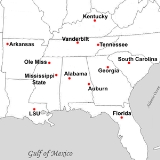
Current members The SEC currently has twelve member institutions in nine Southeastern states. The geographic domain of the conference stretches from Arkansas to South Carolina and from Kentucky to Florida. One or both of the flagship universities in each state in the geographic domain of the SEC is a member of the conference, along with one of the preeminent private universities in the nation.
The conference is divided into two geographic divisions: the Eastern Division and the Western Division. The twelve current members of the Southeastern Conference are:
| Institution | Location (Population) | Founded | Affiliation | Enrollment* | Year Joined | Nickname | Mascot |
|---|
| Eastern Division |
|---|
| University of Florida | Gainesville, Florida (108,655) | 1853 | Public | 51,913 | 1932 | Gators | Albert and Alberta | | University of Georgia | Athens, Georgia (111,580) | 1785 | Public | 33,831 | 1932 | Bulldogs | Hairy Dawg / Uga | | University of Kentucky | Lexington, Kentucky (270,789) | 1865 | Public | 27,209 | 1932 | Wildcats | The Wildcat / Scratch / Blue | | University of South Carolina | Columbia, South Carolina (119,961) | 1801 | Public | 27,065 | 1991 | Gamecocks | Cocky | | University of Tennessee | Knoxville, Tennessee (173,890) | 1794 | Public | 26,400 | 1932 | Volunteers, Lady Volunteers | Smokey | | Vanderbilt University | Nashville, Tennessee (607,413) | 1873 | Private / Non-sectarian | 11,607 | 1932 | Commodores | Mr. C | | Western Division |
|---|
| University of Alabama | Tuscaloosa, Alabama (83,052) | 1831 | Public | 25,580 | 1932 | Crimson Tide | Big Al | | University of Arkansas | Fayetteville, Arkansas (67,158) | 1871 | Public | 18,647 | 1991 | Razorbacks, Ladybacks | Big Red / Boss Hog / Sooie / Pork Chop / Tusk | | Auburn University | Auburn, Alabama (54,348) | 1856 | Public | 24,137 | 1932 | Tigers | Aubie / War Eagle VII | | Louisiana State University | Baton Rouge, Louisiana (224,097) | 1860 | Public | 33,587 | 1932 | Tigers, Lady Tigers | Mike the Tiger | | University of Mississippi | Oxford, Mississippi (14,051) | 1848 | Public | 17,323 | 1932 | Rebels | Colonel Reb | | Mississippi State University | Starkville, Mississippi (22,638) | 1878 | Public | 17,032 | 1932 | Bulldogs | Bully the Bulldog |
- * Enrollment figures include both undergraduate and graduate students.
Sports The Southeastern Conference sponsors championships in many different sports.
Under SEC conference rules reflecting the large number of (male) scholarship participants in football and attempting to address gender equity concerns (see also Title IX), each member institution is required to provide two more women's varsity sports than men's. The equivalent rule was recently adopted by the NCAA for all of Division I.
While South Carolina and Kentucky field men's soccer teams, the conference does not sponsor the sport; both schools in 2005 joined Conference USA for the sport.
Conference sports facilities| School | Football stadium | Capacity | Basketball arena | Capacity | Baseball stadium | Capacity | | Eastern Division |
|---|
| Florida | Ben Hill Griffin Stadium | 88,548 | Stephen C. O'Connell Center | 12,000 | McKethan Stadium | 7,000 | | Georgia | Sanford Stadium | 92,746 | Stegeman Coliseum | 11,000 | Foley Field | 3,291 | | Kentucky | Commonwealth Stadium | 67,530 | Rupp Arena (men and women) Memorial Coliseum (women only) | 23,000 8,500 | Cliff Hagan Stadium | 3,000 | | South Carolina | Williams-Brice Stadium | 80,250 | Colonial Center | 18,000 | Sarge Frye Field | 6,000 | | Tennessee | Neyland Stadium | 104,079 | Thompson-Boling Arena | 24,535 | Lindsey Nelson Stadium | 4,000 | | Vanderbilt | Vanderbilt Stadium | 39,790 | Memorial Gymnasium | 14,168 | Hawkins Field | 2,027 | | Western Division |
|---|
| Alabama | Bryant-Denny Stadium | 92,138 | Coleman Coliseum | 15,043 | Sewell-Thomas Stadium | 6,118 | | Arkansas | Donald W. Reynolds Razorback Stadium (primary) War Memorial Stadium (secondary) | 76,000 53,727 | Bud Walton Arena | 19,200 | Baum Stadium | 10,737 | | Auburn | Jordan-Hare Stadium | 87,451 | Beard-Eaves-Memorial Coliseum | 10,500 | Plainsman Park | 4,096 | | LSU | Tiger Stadium | 92,910 | Pete Maravich Assembly Center | 14,164 | Alex Box Stadium | 7,760 | | Ole Miss | Vaught-Hemingway Stadium | 60,850 | Tad Smith Coliseum | 8,700 | Swayze Field | 3,500 | | Mississippi State | Davis Wade Stadium (Scott Field) | 55,082 | Humphrey Coliseum | 10,500 | Dudy Noble Field | 15,500 |
- One men's home game per year played at Freedom Hall in Louisville.
- New stadium scheduled to open for 2009 season.
- Two games played each year at Little Rock, one non-conference game and one SEC game.
- New arena scheduled to open for 2010-11 season.
- New Alex Box Stadium scheduled to open for 2009 season.
- Though Mississippi State's Dudy Noble Field official seating capacity is 7,200, its total capacity is 15,500, which includes privately owned seating in Left Field Lounge. Mississippi State holds the all-time NCAA on-campus record for one day attendance at 14,991.
Southeastern Conference Schools Ranked by Endowment
FootballBefore expansion, each SEC school played 6 conference games. Five of these games were against permanent opponents, developing some traditional rivalries between schools, and the 6th game rotated around the other 4 members of the conference.
From 1992 through 2001, each team had two permanent inter-divisional opponents, allowing many traditional rivalries from the pre-expansion era (such as Florida vs. Auburn, Kentucky vs. LSU and Vanderbilt vs. Alabama) to continue. However, complaints from some league athletic directors about imbalance in the schedule (for instance, Auburn's two permanent opponents from the East were Florida and Georgia – two of the SEC's stronger football programs at the time – while Mississippi State played relatively weaker Kentucky and South Carolina every year) led to the SEC reducing the permanent opponents to only one per team.
Under the current format, each school plays a total of eight conference games, consisting of the other five teams in its division, two schools from the other division on a rotating basis, and one school from the other division that it plays each year. All permanent inter-divisional games, with the exception of Arkansas vs. South Carolina, were played annually before SEC expansion in 1992. The following table shows the permanent opponent for each school listed by total number of games played (records through 2007 with western wins listed first):
Other league athletic directors have advocated discarding the current format and adopting the one used by the Big 12 Conference, where teams play three teams from the opposite division on a home-and-home basis for two seasons, and then switch and play the other three teams from the opposite side for a two-year home-and-home. However, the potential loss of such heated (and profitable, as the games are often shown on national TV) long-standing rivalries as LSU-Florida, Alabama-Tennessee, and Auburn-Georgia have scuttled such plans on the drawing board. The loss of the annual rivalry between Nebraska and Oklahoma has led some Big 12 athletic directors to make a push to adopt the SEC format for the Big 12.
Interestingly, before the institution of divisional play, many of Auburn's yearly rivalries were with teams in the East (Florida, Georgia and Tennessee), while Tennessee's yearly rivalries were with teams in the West (Alabama, Auburn and Ole Miss).
Television and Radio ContractsThe SEC televises football games across various networks during the fall. The primary networks for SEC coverage are CBS, ESPN, ESPN2, and Raycom (formerly Lincoln Financial and Jefferson Pilot). Games scheduled for airing are generally picked two weeks before they occur, with a few matches that are selected by CBS and ESPN prior to the season. CBS has the first pick for a game and selects the highest-profile game to broadcast to a national, over-the-air audience. The CBS game is usually broadcast at 3:30 ET. CBS also has the rights for the SEC Championship Game. The next selection goes to ESPN, which will usually broadcast a SEC game at 7:45 ET. Raycom offers regional coverage for an SEC game of the week at 12:30 ET, and each school plays at least one game at this time. For those outside of the SEC media market, this game is offered on the ESPN Game Plan package. After the three networks make their selections, ESPN has an option to select another game to broadcast on one of its networks. ESPN also has the option to select additional SEC games for ESPN2, or occasionally will broadcast some games on Thursday night.
For games not selected by any broadcast provider, certain schools offer regional pay-per-view.
As of 2008, all SEC schools are affiliated with XM Radio, offering their radio broadcasts to an audience on XM.
Championship GameThe SEC Championship Game is held by the Southeastern Conference each year. The championship game pits the Southeastern East Division champion against the West Division champion in a game held after the regular season has been completed. The first championship game was during the 1992 season. The first two SEC Championship football games were held at Legion Field in Birmingham, Alabama. Since 1994, the game has been played at the Georgia Dome in Atlanta, Georgia.
Bowl tie-insThe post-season bowl game tie-ins for the SEC for the 2007 season were:
- Sugar Bowl in New Orleans, LA (vs. BCS) – has hosted all SEC teams but Mississippi State, South Carolina and Vanderbilt
- Capital One Bowl in Orlando, FL (vs. Big Ten)
- Outback Bowl in Tampa, FL (vs. Big Ten)
- Cotton Bowl in Dallas, TX (vs. Big 12)
- Chick-Fil-A Bowl in Atlanta, GA (vs. ACC)
- Liberty Bowl in Memphis, TN (vs. Conference USA)
- Music City Bowl in Nashville, TN (vs. ACC)
- Independence Bowl in Shreveport, LA (vs. Big 12)
The Outback, Cotton, and Chick-Fil-A Bowls each pick in the same tier and base their selections on regional differences. For example, the Cotton Bowl has preference on teams from the Western Division while the Outback Bowl has preference over teams in the Eastern Division.
Under SEC guidelines, the Capital One Bowl must pick the SEC Championship game loser if that team has won two or more games than the next team in the selection order. The SEC Championship game loser has not played in the Capital One Bowl since Tennessee following the 2001 season.
It was announced on April 30, 2008, that the SEC will replace Conference USA in the Papajohns.com bowl in Birmingham, AL. The SEC representative will play a team from the Big East. The Papajohns.com bowl will receive the lowest bowl eligible team from the SEC, giving the conference 9 bowl teams if that many are eligible.
RivalriesThe SEC members have long histories. Some of the football rivalries involving SEC teams include:
| |