

Kurskaya-Koltsevaya

Encyclopedia
Kurskaya is a Moscow Metro
station in the Basmanny District
, Central Administrative Okrug, Moscow
. It is on the Koltsevaya Line
, between Komsomolskaya and Taganskaya stations.
Kurskaya opened on 1 January 1950.
built in the 1950s style of Stalinist Architecture
.
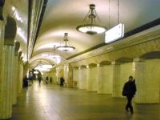
The design features four rows of columns which support the vaults, though the columns are "doubled" hence their wide appearance. In the centre of the station is a large open space with a large vault topping it that rests on four pylons forming an arbour, from which a staircase leads off as a transfer to Kurskaya-Radialnaya
of the Arbatsko-Pokrovskaya Line
. Another interesting detail of the station is the lack of sculptures and artwork, instead however this compensated by small details such as Torchiere
(now removed) in the arbour which light the granite stairwell and hidden lamps in the nieches of the vault, which is covered by a bronze frieze symbolising the dawn and blossoming of Mother Russia
. Additional lighting is provided by eight elegant conical chandeliers with fluorescent tubes. The floor is laid with red and grey granite, and the walls and columns with white koyelga marble.
The station's large vestibule is located right next to the north, and adjacent to Kursky Rail Terminal
, hence the name of the station, and serves both the ring and radial stations, this contains a large circular underground lobby in the centre of which is a bronze sculpture of wheat (inclining Kursk
as the centre of the Chernozem
region), this is also linked to the 1938 vestibule of the Arbatsko-Pokrovskaya station, allowing for a transfer there. The interior of the surface structure, adorned with citations from the Anthem of the Soviet Union once contained a large statue of Joseph Stalin
(sculptor Nikolai Tomsky
), this was removed in 1961. On 3 July 2008 the vestibule was closed for a period of a year to replace escalators, upgrade and renovation. The station's second entrance to Zemlyanoy Val opened in December 1995, is a shared underground vestibule, which also doubles as a transfer to Chkalovskaya
of the Lyublinskaya Line
.
Possibly the most interesting detail of the station is a large metallic plaque on the station wall, adorned with artwork has an inscription: Kurskaya, large ring, 1945-1949. This implies the original plan to have the Koltsevaya Line follow the Garden Ring
, and then a smaller ring line to follow the Boulevard Ring
(the small ring).
Moscow Metro
The Moscow Metro is a rapid transit system serving Moscow and the neighbouring town of Krasnogorsk. Opened in 1935 with one line and 13 stations, it was the first underground railway system in the Soviet Union. As of 2011, the Moscow Metro has 182 stations and its route length is . The system is...
station in the Basmanny District
Basmanny District
Basmanny District is a district of Central Administrative Okrug of Moscow, Russia. Population: The district extends northeast from Kitai-gorod, within the radial boundaries of Vorontsovo Pole Street and Yauza River in the south and Myasnitskaya Street and Novaya Basmannaya Street in the north...
, Central Administrative Okrug, Moscow
Moscow
Moscow is the capital, the most populous city, and the most populous federal subject of Russia. The city is a major political, economic, cultural, scientific, religious, financial, educational, and transportation centre of Russia and the continent...
. It is on the Koltsevaya Line
Koltsevaya Line
The Koltsevaya Line , , is a railway line of the Moscow Metro. The line was built in 1950-1954 encircling the central Moscow, and became crucial to the transfer patterns of passengers....
, between Komsomolskaya and Taganskaya stations.
Kurskaya opened on 1 January 1950.
Design
The station was designed by architects G. Zakharkov and Z. Chernysheva under the supervision of Ivan Zholtovsky who were awarded the Stalin Prize in 1950 for the design. Kurskaya is a rare deep column stationDeep column station
The deep column station is a type of subway station, consisting of a central hall with two side halls, connected by ring-like passages between a row of columns...
built in the 1950s style of Stalinist Architecture
Stalinist architecture
Stalinist architecture , also referred to as Stalinist Gothic, or Socialist Classicism, is a term given to architecture of the Soviet Union between 1933, when Boris Iofan's draft for Palace of the Soviets was officially approved, and 1955, when Nikita Khrushchev condemned "excesses" of the past...
.
The design features four rows of columns which support the vaults, though the columns are "doubled" hence their wide appearance. In the centre of the station is a large open space with a large vault topping it that rests on four pylons forming an arbour, from which a staircase leads off as a transfer to Kurskaya-Radialnaya
Kurskaya-Radialnaya
Kurskaya , also known as Kurskaya-Radialnaya, is a station on the Arbatsko-Pokrovskaya Line of the Moscow Metro. It is named for the Kursky Rail Terminal located nearby. Designed by L.M...
of the Arbatsko-Pokrovskaya Line
Arbatsko-Pokrovskaya Line
The Arbatsko–Pokrovskaya Line is a line of the Moscow Metro. Chronologically the second to open, now it connects with the district of Mitino and town of Krasnogorsk to the northwest of Moscow with the east of the Russian capital passing through the city centre...
. Another interesting detail of the station is the lack of sculptures and artwork, instead however this compensated by small details such as Torchiere
Torchiere
A torchiere , or torch lamp, is a lamp with a tall stand of wood or metal. Originally, torchieres were candelabra, usually with two or three lights...
(now removed) in the arbour which light the granite stairwell and hidden lamps in the nieches of the vault, which is covered by a bronze frieze symbolising the dawn and blossoming of Mother Russia
Mother Russia
Mother Russia is a national personification of Russia, appearing in patriotic posters, statues etc. In the Soviet period, the term Mother Motherland was preferred, as representing the multi-ethnic Soviet Union; still, there is a clear similarity between the pre-1917 Mother Russia and the Soviet...
. Additional lighting is provided by eight elegant conical chandeliers with fluorescent tubes. The floor is laid with red and grey granite, and the walls and columns with white koyelga marble.
The station's large vestibule is located right next to the north, and adjacent to Kursky Rail Terminal
Kursky Rail Terminal
Kursky Rail Terminal is one of the nine rail terminals in Moscow. It was built in 1896.There are currently plans in the pipeline to completely rebuild or refurbish the Kursky Rail Terminal.-Long distance from Moscow:-Long distance via Moscow:...
, hence the name of the station, and serves both the ring and radial stations, this contains a large circular underground lobby in the centre of which is a bronze sculpture of wheat (inclining Kursk
Kursk
Kursk is a city and the administrative center of Kursk Oblast, Russia, located at the confluence of the Kur, Tuskar, and Seym Rivers. The area around Kursk was site of a turning point in the Russian-German struggle during World War II and the site of the largest tank battle in history...
as the centre of the Chernozem
Chernozem
Chernozem , also known as "black land" or "black earth", is a black-coloured soil containing a high percentage of humus 7% to 15%, and high percentages of phosphoric acids, phosphorus and ammonia...
region), this is also linked to the 1938 vestibule of the Arbatsko-Pokrovskaya station, allowing for a transfer there. The interior of the surface structure, adorned with citations from the Anthem of the Soviet Union once contained a large statue of Joseph Stalin
Joseph Stalin
Joseph Vissarionovich Stalin was the Premier of the Soviet Union from 6 May 1941 to 5 March 1953. He was among the Bolshevik revolutionaries who brought about the October Revolution and had held the position of first General Secretary of the Communist Party of the Soviet Union's Central Committee...
(sculptor Nikolai Tomsky
Nikolai Tomsky
Nikolai Vasilyevich Tomsky was a much-decorated Soviet sculptor, designer of many well-known ceremonial monuments of the Socialist Realism era.- Biography :...
), this was removed in 1961. On 3 July 2008 the vestibule was closed for a period of a year to replace escalators, upgrade and renovation. The station's second entrance to Zemlyanoy Val opened in December 1995, is a shared underground vestibule, which also doubles as a transfer to Chkalovskaya
Chkalovskaya
Chkalovskaya is a Moscow Metro station in the Basmanny District, Central Administrative Okrug, Moscow. It is on the Lyublinsko-Dmitrovskaya Line, between Sretensky Bulvar and Rimskaya stations....
of the Lyublinskaya Line
Lyublinskaya Line
Lyublinsko-Dmitrovskaya Line is the line of the Moscow Metro. First opened in 1995 as a semi-chordial radius it is at present in process of being extended through the centre and northwards...
.
Possibly the most interesting detail of the station is a large metallic plaque on the station wall, adorned with artwork has an inscription: Kurskaya, large ring, 1945-1949. This implies the original plan to have the Koltsevaya Line follow the Garden Ring
Garden Ring
The Garden Ring, also known as the "B" Ring , is a circular avenue around the central Moscow, its course corresponding to what used to be the city ramparts surrounding Zemlyanoy Gorod in the 17th century....
, and then a smaller ring line to follow the Boulevard Ring
Boulevard Ring
The Boulevard Ring is Moscow's second centremost ring road . Boulevards form a semicircular chain along the western, northern and eastern sides of the historical White City of Moscow; in the south the incomplete ring is terminated by the embankments of Moskva River...
(the small ring).