


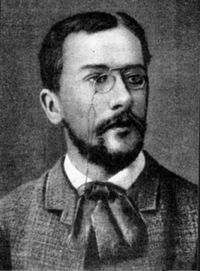
Konstantin Mereschkowski

Encyclopedia
Transliteration
Transliteration is a subset of the science of hermeneutics. It is a form of translation, and is the practice of converting a text from one script into another...
Konstantin Sergeevich Merezhkovsky, Konstantin Sergivich Merezhkovsky, Constantin Sergeevič Mérejkovski, Constantin Sergejewicz Mereschcowsky, and Konstantin Sergejewicz Mereschkovsky) was a prominent Russia
Russia
Russia or , officially known as both Russia and the Russian Federation , is a country in northern Eurasia. It is a federal semi-presidential republic, comprising 83 federal subjects...
n biologist
Biologist
A biologist is a scientist devoted to and producing results in biology through the study of life. Typically biologists study organisms and their relationship to their environment. Biologists involved in basic research attempt to discover underlying mechanisms that govern how organisms work...
, botanist and advocate of eugenics active mainly around Kazan
Kazan
Kazan is the capital and largest city of the Republic of Tatarstan, Russia. With a population of 1,143,546 , it is the eighth most populous city in Russia. Kazan lies at the confluence of the Volga and Kazanka Rivers in European Russia. In April 2009, the Russian Patent Office granted Kazan the...
, whose research on lichens led him to propose the theory of symbiogenesis
Symbiogenesis
Symbiogenesis is the merging of two separate organisms to form a single new organism. The idea originated with Konstantin Mereschkowsky in his 1926 book Symbiogenesis and the Origin of Species, which proposed that chloroplasts originate from cyanobacteria captured by a protozoan...
- that larger, more complex
Complexity
In general usage, complexity tends to be used to characterize something with many parts in intricate arrangement. The study of these complex linkages is the main goal of complex systems theory. In science there are at this time a number of approaches to characterizing complexity, many of which are...
cells
Cell (biology)
The cell is the basic structural and functional unit of all known living organisms. It is the smallest unit of life that is classified as a living thing, and is often called the building block of life. The Alberts text discusses how the "cellular building blocks" move to shape developing embryos....
evolved
Evolution
Evolution is any change across successive generations in the heritable characteristics of biological populations. Evolutionary processes give rise to diversity at every level of biological organisation, including species, individual organisms and molecules such as DNA and proteins.Life on Earth...
from the symbiotic relationship between less complex ones. He presented this theory in 1909, in his Russian work, The Theory of Two Plasms as the Basis of Symbiogenesis, a New Study or the Origins of Organisms, although the fundamentals of the idea already had appeared in his earlier 1905 work, The nature and origins of chromatophores in the plant kingdom.
He was inspired by his work as a leading lichenologist - lichens were of major interest at the time as it had recently been shown that they exhibit a symbiotic relationship between fungi and algae
Algae
Algae are a large and diverse group of simple, typically autotrophic organisms, ranging from unicellular to multicellular forms, such as the giant kelps that grow to 65 meters in length. They are photosynthetic like plants, and "simple" because their tissues are not organized into the many...
. Around the turn of the century he collected
Collecting
The hobby of collecting includes seeking, locating, acquiring, organizing, cataloging, displaying, storing, and maintaining whatever items are of interest to the individual collector. Some collectors are generalists, accumulating merchandise, or stamps from all countries of the world...
a sizeable lichen herbarium
Herbarium
In botany, a herbarium – sometimes known by the Anglicized term herbar – is a collection of preserved plant specimens. These specimens may be whole plants or plant parts: these will usually be in a dried form, mounted on a sheet, but depending upon the material may also be kept in...
, containing over 2000 specimens from lands in Russia
Russia
Russia or , officially known as both Russia and the Russian Federation , is a country in northern Eurasia. It is a federal semi-presidential republic, comprising 83 federal subjects...
, Austria
Austria
Austria , officially the Republic of Austria , is a landlocked country of roughly 8.4 million people in Central Europe. It is bordered by the Czech Republic and Germany to the north, Slovakia and Hungary to the east, Slovenia and Italy to the south, and Switzerland and Liechtenstein to the...
and around the Mediterranean. The collection is currently in the possession of Kazan University. He also studied hydras.
Merezhkovsky rejected Darwinian evolutionary theory. He did not believe that natural selection
Natural selection
Natural selection is the nonrandom process by which biologic traits become either more or less common in a population as a function of differential reproduction of their bearers. It is a key mechanism of evolution....
could explain biological novelty, positing instead the acquisition and inheritance of microbes as central. He was criticised by another Russian lichenologist, Alexandr Alexandrovich Elenkin.
Although the modern evolutionary synthesis
Modern evolutionary synthesis
The modern evolutionary synthesis is a union of ideas from several biological specialties which provides a widely accepted account of evolution...
supports Darwin's theory of evolution by natural selection, Merezhovsky's ideas of symbiogenesis are reflected in the modern endosymbiotic theory
Endosymbiont
An endosymbiont is any organism that lives within the body or cells of another organism, i.e. forming an endosymbiosis...
developed and popularised by Lynn Margulis
Lynn Margulis
Lynn Margulis was an American biologist and University Professor in the Department of Geosciences at the University of Massachusetts Amherst. She is best known for her theory on the origin of eukaryotic organelles, and her contributions to the endosymbiotic theory, which is now generally accepted...
. In this, organelle
Organelle
In cell biology, an organelle is a specialized subunit within a cell that has a specific function, and is usually separately enclosed within its own lipid bilayer....
s such as chloroplast
Chloroplast
Chloroplasts are organelles found in plant cells and other eukaryotic organisms that conduct photosynthesis. Chloroplasts capture light energy to conserve free energy in the form of ATP and reduce NADP to NADPH through a complex set of processes called photosynthesis.Chloroplasts are green...
s and mitochondria
Mitochondrion
In cell biology, a mitochondrion is a membrane-enclosed organelle found in most eukaryotic cells. These organelles range from 0.5 to 1.0 micrometers in diameter...
are the descendants of bacteria
Bacteria
Bacteria are a large domain of prokaryotic microorganisms. Typically a few micrometres in length, bacteria have a wide range of shapes, ranging from spheres to rods and spirals...
that evolved into an intracellular
Intracellular
Not to be confused with intercellular, meaning "between cells".In cell biology, molecular biology and related fields, the word intracellular means "inside the cell".It is used in contrast to extracellular...
symbiosis with early eukaryotic
Eukaryote
A eukaryote is an organism whose cells contain complex structures enclosed within membranes. Eukaryotes may more formally be referred to as the taxon Eukarya or Eukaryota. The defining membrane-bound structure that sets eukaryotic cells apart from prokaryotic cells is the nucleus, or nuclear...
cells.
Merezhkovsky strongly endorsed and promoted eugenics and related subjects like "racial hygiene" (among humans). For example in his work The paradise on earth or a winter night dream
.