
All Topics  
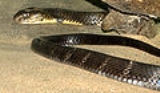
King Cobra

 
King Cobra

   Email Print
   Bookmark   Link


King Cobra


The King Cobra
Cobra

A cobra is a snake and usually a venomous member of the family Elapidae . The name is short for cobra de capello , which is Portuguese language for "snake with hood," or "hood-snake." When disturbed, most of these snakes can rear up and spread their neck in a characteristic threat display....
 (Ophiophagus hannah) is the world's longest venomous snake
Snake

Snakes are elongate legless carnivore reptiles of the suborder Serpentes that can be distinguished from legless lizards by their lack of eyelids and external ears....
, with a length that can be as large as 5.7 m (22 ft). This species is widespread throughout Southeast Asia and parts of India, but found mostly in forested areas. Its genus name, Ophiophagus, literally means "snake-eater", and its diet primarily consists of other snakes, including sizeable pythons and even smaller members of its own species.


Discussion
Ask a question about 'King Cobra'
Start a new discussion about 'King Cobra'
Answer questions from other users
Full Discussion Forum


Recent Posts


Encyclopedia


The King Cobra
Cobra

A cobra is a snake and usually a venomous member of the family Elapidae . The name is short for cobra de capello , which is Portuguese language for "snake with hood," or "hood-snake." When disturbed, most of these snakes can rear up and spread their neck in a characteristic threat display....
 (Ophiophagus hannah) is the world's longest venomous snake
Snake

Snakes are elongate legless carnivore reptiles of the suborder Serpentes that can be distinguished from legless lizards by their lack of eyelids and external ears....
, with a length that can be as large as 5.7 m (22 ft). This species is widespread throughout Southeast Asia and parts of India, but found mostly in forested areas. Its genus name, Ophiophagus, literally means "snake-eater", and its diet primarily consists of other snakes, including sizeable pythons and even smaller members of its own species. The venom
Snake venom

Snake venom is highly modified saliva that is produced by special glands of certain species of snakes. The gland which secretes the zootoxin is a modification of the parotid gland of other vertebrates, and is usually situated on each side of the head below and behind the eye, invested in a muscular sheath....
 of the King Cobra is primarily neurotoxic
Neurotoxin

A neurotoxin is a toxin that acts specifically on nerve cells , usually by interacting with membrane proteins such as ion channels.Some sources are more general, and define the effect of neurotoxins as occurring at nerve tissue....
, and the snake is fully capable of killing a human
Human

A human being, also human or man, is a member of a species of bipedalism primates in the family Hominidae . Mitochondrial DNA evidence indicates that modern humans originated in east Africa about 200,000 years ago....
 with a single bite. The mortality rate from a bite can be as high as 75%.

Profile

The King Cobra is a large powerful snake, averaging 3.6-4 m (12-13 feet) in length typically weighing about 6 kg (13.2 lb). The record-sized wild cobra was shot in the Nakhon Si Thammarat Mountains of south Thailand
Thailand

The Kingdom of Thailand is an independent country that lies in the heart of Southeast Asia. It is bordered to the north by Laos and Myanmar, to the east by Laos and Cambodia, to the south by the Gulf of Thailand and Malaysia, and to the west by the Andaman Sea and Myanmar....
 and was 5.6 m (18.5 ft). An even larger cobra was kept captive at the London Zoo
London Zoo

Zoological Society of London London Zoo is the world's oldest scientific zoo. It was opened in London on April 27 1828, and was originally intended to be used as a collection for science....
 and grew to 5.7 m (18.8 ft) before being euthanized upon the outbreak of World War II
World War II

World War II, or the Second World War , was a global military conflict which involved a Participants in World War II, including all of the great powers, organised into two opposing military alliances: the Allies of World War II and the Axis powers....
  The skin is either olive-green, tan, or black and it has faint, pale yellow cross bands down the length of the body. The belly is cream or pale yellow, and the scales are smooth. The head of a mature snake can be quite massive and bulky in appearance, though like all snakes, they can expand their jaws to swallow large prey items. It has proteroglyph dentition, meaning it has two short, fixed fangs in the front of the mouth which channel venom into the prey like hypodermic needles. The male is larger and thicker than the female. The average lifespan of a King Cobra is about 20 years.

Habitat

Widespread, but not common, across South and South-east Asia
Southeast Asia

Southeast Asia or Southeastern Asia is a subregion of Asia, consisting of the countries that are geographically south of China, east of India and north of Australia....
. It lives in dense highland forest
Forest

File:Stara planina suma.jpgA forest is an area with a high density of trees. There are many definitions of a forest, based on various criteria....
s. The snake has a preference for living in areas dotted with lakes and streams. King Cobra populations have dropped in some areas of its range due to the destruction of forests
Deforestation

Deforestation is the logging or burning of trees in forested areas. There are several reasons for doing so: trees or derived charcoal can be sold as a commodity and are used by humans while cleared land is used as pasture, plantations of commodities and human settlement....
, but despite this the snake is not listed by the IUCN
World Conservation Union

The International Union for Conservation of Nature and Natural Resources is an international organization dedicated to natural resource Conservation ethic....
 as in danger of becoming extinct. It is, however, listed as an Appendix II Animal within CITES.

Hunting


King Cobras, like other snakes, receive chemical information ("smell") via their forked tongue
Forked tongue

A forked tongue is a tongue split into two distinct ends at the tip; this is a feature common to many species of reptiles. Reptiles olfaction using the tip of their tongue, and a forked tongue allows them to sense from which direction a smell is coming....
s, which pick up scent particles and transfer them to a special sensory receptor (Jacobson's Organ
Vomeronasal organ

The vomeronasal organ , or Jacobson's organ, is an auxiliary olfactory sense organ that is found in many animals. It was discovered by Ludvig Jacobson in 1813....
) located in the roof of its mouth. When the scent of a meal has been detected, the snake will flick its tongue to gauge the prey's direction (the twin forks of the tongue acting in stereo); it will also rely on its keen eyesight (King Cobras are able to detect moving prey almost 100 m [300 feet] away), intelligence and sensitivity to earth-borne vibration to track its prey. Following envenomation, the King Cobra will begin to swallow its struggling prey while its toxins begin the digestion
Digestion

Digestion is the mechanical and chemical breaking down of food into smaller components, to a form that can be Absorption, for instance, by a blood stream....
 of its victim. King Cobras, as with all other snakes, do not have rigidly fixed jaws. Instead, the jaw bones are connected by extremely pliable ligaments, enabling the lower jaw bones to move independently of each other. Like other snakes, the King Cobra does not chew its food, instead it swallows its prey whole. The expansion of the jaw enables the snake to swallow prey much larger than its head.

King Cobras are able to hunt at all times of day, although it is rarely seen at night, leading most herpetologists to classify it as a diurnal
Diurnal animal

Scientific term refered to as an animal behavior, diurnality indicates an animal that is active during the daytime and rests during the night. Animals that are not diurnal might be Nocturnality or crepuscular .  Many animal species are diurnal, including many mammals, insects and birds....
 species.

Diet

The King Cobra's diet is mainly composed of other snakes (ophiophagy
Ophiophagy

Ophiophagy is a specialized form of feeding or alimentary behavior of animals which predation and eat snakes. There are ophiophagous mammals , birds , lizards , and even other snakes, such as the Central and South American mussuranas and the North American Common Kingsnake ....
): both non-venomous snakes such as pythons and venomous snakes including kraits and Indian Cobra
Indian Cobra

Naja naja is a species of venomous snake snake native to the Indian subcontinent which includes present day Pakistan, India, Bangladesh and Sri lanka....
s. When food is scarce, King Cobras may also feed on other small vertebrates such as lizards, birds, and rodents. In some cases, the cobra may "constrict" its prey, like birds and larger rodents using its muscular body, though this is uncommon. After a large meal the snake may live for many months without another one due to its slow metabolic rate
Metabolism

Metabolism is the set of chemical reactions that occur in living organisms in order to maintain life. These processes allow organisms to grow and reproduce, maintain their structures, and respond to their environments....
.

Defense

Ophiophagus Hannah2
If a King Cobra encounters a natural predator, such as the mongoose
Mongoose

A mongoose is a member of the family Herpestidae , a family of small, cat-like Carnivoras.The word mongoose is derived from the Marathi language name mangus "mongoose", perhaps ultimately from Dravidian languages ....
, which has some resistance to the neurotoxins, the cobra will generally try to flee. If all else fails, it will flatten its upper body by spreading its ribs, forming the distinctive cobra hood about its neck, which can be the size of an adult's handspan. It will also emit a high-pitched hiss, sometimes with feigned closed-mouth strikes. These efforts usually prove to be very effective, especially since the King cobra is more dangerous than other mongoose prey as well as being much too large for the small mammal to kill.

Venom

King Cobra's venom, which is composed mostly of proteins and polypeptides, is produced in specialized salivary glands (as is the case with all venomous reptiles) just behind the animal's eyes. When biting its prey, venom is forced through the snake's half-inch (1.25 cm) fangs and into the wound. Although its venom is not the most toxic one, a King Cobra's size enables it to inject larger quantities of venom than most other species. On a single bite, it injects as much as 6 to 7 ml of venom The large amount of venom in a single bite allows the King Cobra to kill faster, and to kill larger animals than other serpents. The King Cobra can kill up to 5 times faster than the black mamba, so it just takes a few minutes to kill a human, and can even kill an Asian Elephant
Asian Elephant

The Asian or Asiatic Elephant , sometimes known by the name of one of its subspecies – the Indian Elephant, is one of the three living species of elephant, and the only living species of the genus Elephas....
 within 3 hours if the larger animal is bitten in a vulnerable area such as the trunk.

The King Cobra's venom is primarily neurotoxic and thus attacks the victim's central nervous system
Central nervous system

The central nervous system is the part of the nervous system that functions to coordinate the activity of all parts of the bodies of multicellular organisms....
 and quickly induces severe pain, blurred vision, vertigo
Vertigo (medical)

Vertigo is a specific type of dizziness, a major symptom of a balance disorder. It is the sensation of spinning or swaying while the body is actually stationary with respect to the surroundings....
, drowsiness, and paralysis
Paralysis

Paralysis is the complete loss of muscle function for one or more muscle groups. Paralysis can cause loss of feeling or loss of mobility in the affected area....
. In one to two minutes, cardiovascular collapse occurs, and the victim falls into a coma
Coma

In medicine, a coma is a profound state of unconsciousness. A comatose person cannot be awakened, fails to respond normally to pain or light, does not have sleep-wake cycles, and does not take voluntary actions....
. Death soon follows due to respiratory failure
Respiratory failure

The term respiratory failure, in medicine, is used to describe inadequate gas exchange by the respiratory system, with the result that arterial oxygen and/or carbon dioxide levels cannot be maintained within their normal ranges....
. There are two types of antivenin
Antivenin

Antivenom is a biological product used in the treatment of venom bites or stings. The name, antivenin, comes from the French word venin meaning venom, and historically the word antivenin was predominant around the world, however, this usage is archaic in English....
 made specifically to treat King Cobra envenomations. The Red Cross
International Red Cross and Red Crescent Movement

The International Red Cross and Red Crescent Movement is an international Humanitarianism movement with approximately 97 million volunteers worldwide which started to protect human life and health, to ensure respect for the human being, and to prevent and alleviate human suffering, without any discrimination based on nationality, Race , relig...
 in Thailand manufactures one, and the Central Research Institute in India manufactures the other, however both are made in small quantities, and are not widely available. A protein component of the venom Ohanin causes hypolocomotion and hyperalgesia in mammals other components have cardiotoxic, cytotoxic and neurotoxic effects.

Despite the King Cobra's fearsome reputation and deadly bite, it is a shy and reclusive animal
Animal

Animals are a major group of multicellular, eukaryotic organisms of the Kingdom Animalia or Metazoa. Their body plan eventually becomes fixed as they develop, although some undergo a process of metamorphosis later on in their life....
, avoiding confrontation with humans as often as possible. There are other venomous snakes within this species' range, in fact, that are responsible for more fatal snake bites than the King Cobra, such as the Monocled Cobra, or Russell's Viper .

In Burma
Myanmar

Burma, officially the Union of Myanmar, is the largest country by geographical area in mainland Southeast Asia, or Indochina. The country is bordered by the People's Republic of China on the northeast, Laos on the east, Thailand on the southeast, Bangladesh on the west, India on the northwest, and the Bay of Bengal to the southwest with...
, King Cobras are often used by female snake charmers. The charmer is usually tattooed with three pictograms using an ink mixed with snake venom; superstition holds that it protects the charmer from the snake. The charmer kisses the snake on the top of its head at the end of the show.

Reproduction

The female king cobra is a very dedicated parent. Before she is ready to lay her eggs, she uses the coils of her long body to gather a big mound of leaf litter. She deposits 20-40 eggs into the mound, which acts as an incubator. The female stays with her eggs and guards the mound tenaciously, rearing up into a threat display if any large animal gets too close.

Related species

The King Cobra belongs to the family Elapidae
Elapidae

The Elapidae, or elapids, are a family of venom snakes found in tropical and subtropical regions around the world, including the Indian Ocean and the Pacific....
. There are over 200 species of elapid found around the world, excepting Antarctica and Europe
Europe

Europe is, conventionally, one of the world's seven continents. Comprising the westernmost peninsula of Eurasia, Europe is generally divided from Asia to its east by the water divide of the Ural Mountains, the Ural , the Caspian Sea, and by the Caucasus Mountains to the southeast....
. All are venomous and have short, fixed fangs (proteroglyphs), but may differ widely in habits, behaviour and appearance. Four better known species of the Elapidae are the Coral Snake
Coral snake

The coral snakes are a large group of elapid snakes that can be divided into two distinct groups: New World coral snakes and Old World Calliophis snakes....
, Death Adder
Acanthophis

Acanthophis is a genus of highly venomous snake Elapidae snakes. Commonly called death adders, they are native to Australia, New Guinea and nearby islands, and are among the most venomous snakes in the world....
, Black Mamba
Black mamba

The Black Mamba , is an elapidae snake and is one of Africa's most dangerous and feared snakes. It has a wide range of known locations throughout Africa....
, and of course, the King Cobra.

Gallery


External links