


Kells Priory

Encyclopedia

Ireland
Ireland is an island to the northwest of continental Europe. It is the third-largest island in Europe and the twentieth-largest island on Earth...
.
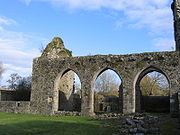
The Augustine priory is situated alongside King's River beside the village of Kells
Kells, County Kilkenny
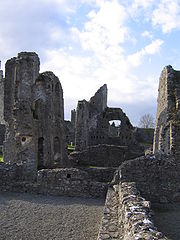
Kells is a village in County Kilkenny in Ireland. It is about 15 km south of Kilkenny. It is situated on high ground to the south of the Kings River.Kells Priory though in ruins, is one of the best preserved in Ireland....
, about 15 km south of the medieval city of Kilkenny
Kilkenny
Kilkenny is a city and is the county town of the eponymous County Kilkenny in Ireland. It is situated on both banks of the River Nore in the province of Leinster, in the south-east of Ireland...
. The priory is a National Monument
National Monument (Ireland)
The Irish state has officially approved the following List of National Monuments of Ireland. In the Republic of Ireland, a structure or site may be deemed to be a "National Monument", and therefore worthy of state protection, if it is of national importance...
and is in the guardianship of the Office of Public Works
Office of Public Works
The Office of Public Works is a State Agency of the Department of Finance in the Republic of Ireland...
. One of its most striking feature is a collection of medieval tower house
Tower house
A tower house is a particular type of stone structure, built for defensive purposes as well as habitation.-History:Tower houses began to appear in the Middle Ages, especially in mountain or limited access areas, in order to command and defend strategic points with reduced forces...
s spaced at intervals along and within walls which enclose a site of just over 3 acres (12,140.6 m²). These give the priory
Priory
A priory is a house of men or women under religious vows that is headed by a prior or prioress. Priories may be houses of mendicant friars or religious sisters , or monasteries of monks or nuns .The Benedictines and their offshoots , the Premonstratensians, and the...
the appearance more of a fortress than of a place of worship and from them comes its local name of "Seven Castles".
4 km southeast of the priory on the R697
R697 road
The R697 road is a regional road in Ireland which runs north-south from the centre of Kilkenny in County Kilkenny to the N24 national primary road in Carrick-on-Suir.The route is long.-References:* – Department of Transport...
regional road
Regional road
A regional road in Ireland is a class of road not forming a major route , but nevertheless forming a link in the national route network. There are over 11,600 kilometres of regional roads. Regional roads are numbered with three digit route numbers, prefixed by "R" A regional road in Ireland is a...
is Kilree round tower
Irish round tower
Irish round towers , Cloigthithe – literally "bell house") are early medieval stone towers of a type found mainly in Ireland, with three in Scotland and one on the Isle of Man...
and 9th century High Cross, said to be the burial place of Niall Caille.
History
Richard de Clare, 2nd Earl of Pembroke
Richard de Clare, 2nd Earl of Pembroke , Lord of Leinster, Justiciar of Ireland . Like his father, he was also commonly known as Strongbow...
and the priory succeeded an earlier church which was dedicated to St. Mary, the Blessed Virgin and served as parish church to nearby Kells village.
During its first century and a half the priory was attacked and burned on three occasions, firstly by Lord William de Bermingham in 1252, by the Scots army of Edward Bruce
Edward Bruce
Edward the Bruce , sometimes modernised Edward of Bruce, was a younger brother of King Robert I of Scotland, who supported his brother in the struggle for the crown of Scotland, then pursued his own claim in Ireland. He was proclaimed High King of Ireland, but was eventually defeated and killed in...
on Palm Sunday
Palm Sunday
Palm Sunday is a Christian moveable feast that falls on the Sunday before Easter. The feast commemorates Jesus' triumphal entry into Jerusalem, an event mentioned in all four Canonical Gospels. ....
1326, and by a second William de Bermingham in 1327. It seems likely then that the walls and fortifications date back to this period of unrest.
Alice Kyteler
Dame Alice Kyteler , was a woman who was the earliest person accused and condemned for witchcraft in Ireland. She fled the country, but her servant Petronella de Meath was flogged and burned at the stake on November 3, 1324....
and William Outlawe were ordered to appear before the Bishop to answer charges of witchcraft. Outlaw was supported by Arnold de Paor, Lord of Kells who arrested the Bishop and had him imprisoned in Kilkenny Castle
Kilkenny Castle
Kilkenny Castle is a castle in Kilkenny, Ireland built in 1195 by William Marshal, 1st Earl of Pembroke to control a fording-point of the River Nore and the junction of several routeways...
for 17 days. This caused great scandal and on his release the Bishop successfully prosecuted the heretics. Alice Kyteler fled to England and remained there, Alice Smith also fled, but her mother Petronilla de Meath
Petronilla de Meath
Petronilla de Meath was the maidservant of Dame Alice Kyteler, a fourteenth century Irish noblewoman. After the death of Kyteler's fourth husband, Kyteler was accused of practicing witchcraft and Petronilla was accused of being her accomplice. Petronilla was tortured and forced to proclaim that...
became Ireland's first heretic to be burned at the stake.
Dissolution
Dissolution of the Monasteries
The Dissolution of the Monasteries, sometimes referred to as the Suppression of the Monasteries, was the set of administrative and legal processes between 1536 and 1541 by which Henry VIII disbanded monasteries, priories, convents and friaries in England, Wales and Ireland; appropriated their...
of Kells Priory finally took place in March 1540 and the church and property were surrendered to James Butler, 9th Earl of Ormonde
James Butler, 9th Earl of Ormonde
James Butler, 9th Earl of Ormond and 2nd Earl of Ossory was the son of Piers Butler, 8th Earl of Ormond and Lady Margaret Fitzgerald...
.
Layout
Excavations
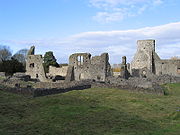
There were some 20,000 archaeological finds which range from pieces of carved stone, pottery including Ham Green, floor and ridge tiles, metal objects as well as a collection of painted window glass which has allowed the reconstruction what some of the window patterns may have looked like. The original priory church was a simple cruciform building, but, over time, was extended in almost every possible direction including the fifteenth century second enclosure.
See also
- List of abbeys and priories in Ireland (County Kilkenny)
External links
- A site by Daniel Tietzsch-Tyler with photos and plans.
- Placeopedia - Geographic Position and Map of the Priory
- http://www.roundtowers.org/kilree/index.htm - Kilree Round Tower and High Cross