
All Topics  
Irish round tower

 
Irish Round Tower

   Email Print
   Bookmark   Link


Irish round tower


This is about Irish-style round towers. See round tower
Round tower

Round tower may refer to:Types of tower* Irish round tower, a type of early mediaeval stone tower* Broch, a type of Iron Age drystone structure found in Scotland...
 for other types of towers.
Irish round towers are early medieval stone towers of a type found mainly in Ireland
Ireland

Ireland is the List of islands by area in Europe, and the twentieth-largest island in the world. It lies to the north-west of continental Europe and is surrounded by hundreds of islands and islet....
, with three in Scotland
Scotland

conventional_long_name = ScotlandAlba|common_name= Scotland|image_flag = Flag of Scotland.svg|flag_width = 130px...
 and one on the Isle of Man
Isle of Man

The Isle of Man , or Mann , is a self-governing Crown dependency, located in the Irish Sea at the geographical centre of the British Isles....
. Though there is no certain agreement as to their purpose, it is thought they were principally bell towers, places of refuge, or a combination of these.

Generally found in the vicinity of a church or monastery
Monastery

Monastery , a term derived from the Greek language word ???ast?????, neut. of ???ast????? - monasterios denotes the building, or complex of buildings, that houses a room reserved for prayer as well as the domestic quarters and workplace of Monk, whether monks or nuns, and whether living in Cenobium or alone ....
, the door of the tower faces the west doorway of the church.


Discussion
Ask a question about 'Irish round tower'
Start a new discussion about 'Irish round tower'
Answer questions from other users
Full Discussion Forum


Encyclopedia


This is about Irish-style round towers. See round tower
Round tower

Round tower may refer to:Types of tower* Irish round tower, a type of early mediaeval stone tower* Broch, a type of Iron Age drystone structure found in Scotland...
 for other types of towers.
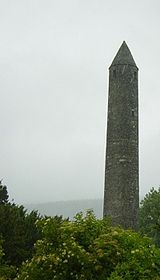
Round Tower, Glendalough
Irish round towers are early medieval stone towers of a type found mainly in Ireland
Ireland

Ireland is the List of islands by area in Europe, and the twentieth-largest island in the world. It lies to the north-west of continental Europe and is surrounded by hundreds of islands and islet....
, with three in Scotland
Scotland

conventional_long_name = ScotlandAlba|common_name= Scotland|image_flag = Flag of Scotland.svg|flag_width = 130px...
 and one on the Isle of Man
Isle of Man

The Isle of Man , or Mann , is a self-governing Crown dependency, located in the Irish Sea at the geographical centre of the British Isles....
. Though there is no certain agreement as to their purpose, it is thought they were principally bell towers, places of refuge, or a combination of these.

Generally found in the vicinity of a church or monastery
Monastery

Monastery , a term derived from the Greek language word ???ast?????, neut. of ???ast????? - monasterios denotes the building, or complex of buildings, that houses a room reserved for prayer as well as the domestic quarters and workplace of Monk, whether monks or nuns, and whether living in Cenobium or alone ....
, the door of the tower faces the west doorway of the church. In this way it has been possible to determine without excavation the approximate site of lost churches, where the tower still exists.

Construction and distribution


Surviving towers range in height from eighteen to forty metres, that at Kilmacduagh
Kilmacduagh monastery

Kilmacduagh Monastery is found 5 km from the town of Gort in County Galway, Ireland. It was the birthplace of the Diocese of Kilmacduagh, whose name means "church of Duagh's son"....
 being the highest surviving in Ireland. The masonry differs according to date, the earliest examples being uncut rubble, while the later ones are of neatly joined stone work. The lower portion is solid masonry
Masonry

Masonry is the building of structures from individual units laid in and bound together by mortar , and the term "masonry" can also refer to the units themselves....
 with a single door raised two to three metres above, often accessible only by a ladder. Within, in some, are two or more floors (or signs of where such floors existed), usually of wood, and it is thought that there were ladders in between. The windows, which are high up, are slits in the stone. The cap (roof), is of stone, usually conical in shape, although some of the towers are now crowned by a later circle of battlement
Battlement

A battlement, in defensive architecture such as that of city walls or castles, comprises a parapet , in which portions have been cut out at intervals to allow the discharge of arrows or other missiles....
s.

The towers were probably built between the 9th and 12th centuries. In Ireland about 120 examples are thought once to have existed; most are in ruins, while eighteen to twenty are almost perfect. There are three surviving examples in northeastern Scotland
Scotland

conventional_long_name = ScotlandAlba|common_name= Scotland|image_flag = Flag of Scotland.svg|flag_width = 130px...
, the Brechin
Brechin

Brechin is a former royal burgh in Angus, Scotland. Traditionally Brechin is often described as a city because of its cathedral and its status as the seat of a pre-Scottish Reformation Roman Catholic diocese , however this status was never officially recognised....
 Round Tower, the Abernethy Round Tower, and the Muthill
Muthill

Muthill is a village in Perth and Kinross, Perthshire, Scotland. It lies on the former railway line connecting Perth, Scotland and Crieff, 3 miles south of Crieff....
 Round Tower.

Famous examples are to be found at Devenish Island
Devenish Island

Devenish Island is an island in Lower Lough Erne, north of Enniskillen, County Fermanagh, Northern Ireland. Aligned roughly north-south, it is about one and a quarter miles long and two-thirds of a mile wide....
, on Lough Erne
Lough Erne

Lough Erne refers to two lakes in Northern Ireland, which are in effect widened sections of the River Erne. The waterway is mostly situated in County Fermanagh....
, in County Fermanagh
County Fermanagh

County Fermanagh , is the westernmost of the six counties that form Northern Ireland, and is part of the Province of Ulster. Fermanagh is often referred to as Ireland's Lake District, together with neighbouring County Cavan....
; Glendalough
Glendalough

Glendalough is a Valley#Glacial valleys located in County Wicklow, Republic of Ireland, renowned for its Early Middle Ages monastic settlement founded in the 6th century by Kevin of Glendalough, a hermit priest, and destroyed in 1398 in Ireland by English troops....
, County Wicklow
County Wicklow

County Wicklow is a Counties of Ireland on the east coast of Republic of Ireland, immediately south of Dublin. The county is bordered by the Irish Sea and the counties of County Carlow, County Kildare, County Wexford, as well as two parts of what was County Dublin, County of Dun Laoghaire-Rathdown and County of South Dublin....
; and Kildare
Kildare

Kildare is a town in County Kildare, Republic of Ireland. Its population of 7,538 makes it the seventh largest town in Kildare and the 55th largest in the Republic of Ireland, with a growth rate of 32.4pc since the 2002 census....
 Town, County Kildare
County Kildare

County Kildare is an Republic of Ireland county located to the southwest of Dublin in the province of Leinster. The name comes from the Irish, meaning church of the oaks ....
 (which is high), while that at Clondalkin
Clondalkin

Clondalkin is a village and suburb 10 km west of Dublin, Republic of Ireland, situated in the administrative County of South Dublin. The name is also used in relation to the area's religious parishes....
 is the only Round Tower in Ireland to still retain its original cap. The only known round tower with a hexagonal base is at Kinneigh
Castletown-Kinneigh

Castletown-Kinneigh is a small rural village near Ballineen in West Cork.The village has a round tower which is one of only two such towers in County Cork ....
 in County Cork
County Cork

County Cork is the most southerly and the largest of the modern counties of Republic of Ireland. Cork is nicknamed "The Rebel County", as a result of the support of the townsmen of Cork in 1491 for Perkin Warbeck, a pretender to the throne of England during the Wars of the Roses....
, built in 1014.

Purpose

The purpose of the towers has been somewhat unclear until recent times. A popular theory in the past was that the towers were originally a redoubt against raiders such as Viking
Viking

A Viking is one of the Norsemen explorers, warriors, merchants, and Piracy who raided and colonized wide areas of Europe from the late eighth to the early eleventh century....
s. If a lookout posted in the tower spotted a Viking force, the local population (or at least the clerics) would enter, using a ladder which could be raised from within. The towers would be used to store religious relic
Relic

A relic is an object or a personal item of Religion significance, carefully preserved with an air of veneration as a tangible memorial. Relics are an important aspect of some forms of Buddhism, Christianity, Hinduism, shamanism, and many other religions....
s and other plunderables.

However, there are many problems with this theory. Many towers are built in positions which are not ideal to survey the surrounding countryside and would not work efficiently as watch towers for incoming attacks.

The doors to these towers would have been wooden and therefore easily burned down. Due to the almost chimney-like design of the towers, the smoke from the burning door would have been carried upwards inside the tower causing any occupants to suffocate.

The main reason for the entrance-way being built above ground level was to maintain the structural integrity of the building rather than for defence. The towers were generally built with very little foundation. The tower at Monasterboice
Monasterboice

The historic ruins of Monasterboice are of an early Christian settlement in County Louth in the Republic of Ireland, north of Drogheda. It was founded in the late 5th century by Saint Buite who died around Anno Domini 521 and was an important centre of religion and learning until founding of nearby Mellifont Abbey in 1142....
 has an underground foundation of only sixty centimetres. Building the door at ground level would weaken the tower. The buildings still stand today because their round shape is gale
Gale

A gale is a very strong wind. There are conflicting definitions of how strong. The U.S. Government's National Weather Service defines a gale as 34 to 47 knots of sustained surface winds....
-resistant and the section of the tower underneath the entrance is packed with soil and stones.

The distance from the ground to the raised doorway is somewhat greater than that from the first floor to the second; thus large, rigid steps would be too large for the door. Excavations in the 1990s, revealing posthole
Posthole

In archaeology a posthole is a cut feature used to hold a surface timber or stone. They are usually much deeper than they are wide although cut may not make this apparent....
s, confirm that wooden steps were built. However, the use of ladders prior to the construction of such steps cannot be ruled out.

Therefore, the primary reason for the round tower was to act as a belfry
Bell tower

A bell tower is a tower which contains one or more Bell s, or which is designed to hold bells, even if it has none. In the European tradition, such a tower most commonly serves as part of a church and contains church bells....
 imitating the continental European style of bell tower which was popular at the time. The Irish
Irish language

Irish , also known as Irish Gaelic, is a Goidelic languages of the Indo-European language family, originating in Ireland and historically spoken by the Irish people....
 word for round towers, cloictheach, literally meaning bellhouse indicates this, as noted by George Petrie in 1845.

Modern symbolic towers

Milford Irish Tower1
Daniel O'Connell
Daniel O'Connell

Daniel O'Connell , known as The Liberator, or The Emancipator, was an Ireland political leader in the first half of the nineteenth century....
's tomb at Glasnevin Cemetery
Glasnevin Cemetery

Glasnevin Cemetery , also known as Prospect Cemetery, is the main Catholic cemetery in Dublin, the capital of Republic of Ireland. It first opened in 1832....
 had a round tower built above it after his burial in 1847.

At Saint Mary's Cemetery in Milford, Massachusetts
Milford, Massachusetts

Milford is a town in Worcester County, Massachusetts, Massachusetts, United States. The population was 26,799 according to the United States Census, 2000....
 a round tower was built of Milford granite in the late 19th century as a memorial to central Massachusetts' Irish immigrants, of whom thousands are buried there.

In 2002 Tony Ryan
Tony Ryan

Thomas Anthony "Tony" Ryan was an Ireland millionaire, philanthropist and businessman.He was a founder of Guinness Peat Aviation and co-founder of Ryanair with Christy Ryan and Liam Lonergan....
, a native of Tipperary
Tipperary

Tipperary is the name of a town in the south-west of County Tipperary, Republic of Ireland . The name "Tipperary" is derived from a well in the townland of Glenbane in the parish of Lattin and Cullen where the river "Arra" rises....
, built a round tower at his Castleton Lyons
Castleton Lyons

Castleton Lyons near Lexington, Kentucky is an United States horse racing stable and horse breeding business best known by the name Castleton Farm....
 Stud in Kentucky
Kentucky

The Commonwealth of Kentucky is a U.S. state located in the East Central United States of America. Kentucky is normally included in the group of Southern United States , but it is uncommonly included, geographically and culturally, in the Midwestern United States....
.

Another "revival" round tower was built in the Island of Ireland Peace Park
Island of Ireland Peace Park

The Island of Ireland Peace Park and its surrounding park , also called the Irish Peace Park or Irish Peace Tower in Mesen, near Ypres in Flanders, Belgium, is a war memorial to the soldiers of the island of Ireland who died, were wounded or are missing from World War I....
 in Belgium
Belgium

* A small German-speaking Community of Belgium exists in eastern Wallonia. Belgium's linguistic diversity and related political and cultural conflicts are reflected in the history of Belgium and a complex Communities and regions of Belgium....
, as a war memorial
War memorial

A war memorial is a building, monument, statue or other edifice to celebrate a war or victory, or to commemorate those who died or were injured in war....
 to the soldiers of the island of Ireland
Ireland

Ireland is the List of islands by area in Europe, and the twentieth-largest island in the world. It lies to the north-west of continental Europe and is surrounded by hundreds of islands and islet....
 who died, were wounded or are missing from World War I
World War I

World War I, or the First World War , was a global military conflict which involved the Great powers, organized into two opposing military alliances: the Allies of World War I and the Central Powers....
. The tower is in the traditional design of an Irish round tower and is partially built with stone from a former army barracks in Tipperary
Tipperary

Tipperary is the name of a town in the south-west of County Tipperary, Republic of Ireland . The name "Tipperary" is derived from a well in the townland of Glenbane in the parish of Lattin and Cullen where the river "Arra" rises....
.

Examples

Image:Round tower Antrim Ireland.jpg|Antrim
Antrim

Antrim may refer to:...
Image:Aghagower Round Tower 2007 08 12.jpg|Aghagower Image:Ardpatrick RoundTower.JPG|Ardpatrick
Ardpatrick

Ardpatrick is a small village in County Limerick, Republic of Ireland. It lies at the foot of the north slopes of the Ballyhoura Mountains, on the edge of the Golden Vale....
Image:Armoy round tower County Antrim.jpg|Armoy
Armoy

Armoy is a small village in County Antrim, Northern Ireland, 9 km south west of Ballycastle, adjacent to the A44 road between Ballymena and Ballycastle and 13 km north east of Ballymoney....
Image:Round Tower, Dromiskin.JPG|Dromiskin
Dromiskin

Dromiskin is a village in County Louth, Republic of Ireland. It is situated 10km south of Dundalk, about 1km inland from the Irish Sea coast, and is located in one of Louth's most historical areas....
Image:Turlough round tower.jpg|Turlough
Turlough

Turlough can mean:* Turlough * Turlough O'Neill Ulster chieftain* Turlough ? Carolan Irish harper* Vislor Turlough, fictional character from Doctor Who...


See also

  • Broch
    Broch

    A Broch is an Iron Age drystone hollow-walled structure of a type found only in Scotland. Brochs include some of the most sophisticated examples of drystone architecture ever created, and belong to the classification "complex atlantic roundhouse" devised by Scottish archaeologists in the 1980s....
  • Pele tower
  • Rock of Cashel
    Rock of Cashel

    The Rock of Cashel , also known as Cashel of the Kings and St. Patrick's Rock, is a historic site in Ireland's Provinces of Ireland of Munster, located at Cashel, Tipperary, County Tipperary....


External links

  • — detailed photographic archive and information for fifty two Irish round towers.
  • from "A Handbook of Irish Antiquities (1848)" by William Wakeman
  • — articles and photos about Kinneigh Round Tower