


Keeshond

Encyclopedia
The Keeshond is a medium-sized dog
with a plush two-layer coat of silver and black fur with a 'ruff' and a curled tail. It originated in Germany, and its closest relatives are the other German spitzes such as the Pomeranian
. Originally called the German Spitz
, more specifically the Wolfsspitz, the name was officially changed to Keeshond, in 1926 in England, where it had been known as the Dutch Barge Dog.
 A member of the spitz
group of dogs, the Keeshond in American Kennel Club
(AKC) standard is 17 inches (43.2 cm) to 18 inches (45.7 cm) tall and 19.25 inches (48.9 cm) ± 2.4 inches (6.1 cm) in the FCI
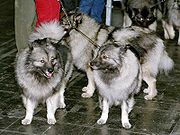
standard and weighs 35 pounds (15.9 kg) to 45 pounds (20.4 kg). Sturdily built, they have a typical spitz appearance, neither coarse nor refined. They have a wedge-shaped head, a medium-length muzzle with a definite stop, small pointed ears, and an expressive face. The tail is tightly curled and, in profile, should be carried such that it is indistinguishable from the compact body of the dog.
.
The plumed tail should be silver or cream with a black tip on the very end. The tail should be tightly curled over the back. The tail is an important part of the Keeshond's shape. The ears and muzzle are to be black, although some tend to develop "milk mouth", a white shading around the nose and front of the muzzle. This increases as the dog ages. In American shows, this white shading is acceptable, although not desired.
According to the American Kennel Club
breed standard, the legs and feet are to be cream; feet that are totally black or white are severe faults. Black markings more than halfway down the foreleg, except for pencilling, are faulted.
The other important marking is the "spectacles," a delicate dark line running from the outer corner of each eye toward the lower corner of each ear, which, coupled with markings forming short eyebrows, is necessary for the distinct expressive look of the breed. All markings should be clear, not muddled or broken. Absence of the spectacles is considered a serious fault. The eyes should be dark brown, almond-shaped with black eye rims.
Ears should be small, triangular, and erect.
and obedience
dogs. So amenable to proper training is this bright, sturdy dog that Keeshonden have been successfully trained to serve as guide dogs
for the blind; only their lack of size has prevented them from being more widely used in this role.
They love children and are excellent family dogs, preferring to be close to their humans whenever possible. They generally get along with other dogs as well and will enjoy a good chase around the yard. Keeshonden are very intuitive and empathic and are often used as comfort dogs. Most notably, at least one Keeshond, Tikva, was at Ground Zero on 9/11 to help comfort the rescue workers. The breed has a tendency to become especially clingy towards their owners, even in comparison to other dogs. If their owner is out, or in another room behind a closed door, they may sit, waiting for their owner to reappear, even if there are other people nearby. Many have been referred to as their "owner's shadow," or "velcro dogs".
They are known by their loud, distinctive bark. Throughout the centuries, the Keeshond has been very popular as a watch dog on manors in the Netherlands
and middle Europe
. This trait is evident to this day, and they are alert dogs that warn their owners of any new visitors. Although loud and alert, Keeshonden are not aggressive towards visitors. They generally welcome visitors affectionately once their family has accepted them. Unfortunately, barking may become a problem if not properly handled. Keeshonden that are kept in a yard, and not allowed to be with their humans, are unhappy and often become nuisance barkers.
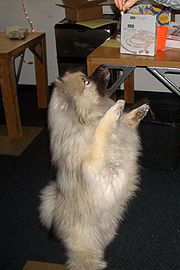 The Keeshond is a very bright dog as evidenced by its level of achievement in Obedience work. The Keeshond ranks 16th in Stanley Coren
's The Intelligence of Dogs
, being of excellent working/obedience intelligence. This intelligence makes a Keeshond a good choice for the dog owner who is willing to help a dog learn the right lessons, but also entails added responsibility.
Many people purchase a Keeshond thinking that, since they are agreeable family dogs, they must also be easy to train. While affectionate, Keeshonden may not be for the inexperienced trainer. Consistency and fairness are needed; and, while most dogs need a structured environment, it is especially necessary with a Keeshond. Like most of the independent-minded spitz breeds, Keeshonden respond poorly to heavy-handed or forceful training methods.
Many behavioral problems with Keeshonden stem from these intelligent dogs inventing their own activities (often destructive ones, like digging and chewing) out of boredom. They need daily contact with their owners and lots of activity to remain happy. Therefore, it is not the right choice of breed for those who want a dog that lives happily alone in a kennel or backyard.
Keeshonden can also be timid dogs. It is important to train them to respect, but not fear, their owners and family. Keeshonden want to please, so harsh punishment is not necessary when the dog does not obey as quickly as desired. They like to spend time with their owners and love attention.
s (trick knee), epilepsy
, Cushing's disease
, primary hyperparathyroidism
, and hypothyroidism
. Von Willebrand's disease has been known in Keeshonden but is very rare. An accurate test for the gene causing primary hyperparathyroidism (or PHPT) has recently been developed at Cornell University. As with any breed, it is important when buying a puppy to make sure that the parents have been tested and certified free from inherited problems. A healthy, well-bred Keeshond can be expected to live 12 to 15 years on average.
, Cornelis (Kees) de Gyselaer (spelled 'Gijselaar' in Modern Dutch), leader of the rebellion against the House of Orange. The dog became the rebels' symbol; and, when the House of Orange returned to power, this breed almost disappeared. The word 'keeshond' is a compound word: 'Kees' is a nickname for Cornelius (de Gyselaer), and 'hond' is the Dutch word for dog. In the Netherlands, "keeshond" is the term for German Spitzes that encompass them all from the toy or dwarf (Pomeranian)
to the Wolfsspitz (Keeshond). The sole difference among the German Spitzes is their coloring and size guidelines. Although many American references point to the Keeshond as we know it originating in the Netherlands, the breed is cited as being part of the German Spitz family, originating in Germany along with the Pomeranian (toy or dwarf German Spitz) and American Eskimo dog (small or standard German Spitz) according to the FCI
.
The first standard for "Wolfsspitze" was posted at the Dog Show of 1880 in Berlin. The Club for German Spitzes was founded in 1899. The German standard was revised in 1901 to specify the characteristic color that we know today, "silver grey tipped with black". In the late 19th century the "Overweight Pomeranian", a white German Spitz and most likely a Standard German Spitz, was shown in the British Kennel Club
. The "Overweight Pomeranian" was no longer recognized by the British Kennel Club in 1915. In the 1920s, Baroness van Hardenbroeck took an interest in the breed and began to build it up again. The Nederlandse Keeshond Club was formed in 1924. The Dutch Barge Dog Club of England was formed in 1925 by Mrs. Wingfield-Digby and accepted into the British Kennel Club in 1926, when the breed and the club were renamed to Keeshond.
Carl Hinderer is credited with bringing his Schloss Adelsburg Kennel, which he founded in 1922 in Germany, with him to America in 1923. His German Champion Wolfsspitz followed him two by two in 1926. At that time, less than ten years after World War I, Germany was not regarded fondly in England and America; and the Wolfsspitz/Keeshond was not recognized by the AKC. Consequently, Carl had to register each puppy with his club in Germany. Despite this, Carl joined the Maryland KC and attended local shows.
Carl regularly wrote to the AKC, including the New York headquarters, to promote the Wolfsspitz. While going through New York on his way to Germany in 1930, Carl visited the AKC offices and presented Wachter, his Germany champion, to AKC President, Dr. DeMond, who promptly agreed to start the recognition process, with some caveats including changing the name to Keeshond, and asked Carl to bring back all the relevant data from Germany. Carl also translated the German standard to English for the AKC. The Keeshond was accepted for AKC
registration in 1930.
Despite intense lobbying the FCI
would not accept the Keeshond as a separate breed since it viewed the Wolfsspitz and Keeshond as identical. In 1997, the German Spitz Club updated its standard so that the typically smaller Keeshond preferred in America and other English-speaking countries could be included. This greatly expanded the gene pool and unified the standard internationally for the first time. Now bred for many generations as a companion dog, the Keeshond easily becomes a loving family member.
As a result of the breed's history and friendly disposition, Keeshonden are sometimes referred to as "The Smiling Dutchman".
s, were allowed, but as time progressed, only the silver-grey and cream (wolf-gray) color was finally established into the Wolfsspitz type. http://www.dogstuff.info/our_colored_keeshonden_lefebvre.html
While other-colored Keeshonden can have terrific conformation, they are not allowed to be shown in the show ring. Colored Keeshonden are considered "pet quality" and thus should be spayed or neutered.
The appearance of oddly-colored Kees in otherwise wolf-gray litters has caused research into the early history of Keeshond coat colors. Because of this, some breeders wonder whether the Keeshond should be bred for colors other than grey. There are many bloodlines carrying the colored gene, and rather than examples of mixed breeding, colors are legitimate throwbacks to an earlier era of the breed.
No one knows the exact number of colored Keeshonden born in the United States. Incorrect or incomplete documentation make it impossible to determine how many colored Keeshonden, and of which colors, have been born in the United States.
Dog
The domestic dog is a domesticated form of the gray wolf, a member of the Canidae family of the order Carnivora. The term is used for both feral and pet varieties. The dog may have been the first animal to be domesticated, and has been the most widely kept working, hunting, and companion animal in...
with a plush two-layer coat of silver and black fur with a 'ruff' and a curled tail. It originated in Germany, and its closest relatives are the other German spitzes such as the Pomeranian
Pomeranian (dog)
The Pomeranian is a breed of dog of the Spitz type, named for the Pomerania region in Central Europe . Classed as a toy dog breed because of its small size, the Pomeranian is descended from the larger Spitz type dogs, specifically the German Spitz...
. Originally called the German Spitz
German Spitz
German Spitz is used to refer to both a breed of dog and category or type of dog. Several modern breeds have been developed from the German Spitz, and are either registered as separate breeds or as varieties of German Spitz. All the German Spitz type dogs are dogs of the Spitz type of German origin...
, more specifically the Wolfsspitz, the name was officially changed to Keeshond, in 1926 in England, where it had been known as the Dutch Barge Dog.
Appearance
Spitz
Spitz-type dogs are a type of dog, characterized by long, thick, and often white fur, and pointed ears and muzzles...
group of dogs, the Keeshond in American Kennel Club
American Kennel Club
The American Kennel Club is a registry of purebred dog pedigrees in the United States. Beyond maintaining its pedigree registry, this kennel club also promotes and sanctions events for purebred dogs, including the Westminster Kennel Club Dog Show, an annual event which predates the official...
(AKC) standard is 17 inches (43.2 cm) to 18 inches (45.7 cm) tall and 19.25 inches (48.9 cm) ± 2.4 inches (6.1 cm) in the FCI
Fédération Cynologique Internationale
Fédération Cynologique Internationale is an international federation of kennel clubs based in Thuin, Belgium. The English language translation, World Canine Organisation, is not often used.Its goals are described in Article 2 of their regulations:...
standard and weighs 35 pounds (15.9 kg) to 45 pounds (20.4 kg). Sturdily built, they have a typical spitz appearance, neither coarse nor refined. They have a wedge-shaped head, a medium-length muzzle with a definite stop, small pointed ears, and an expressive face. The tail is tightly curled and, in profile, should be carried such that it is indistinguishable from the compact body of the dog.
Coat
Like all spitz, the Keeshonden have a dense double coat, with a thick ruff around the neck. Typically, the males of this breed will have a thicker, more pronounced, ruff than the females. The tail is well plumed, and feathering on the fore and hind legs adds to the soft look of the breed. The coat is shown naturally and should not be wavy, silky, or long enough to form a natural part down the back. The top layer should be smooth, and the under layer should be woollenWool
Wool is the textile fiber obtained from sheep and certain other animals, including cashmere from goats, mohair from goats, qiviut from muskoxen, vicuña, alpaca, camel from animals in the camel family, and angora from rabbits....
.
Color
The Keeshond is a color-specific spitz type; many of the names of the dog refer to the distinctive wolf color of the breed. The color is a mix of grey, black, and cream. The top coat is tipped with black, while the undercoat is silver or cream (never tawny). The color can range from very pale to very dark; but it should neither be black nor white. The ruff and "trousers" of the hind legs should be a distinctly lighter silver or cream.The plumed tail should be silver or cream with a black tip on the very end. The tail should be tightly curled over the back. The tail is an important part of the Keeshond's shape. The ears and muzzle are to be black, although some tend to develop "milk mouth", a white shading around the nose and front of the muzzle. This increases as the dog ages. In American shows, this white shading is acceptable, although not desired.
According to the American Kennel Club
American Kennel Club
The American Kennel Club is a registry of purebred dog pedigrees in the United States. Beyond maintaining its pedigree registry, this kennel club also promotes and sanctions events for purebred dogs, including the Westminster Kennel Club Dog Show, an annual event which predates the official...
breed standard, the legs and feet are to be cream; feet that are totally black or white are severe faults. Black markings more than halfway down the foreleg, except for pencilling, are faulted.
The other important marking is the "spectacles," a delicate dark line running from the outer corner of each eye toward the lower corner of each ear, which, coupled with markings forming short eyebrows, is necessary for the distinct expressive look of the breed. All markings should be clear, not muddled or broken. Absence of the spectacles is considered a serious fault. The eyes should be dark brown, almond-shaped with black eye rims.
Ears should be small, triangular, and erect.
Temperament
Keeshonden tend to be very playful, with quick reflexes and strong jumping ability. They are quick learners and eager to please. Because Keeshonden are quick learners, they also learn things you did not necessarily wish to teach them—very quickly. However, Keeshonden make excellent agilityDog agility
Dog agility is a dog sport in which a handler directs a dog through an obstacle course in a race for both time and accuracy. Dogs run off-leash with no food or toys as incentives, and the handler can touch neither dog nor obstacles...
and obedience
Obedience training
Obedience training usually refers to the training of a dog and the term is most commonly used in that context. Obedience training ranges from very basic training, such as teaching the dog to reliably respond to basic commands such as "sit", "down", "come", and "stay", to high level competition...
dogs. So amenable to proper training is this bright, sturdy dog that Keeshonden have been successfully trained to serve as guide dogs
Service dog
A service dog is a type of assistance dog specifically trained to help people who have disabilities including visual or hearing impairment, and also to help people with mental disabilities including Post Traumatic Stress Disorder and severe depression...
for the blind; only their lack of size has prevented them from being more widely used in this role.
They love children and are excellent family dogs, preferring to be close to their humans whenever possible. They generally get along with other dogs as well and will enjoy a good chase around the yard. Keeshonden are very intuitive and empathic and are often used as comfort dogs. Most notably, at least one Keeshond, Tikva, was at Ground Zero on 9/11 to help comfort the rescue workers. The breed has a tendency to become especially clingy towards their owners, even in comparison to other dogs. If their owner is out, or in another room behind a closed door, they may sit, waiting for their owner to reappear, even if there are other people nearby. Many have been referred to as their "owner's shadow," or "velcro dogs".
They are known by their loud, distinctive bark. Throughout the centuries, the Keeshond has been very popular as a watch dog on manors in the Netherlands
Netherlands
The Netherlands is a constituent country of the Kingdom of the Netherlands, located mainly in North-West Europe and with several islands in the Caribbean. Mainland Netherlands borders the North Sea to the north and west, Belgium to the south, and Germany to the east, and shares maritime borders...
and middle Europe
Europe
Europe is, by convention, one of the world's seven continents. Comprising the westernmost peninsula of Eurasia, Europe is generally 'divided' from Asia to its east by the watershed divides of the Ural and Caucasus Mountains, the Ural River, the Caspian and Black Seas, and the waterways connecting...
. This trait is evident to this day, and they are alert dogs that warn their owners of any new visitors. Although loud and alert, Keeshonden are not aggressive towards visitors. They generally welcome visitors affectionately once their family has accepted them. Unfortunately, barking may become a problem if not properly handled. Keeshonden that are kept in a yard, and not allowed to be with their humans, are unhappy and often become nuisance barkers.
Training
Stanley Coren
Stanley Coren is a psychology professor and neuropsychological researcher who has become best known to the general public for a series of books regarding the intelligence, mental abilities and history of dogs...
's The Intelligence of Dogs
The Intelligence of Dogs
The Intelligence of Dogs is a book on dog intelligence by Stanley Coren, a professor of psychology at the University of British Columbia in Vancouver. Published in 1994, the book explains Coren's theories about the differences in intelligence between different breeds of dogs...
, being of excellent working/obedience intelligence. This intelligence makes a Keeshond a good choice for the dog owner who is willing to help a dog learn the right lessons, but also entails added responsibility.
Many people purchase a Keeshond thinking that, since they are agreeable family dogs, they must also be easy to train. While affectionate, Keeshonden may not be for the inexperienced trainer. Consistency and fairness are needed; and, while most dogs need a structured environment, it is especially necessary with a Keeshond. Like most of the independent-minded spitz breeds, Keeshonden respond poorly to heavy-handed or forceful training methods.
Many behavioral problems with Keeshonden stem from these intelligent dogs inventing their own activities (often destructive ones, like digging and chewing) out of boredom. They need daily contact with their owners and lots of activity to remain happy. Therefore, it is not the right choice of breed for those who want a dog that lives happily alone in a kennel or backyard.
Keeshonden can also be timid dogs. It is important to train them to respect, but not fear, their owners and family. Keeshonden want to please, so harsh punishment is not necessary when the dog does not obey as quickly as desired. They like to spend time with their owners and love attention.
Health
Keeshonden are generally a very healthy breed. Though congenital health issues are not common, the conditions which have been known to sometimes occur in Keeshonden are hip dysplasia, luxating patellaLuxating patella
Luxating patella is a condition in which the patella, or kneecap, dislocates or moves out of its normal location....
s (trick knee), epilepsy
Epilepsy in animals
Epilepsy can occur in animals other than humans . It is characterized by recurrent, unprovoked seizures. Canine epilepsy is often genetic. Epilepsy in cats and other pets is rarer, likely because there is no hereditary component to epilepsy in these animals.-Canine epilepsy:In dogs, epilepsy is...
, Cushing's disease
Cushing's syndrome
Cushing's syndrome is a hormone disorder caused by high levels of cortisol in the blood. This can be caused by taking glucocorticoid drugs, or by tumors that produce cortisol or adrenocorticotropic hormone or CRH...
, primary hyperparathyroidism
Hyperparathyroidism
Hyperparathyroidism is overactivity of the parathyroid glands resulting in excess production of parathyroid hormone . The parathyroid hormone regulates calcium and phosphate levels and helps to maintain these levels...
, and hypothyroidism
Hypothyroidism
Hypothyroidism is a condition in which the thyroid gland does not make enough thyroid hormone.Iodine deficiency is the most common cause of hypothyroidism worldwide but it can be caused by other causes such as several conditions of the thyroid gland or, less commonly, the pituitary gland or...
. Von Willebrand's disease has been known in Keeshonden but is very rare. An accurate test for the gene causing primary hyperparathyroidism (or PHPT) has recently been developed at Cornell University. As with any breed, it is important when buying a puppy to make sure that the parents have been tested and certified free from inherited problems. A healthy, well-bred Keeshond can be expected to live 12 to 15 years on average.
Grooming
Because of their double coat, Keeshonden need regular brushing; an hour a week will keep the dog comfortable and handsome. The Keeshond's coat sheds dirt when dry, and the breed is not prone to doggy odor, so frequent bathing is unnecessary. The coat acts as insulation and protects the dog from sunburn and insects, so shaving or clipping is not desirable. The coat also loses its distinct color as the black tipping on the hairs will be shorn off. If frequent brushing is too much effort, it is better to choose another breed rather than clip the Keeshond short.History
The Keeshond was named after the 18th-century Dutch PatriotPatriots (faction)
The Patriots were a political faction in the Dutch Republic in the second half of the 18th century. They were led by Joan van der Capellen tot den Pol, gaining power from November 1782....
, Cornelis (Kees) de Gyselaer (spelled 'Gijselaar' in Modern Dutch), leader of the rebellion against the House of Orange. The dog became the rebels' symbol; and, when the House of Orange returned to power, this breed almost disappeared. The word 'keeshond' is a compound word: 'Kees' is a nickname for Cornelius (de Gyselaer), and 'hond' is the Dutch word for dog. In the Netherlands, "keeshond" is the term for German Spitzes that encompass them all from the toy or dwarf (Pomeranian)
Pomeranian (dog)
The Pomeranian is a breed of dog of the Spitz type, named for the Pomerania region in Central Europe . Classed as a toy dog breed because of its small size, the Pomeranian is descended from the larger Spitz type dogs, specifically the German Spitz...
to the Wolfsspitz (Keeshond). The sole difference among the German Spitzes is their coloring and size guidelines. Although many American references point to the Keeshond as we know it originating in the Netherlands, the breed is cited as being part of the German Spitz family, originating in Germany along with the Pomeranian (toy or dwarf German Spitz) and American Eskimo dog (small or standard German Spitz) according to the FCI
Fédération Cynologique Internationale
Fédération Cynologique Internationale is an international federation of kennel clubs based in Thuin, Belgium. The English language translation, World Canine Organisation, is not often used.Its goals are described in Article 2 of their regulations:...
.
The first standard for "Wolfsspitze" was posted at the Dog Show of 1880 in Berlin. The Club for German Spitzes was founded in 1899. The German standard was revised in 1901 to specify the characteristic color that we know today, "silver grey tipped with black". In the late 19th century the "Overweight Pomeranian", a white German Spitz and most likely a Standard German Spitz, was shown in the British Kennel Club
The Kennel Club
The Kennel Club is a kennel club based in London and Aylesbury, United Kingdom.The Kennel Club registration system divides dogs into seven breed groups. The Kennel Club Groups are: Hound, Working, Terrier, Gundog, Pastoral, Utility and Toy...
. The "Overweight Pomeranian" was no longer recognized by the British Kennel Club in 1915. In the 1920s, Baroness van Hardenbroeck took an interest in the breed and began to build it up again. The Nederlandse Keeshond Club was formed in 1924. The Dutch Barge Dog Club of England was formed in 1925 by Mrs. Wingfield-Digby and accepted into the British Kennel Club in 1926, when the breed and the club were renamed to Keeshond.
Carl Hinderer is credited with bringing his Schloss Adelsburg Kennel, which he founded in 1922 in Germany, with him to America in 1923. His German Champion Wolfsspitz followed him two by two in 1926. At that time, less than ten years after World War I, Germany was not regarded fondly in England and America; and the Wolfsspitz/Keeshond was not recognized by the AKC. Consequently, Carl had to register each puppy with his club in Germany. Despite this, Carl joined the Maryland KC and attended local shows.
Carl regularly wrote to the AKC, including the New York headquarters, to promote the Wolfsspitz. While going through New York on his way to Germany in 1930, Carl visited the AKC offices and presented Wachter, his Germany champion, to AKC President, Dr. DeMond, who promptly agreed to start the recognition process, with some caveats including changing the name to Keeshond, and asked Carl to bring back all the relevant data from Germany. Carl also translated the German standard to English for the AKC. The Keeshond was accepted for AKC
American Kennel Club
The American Kennel Club is a registry of purebred dog pedigrees in the United States. Beyond maintaining its pedigree registry, this kennel club also promotes and sanctions events for purebred dogs, including the Westminster Kennel Club Dog Show, an annual event which predates the official...
registration in 1930.
Despite intense lobbying the FCI
Fédération Cynologique Internationale
Fédération Cynologique Internationale is an international federation of kennel clubs based in Thuin, Belgium. The English language translation, World Canine Organisation, is not often used.Its goals are described in Article 2 of their regulations:...
would not accept the Keeshond as a separate breed since it viewed the Wolfsspitz and Keeshond as identical. In 1997, the German Spitz Club updated its standard so that the typically smaller Keeshond preferred in America and other English-speaking countries could be included. This greatly expanded the gene pool and unified the standard internationally for the first time. Now bred for many generations as a companion dog, the Keeshond easily becomes a loving family member.
As a result of the breed's history and friendly disposition, Keeshonden are sometimes referred to as "The Smiling Dutchman".
Breed pronunciation
Out of the 350 some purebreds, the Keeshond has possibly the most mispronounced name. "Kay sawn", "Case-hond", "kās-hond", "keys-hând", "keesh-ond", "keesh-hond", and "keesh-hound" are all improper pronunciations . The proper pronunciation is "kayz-hond" or "kayz-hawnd" with the proper pronunciation of the plural being "kayz-honden" or "kayz-hawnden" .Colored Keeshonden
Historically, Keeshonden being part of the German Spitz family had been interbred with their smaller brethren (small, standard, and dwarf German spitzes) and came in several colors—white, black, red, orange, orange-shaded white (also called orange and cream), and silver gray. Originally, like the other German spitzes, many colors, including piebaldPiebald
A piebald or pied animal is one that has a spotting pattern of large unpigmented, usually white, areas of hair, feathers, or scales and normally pigmented patches, generally black. The colour of the animal's skin underneath its coat is also pigmented under the dark patches and unpigmented under...
s, were allowed, but as time progressed, only the silver-grey and cream (wolf-gray) color was finally established into the Wolfsspitz type. http://www.dogstuff.info/our_colored_keeshonden_lefebvre.html
While other-colored Keeshonden can have terrific conformation, they are not allowed to be shown in the show ring. Colored Keeshonden are considered "pet quality" and thus should be spayed or neutered.
The appearance of oddly-colored Kees in otherwise wolf-gray litters has caused research into the early history of Keeshond coat colors. Because of this, some breeders wonder whether the Keeshond should be bred for colors other than grey. There are many bloodlines carrying the colored gene, and rather than examples of mixed breeding, colors are legitimate throwbacks to an earlier era of the breed.
No one knows the exact number of colored Keeshonden born in the United States. Incorrect or incomplete documentation make it impossible to determine how many colored Keeshonden, and of which colors, have been born in the United States.