


Shredded Wheat

Encyclopedia
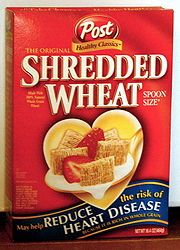
Breakfast cereal
A breakfast cereal is a food made from processed grains that is often, but not always, eaten with the first meal of the day. It is often eaten cold, usually mixed with milk , water, or yogurt, and sometimes fruit but sometimes eaten dry. Some cereals, such as oatmeal, may be served hot as porridge...
made from whole
Whole grain
Whole grains are cereal grains that contain cereal germ, endosperm, and bran, in contrast to refined grains, which retain only the endosperm. Whole grains can generally be sprouted while refined grains generally will not sprout. Whole-meal products are made by grinding whole grains in order to make...
wheat
Wheat
Wheat is a cereal grain, originally from the Levant region of the Near East, but now cultivated worldwide. In 2007 world production of wheat was 607 million tons, making it the third most-produced cereal after maize and rice...
. As of January 2010, it was available in three sizes: bite sized (¾×1 in), miniature (nearly half the size of the bite-sized pieces), and full size, which may be broken into small pieces before milk is added (many brands refer to these pieces as "biscuits" and show the biscuit count on the box).
Both sizes are available in a frosted variety, which has one side coated with sugar
Sugar
Sugar is a class of edible crystalline carbohydrates, mainly sucrose, lactose, and fructose, characterized by a sweet flavor.Sucrose in its refined form primarily comes from sugar cane and sugar beet...
and usually gelatin
Gelatin
Gelatin is a translucent, colorless, brittle , flavorless solid substance, derived from the collagen inside animals' skin and bones. It is commonly used as a gelling agent in food, pharmaceuticals, photography, and cosmetic manufacturing. Substances containing gelatin or functioning in a similar...
. Some manufacturers have produced "filled" versions of the bite-size cereal containing a raisin at the centre, or apricot, blueberry or cranberry filling.
In the United States
United States
The United States of America is a federal constitutional republic comprising fifty states and a federal district...
, shredded wheat is most heavily advertised and marketed by Post Cereals
Post Cereals
Post Foods, LLC, also known as Post Cereals is a food company that was founded by C.W. Post in 1895 with the first Postum, a "cereal beverage," developed by Post in Battle Creek, Michigan. The first cereal, Grape-Nuts, was developed in 1897. Post has its headquarters in the Bank of America Plaza...
, which acquired the product in 1993 through its parent company, Kraft Foods
Kraft Foods
Kraft Foods Inc. is an American confectionery, food and beverage conglomerate. It markets many brands in more than 170 countries. 12 of its brands annually earn more than $1 billion worldwide: Cadbury, Jacobs, Kraft, LU, Maxwell House, Milka, Nabisco, Oscar Mayer, Philadelphia, Trident, Tang...
, buying it from its long-time producer Nabisco
Nabisco
Nabisco is an American brand of cookies and snacks. Headquartered in East Hanover, New Jersey, the company is a subsidiary of Illinois-based Kraft Foods. Nabisco's plant in Chicago, a production facility at 7300 S...
. Kellogg's sells eight varieties of miniature, or bite-sized, shredded wheat cereal. Natural and organic manufacturer Barbara's Bakery makes an all-natural version of shredded wheat. In the United Kingdom
United Kingdom
The United Kingdom of Great Britain and Northern IrelandIn the United Kingdom and Dependencies, other languages have been officially recognised as legitimate autochthonous languages under the European Charter for Regional or Minority Languages...
, the Shredded Wheat brand is owned by Cereal Partners
Cereal Partners Worldwide
Cereal Partners Worldwide S.A. is a joint venture between General Mills and Nestlé, established in 1991 to produce breakfast cereals. The company is headquartered in Lausanne, Switzerland, and markets cereals in more than 130 countries Cereal Partners Worldwide S.A. is a joint venture between...
, a Nestle
Nestlé
Nestlé S.A. is the world's largest food and nutrition company. Founded and headquartered in Vevey, Switzerland, Nestlé originated in a 1905 merger of the Anglo-Swiss Milk Company, established in 1867 by brothers George Page and Charles Page, and Farine Lactée Henri Nestlé, founded in 1866 by Henri...
/General Mills
General Mills
General Mills, Inc. is an American Fortune 500 corporation, primarily concerned with food products, which is headquartered in Golden Valley, Minnesota, a suburb of Minneapolis. The company markets many well-known brands, such as Betty Crocker, Yoplait, Colombo, Totinos, Jeno's, Pillsbury, Green...
company, although there are many generic versions and variants by different names. It was first made in the US in 1893, while UK production began in 1926.
US
Henry PerkyHenry Perky
Henry Drushel Perky was a lawyer, businessman, promoter and inventor. Perky is the inventor of shredded wheat.- Early life :...
invented shredded wheat cereal in 1893. The wheat is first cooked in water until its moisture content reaches about 50%. It is then tempered, allowing moisture to diffuse evenly into the grain. The grain then passes through a set of rollers with grooves in one side, yielding a web of shredded wheat strands. Many webs are stacked together, and this moist stack of strands is crimped at regular intervals to produce individual pieces of cereal with the strands attached at each end. These then go into an oven, where they are baked until their moisture content is reduced to 5%. The Natural Food Company was based at Niagara Falls, NY in 1901. It became the Shredded Wheat Company in 1904. It was bought by Nabisco
Nabisco
Nabisco is an American brand of cookies and snacks. Headquartered in East Hanover, New Jersey, the company is a subsidiary of Illinois-based Kraft Foods. Nabisco's plant in Chicago, a production facility at 7300 S...
(National Biscuit Company) in December 1928. US production moved to Naperville
Naperville, Illinois
Naperville is a city in DuPage and Will Counties in Illinois in the United States, voted the second best place to live in the United States by Money Magazine in 2006. As of the 2010 census, the city had a total population of 141,853. It is the fifth largest city in the state, behind Chicago,...
in Illinois
Illinois
Illinois is the fifth-most populous state of the United States of America, and is often noted for being a microcosm of the entire country. With Chicago in the northeast, small industrial cities and great agricultural productivity in central and northern Illinois, and natural resources like coal,...
in 1954, where it is still made. In 1993, Nabisco sold the brand to Kraft General Foods
Kraft Foods
Kraft Foods Inc. is an American confectionery, food and beverage conglomerate. It markets many brands in more than 170 countries. 12 of its brands annually earn more than $1 billion worldwide: Cadbury, Jacobs, Kraft, LU, Maxwell House, Milka, Nabisco, Oscar Mayer, Philadelphia, Trident, Tang...
, but it was still under the Nabisco name until 1999, whereupon it was given by the phrase "Nabisco brought to you by Post". Canadian production has been at Niagara Falls, Ontario
Ontario
Ontario is a province of Canada, located in east-central Canada. It is Canada's most populous province and second largest in total area. It is home to the nation's most populous city, Toronto, and the nation's capital, Ottawa....
, since 1904 due to nearby hydro-electric power. US production is also at Niagara Falls, Ontario. Until recently, US production took place in Niagara Falls, New York, but that factory was closed to consolidate the two factories.
History
The original company opened a factory in Welwyn Garden CityWelwyn Garden City
-Economy:Ever since its inception as garden city, Welwyn Garden City has attracted a strong commercial base with several designated employment areas. Among the companies trading in the town are:*Air Link Systems*Baxter*British Lead Mills*Carl Zeiss...
(UK) in 1926 at which time Welgar was its registered trade mark, which became part of Nabisco
Nabisco
Nabisco is an American brand of cookies and snacks. Headquartered in East Hanover, New Jersey, the company is a subsidiary of Illinois-based Kraft Foods. Nabisco's plant in Chicago, a production facility at 7300 S...
in 1928. The tall concrete cereal silos that form part of the factory are a local landmark and are listed structures.The first 18 storage units were completed in 1926 with a further 27 constructed in 1938, in both instances they were built by Peter Lind & Company
Peter Lind & Company
Peter Lind & Company is a private building contractor of Danish origin based in Central London with operating centres at Spalding in Lincolnshire & Barnsley Yorks.-History:The Company was founded by Peter Lind, a Danish engineer, in 1915....
of London who continue in business today. In 1988, Nabisco sold the UK site to Rank Hovis McDougall (who made own-label cereals for supermarkets), whose breakfast cereals division briefly became The Shredded Wheat Company. In 1990, RHM sold the site to Cereal Partners
Cereal Partners Worldwide
Cereal Partners Worldwide S.A. is a joint venture between General Mills and Nestlé, established in 1991 to produce breakfast cereals. The company is headquartered in Lausanne, Switzerland, and markets cereals in more than 130 countries Cereal Partners Worldwide S.A. is a joint venture between...
. Now, all Shredded Wheat is made at Staverton
Staverton, Wiltshire
Staverton is a village and civil parish in the English county of Wiltshire.Staverton is near the confluence of the River Avon and the River Biss and is on the south bank of the former; to the south of the village is the Kennet and Avon Canal and a marina serves the canal communities. Staverton is...
near Bath, as the Welwyn Garden City site was shut down in 2008. Also, "Bitesize", "Fruitful" and "Honey Nut" Shredded Wheat are made in the UK.
Advertising
Shredded Wheat has a particular place in UK popular culture due to a long-running TV advertising campaign. The advertising campaign in the 1970s featured a song with the lyrics:- "There are two men in my life,
- To one I am a mother,
- To the other I'm a wife,
- And I give them both the best
- With natural Shredded Wheat"
The Three Shredded Wheat advert suggested that the cereal was so nourishing that it was impossible to eat three. Even a black hole
Black hole
A black hole is a region of spacetime from which nothing, not even light, can escape. The theory of general relativity predicts that a sufficiently compact mass will deform spacetime to form a black hole. Around a black hole there is a mathematically defined surface called an event horizon that...
was shown as exploding when the third biscuit was sucked into it. Phrases such as I bet you can't eat three and He must have eaten three were in common use as humorous remarks in the 1970s. A later UK poster advert for Carling Black Label showed a bowl with four Shredded Wheat and the caption "I bet he drinks Carling Black Label".
Bernard Manning
Bernard Manning
Bernard John Manning was an English comedian and nightclub owner. He was born and raised in Manchester in northwest England....
, the UK comedian, made this into a joke: Why does Arthur Scargill
Arthur Scargill
Arthur Scargill is a British politician who was President of the National Union of Mineworkers from 1982 to 2002, leading the union through the 1984–85 miners' strike, a key event in British labour and political history...
eat three Shredded Wheat? Answer: He eats two, the other one he puts on his head; (Scargill was known for having a particularly bad comb over).
Trademark of the term "shredded wheat"
In the United States Supreme Court case Kellogg Co. v. National Biscuit Co.Kellogg Co. v. National Biscuit Co.
Kellogg Co. v. National Biscuit Co., 305 U.S. 111 , was a United States Supreme Court case in which the Court ruled that the Kellogg Company was not violating any trademark or unfair competition laws when it manufactured its own Shredded Wheat breakfast cereal, which had originally been invented by...
(1938), National Biscuit Co. sued Kellogg, attempting to enjoin Kellogg from using shredded wheat as a trade name and from manufacturing the cereal in its pillow-shaped form. The Supreme Court ruled that shredded wheat was generic and not trademarkable; and that in any case, when the first patent
Patent
A patent is a form of intellectual property. It consists of a set of exclusive rights granted by a sovereign state to an inventor or their assignee for a limited period of time in exchange for the public disclosure of an invention....
for shredded wheat machinery expired in 1912, the right to apply the name "shredded wheat" to the product passed into the public domain along with that patent.http://caselaw.lp.findlaw.com/scripts/getcase.pl?court=US&vol=305&invol=111
Serving
The shape and inherent dryness of the standard, large version of the cereal pieces led to the satirical nickname "Baled Hay". Sugar and milk are typically added to the standard cereal to enhance its taste and texture. Shredded Wheat can be served the "Canadian Way" by pouring warm milk over full size pieces, and adding butter and salt, or by first softening them by pouring boiling water over them, draining it off, then adding milk to make a sort of porridge.See also
- Frosted Mini-WheatsFrosted Mini-WheatsFrosted Mini-Wheats is a breakfast cereal manufactured by Kellogg's consisting of shredded wheat cereal pieces and frosting.-History:Kelloggs introduced Frosted Mini-Wheats in the United States...
, a brand of frosted shredded wheat - Raisin WheatsRaisin WheatsRaisin Wheats are a Kellogg's breakfast cereal, made from shredded wholegrain wheat filled with raisin...
, a brand of filled shredded wheat - WeetabixWeetabixWeetabix is a whole grain wheat breakfast cereal produced by Weetabix Limited of the United Kingdom. It comes in the form of palm-sized biscuits. Variants include organic and Weetabix Minis versions. The UK cereal is manufactured in Burton Latimer, Kettering, United Kingdom and in Canada and...
– another wheat-based biscuit cereal. - TriscuitTriscuitTriscuit is a snack cracker, made by Nabisco, which takes the form of square baked whole wheat wafers. It was invented in 1900, a patent was granted in 1902, and the Shredded Wheat Company, in Niagara Falls, New York began production the next year....
External links
- Kellogg Co. v. National Biscuit Co., 305 U.S 111 (1938) at Findlaw
- Shredded wheat history chronology
- Closure of Welwyn Garden City plant
- Picture of Welwyn Garden City factory, Feb 2007, at Geograph.org.uk
- Darling Associates project to redevelop Welwyn Garden City factory
- Digital Images related to Shredded Wheat Production in North America Niagara Falls Public Library (Ont.)
- food product design site
- 1905 Advertisement