

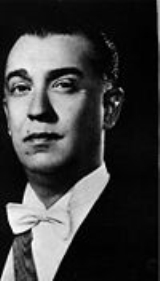
Juscelino Kubitschek de Oliveira

Encyclopedia
Juscelino Kubitschek de Oliveira (ʒuseˈlinu kubiˈtʃɛki di oliˈvejrɐ; September 12, 1902 – August 22, 1976), known also by his initials JK, was a prominent Brazilian politician of gypsy Czech origin
who was President of Brazil from 1956 to 1961. He was born in Diamantina, Minas Gerais
, and died in 1976. His term was marked by relative economic prosperity and political stability, being most known by the construction of a new capital, Brasília
.
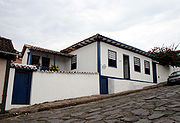 Kubitschek was born into a very poor family in the countryside of Brazilian state Minas Gerais. His father, João César de Oliveira (1872–1905), who died when Juscelino was two years old, was a traveling salesman. He was raised by his mother, a schoolteacher named Júlia Kubitschek (née Kubíček; 1873–1971), of Czech Roma(gypsy) descent.
Trained as a medical doctor, Kubitschek was elected to the Chamber of Deputies of Brazil
from his home state in 1934. With the imposition of Getúlio Vargas
' dictatorship
in 1937, Kubitschek returned to practicing medicine. However, he was soon appointed mayor
of Belo Horizonte in 1940. There, he idealized the project of an artificial lake (Pampulha Lake
) to supply water to the city and also an architectural complex, with several buildings projected by renowned architect Oscar Niemeyer
.
He was again elected to the National Congress of Brazil in 1945 and became governor of the state in 1950. In 1955, he ran for president with the slogan "fifty years of progress in five" and won.
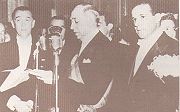 He was sworn in on January 31, 1956 as President of what was then known as the Republic of the United States of Brazil.
The plan had 31 goals distributed in six large groups: energy, transports, food, base industries, education and the main goal, the construction of Brasilia
. This plan searched to stimulate the diversification and expansion of the Brazilian economy
, based on the industrial expansion and the integration of the national territory.
He avoided any direct clash with his political adversaries, like the UDN, the main opposition party of the Kubitschek administration. He also gave political amnesty to the men that took part in the Jacareanga and Aragarças military revolts.
He promoted the implementation of the automobile industry, with the coming of the automobile industries to Brazil, promoted the naval industry and the heavy industry, and the construction of hydro-electric power stations. With the exception of the hydro-electrical companies, Juscelino practically created no state owned companies. He also had a very progressive agenda on the Education front, but that was never carried out.
Kubitschek also cared a lot for the construction of the great transregional roads. He was criticized for focusing only in road construction and putting aside the rail transportation. Today, this decision is still controversial. Still, the construction of the roads helped the integration of the Amazonic region, together with the construction of Brasilia.
The economy boomed, but at considerable cost. His opponents alleged that he had brought "fifty years of inflation in five." Like many other Latin American currencies, the cruzeiro was repeatedly devalued. The country also went further into debt trying to pay for various ambitious projects, although such debts were very small compared to the tremendous rise of the external debt during the military dictatorship (1964–1985).
It has been said that Kubistchek had little time for accountants. Most of his grandiose plans as Mayor of Minas Gerais's elegant capital city, Belo Horizonte, and his later feats as State Governor were made possible only by virtue of his economic and administrative 'guru', an ethical, wise and hard-working politician called Milton Campos.
The reckless spending that went on during Kubitschek's presidency (that allegedly started during his earlier executive positions as Mayor and Governor) were later seen as emblematic of the corrupt practices that are so evident in the governments of today.
It is true that foreign debt and corruption were very much the Achille's heel of his administration, and it is also true to say that both inflation and foreign debt became considerably greater problems during the period, 1964–1984, when Brazil was ruled by military presidents.
Admittedly, from 1964 to 1980, Brazil grew steadily, and did so in compliance with a definite strategy and some of the country's best economists and planners were in office during this period. It was in the late 60s and early 70s that Brazil's current energy potential was fully developed. During most of this 20-year period, the generals that ruled Brazil were elected by indirect vote and in several instances congressional activities were severely restricted and often banned altogether.
The cost of dictatorships is all too evident: serious deterioration of institutional government and terrible breaches of human rights. It was during the military years that Brazil first became known for torture in prisons and human rights abuse.
Juscelino Kubitschek's administration, however, which came before the generals's, is seen as relatively peaceful and democratic. It is true that his inauguration was made possible only by a military coup, staged by General Henrique Lott in 1956, who deposed the legal stand-in President Carlos Luz, lest the latter would not hand in power to president-elect Kubitschek on the grounds of the scarcety of votes (Kubitschek, the winner on the 1956 presidential elections, received an unimpressive 36 per cent of the poll, and some legal haggling made a legal requirement that would put a mandatory constitutional prerequisite of 51 per cent). Still, Juscelino took office as planned and served a full term.
By the end of his term, the foreign debt had grown 1.5 billion dollar
s larger, getting to 3.8 billion dollars in the whole. The inflation
and wealth inequality had grown larger, with the occurrence of strikes in the rural zone that expanded to the urban areas. However, the minimum wage from that time is still considered the largest in any moment of the Brazilian history.
Kubitschek ended his time in office with a growth of 80% in industrial production but with an inflation rate of 43%.
The works, led by the architects Lucio Costa
and Oscar Niemeyer
, started in the month of February 1957. More than 200 machines were put to work and 30,000 workers came from every part of the country, especially the northeast
. The construction went on day and night to meet the objective of finishing Brasília by April 21, 1960, in a homage to the Inconfidência Mineira
. The building was finished in 41 months, before the established date. As soon as it was inaugurated, Brasília was considered a masterpiece of modern urbanism
and Modern architecture
.
The new capital was to integrate all the Brazilian regions, create jobs and absorb workforce from the Brazilian Northeast and to stimulate the economy of the Central-west and North.
During his office, the Brazilian press even said that he had the seventh greatest fortune in the world, a claim that was never proved. The candidate for the next presidency, Janio Quadros
, used the accusations during his presidential campaign, promising to "sweep the corruption out of the country". Later, during the military regime, Juscelino would be questioned about the corruption allegations and about supposed ties with communist groups.
Kubitschek was succeeded by Jânio Quadros
in 1961. After the military took power in 1964, Kubitschek's political rights were suspended for 10 years. He went into self-imposed exile and stayed in numerous U.S. and European cities.
During the 50s, the Brazilian society was in transition from a rural to an urban society. With the industrial reforms, the emergence of the country as an industrial force could not be stopped anymore. This was also the time when household appliances started to enter people's lives. The middle class was now able to buy products that helped in their everyday tasks thanks to the infusion of foreign capital. The "American way of life" started to be implanted in the public's consciousness with radio shows, magazines and the newly arrived television.
Brazilian cinema was at its peak, with many movies being produced every year, mostly comedies called "Chanchadas". The prestige of the Brazilian cinema was such that in 1953 the movie "O Cangaceiro" received several foreign awards. Movie Companies like "Vera Cruz" and "Atlântida" were at their pinnacle.
Radio station audiences, especially for "Rádio Nacional", peaked. In 1958, João Gilberto
published his record "Chega de Saudade", creating the Bossa Nova
. Artists like Tom Jobim and Vinicius de Moraes
came to be nationally and internationally known.
In sports, the national football team became 1958 FIFA World Cup
champions in Sweden
. Boxer Éder Jofre
was world champion, as was the Brazilian basketball team in 1959, in Chile
. Tennis player Maria Esther Bueno won both Wimbledon
and US Open tournaments.
All these achievements infused a sense of victory and confidence in the future in the Brazilian public.

 He returned to Brazil in 1967, but was killed in a car crash in 1976, near the city of Resende
in the state of Rio de Janeiro
. 350,000 mourners were present at his burial in Brasília. He is now buried in the Memorial JK, which was opened in 1981.
On April 26, 2000, former governor of Rio de Janeiro, Leonel Brizola
, alleged that the ex-presidents of Brazil, João Goulart
and Kubitschek, were assassinated as part of Operation Condor
and requested the opening of investigations into their deaths. They were purported to have died respectively of a heart attack and a car accident.
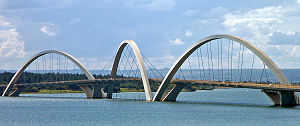
of Brasília
and the Juscelino Kubitschek bridge
were named after him. There is also a luxurious hotel named Kubitschek Plaza
located in that city.
Many cities have things named after him, "JK" is a ubiquitous acroynm honoring the ex president, who is often seen by Brazilians as the "father of modern Brazil".
star Fernando Bujones
. Márcia Kubitschek was elected to the National Congress of Brazil
in 1987 and served as lieutenant governor
of the Brazilian Federal District
from 1991 to 1994.
Czech Brazilian
Czech Brazilians refer to Brazilians of Czech descent who were born in or who trace their ancestry to the territory of the historic Czech lands or succession states, now known as the Czech Republic, and are residents and/or citizens of Brazil....
who was President of Brazil from 1956 to 1961. He was born in Diamantina, Minas Gerais
Minas Gerais
Minas Gerais is one of the 26 states of Brazil, of which it is the second most populous, the third richest, and the fourth largest in area. Minas Gerais is the Brazilian state with the largest number of Presidents of Brazil, the current one, Dilma Rousseff, being one of them. The capital is the...
, and died in 1976. His term was marked by relative economic prosperity and political stability, being most known by the construction of a new capital, Brasília
Brasília
Brasília is the capital city of Brazil. The name is commonly spelled Brasilia in English. The city and its District are located in the Central-West region of the country, along a plateau known as Planalto Central. It has a population of about 2,557,000 as of the 2008 IBGE estimate, making it the...
.
Life
Trained as a medical doctor, Kubitschek was elected to the Chamber of Deputies of Brazil
Chamber of Deputies of Brazil
The Chamber of Deputies of Brazil is a federal legislative body and the lower house of the National Congress of Brazil. As of 2006, the chamber comprises 513 deputies, who are elected by proportional representation to serve four-year terms...
from his home state in 1934. With the imposition of Getúlio Vargas
Getúlio Vargas
Getúlio Dornelles Vargas served as President of Brazil, first as dictator, from 1930 to 1945, and in a democratically elected term from 1951 until his suicide in 1954. Vargas led Brazil for 18 years, the most for any President, and second in Brazilian history to Emperor Pedro II...
' dictatorship
Estado Novo (Brazil)
Vargas Era is the period in the history of Brazil that lasted from 1930 to 1945, when the country was under the leadership of Getúlio Dornelles Vargas....
in 1937, Kubitschek returned to practicing medicine. However, he was soon appointed mayor
Mayor
In many countries, a Mayor is the highest ranking officer in the municipal government of a town or a large urban city....
of Belo Horizonte in 1940. There, he idealized the project of an artificial lake (Pampulha Lake
Pampulha
Pampulha is a man-made lagoon located in Belo Horizonte, Brazil. It is also the name of the surrounding residential neighborhood and is one of the city's administrative regions....
) to supply water to the city and also an architectural complex, with several buildings projected by renowned architect Oscar Niemeyer
Oscar Niemeyer
Oscar Ribeiro de Almeida Niemeyer Soares Filho is a Brazilian architect specializing in international modern architecture...
.
He was again elected to the National Congress of Brazil in 1945 and became governor of the state in 1950. In 1955, he ran for president with the slogan "fifty years of progress in five" and won.
Presidency
Kubitschek's presidency was marked by a time of political optimism. He launched the "Plan of National Development", also known as the "Plano de metas (Goal's plan)", famous by the motto: "Fifty years of progress in five."The plan had 31 goals distributed in six large groups: energy, transports, food, base industries, education and the main goal, the construction of Brasilia
Brasília
Brasília is the capital city of Brazil. The name is commonly spelled Brasilia in English. The city and its District are located in the Central-West region of the country, along a plateau known as Planalto Central. It has a population of about 2,557,000 as of the 2008 IBGE estimate, making it the...
. This plan searched to stimulate the diversification and expansion of the Brazilian economy
Economy of Brazil
The economy of Brazil is the world's seventh largest by nominal GDP and eighth largest by purchasing power parity. Brazil has moderately free markets and an inward-oriented economy...
, based on the industrial expansion and the integration of the national territory.
Guarantor of democracy
His government was marked by a time of political stability and maintenance of the democratic regime. Kubitschek used his outstanding political ability to reconcile Brazilian society. Kubitchek managed to re-buid the government structure, as he transferred the capital to it's new location.He avoided any direct clash with his political adversaries, like the UDN, the main opposition party of the Kubitschek administration. He also gave political amnesty to the men that took part in the Jacareanga and Aragarças military revolts.
Economy and major works
Although his main project was to develop the national industry, it was with the "Goals plan", launched in 1956, that there was a greater opening of the national economy for foreign capital.He exempted from taxes all the machines and industrial equipments imports, as well as to the foreign capital. However, the exemption was made only if the foreign capital was associated with the national capital ("associated capital"). To amplify the internal market, he developed a generous credit policy.He promoted the implementation of the automobile industry, with the coming of the automobile industries to Brazil, promoted the naval industry and the heavy industry, and the construction of hydro-electric power stations. With the exception of the hydro-electrical companies, Juscelino practically created no state owned companies. He also had a very progressive agenda on the Education front, but that was never carried out.
Kubitschek also cared a lot for the construction of the great transregional roads. He was criticized for focusing only in road construction and putting aside the rail transportation. Today, this decision is still controversial. Still, the construction of the roads helped the integration of the Amazonic region, together with the construction of Brasilia.
The economy boomed, but at considerable cost. His opponents alleged that he had brought "fifty years of inflation in five." Like many other Latin American currencies, the cruzeiro was repeatedly devalued. The country also went further into debt trying to pay for various ambitious projects, although such debts were very small compared to the tremendous rise of the external debt during the military dictatorship (1964–1985).
It has been said that Kubistchek had little time for accountants. Most of his grandiose plans as Mayor of Minas Gerais's elegant capital city, Belo Horizonte, and his later feats as State Governor were made possible only by virtue of his economic and administrative 'guru', an ethical, wise and hard-working politician called Milton Campos.
The reckless spending that went on during Kubitschek's presidency (that allegedly started during his earlier executive positions as Mayor and Governor) were later seen as emblematic of the corrupt practices that are so evident in the governments of today.
It is true that foreign debt and corruption were very much the Achille's heel of his administration, and it is also true to say that both inflation and foreign debt became considerably greater problems during the period, 1964–1984, when Brazil was ruled by military presidents.
Admittedly, from 1964 to 1980, Brazil grew steadily, and did so in compliance with a definite strategy and some of the country's best economists and planners were in office during this period. It was in the late 60s and early 70s that Brazil's current energy potential was fully developed. During most of this 20-year period, the generals that ruled Brazil were elected by indirect vote and in several instances congressional activities were severely restricted and often banned altogether.
The cost of dictatorships is all too evident: serious deterioration of institutional government and terrible breaches of human rights. It was during the military years that Brazil first became known for torture in prisons and human rights abuse.
Juscelino Kubitschek's administration, however, which came before the generals's, is seen as relatively peaceful and democratic. It is true that his inauguration was made possible only by a military coup, staged by General Henrique Lott in 1956, who deposed the legal stand-in President Carlos Luz, lest the latter would not hand in power to president-elect Kubitschek on the grounds of the scarcety of votes (Kubitschek, the winner on the 1956 presidential elections, received an unimpressive 36 per cent of the poll, and some legal haggling made a legal requirement that would put a mandatory constitutional prerequisite of 51 per cent). Still, Juscelino took office as planned and served a full term.
By the end of his term, the foreign debt had grown 1.5 billion dollar
Dollar
The dollar is the name of the official currency of many countries, including Australia, Belize, Canada, Ecuador, El Salvador, Hong Kong, New Zealand, Singapore, Taiwan, and the United States.-Etymology:...
s larger, getting to 3.8 billion dollars in the whole. The inflation
Inflation
In economics, inflation is a rise in the general level of prices of goods and services in an economy over a period of time.When the general price level rises, each unit of currency buys fewer goods and services. Consequently, inflation also reflects an erosion in the purchasing power of money – a...
and wealth inequality had grown larger, with the occurrence of strikes in the rural zone that expanded to the urban areas. However, the minimum wage from that time is still considered the largest in any moment of the Brazilian history.
Kubitschek ended his time in office with a growth of 80% in industrial production but with an inflation rate of 43%.
The construction of Brasília
The idea of building a new capital in the center of the country was already idealized in the Brazilian constitution of 1891, 1934 and 1946, but it was only in 1956 that the construction began to take form.The works, led by the architects Lucio Costa
Lúcio Costa
Lucio Costa was a Brazilian architect and urban planner.-Career:Costa was born in Toulon, France.Educated at the Royal Grammar School, Newcastle upon Tyne, England and in Montreux until 1916, he graduated as an architect in 1924 from the School of Fine Art in Rio de Janeiro...
and Oscar Niemeyer
Oscar Niemeyer
Oscar Ribeiro de Almeida Niemeyer Soares Filho is a Brazilian architect specializing in international modern architecture...
, started in the month of February 1957. More than 200 machines were put to work and 30,000 workers came from every part of the country, especially the northeast
Northeast Region, Brazil
The Northeast Region of Brazil is composed of the following states: Maranhão, Piauí, Ceará, Rio Grande do Norte, Paraíba, Pernambuco, Alagoas, Sergipe and Bahia, and it represents 18.26% of the Brazilian territory....
. The construction went on day and night to meet the objective of finishing Brasília by April 21, 1960, in a homage to the Inconfidência Mineira
Inconfidência Mineira
The Inconfidência Mineira of 1789 was an unsuccessful Brazilian independence movement.It was a result of the confluence of external and internal causes...
. The building was finished in 41 months, before the established date. As soon as it was inaugurated, Brasília was considered a masterpiece of modern urbanism
Urbanism
Broadly, urbanism is a focus on cities and urban areas, their geography, economies, politics, social characteristics, as well as the effects on, and caused by, the built environment.-Philosophy:...
and Modern architecture
Modern architecture
Modern architecture is generally characterized by simplification of form and creation of ornament from the structure and theme of the building. It is a term applied to an overarching movement, with its exact definition and scope varying widely...
.
The new capital was to integrate all the Brazilian regions, create jobs and absorb workforce from the Brazilian Northeast and to stimulate the economy of the Central-west and North.
Corruption
Kubitschek was not free from controversies. He was often accused of corruption. In Brazilian history he remains as the president with the greatest list of achievements, so he was vulnerable to attacks from all sides, but none of the accusations made against him were ever proven true. The accusation began at the time he was governor and intensified during his presidency. The building of Brasília was the main source of accusations. There were serious reasons to believe that people from Juscelino's political group had been favoured in the construction. Also, the Brazilian Pan-Air had the monopoly of people and goods transportation during the construction, another source of controversy.During his office, the Brazilian press even said that he had the seventh greatest fortune in the world, a claim that was never proved. The candidate for the next presidency, Janio Quadros
Jânio Quadros
Jânio da Silva Quadros , , was a Brazilian politician who served as President of Brazil for only 7 months in 1961.-Career:...
, used the accusations during his presidential campaign, promising to "sweep the corruption out of the country". Later, during the military regime, Juscelino would be questioned about the corruption allegations and about supposed ties with communist groups.
Kubitschek was succeeded by Jânio Quadros
Jânio Quadros
Jânio da Silva Quadros , , was a Brazilian politician who served as President of Brazil for only 7 months in 1961.-Career:...
in 1961. After the military took power in 1964, Kubitschek's political rights were suspended for 10 years. He went into self-imposed exile and stayed in numerous U.S. and European cities.
The "Golden Years"
Despite all the problems, Kubitschek's presidency was seen as a time of optimism. The president was a cheerful and charismatic figure that exhaled confidence.During the 50s, the Brazilian society was in transition from a rural to an urban society. With the industrial reforms, the emergence of the country as an industrial force could not be stopped anymore. This was also the time when household appliances started to enter people's lives. The middle class was now able to buy products that helped in their everyday tasks thanks to the infusion of foreign capital. The "American way of life" started to be implanted in the public's consciousness with radio shows, magazines and the newly arrived television.
Brazilian cinema was at its peak, with many movies being produced every year, mostly comedies called "Chanchadas". The prestige of the Brazilian cinema was such that in 1953 the movie "O Cangaceiro" received several foreign awards. Movie Companies like "Vera Cruz" and "Atlântida" were at their pinnacle.
Radio station audiences, especially for "Rádio Nacional", peaked. In 1958, João Gilberto
João Gilberto
João Gilberto Prado Pereira de Oliveira, known as João Gilberto , is a Brazilian singer and guitarist. His seminal recordings, including many songs by Antônio Carlos Jobim and Vinicius de Moraes, established the new musical genre of Bossa nova in the late 1950s.-Biography:From an early age, music...
published his record "Chega de Saudade", creating the Bossa Nova
Bossa Nova
Bossa Nova may refer to:*Bossa nova, a style of music*Bossa Nova , a dance form associated with the music*Bossa Nova , a 2000 film*Bossa Nova - album by John Pizzarelli...
. Artists like Tom Jobim and Vinicius de Moraes
Vinicius de Moraes
Marcus Vinicius de Moraes , known as Vinicius de Moraes and nicknamed O Poetinho , was born in Rio de Janeiro, Brazil. Son of Lydia Cruz de Moraes and Clodoaldo Pereira da Silva Moraes, he was a seminal figure in contemporary Brazilian music...
came to be nationally and internationally known.
In sports, the national football team became 1958 FIFA World Cup
1958 FIFA World Cup
The 1958 FIFA World Cup, the sixth staging of the World Cup, was hosted by Sweden from 8 June to 29 June. The tournament was won by Brazil, who beat Sweden 5–2 in the final for their first title. To date, this marks the only occasion that a World Cup staged in Europe was not won by a European...
champions in Sweden
Sweden
Sweden , officially the Kingdom of Sweden , is a Nordic country on the Scandinavian Peninsula in Northern Europe. Sweden borders with Norway and Finland and is connected to Denmark by a bridge-tunnel across the Öresund....
. Boxer Éder Jofre
Eder Jofre
Éder Jofre is a retired Brazilian boxer and former bantamweight and featherweight champion .-Amateur career:Jofre represented his native country at the 1956 Summer Olympics in Melbourne, Australia.-Olympic Results:*1st round bye...
was world champion, as was the Brazilian basketball team in 1959, in Chile
Chile
Chile ,officially the Republic of Chile , is a country in South America occupying a long, narrow coastal strip between the Andes mountains to the east and the Pacific Ocean to the west. It borders Peru to the north, Bolivia to the northeast, Argentina to the east, and the Drake Passage in the far...
. Tennis player Maria Esther Bueno won both Wimbledon
The Championships, Wimbledon
The Championships, Wimbledon, or simply Wimbledon , is the oldest tennis tournament in the world, considered by many to be the most prestigious. It has been held at the All England Club in Wimbledon, London since 1877. It is one of the four Grand Slam tennis tournaments, the other three Majors...
and US Open tournaments.
All these achievements infused a sense of victory and confidence in the future in the Brazilian public.
Return to Brazil and death
Resende, Rio de Janeiro
Resende is a municipality located in the Brazilian state of Rio de Janeiro. Its population was 119,801 and its area is 1,144 km².Resendense refers to people or things from Resende, RJ. Its territory boundaries to the state of São Paulo and Minas Gerais...
in the state of Rio de Janeiro
Rio de Janeiro (state)
Rio de Janeiro is one of the 27 states of Brazil.Rio de Janeiro has the second largest economy of Brazil behind only São Paulo state.The state of Rio de Janeiro is located within the Brazilian geopolitical region classified as the Southeast...
. 350,000 mourners were present at his burial in Brasília. He is now buried in the Memorial JK, which was opened in 1981.
On April 26, 2000, former governor of Rio de Janeiro, Leonel Brizola
Leonel Brizola
Leonel de Moura Brizola was a Brazilian politician. Launched in politics by Getúlio Vargas, Brizola was the only politician to serve as governor of two different states in the whole history of Brazil. In 1959 he was elected governor of Rio Grande do Sul, and in 1982 and 1990 he was elected...
, alleged that the ex-presidents of Brazil, João Goulart
João Goulart
João Belchior Marques Goulart was a Brazilian politician and the 24th President of Brazil until a military coup d'état deposed him on April 1, 1964. He is considered to have been the last left-wing President of the country until Luiz Inácio Lula da Silva took office in 2003.-Name:João Goulart is...
and Kubitschek, were assassinated as part of Operation Condor
Operation Condor
Operation Condor , was a campaign of political repression involving assassination and intelligence operations officially implemented in 1975 by the right-wing dictatorships of the Southern Cone of South America...
and requested the opening of investigations into their deaths. They were purported to have died respectively of a heart attack and a car accident.
Honours
The Presidente Juscelino Kubitschek International AirportBrasília International Airport
Brasília-Presidente Juscelino Kubitschek International Airport is the airport serving Brasília, Brazil. Since April 22, 1999 the airport is named after Juscelino Kubitschek de Oliveira , the 21st President of Brazil....
of Brasília
Brasília
Brasília is the capital city of Brazil. The name is commonly spelled Brasilia in English. The city and its District are located in the Central-West region of the country, along a plateau known as Planalto Central. It has a population of about 2,557,000 as of the 2008 IBGE estimate, making it the...
and the Juscelino Kubitschek bridge
Juscelino Kubitschek bridge
The Juscelino Kubitschek Bridge , also known as the President JK Bridge or just the JK Bridge, is a steel and concrete bridge that crosses Lake Paranoá in Brasília. It links the southern part of the lake, and St. Sebastian Paranoá the Pilot Plan , through the Monumental Axis...
were named after him. There is also a luxurious hotel named Kubitschek Plaza
Kubitschek Plaza
Kubitschek Plaza is a luxurious 5 star hotel located in Brasília, Brazil. Its named after President Juscelino Kubitschek de Oliveira, founder of Brasília. Its part of the Plaza Brasília Hotels along with Manhattan Plaza, Brasília Palace and St. Paul Plaza...
located in that city.
Many cities have things named after him, "JK" is a ubiquitous acroynm honoring the ex president, who is often seen by Brazilians as the "father of modern Brazil".
Descendants
In 1980, his daughter Márcia (1942–2000) married Cuban-American balletBallet
Ballet is a type of performance dance, that originated in the Italian Renaissance courts of the 15th century, and which was further developed in France and Russia as a concert dance form. The early portions preceded the invention of the proscenium stage and were presented in large chambers with...
star Fernando Bujones
Fernando Bujones
Fernando Bujones was an American ballet dancer.Born in Miami, Florida to Cuban parents, Bujones is regarded as one of the finest male dancers of the 20th century and hailed as one of the greatest American male dancers of his generation.Bujones' first formal ballet classes were in Alicia Alonso's...
. Márcia Kubitschek was elected to the National Congress of Brazil
National Congress of Brazil
The National Congress of Brazil is the legislative body of Brazil's federal government.Unlike regional legislative bodies – Legislative Assemblies and City Councils -, the Congress is bicameral, composed of the Federal Senate and the Chamber of Deputies .The Senate represents the 26 states and...
in 1987 and served as lieutenant governor
Lieutenant governor
A lieutenant governor or lieutenant-governor is a high officer of state, whose precise role and rank vary by jurisdiction, but is often the deputy or lieutenant to or ranking under a governor — a "second-in-command"...
of the Brazilian Federal District
Brazilian Federal District
The Federal District is set apart for Brasília, the capital of Brazil. Located in a region called Planalto Central, or Central Plateau, the Federal District is divided in 29 administrative regions. Brasilia - place where the three branches of the Federal Government are located - is the main...
from 1991 to 1994.