
All Topics  
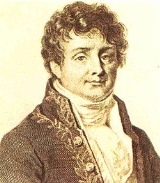
Joseph Fourier

 
Joseph Fourier

   Email Print
   Bookmark   Link


Joseph Fourier


Jean Baptiste Joseph Fourier (March 21, 1768 – May 16, 1830) was a French
France

France , officially the French Republic , is a country whose Metropolitan France is located in Western Europe and that also comprises various Overseas departments and territories of France....
 mathematician
Mathematician

A mathematician is a person whose primary area of study and/or research is the field of mathematics....
 and physicist
Physicist

A physicist is a scientist who studies or practices physics. Physicists study a wide range of physical phenomena in many Physics#Major fields of physics spanning all length scales: from atom particles of which all ordinary matter is made to the behavior of the material Universe as a whole ....
 best known for initiating the investigation of Fourier series
Fourier series

In mathematics, a Fourier series decomposes a periodic function into a sum of simple oscillating functions, namely sine wave . The study of Fourier series is a branch of Fourier analysis....
 and their application to problems of heat flow. The Fourier transform
Fourier transform

In mathematics, Fourier analysis is a subject area which grew out of the study of Fourier series. The subject began with trying to understand when it was possible to represent general functions by sums of simpler trigonometric functions....
 is also named in his honour. Fourier is also generally credited with the discovery of the greenhouse effect
Greenhouse effect

The greenhouse effect refers to the change in the steady state temperature of a planet or moon by the presence of an atmosphere containing gas that absorbs and emits infrared....
.

Life
Fourier was born at Auxerre
Auxerre

Auxerre is a Communes of France in the Bourgogne regions of France in north-central France, between Paris and Dijon. It is the capital of the Yonne Departments of France....
 (now in the Yonne
Yonne

Yonne is a France departments of France named after the Yonne River. It is one of the four constituent departments of Bourgogne in eastern France and its Prefectures in France is Auxerre....
 département of France
France

France , officially the French Republic , is a country whose Metropolitan France is located in Western Europe and that also comprises various Overseas departments and territories of France....
), the son of a tailor
Tailor

A tailor is a person whose occupation is to sew and scissor menswear style jackets and the skirts or trousers that go with them.Although the term dates to the thirteenth century, tailor took on its modern sense in the late eighteenth century, and now refers to makers of men's and women's suit , coat s, trousers, and similar garments, u...
.


Discussion
Ask a question about 'Joseph Fourier'
Start a new discussion about 'Joseph Fourier'
Answer questions from other users
Full Discussion Forum


Quotations


Mathematics compares the most diverse phenomena and discovers the secret analogies that unite them.

Profound study of nature is the most fertile source of mathematical discoveries.


Encyclopedia


Jean Baptiste Joseph Fourier (March 21, 1768 – May 16, 1830) was a French
France

France , officially the French Republic , is a country whose Metropolitan France is located in Western Europe and that also comprises various Overseas departments and territories of France....
 mathematician
Mathematician

A mathematician is a person whose primary area of study and/or research is the field of mathematics....
 and physicist
Physicist

A physicist is a scientist who studies or practices physics. Physicists study a wide range of physical phenomena in many Physics#Major fields of physics spanning all length scales: from atom particles of which all ordinary matter is made to the behavior of the material Universe as a whole ....
 best known for initiating the investigation of Fourier series
Fourier series

In mathematics, a Fourier series decomposes a periodic function into a sum of simple oscillating functions, namely sine wave . The study of Fourier series is a branch of Fourier analysis....
 and their application to problems of heat flow. The Fourier transform
Fourier transform

In mathematics, Fourier analysis is a subject area which grew out of the study of Fourier series. The subject began with trying to understand when it was possible to represent general functions by sums of simpler trigonometric functions....
 is also named in his honour. Fourier is also generally credited with the discovery of the greenhouse effect
Greenhouse effect

The greenhouse effect refers to the change in the steady state temperature of a planet or moon by the presence of an atmosphere containing gas that absorbs and emits infrared....
.

Life


Fourier was born at Auxerre
Auxerre

Auxerre is a Communes of France in the Bourgogne regions of France in north-central France, between Paris and Dijon. It is the capital of the Yonne Departments of France....
 (now in the Yonne
Yonne

Yonne is a France departments of France named after the Yonne River. It is one of the four constituent departments of Bourgogne in eastern France and its Prefectures in France is Auxerre....
 département of France
France

France , officially the French Republic , is a country whose Metropolitan France is located in Western Europe and that also comprises various Overseas departments and territories of France....
), the son of a tailor
Tailor

A tailor is a person whose occupation is to sew and scissor menswear style jackets and the skirts or trousers that go with them.Although the term dates to the thirteenth century, tailor took on its modern sense in the late eighteenth century, and now refers to makers of men's and women's suit , coat s, trousers, and similar garments, u...
. He was orphaned at age nine. Fourier was recommended to the Bishop of Auxerre, and through this introduction, he was educated by the Benveniste
Benveniste

Benveniste is the surname of an old, rich, and scholarly family of Narbonne, France, several branches of which were found all over Spain and the Provence, France, as well as at various places in the Orient....
s of the Convent of St. Mark. The commissions in the scientific corps of the army were reserved for those of good birth, and being thus ineligible, he accepted a military lectureship on mathematics. He took a prominent part in his own district in promoting the French Revolution
French Revolution

The French Revolution was a period of political and social upheaval and radical change in the history of France, during which the French governmental structure, previously an absolute monarchy with feudalism for the aristocracy and Roman Catholic Church clergy, underwent radical change to forms based on Age of Enlightenment principles of cit...
, and was rewarded by an appointment in 1795 in the École Normale Supérieure
École Normale Supérieure

The ?cole normale sup?rieure is a France Grandes ?coles . The ENS was initially conceived during the French Revolution, and intended to provide the First French Republic with a new body of teacher, trained in the critical spirit and secular values of the the Enlightenment....
, and subsequently by a chair at the École Polytechnique
École Polytechnique

The ?cole Polytechnique , often referred to by the nickname X, is the foremost France grande ?cole of engineering . Founded in 1794 and initially located in the Quartier Latin in central Paris, it was moved to Palaiseau in 1976....
.

Fourier went with Napoleon Bonaparte on his Egyptian expedition in 1798, and was made governor of Lower Egypt
Lower Egypt

Lower Egypt is the northern-most section of Egypt. It refers to the Fertile Crescent Nile Delta region, which stretches from the area between El-Aiyat and Zawyet Dahshur, south of modern-day Cairo, and the Mediterranean Sea....
 and secretary of the Institut d'Égypte
Institut d'Égypte

The Institut d??gypte was a learned academy formed by Napoleon I of France to carry out research during his French Invasion of Egypt ....
. Cut off from France by the English fleet, he organized the workshops on which the French army had to rely for their munitions of war. He also contributed several mathematical papers to the Egyptian Institute (also called the Cairo Institute) which Napoleon founded at Cairo
Cairo

Cairo , which means "the triumphant", is the Cairo and largest city of Egypt.It is the most populous metropolitan area in Egypt and is also one of the most populous in the world....
, with a view of weakening English influence in the East. After the British victories and the capitulation of the French under General Menou in 1801, Fourier returned to France, and was made prefect of Isère
Isère

Is?re is a departments of France, in the Rh?ne-Alpes regions of France in the east of France named after the Is?re River....
, and it was while there that he made his experiments on the propagation of heat.

Fourier moved to England in 1816. Later he returned to France, and in 1822 succeeded Jean Baptiste Joseph Delambre
Jean Baptiste Joseph Delambre

Jean Baptiste Joseph, chevalier Delambre was a France mathematician and astronomer.After a childhood fever, he suffered from very sensitive eyes, and believed that he would soon go blind....
 as Permanent Secretary of the French Academy of Sciences
French Academy of Sciences

The French Academy of Sciences is a learned society, founded in 1666 by Louis XIV of France at the suggestion of Jean-Baptiste Colbert, to encourage and protect the spirit of French people Scientific method....
.

In 1822 he published his Théorie analytique de la chaleur, in which he bases his reasoning on Newton's law of cooling, namely, that the flow of heat between two adjacent molecules is proportional to the extremely small difference of their temperatures. In this work he claims that any function of a variable, whether continuous or discontinuous, can be expanded in a series of sines of multiples of the variable. Though this result is not correct, Fourier's observation that some discontinuous functions are the sum of infinite series was a breakthrough. The question of determining when a function is the sum of its Fourier series has been fundamental for centuries. Joseph Louis Lagrange
Joseph Louis Lagrange

Joseph-Louis Lagrange, born Giuseppe Lodovico Lagrangia was an Italy mathematician and astronomer, who lived most of his life in Prussia and France, making significant contributions to all fields of mathematical analysis, to number theory, and to classical mechanics and celestial mechanics....
 had given particular cases of this (false) theorem, and had implied that the method was general, but he had not pursued the subject. Johann Dirichlet
Johann Peter Gustav Lejeune Dirichlet

Johann Peter Gustav Lejeune Dirichlet was a Germany mathematician credited with the modern "formal" definition of a function .His family hailed from the town of Richelette in Belgium, from which his surname "Lejeune Dirichlet" was derived....
 was the first to give a satisfactory demonstration of it with some restrictive conditions. A more subtle, but equally fundamental, contribution is the concept of dimensional homogeneity in equations; i.e. an equation can only be formally correct if the dimensions match on either side of the equality. Fourier also developed the method of representing physical units, such as velocity and acceleration, by their fundamental dimensions of mass, time, and length, to obtain relations between them.

Fourier left an unfinished work on determinate equations which was edited by Claude-Louis Navier
Claude-Louis Navier

Claude-Louis Navier born Claude Louis Marie Henri Navier, was a France engineer and physicist who specialized in mechanics.The Navier-Stokes equations are named after him and George Gabriel Stokes....
 and published in 1831. This work contains much original matter — in particular, there is a demonstration of Fourier's theorem on the position of the roots of an algebraic equation. Joseph Louis Lagrange
Joseph Louis Lagrange

Joseph-Louis Lagrange, born Giuseppe Lodovico Lagrangia was an Italy mathematician and astronomer, who lived most of his life in Prussia and France, making significant contributions to all fields of mathematical analysis, to number theory, and to classical mechanics and celestial mechanics....
 had shown how the roots of an algebraic equation might be separated by means of another equation whose roots were the squares of the differences of the roots of the original equation. François Budan
François Budan de Boislaurent

Ferdinand Fran?ois D?sir? Budan de Boislaurent was a France mathematician, best known for enunciating the Fourier transform in 1807 and 1811, although his demonstration was not altogether accurate, and, although being published before Joseph Fourier's explanation, was discovered afterwards....
, in 1807 and 1811, had enunciated the theorem generally known by the name of Fourier, but the demonstration was not altogether satisfactory. Fourier's proof is the same as that usually given in textbooks on the theory of equations. The final solution of the problem was given in 1829 by Jacques Charles François Sturm
Jacques Charles François Sturm

Jacques Charles Fran?ois Sturm was a France mathematician of Germany extraction....
.

Fourier was buried in the Pere Lachaise Cemetery in Paris, a tomb decorated with a Egyptian motif to reflect his position as secretary of the Cairo Institute, and his collation of the landmark Description de l'Égypte
Description de l'Egypte

Description de l'?gypte is the title of several books.* Description de l'?gypte - Description de l'?gypte ou Recueil des observations et des recherches qui ont ?t? faites en ?gypte pendant l'exp?dition de l'arm?e fran?aise Pub; First Edition , L'Imprimerie Imperiale, 1809-1813; l'Imprimerie Royale, 1817-1822....
.

Discovery of greenhouse effect


Fourier is also credited with the discovery in 1824 that gases in the atmosphere might increase the surface temperature of the Earth. This was the effect that would later be called the greenhouse effect
Greenhouse effect

The greenhouse effect refers to the change in the steady state temperature of a planet or moon by the presence of an atmosphere containing gas that absorbs and emits infrared....
. He described the phenomenon in 1824 and then again in a very similar paper in 1827 whereby an atmosphere serves to warm a planet. This established the concept of planetary energy balance — that planets obtain energy from a number of sources that cause temperature increase. Planets also lose energy by infrared radiation (that Fourier called "chaleur obscure" or "dark heat") with the rate increasing with temperature. A balance is reached between heat gain and heat loss; the atmosphere shifts the balance toward the higher temperatures by slowing the heat loss. Although Fourier understood that the rate of infrared radiation increased with temperature, the Stefan–Boltzmann law which gives the exact form of this dependency (a fourth-power law) was discovered fifty years later.

Fourier recognized that Earth primarily gets energy from Solar radiation, to which the atmosphere
Earth's atmosphere

The Earth's atmosphere is a layer of gases surrounding the planet Earth that is retained by the Earth's gravity. Dry air contains roughly 78.08% nitrogen, 20.95% oxygen, 0.93% argon, 0.038% Carbon dioxide in the Earth's atmosphere, and trace amounts of other gases....
 is largely transparent
Transparency (optics)

In optics, transparency is the material property of allowing light to pass through. In mineralogy, another term for this property is diaphaneity....
, and that geothermal
Geothermal (geology)

In geology, geothermal refers to heat sources within the planet. Geothermal is technically an adjective but in U.S. English the word has attained frequent use as a noun ....
 heat doesn't contribute much to the energy balance. However, he mistakenly believed that there is a significant contribution of radiation from interplanetary space.

Fourier referred to an experiment by M de Saussure
Horace-Bénédict de Saussure

Horace-B?n?dict de Saussure was a Switzerland aristocrat, physicist and Alpine traveller, often considered the founder of alpinism....
, who exposed a black box to sunlight. When a thin sheet of glass is put on top of the box, the temperature inside of the box increases . Infrared radiation was discovered by William Herschel
William Herschel

Sir Frederick William Herschel, Fellow of the Royal Society Royal Guelphic Order was a German-born British astronomer and composer who became famous for discovering Uranus....
 twenty five years later.

See also

  • Fourier analysis
  • Fourier number
    Fourier number

    In physics and engineering, the Fourier number or Fourier modulus, named after Joseph Fourier, is a dimensionless number that characterizes heat conduction....
  • Fourier series
    Fourier series

    In mathematics, a Fourier series decomposes a periodic function into a sum of simple oscillating functions, namely sine wave . The study of Fourier series is a branch of Fourier analysis....
  • Fourier transform
    Fourier transform

    In mathematics, Fourier analysis is a subject area which grew out of the study of Fourier series. The subject began with trying to understand when it was possible to represent general functions by sums of simpler trigonometric functions....
  • Fourier's Law
    Heat conduction

    Heat conduction or thermal conduction is the spontaneous heat transfer through matter, from a region of higher temperature to a region of lower temperature, and acts to equalize temperature differences....
  • Heat equation
    Heat equation

    The heat equation is an important partial differential equation which describes the distribution of heat in a given region over time. For a function u of three spatial variables and the time variable t, the heat equation is...


External links