

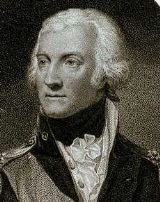
John Borlase Warren

Encyclopedia
Sir John Borlase Warren, 1st Baronet (2 September 1753 – 27 February 1822), was an English
admiral
, politician and diplomat. Born in Stapleford, Nottinghamshire
, he was the son and heir of John Borlase Warren (died 1763) of Stapleford and Little Marlow
. He entered Emmanuel College
, Cambridge in 1769, but in 1771 entered the Royal Navy
as an able seaman
; in 1774 he became member of Parliament
for Great Marlow
; and in 1775 he was created a baronet
, the baronetcy held by his ancestors, the Borlases, having become extinct in 1689.
His career as a seaman really began in 1777, and two years later he obtained command of a ship. In April 1794, as Commodore
of the frigate
squadron off the north west French coast assisting in the blockade of Brest
, Warren and his squadron captured a number of French
frigate
s. In 1795, he commanded one of the two squadrons carrying troops for the Quiberon expedition
and in 1796 his frigate squadron off Brest is said to have captured or destroyed 220 vessels. In October 1798, a French fleet — carrying 5,000 men — sailed from Brest intending to invade Ireland
. The plan was frustrated in no small part due to the squadron under his command during the Action of 12 October 1798.
In 1802, he was sworn of the Privy Council
and sent to St. Petersburg as ambassador extraordinary, but he did not forsake the sea. In 1806 he captured a large French warship, the Marengo
, at the Action of 13 March 1806
. He was commander-in-chief on the North American Station from 1807 to 1810. He became an Admiral
in 1810, and was commander-in-chief on the this Station again from 1813 to 1814. During the British invasion he led a detail of British troops that occupied Havre de Grace and set fire to much of the town, including the home of Commodore John Rodgers. He died on 27 February 1822. His two sons predeceased him. His daughter and heiress, Frances Maria (1784–1837), married George Venables-Vernon, 4th Baron Vernon. Their son was George Venables-Vernon, 5th Baron Vernon
.
There is a monument to him in St. Mary's Church, Attenborough
in Nottinghamshire
. A popular figure in the area of his birth, there are a number of pubs named after him in Nottingham and nearby towns.
|-
English people
The English are a nation and ethnic group native to England, who speak English. The English identity is of early mediaeval origin, when they were known in Old English as the Anglecynn. England is now a country of the United Kingdom, and the majority of English people in England are British Citizens...
admiral
Admiral
Admiral is the rank, or part of the name of the ranks, of the highest naval officers. It is usually considered a full admiral and above vice admiral and below admiral of the fleet . It is usually abbreviated to "Adm" or "ADM"...
, politician and diplomat. Born in Stapleford, Nottinghamshire
Stapleford, Nottinghamshire
-External links:***...
, he was the son and heir of John Borlase Warren (died 1763) of Stapleford and Little Marlow
Little Marlow
Little Marlow is a village and civil parish in Buckinghamshire, England.It is on the north bank of the River Thames, about a mile east of Marlow. The toponym "Marlow" is derived from the Old English for "land remaining after the draining of a pool"...
. He entered Emmanuel College
Emmanuel College, Cambridge
Emmanuel College is a constituent college of the University of Cambridge.The college was founded in 1584 by Sir Walter Mildmay on the site of a Dominican friary...
, Cambridge in 1769, but in 1771 entered the Royal Navy
Royal Navy
The Royal Navy is the naval warfare service branch of the British Armed Forces. Founded in the 16th century, it is the oldest service branch and is known as the Senior Service...
as an able seaman
Able Seaman (rank)
In the British Royal Navy in the middle of the 18th century, the term able seaman referred to a seaman with at least two years' experience at sea...
; in 1774 he became member of Parliament
Parliament of Great Britain
The Parliament of Great Britain was formed in 1707 following the ratification of the Acts of Union by both the Parliament of England and Parliament of Scotland...
for Great Marlow
Great Marlow (UK Parliament constituency)
Great Marlow, sometimes simply called Marlow, was a parliamentary borough in Buckinghamshire. It elected two Members of Parliament to the House of Commons between 1301 and 1307, and again from 1624 until 1868, and then one member from 1868 until 1885, when the borough was abolished.-History:In the...
; and in 1775 he was created a baronet
Baronet
A baronet or the rare female equivalent, a baronetess , is the holder of a hereditary baronetcy awarded by the British Crown...
, the baronetcy held by his ancestors, the Borlases, having become extinct in 1689.
His career as a seaman really began in 1777, and two years later he obtained command of a ship. In April 1794, as Commodore
Commodore (rank)
Commodore is a military rank used in many navies that is superior to a navy captain, but below a rear admiral. Non-English-speaking nations often use the rank of flotilla admiral or counter admiral as an equivalent .It is often regarded as a one-star rank with a NATO code of OF-6, but is not always...
of the frigate
Frigate
A frigate is any of several types of warship, the term having been used for ships of various sizes and roles over the last few centuries.In the 17th century, the term was used for any warship built for speed and maneuverability, the description often used being "frigate-built"...
squadron off the north west French coast assisting in the blockade of Brest
Brest, France
Brest is a city in the Finistère department in Brittany in northwestern France. Located in a sheltered position not far from the western tip of the Breton peninsula, and the western extremity of metropolitan France, Brest is an important harbour and the second French military port after Toulon...
, Warren and his squadron captured a number of French
France
The French Republic , The French Republic , The French Republic , (commonly known as France , is a unitary semi-presidential republic in Western Europe with several overseas territories and islands located on other continents and in the Indian, Pacific, and Atlantic oceans. Metropolitan France...
frigate
Frigate
A frigate is any of several types of warship, the term having been used for ships of various sizes and roles over the last few centuries.In the 17th century, the term was used for any warship built for speed and maneuverability, the description often used being "frigate-built"...
s. In 1795, he commanded one of the two squadrons carrying troops for the Quiberon expedition
Invasion of France (1795)
The invasion of France in 1795 or the Battle of Quiberon was a major landing on the Quiberon peninsula by émigré, counter-revolutionary troops in support of the Chouannerie and Vendée Revolt, beginning on 23 June and finally definitively repulsed on 21 July...
and in 1796 his frigate squadron off Brest is said to have captured or destroyed 220 vessels. In October 1798, a French fleet — carrying 5,000 men — sailed from Brest intending to invade Ireland
Ireland
Ireland is an island to the northwest of continental Europe. It is the third-largest island in Europe and the twentieth-largest island on Earth...
. The plan was frustrated in no small part due to the squadron under his command during the Action of 12 October 1798.
In 1802, he was sworn of the Privy Council
Privy Council of the United Kingdom
Her Majesty's Most Honourable Privy Council, usually known simply as the Privy Council, is a formal body of advisers to the Sovereign in the United Kingdom...
and sent to St. Petersburg as ambassador extraordinary, but he did not forsake the sea. In 1806 he captured a large French warship, the Marengo
French ship Jean-Jacques Rousseau (1795)
The Jean-Jacques Rousseau was a Téméraire class 74-gun ship of the line of the French Navy.In October 1796, under captain Racord, she was part of the Villeneuve's squadron that sailed from Toulon to Brest...
, at the Action of 13 March 1806
Action of 13 March 1806
The Action of 13 March 1806 was a naval engagement of the Napoleonic Wars, fought when a British and a French squadron met unexpectedly in the mid-Atlantic. Neither force was aware of the presence of the other prior to the encounter and were participating in separate campaigns...
. He was commander-in-chief on the North American Station from 1807 to 1810. He became an Admiral
Admiral
Admiral is the rank, or part of the name of the ranks, of the highest naval officers. It is usually considered a full admiral and above vice admiral and below admiral of the fleet . It is usually abbreviated to "Adm" or "ADM"...
in 1810, and was commander-in-chief on the this Station again from 1813 to 1814. During the British invasion he led a detail of British troops that occupied Havre de Grace and set fire to much of the town, including the home of Commodore John Rodgers. He died on 27 February 1822. His two sons predeceased him. His daughter and heiress, Frances Maria (1784–1837), married George Venables-Vernon, 4th Baron Vernon. Their son was George Venables-Vernon, 5th Baron Vernon
George Venables-Vernon, 5th Baron Vernon
George John Warren Vernon, 5th Baron Vernon was the only son of George Charles Venables-Vernon, 4th Baron Vernon of Sudbury, Derbyshire, and Frances Maria, only daughter of Admiral Sir John Borlase Warren. He was one of the last Members of Pariament for Derbyshire and the first for South Derbyshire...
.
There is a monument to him in St. Mary's Church, Attenborough
St. Mary's Church, Attenborough
St. Mary's Church, Attenborough is a parish church in the Church of England in the village of Attenborough, Nottinghamshire.The church is Grade I listed by the Department for Culture, Media & Sport as a building of outstanding architectural or historic interest.-History:The present day church...
in Nottinghamshire
Nottinghamshire
Nottinghamshire is a county in the East Midlands of England, bordering South Yorkshire to the north-west, Lincolnshire to the east, Leicestershire to the south, and Derbyshire to the west...
. A popular figure in the area of his birth, there are a number of pubs named after him in Nottingham and nearby towns.
External links
|-|-