


Johann Haller

Encyclopedia
Poland
Poland , officially the Republic of Poland , is a country in Central Europe bordered by Germany to the west; the Czech Republic and Slovakia to the south; Ukraine, Belarus and Lithuania to the east; and the Baltic Sea and Kaliningrad Oblast, a Russian exclave, to the north...
.
Copernicus
Born in RothenburgRothenburg ob der Tauber
Rothenburg ob der Tauber is a town in the district of Ansbach of Mittelfranken , the Franconia region of Bavaria, Germany, well known for its well-preserved medieval old town, a destination for tourists from around the world. In the Middle Ages, it was an Imperial Free City...
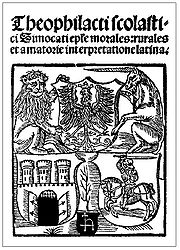
, Haller is perhaps best known for publishing in 1509 a volume of poems by Theophylact Simocatta
Theophylact Simocatta
Theophylact Simocatta was an early seventh-century Byzantine historiographer, arguably ranking as the last historian of Late Antiquity, writing in the time of Heraclius about the late Emperor Maurice .-Life:His history of the reign of emperor Maurice is in eight books...
which had been translated from Byzantine Greek by Nicolaus Copernicus. At the time there was no printing press in Copernicus' area—Lidzbark (Heilsberg)
Lidzbark Warminski
Lidzbark Warmiński is a town in the Warmian-Masurian Voivodeship in Poland. It is the capital of Lidzbark County.- History :The town was originally an Old Prussian settlement known as Lecbarg until being conquered in 1240 by the Teutonic Knights, who called it Heilsberg...
, Frombork (Frauenburg)
Frombork
Frombork is a town in northern Poland, on the Vistula Lagoon, in Braniewo County, Warmian-Masurian Voivodeship. It had a population of 2,528 as of 2005....
, Toruń (Thorn)
Torun
Toruń is an ancient city in northern Poland, on the Vistula River. Its population is more than 205,934 as of June 2009. Toruń is one of the oldest cities in Poland. The medieval old town of Toruń is the birthplace of the astronomer Nicolaus Copernicus....
—therefore Copernicus' translation could have been printed only in Breslau (Wrocław), Kraków
Kraków
Kraków also Krakow, or Cracow , is the second largest and one of the oldest cities in Poland. Situated on the Vistula River in the Lesser Poland region, the city dates back to the 7th century. Kraków has traditionally been one of the leading centres of Polish academic, cultural, and artistic life...
or farther afield. Copernicus, who had studied in Kraków, opted for Johann Haller, who together with Kasper Hochfeld had already published the first illustrated work in Poland, Jan Łaski's Statutes (1506), and one of 25 works by Laurentius Corvinus
Laurentius Corvinus
Laurentius Corvinus was a Silesian scholar who lectured as an ‘extraordinary’ professor at the University of Krakow when Nicolaus Copernicus began to study there...
(1508). Corvinus had lectured at the Kraków Academy while Copernicus studied there, and they were well acquainted. Corvinus took a job at Thorn, but in June 1509 traveled to the printer Haller in Kraków, bringing with him the manuscript entrusted to him by Copernicus. Corvinus (Rabe) added a poem, and Copernicus wrote a dedication to his uncle, Prince-Bishop of Warmia Lucas Watzenrode
Lucas Watzenrode the Younger
Lucas Watzenrode the Younger was Prince-Bishop of Warmia and patron to his nephew, astronomer Nicolaus Copernicus.-Early life:...
. Haller published the book before the end of 1509. Its cover featured the arms
Coat of arms
A coat of arms is a unique heraldic design on a shield or escutcheon or on a surcoat or tabard used to cover and protect armour and to identify the wearer. Thus the term is often stated as "coat-armour", because it was anciently displayed on the front of a coat of cloth...
of Poland
Poland
Poland , officially the Republic of Poland , is a country in Central Europe bordered by Germany to the west; the Czech Republic and Slovakia to the south; Ukraine, Belarus and Lithuania to the east; and the Baltic Sea and Kaliningrad Oblast, a Russian exclave, to the north...
, Lithuania
Lithuania
Lithuania , officially the Republic of Lithuania is a country in Northern Europe, the biggest of the three Baltic states. It is situated along the southeastern shore of the Baltic Sea, whereby to the west lie Sweden and Denmark...
and Kraków
Kraków
Kraków also Krakow, or Cracow , is the second largest and one of the oldest cities in Poland. Situated on the Vistula River in the Lesser Poland region, the city dates back to the 7th century. Kraków has traditionally been one of the leading centres of Polish academic, cultural, and artistic life...
.
Haller's life
After his studies at the Kraków Academy, Haller had become a merchant in wine, copper and tin, thus enabling himself to engage, at a later time, in the production of printing elements and finally establishing a printing press in KrakówKraków
Kraków also Krakow, or Cracow , is the second largest and one of the oldest cities in Poland. Situated on the Vistula River in the Lesser Poland region, the city dates back to the 7th century. Kraków has traditionally been one of the leading centres of Polish academic, cultural, and artistic life...
. His first printing products were almanac
Almanac
An almanac is an annual publication that includes information such as weather forecasts, farmers' planting dates, and tide tables, containing tabular information in a particular field or fields often arranged according to the calendar etc...
s, followed by a breviary
Breviary
A breviary is a liturgical book of the Latin liturgical rites of the Catholic Church containing the public or canonical prayers, hymns, the Psalms, readings, and notations for everyday use, especially by bishops, priests, and deacons in the Divine Office...
for the clergy. Haller acquired a partial monopoly on them, thereby protecting himself from competition. He soon expanded his business to include scientific and scholarly books inn astronomy, mathematics, philosophy and law, as well as royal and church statutes.
Altogether Haller produced 3,530 prints. His masterpieces are illustrated books containing 354 sheets of woodcuts.
See also
- List of Poles
- PrintingPrintingPrinting is a process for reproducing text and image, typically with ink on paper using a printing press. It is often carried out as a large-scale industrial process, and is an essential part of publishing and transaction printing....
- Early printing in Poland
External links
- Communicating Europe to the Region: Breslau in the Age of the Renaissance Lambrecht, German History, 2002 (pdf file)