

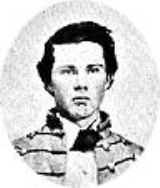
James K. Marshall

Encyclopedia
James Keith "Jimmy" Marshall (April 17, 1839 – July 3, 1863) was a Confederate Army
officer during the American Civil War
. Marshall commanded the wounded J. Johnston Pettigrew
's brigade
during Pickett's Charge
at the Battle of Gettysburg
. He was killed
during the assault.
, to Edward Carrington Marshall and Rebecca Courtenay Peyton Marshall. He was a grandson of Chief Justice of the United States
John Marshall
. He was related through blood or marriage to Thomas Jefferson
, George E. Pickett, and Robert E. Lee
. His great-grandfather had attended school with George Washington
and was commander of the 3rd Virginia Infantry during the American Revolutionary War
. He was also a first cousin of Col. Thomas A. Marshall and second cousin of General Lee's aide, Col. Charles Marshall
.
James K. Marshall graduated from the Virginia Military Institute
in 1860. He was chosen as the final orator for graduation ceremonies by the Society of Cadets. He also served as first lieutenant of a cadet company. When the Civil War broke out, Marshall was serving as a teacher in Edenton, North Carolina
.
Daniel Harvey Hill
in the spring of 1861. He did not take part in the Battle of Big Bethel
. He was made colonel of the 52nd North Carolina on April 23, 1862 under the command of Brig. Gen J. Johnston Pettigrew, despite having no combat experience. Marshall was initially elected to the post of lieutenant colonel
and Zebulon Vance was elected colonel, however, Vance declined the position so Marshall took the spot instead. Marshall spent much of this period defending the Blackwater River. Pettigrew's Brigade joined the Army of Northern Virginia
in late May 1863, for the Gettysburg Campaign
.
, routing them from the field and sending them running toward Seminary Ridge
. Marshall's men next attacked the 80th New York of Col. Theodore Gates and forced them to retreat. Soon after this attack, Maj. Gen.
Henry Heth
was wounded and Pettigrew was elevated to divisional command. Due to the high casualty rate in Pettigrew's Brigade command structure, Marshall was given charge of it. The brigade suffered 1,100 casualties
out of 2,584 engaged, however Marshall's 52nd North Carolina suffered only 26 casualties.
The brigade was not involved in any fighting on July 2, 1863. Marshall had the brigade's Moravian band perform for the men to heighten their morale after the first day's carnage.
Leading the decimated brigade during Pickett's Charge, Marshall's men crossed the field around the Bliss Farm and Stevens' Run and then crossed the Emmitsburg Rd, coming under withering fire at the fence line. While crossing the Emmitsburg Road, Marshall turned to Capt. Stockton Heath (son of Maj. Gen. Henry Heth) and said "We do not know which of us will be next to fall." Just minutes later, as Marshall neared the stonewall on Cemetery Ridge
he was struck in the forehead and killed instantly by two bullets while cheering his men on.
.
Marshall's remains were buried on the field at Gettysburg. It is assumed, but not known for sure, that he was re-interred at Hollywood Cemetery in Richmond, Virginia
.
Confederate States Army
The Confederate States Army was the army of the Confederate States of America while the Confederacy existed during the American Civil War. On February 8, 1861, delegates from the seven Deep South states which had already declared their secession from the United States of America adopted the...
officer during the American Civil War
American Civil War
The American Civil War was a civil war fought in the United States of America. In response to the election of Abraham Lincoln as President of the United States, 11 southern slave states declared their secession from the United States and formed the Confederate States of America ; the other 25...
. Marshall commanded the wounded J. Johnston Pettigrew
J. Johnston Pettigrew
James Johnston Pettigrew was an author, lawyer, linguist, diplomat, and a Confederate general in the American Civil War...
's brigade
Brigade
A brigade is a major tactical military formation that is typically composed of two to five battalions, plus supporting elements depending on the era and nationality of a given army and could be perceived as an enlarged/reinforced regiment...
during Pickett's Charge
Pickett's Charge
Pickett's Charge was an infantry assault ordered by Confederate Gen. Robert E. Lee against Maj. Gen. George G. Meade's Union positions on Cemetery Ridge on July 3, 1863, the last day of the Battle of Gettysburg during the American Civil War. Its futility was predicted by the charge's commander,...
at the Battle of Gettysburg
Battle of Gettysburg
The Battle of Gettysburg , was fought July 1–3, 1863, in and around the town of Gettysburg, Pennsylvania. The battle with the largest number of casualties in the American Civil War, it is often described as the war's turning point. Union Maj. Gen. George Gordon Meade's Army of the Potomac...
. He was killed
Killed in action
Killed in action is a casualty classification generally used by militaries to describe the deaths of their own forces at the hands of hostile forces. The United States Department of Defense, for example, says that those declared KIA need not have fired their weapons but have been killed due to...
during the assault.
Early life
Marshall was born in Fauquier County, VirginiaFauquier County, Virginia
As of the census of 2000, there were 55,139 people, 19,842 households, and 15,139 families residing in the county. The population density was 85 people per square mile . There were 21,046 housing units at an average density of 32 per square mile...
, to Edward Carrington Marshall and Rebecca Courtenay Peyton Marshall. He was a grandson of Chief Justice of the United States
Chief Justice of the United States
The Chief Justice of the United States is the head of the United States federal court system and the chief judge of the Supreme Court of the United States. The Chief Justice is one of nine Supreme Court justices; the other eight are the Associate Justices of the Supreme Court of the United States...
John Marshall
John Marshall
John Marshall was the Chief Justice of the United States whose court opinions helped lay the basis for American constitutional law and made the Supreme Court of the United States a coequal branch of government along with the legislative and executive branches...
. He was related through blood or marriage to Thomas Jefferson
Thomas Jefferson
Thomas Jefferson was the principal author of the United States Declaration of Independence and the Statute of Virginia for Religious Freedom , the third President of the United States and founder of the University of Virginia...
, George E. Pickett, and Robert E. Lee
Robert E. Lee
Robert Edward Lee was a career military officer who is best known for having commanded the Confederate Army of Northern Virginia in the American Civil War....
. His great-grandfather had attended school with George Washington
George Washington
George Washington was the dominant military and political leader of the new United States of America from 1775 to 1799. He led the American victory over Great Britain in the American Revolutionary War as commander-in-chief of the Continental Army from 1775 to 1783, and presided over the writing of...
and was commander of the 3rd Virginia Infantry during the American Revolutionary War
American Revolutionary War
The American Revolutionary War , the American War of Independence, or simply the Revolutionary War, began as a war between the Kingdom of Great Britain and thirteen British colonies in North America, and ended in a global war between several European great powers.The war was the result of the...
. He was also a first cousin of Col. Thomas A. Marshall and second cousin of General Lee's aide, Col. Charles Marshall
Charles Marshall (Colonel)
Charles Marshall was a Confederate Army officer during the American Civil War. Marshall served as an aide de camp, assistant adjutant general and military secretary to Gen. Robert E. Lee. He was also an uncle of WWII General George Marshall.-Early life:Marshall was born in Warrenton, Virginia to...
.
James K. Marshall graduated from the Virginia Military Institute
Virginia Military Institute
The Virginia Military Institute , located in Lexington, Virginia, is the oldest state-supported military college and one of six senior military colleges in the United States. Unlike any other military college in the United States—and in keeping with its founding principles—all VMI students are...
in 1860. He was chosen as the final orator for graduation ceremonies by the Society of Cadets. He also served as first lieutenant of a cadet company. When the Civil War broke out, Marshall was serving as a teacher in Edenton, North Carolina
Edenton, North Carolina
Edenton is a town in Chowan County, North Carolina, United States. The population was 4,966 at the 2008 census. It is the county seat of Chowan County. Edenton is located in North Carolina's Inner Banks region. In recent years Edenton has become a popular retirement location and a destination for...
.
Civil War
Marshall became a captain of Company M of the 1st North Carolina "Bethel Regiment" of Col.Colonel (United States)
In the United States Army, Air Force, and Marine Corps, colonel is a senior field grade military officer rank just above the rank of lieutenant colonel and just below the rank of brigadier general...
Daniel Harvey Hill
Daniel Harvey Hill
On July 22, 1862, Hill and Union Maj. Gen. John A. Dix concluded an agreement for the general exchange of prisoners between the Union and Confederate armies. This agreement became known as the Dix-Hill Cartel....
in the spring of 1861. He did not take part in the Battle of Big Bethel
Battle of Big Bethel
The Battle of Big Bethel, also known as the Battle of Bethel Church or Great Bethel was one of the earliest land battles of the American Civil War after the surrender of Fort Sumter...
. He was made colonel of the 52nd North Carolina on April 23, 1862 under the command of Brig. Gen J. Johnston Pettigrew, despite having no combat experience. Marshall was initially elected to the post of lieutenant colonel
Lieutenant colonel
Lieutenant colonel is a rank of commissioned officer in the armies and most marine forces and some air forces of the world, typically ranking above a major and below a colonel. The rank of lieutenant colonel is often shortened to simply "colonel" in conversation and in unofficial correspondence...
and Zebulon Vance was elected colonel, however, Vance declined the position so Marshall took the spot instead. Marshall spent much of this period defending the Blackwater River. Pettigrew's Brigade joined the Army of Northern Virginia
Army of Northern Virginia
The Army of Northern Virginia was the primary military force of the Confederate States of America in the Eastern Theater of the American Civil War, as well as the primary command structure of the Department of Northern Virginia. It was most often arrayed against the Union Army of the Potomac...
in late May 1863, for the Gettysburg Campaign
Gettysburg Campaign
The Gettysburg Campaign was a series of battles fought in June and July 1863, during the American Civil War. After his victory in the Battle of Chancellorsville, Confederate General Robert E. Lee's Army of Northern Virginia moved north for offensive operations in Maryland and Pennsylvania. The...
.
Gettysburg
Pettigrew's Brigade saw intense fighting during the Battle of Gettysburg. On July 1, 1863, Marshall's regiment initially encountered two companies from the 80th New York Infantry at the Harmon farm. A detachment of this regiment burned down the house, and barn, sending Amelia Harmon and her aunt, who were still inside, running westward away from the danger. After dispersing these men, a portion of the 52nd North Carolina fought part of the 8th New York Cavalry at Meal's Orchard. The 52nd crossed Willoughby Run and faced resistance from more cavalry units around Fairfield Road. After crossing Fairfield Road, Marshall's men slammed into the flank of the 121st Pennsylvania of Lt. Col. Alexander BiddleAlexander Biddle
Alexander Biddle was an officer in the Union Army during the American Civil War.-Life:His father was Thomas A. Biddle , the son of American Revolutionary War soldier Clement Biddle ....
, routing them from the field and sending them running toward Seminary Ridge
Seminary Ridge
Seminary Ridge is a dendritic ridge which was an area of Battle of Gettysburg engagements during the American Civil War and of military installations during World War II.-Geography:...
. Marshall's men next attacked the 80th New York of Col. Theodore Gates and forced them to retreat. Soon after this attack, Maj. Gen.
Major general (United States)
In the United States Army, United States Marine Corps, and United States Air Force, major general is a two-star general-officer rank, with the pay grade of O-8. Major general ranks above brigadier general and below lieutenant general...
Henry Heth
Henry Heth
Henry "Harry" Heth was a career United States Army officer and a Confederate general in the American Civil War. He is best remembered for inadvertently precipitating the Battle of Gettysburg, when he sent some of his troops of the Army of Northern Virginia to the small Pennsylvania village,...
was wounded and Pettigrew was elevated to divisional command. Due to the high casualty rate in Pettigrew's Brigade command structure, Marshall was given charge of it. The brigade suffered 1,100 casualties
Casualty of war
Casualty of war: Military or civilian casualty suffered in war or deployments on the side in which it occurred.-See also:Related terms* Casualty* Collateral damage* Conflict epidemiology* Fragging* Friendly fireStatistics...
out of 2,584 engaged, however Marshall's 52nd North Carolina suffered only 26 casualties.
The brigade was not involved in any fighting on July 2, 1863. Marshall had the brigade's Moravian band perform for the men to heighten their morale after the first day's carnage.
Leading the decimated brigade during Pickett's Charge, Marshall's men crossed the field around the Bliss Farm and Stevens' Run and then crossed the Emmitsburg Rd, coming under withering fire at the fence line. While crossing the Emmitsburg Road, Marshall turned to Capt. Stockton Heath (son of Maj. Gen. Henry Heth) and said "We do not know which of us will be next to fall." Just minutes later, as Marshall neared the stonewall on Cemetery Ridge
Cemetery Ridge
Cemetery Ridge is a geographic feature in Gettysburg National Military Park south of the town of Gettysburg, Pennsylvania, that figured prominently in the Battle of Gettysburg, July 1 to July 3, 1863. It formed a primary defensive position for the Union Army during the battle, roughly the center of...
he was struck in the forehead and killed instantly by two bullets while cheering his men on.
Aftermath
Marshall's family did not know what had happened to him until several months later when they received a letter from Marshall's cousin F. Lewis Marshall informing them of James K. Marshall's death at Gettysburg. The family had heard conflicting reports of Marshall's fate, and thought that he was a prisoner of warPrisoner of war
A prisoner of war or enemy prisoner of war is a person, whether civilian or combatant, who is held in custody by an enemy power during or immediately after an armed conflict...
.
Marshall's remains were buried on the field at Gettysburg. It is assumed, but not known for sure, that he was re-interred at Hollywood Cemetery in Richmond, Virginia
Richmond, Virginia
Richmond is the capital of the Commonwealth of Virginia, in the United States. It is an independent city and not part of any county. Richmond is the center of the Richmond Metropolitan Statistical Area and the Greater Richmond area...
.
Further reading
- Pfanz, Harry W. Gettysburg – The First Day. Chapel Hill: University of North Carolina Press, 2001. ISBN 0-8078-2624-3.