


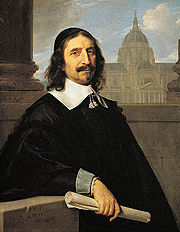
Jacques Lemercier

Encyclopedia
France
The French Republic , The French Republic , The French Republic , (commonly known as France , is a unitary semi-presidential republic in Western Europe with several overseas territories and islands located on other continents and in the Indian, Pacific, and Atlantic oceans. Metropolitan France...
architect
Architect
An architect is a person trained in the planning, design and oversight of the construction of buildings. To practice architecture means to offer or render services in connection with the design and construction of a building, or group of buildings and the space within the site surrounding the...
and engineer
Engineer
An engineer is a professional practitioner of engineering, concerned with applying scientific knowledge, mathematics and ingenuity to develop solutions for technical problems. Engineers design materials, structures, machines and systems while considering the limitations imposed by practicality,...
, one of the influential trio that included Louis Le Vau
Louis Le Vau
Louis Le Vau was a French Classical architect who worked for Louis XIV of France. He was born and died in Paris.He was responsible, with André Le Nôtre and Charles Le Brun, for the redesign of the château of Vaux-le-Vicomte. His later works included the Palace of Versailles and his collaboration...
and François Mansart
François Mansart
François Mansart was a French architect credited with introducing classicism into Baroque architecture of France...
who formed the classicizing French Baroque manner, drawing from French traditions of the previous century and current Roman practice the fresh, essentially French synthesis associated with Cardinal Richelieu and Louis XIII
Louis XIII of France
Louis XIII was a Bourbon monarch who ruled as King of France and of Navarre from 1610 to 1643.Louis was only eight years old when he succeeded his father. His mother, Marie de Medici, acted as regent during Louis' minority...
.
Life and career
Lemercier was the son of a master masonStonemasonry
The craft of stonemasonry has existed since the dawn of civilization - creating buildings, structures, and sculpture using stone from the earth. These materials have been used to construct many of the long-lasting, ancient monuments, artifacts, cathedrals, and cities in a wide variety of cultures...
, one of a large interrelated tribe of professionals. Profiting by a voyage to Italy with a long stay in Rome, presumably from about 1607 to 1610, Lemercier developed the simplified classicizing manner established by Salomon de Brosse
Salomon de Brosse
Salomon de Brosse was the most influential early 17th-century French architect, a major influence on François Mansart. Salomon was from a prominent Huguenot family, the grandson through his mother of the designer Jacques I Androuet du Cerceau and the son of the architect Jean de Brosse...
, who died in 1636, and whose Palais du Luxembourg for Marie de Medici Lemercier would see to completion.
On his return to France, after several years working as an engineer building bridges, his first major commission, however, was to complete the Parisian Church of the Oratorians, (1616), which had been begun by Charles Métezeau; its success made his reputation. As early as 1618 he appears as architecte du roy, with a salary of 1200 livres, out of which he had to reimburse his atelier. In 1625 Richelieu put him in charge of the main royal project, the galleries being added to the Louvre
Louvre
The Musée du Louvre – in English, the Louvre Museum or simply the Louvre – is one of the world's largest museums, the most visited art museum in the world and a historic monument. A central landmark of Paris, it is located on the Right Bank of the Seine in the 1st arrondissement...
, where Lemercier was working to the design established by Pierre Lescot
Pierre Lescot
Pierre Lescot was a French architect active during the French Renaissance, "the man who was first responsible for the implantation of pure and correct classical architecture in France." He was born in Paris....
a generation before; for the sake of regularity, Lescot's ranges in the Cour Carré were multiplied round further courtyards, quadrupling the building area, each of the four sides having a pavilion at its center. In this manner Lemercier built the northern half of the west side and the famous Pavillon de l'Horloge at the center of the west wing. Its high squared dome breaks the wing's roofline and three arched openings provide access to the enclosed court. Two superposed orders of columns and rich sculptural decor in pediments and niches, on piers and panels are kept under control by strong horizontal cornice lines.
During 1638 and 1639 Lemercier was appointed premier architecte charged with supervision of all the royal building enterprises, in which capacity he fell into a disagreeable dispute with the cultivated Nicolas Poussin
Nicolas Poussin
Nicolas Poussin was a French painter in the classical style. His work predominantly features clarity, logic, and order, and favors line over color. His work serves as an alternative to the dominant Baroque style of the 17th century...
about the decorations in the Louvre.
The Hôtel de Liancourt (1623) stands out among Lemercier's Paris hôtels particuliers
Hôtel particulier
In French contexts an hôtel particulier is an urban "private house" of a grand sort. Whereas an ordinary maison was built as part of a row, sharing party walls with the houses on either side and directly fronting on a street, an hôtel particulier was often free-standing, and by the 18th century it...
for aristocratic patrons.
For Richelieu Lemercier built the Paris residence (from 1627 on), the "Palais-Cardinal" which still forms the nucleus of the Palais Royal
Palais Royal
The Palais-Royal, originally called the Palais-Cardinal, is a palace and an associated garden located in the 1st arrondissement of Paris...
, where Lemercier's work can be seen in the cour d'honneur
Cour d'Honneur
Cour d'Honneur is the architectural term for defining a three-sided courtyard, created when the main central block, or corps de logis, is flanked by symmetrical advancing secondary wings, containing minor rooms...
facing the Place. A more expansive town-planning project, one of the most ambitious non-military French projects of the century, was the palatial residence, the grand parish church and the entire new town of Richelieu
Richelieu, Indre-et-Loire
Richelieu is a commune in the Indre-et-Loire department in central France.It lies south of Chinon and west of Sainte-Maure de Touraine and is surrounded by mostly agricultural land...
, in Poitou
Poitou
Poitou was a province of west-central France whose capital city was Poitiers.The region of Poitou was called Thifalia in the sixth century....
(Indre-et-Loire
Indre-et-Loire
Indre-et-Loire is a department in west-central France named after the Indre and the Loire rivers.-History:Indre-et-Loire is one of the original 83 départements created during the French Revolution on 4 March 1790...
). The lost château itself was an improvisation on the theme set by Brosse's Luxembourg. Also for the Cardinal Lemercier rebuilt the Château de Rueil, not so far from Paris, also demolished. The Château of Thouars
Thouars
Thouars is a commune in the Deux-Sèvres department in western France.It is on the River Thouet. Its inhabitants are known as Thouarsais.-History:...
, with its majestic long façade, is his also, and survives.
Less known, because gardens are less permanent, are parterre
Parterre
A parterre is a formal garden construction on a level surface consisting of planting beds, edged in stone or tightly clipped hedging, and gravel paths arranged to form a pleasing, usually symmetrical pattern. Parterres need not have any flowers at all...
gardens laid out to Lemercier's designs, at Montjeu, at Richelieu and at Rueil (Mignot; Gady).
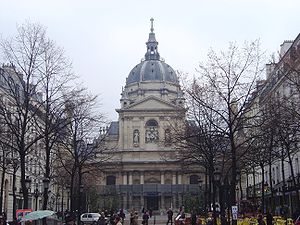
Collège de Sorbonne
The Collège de Sorbonne was a theological college of the University of Paris, founded in 1257 by Robert de Sorbon, after whom it is named. With the rest of the Paris colleges, it was suppressed during the French Revolution. It was restored in 1808 but finally closed in 1882. The name Sorbonne...
, the college has been rebuilt, but its domed church (1635) is the acknowledged surviving masterpiece of Lemercier. The hemispherical dome on a tall octagonal drum, first of its type in France, has four small cupolas in the angles of the Greek cross above the two Corinthian order
Corinthian order
The Corinthian order is one of the three principal classical orders of ancient Greek and Roman architecture. The other two are the Doric and Ionic. When classical architecture was revived during the Renaissance, two more orders were added to the canon, the Tuscan order and the Composite order...
s on the façade, of full columns below, flat pilasters above. The interior was intended to be frescoed. The square intersection is surrounded by cylindrical vaults and a semicircular choir apse. The north side consists of a portico. In the church Richelieu was interred in 1642.
At the royal abbey church of Val-de-Grâce
Val-de-Grâce
This article describes the hospital and former abbey. For the main article on Mansart and Lemercier's central church, see Church of the Val-de-Grâce....
Lemercier succeeded the elder Mansart
François Mansart
François Mansart was a French architect credited with introducing classicism into Baroque architecture of France...
who completed the structure to the cornice line, and refused to agree to a change in the building's design. Lemercier completed it with a dome.
Louis XIII of France
Louis XIII was a Bourbon monarch who ruled as King of France and of Navarre from 1610 to 1643.Louis was only eight years old when he succeeded his father. His mother, Marie de Medici, acted as regent during Louis' minority...
in initial planning for an expansion of the hunting lodge at Versailles, a project which was only realized by other architects, notably Louis Le Vau
Louis Le Vau
Louis Le Vau was a French Classical architect who worked for Louis XIV of France. He was born and died in Paris.He was responsible, with André Le Nôtre and Charles Le Brun, for the redesign of the château of Vaux-le-Vicomte. His later works included the Palace of Versailles and his collaboration...
and Jules Hardouin-Mansart, under the guidance of Louis XIV
Louis XIV of France
Louis XIV , known as Louis the Great or the Sun King , was a Bourbon monarch who ruled as King of France and Navarre. His reign, from 1643 to his death in 1715, began at the age of four and lasted seventy-two years, three months, and eighteen days...
.
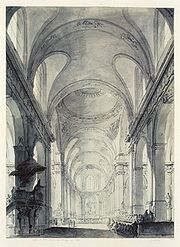
One of his last commissions was the design of the Church of Saint-Roch, where the cornerstone was laid by Louis XIV
Louis XIV of France
Louis XIV , known as Louis the Great or the Sun King , was a Bourbon monarch who ruled as King of France and Navarre. His reign, from 1643 to his death in 1715, began at the age of four and lasted seventy-two years, three months, and eighteen days...
in 1653. With a length of m. it is one of the largest churches of Paris. the deep choir emphasizes the extent of the interior, scarcely interrupted by the discreet low dome over the crossing
Crossing (architecture)
A crossing, in ecclesiastical architecture, is the junction of the four arms of a cruciform church.In a typically oriented church , the crossing gives access to the nave on the west, the transept arms on the north and south, and the choir on the east.The crossing is sometimes surmounted by a tower...
, which is hidden on the exterior beneath the transept roof. Lemercier completed the choir and crossing and the rest of the interior was carried out to his plan. Work was interrupted 1701–1740 save for a chapel inserted 1705–1710 designed by Jules Hardouin-Mansart. The present façade is an 18th-century composition by Robert de Cotte
Robert de Cotte
Robert de Cotte was a French architect-administrator, under whose design control of the royal buildings of France from 1699, the earliest notes presaging the Rococo style were introduced. First a pupil of Jules Hardouin-Mansart, he later became his brother-in-law and his collaborator...
.
In a long career, the scrupulous Lemercier amassed no fortune. Though in 1645 Lemercier was receiving, as first among the royal architects (premier architecte du Roi), a salary of 3000 livres, after his death— in the house he had built for himself, still standing at n° 46 rue de l’Arbre Sec (Gady)— it was necessary to sell the large library he had collected, in order to settle his debts.
See also the following French architects of the first half of the 17th century:
- Salomon de BrosseSalomon de BrosseSalomon de Brosse was the most influential early 17th-century French architect, a major influence on François Mansart. Salomon was from a prominent Huguenot family, the grandson through his mother of the designer Jacques I Androuet du Cerceau and the son of the architect Jean de Brosse...
- Liberal BruantLibéral BruantLibéral Bruant , was a French architect best known as the designer of the Hôtel des Invalides, Paris, now dominated by the dome erected by Jules Hardouin Mansart, his collaborator in earlier stages of the construction...
- Pierre Le MuetPierre Le MuetPierre Le Muet was a French architect famous for his book Manière de bâtir pour toutes sortes de personnes , and for the châteaux he constructed, most notably Tanlay in Burgundy, as well as some modest houses in Paris, the grandest of which, the Hôtel d’Avaux survives and has recently been...
- Louis Le VauLouis Le VauLouis Le Vau was a French Classical architect who worked for Louis XIV of France. He was born and died in Paris.He was responsible, with André Le Nôtre and Charles Le Brun, for the redesign of the château of Vaux-le-Vicomte. His later works included the Palace of Versailles and his collaboration...
- François MansartFrançois MansartFrançois Mansart was a French architect credited with introducing classicism into Baroque architecture of France...
- Charles Métezeau
Further reading
- Gady, Alexandre, 2005. Jacques Lemercier, architecte et ingénieur du roi ISBN 2-7351-1042-7 Review by Thierry Sarment. The first monograph devoted to Jacques Lemercier.