


Izapa Stela 5

Encyclopedia
Mesoamerica
Mesoamerica is a region and culture area in the Americas, extending approximately from central Mexico to Belize, Guatemala, El Salvador, Honduras, Nicaragua, and Costa Rica, within which a number of pre-Columbian societies flourished before the Spanish colonization of the Americas in the 15th and...
n site of Izapa
Izapa
Izapa is a very large pre-Columbian archaeological site located in the Mexican state of Chiapas; it was occupied during the Late Formative period. The site is situated on the Izapa River, a tributary of the Suchiate River, near the base of the Tacaná volcano), the fourth largest mountain in...
, in the Soconusco
Soconusco
Soconusco is a region of the Mexican state of Chiapas, located in the extreme south of the state and separated from Guatemala by the Suchiate River. It is a region of rich lowlands and foothills. The economic center is Tapachula. Soconusco consists of 16 municipalities.The name comes from the...
region of Chiapas
Chiapas
Chiapas officially Estado Libre y Soberano de Chiapas is one of the 31 states that, with the Federal District, comprise the 32 Federal Entities of Mexico. It is divided in 118 municipalities and its capital city is Tuxtla Gutierrez. Other important cites in Chiapas include San Cristóbal de las...
, Mexico
Mexico
The United Mexican States , commonly known as Mexico , is a federal constitutional republic in North America. It is bordered on the north by the United States; on the south and west by the Pacific Ocean; on the southeast by Guatemala, Belize, and the Caribbean Sea; and on the east by the Gulf of...
along the present-day Guatemalan border. These stelae date from roughly 300 BCE
Common Era
Common Era ,abbreviated as CE, is an alternative designation for the calendar era originally introduced by Dionysius Exiguus in the 6th century, traditionally identified with Anno Domini .Dates before the year 1 CE are indicated by the usage of BCE, short for Before the Common Era Common Era...
to 50 or 100 BCE, although some argue for dates as late as 250 CE.
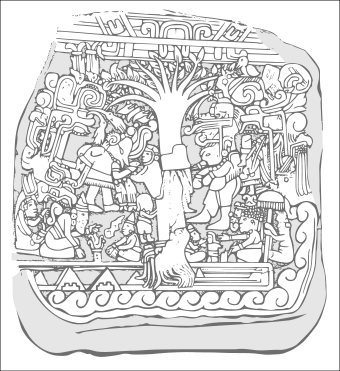
Also known as the "Tree of Life" stone, the complex religious imagery of Izapa Stela 5 has led to different theories and speculations concerning its subject matter, including the possibility it suggests Pre-Columbian trans-oceanic contact
Pre-Columbian trans-oceanic contact
Theories of Pre-Columbian trans-oceanic contact are those theories that propose interaction between indigenous peoples of the Americas who settled the Americas before 10,000 BC, and peoples of other continents , which occurred before the arrival of Christopher Columbus in the Caribbean in 1492.Many...
.
The stela
Documented by Smithsonian archaeologist Matthew W. Stirling in 1941, Stela 5 is composed of volcanic andesiteAndesite
Andesite is an extrusive igneous, volcanic rock, of intermediate composition, with aphanitic to porphyritic texture. In a general sense, it is the intermediate type between basalt and dacite. The mineral assemblage is typically dominated by plagioclase plus pyroxene and/or hornblende. Magnetite,...
and weighs around one-and-a-half tons. Stela 5 presents the most complex imagery of all the stelae at Izapa. Researcher Garth Norman, for example, has counted "at least 12" human figures, a dozen animals, over 25 botanical or inanimate objects, and 9 stylized deity masks.
Like much of Izapan monumental sculpture, the subject matter of Stela 5 is considered mythological and religious in nature and is executed with a stylized opulence. Given the multiple overlapping scenes, it appears to be a narrative.
Theories and speculations
Mainstream Mesoamerican researchers identify the central image as a Mesoamerican world tree, connecting the sky above and the water or underworld below.Linda Schele
Linda Schele
Linda Schele was an expert in the field of Maya epigraphy and iconography. She played an invaluable role in the decipherment of much of the Maya hieroglyphics. She produced a massive volume of drawings of stelae and inscriptions, which, following her wishes, are free for use to scholars...
and Mary Ellen Miller further propose that the stela records a creation myth, with barely formed humans emerging from a hole drilled into the tree's left side. The associated seated figures are completing these humans in various ways. Julia Guernsey Kappelman, on the other hand, suggests the seated figures are Izapa elites conducting ritual activities in a "quasi-historical scene", which is framed by, and placed in the context of, the "symbolic landscape of creation".
Lehi's vision
Based on the "Tree of Life" theories put forth by Stirling and others, M. Wells JakemanM. Wells Jakeman
Max Wells Jakeman was the founder of the department of archaeology at Brigham Young University and an early member of the advisory board of the New World Archaeology Foundation . Jakeman has been described as "the father of Book of Mormon archaeology".Jakeman received his Ph.D...
proposed that the bas-relief image was a representation of Lehi's dream of the tree of life in the Book of Mormon
Book of Mormon
The Book of Mormon is a sacred text of the Latter Day Saint movement that adherents believe contains writings of ancient prophets who lived on the American continent from approximately 2600 BC to AD 421. It was first published in March 1830 by Joseph Smith, Jr...
. Jakeman published multiple interpretations and theories about the stone during his lifetime and the Lehi theory quickly filtered through Mormon culture.
Other Latter-day Saint researchers have claimed that the six figures at the level of the tree represent Lehi's family at the time of the vision, from left to right: Sariah, Lehi, Laman, Lemuel, Sam and Nephi. Four of the six figures are facing the tree, representing those who ate of the fruit in Lehi's vision, and the Laman and Lemuel figures are facing away representing their rejection of the tree. However, most modern LDS scholars are skeptical about a possible link between the stella and the Book of Mormon.
Out of Africa
Ivan van SertimaIvan van Sertima
Ivan Gladstone Van Sertima was an associate professor of Africana Studies at Rutgers University in the United States....
interpreted the imagery to support theories of an African origin
Olmec alternative origin speculations
Olmec alternative origin speculations are explanations that have been suggested for the formation of Olmec civilization which contradict generally accepted scholarly consensus. These origin theories typically involve contact with Old World societies...
citing, for example, what he interprets as a boat at the bottom of the scene.
Disagreement
Mainstream Mesoamerican scholars do not support linking Izapa Stela 5 to the Bible, the Book of Mormon, or an "out of Africa" theory. For example, Julia Guernsey Kappelman, author of a definitive work on Izapan culture, finds that Jakeman's research "belies an obvious religious agenda that ignored Izapa Stela 5's heritage".External links
- Picture and drawing of the stone
- Stela 5 at the Archaeological Ruins of Izapa
- The History of an Idea: The Scene on Stela 5 from Izapa, Mexico, as a Representation of Lehi's Vision of the Tree of Life
- A New Artistic Rendering of Izapa Stela 5: A Step toward Improved Interpretation
- Mormon article containing a drawing of Stela 5