

Itchycoo Park

Encyclopedia
"Itchycoo Park" is a psychedelic pop
song written by Steve Marriott
and Ronnie Lane
, first recorded by their group, the Small Faces. The song reached number three in the UK Singles Chart
, 1967.
in August, 1967. Together with "Lazy Sunday
", "Tin Soldier
" and "All or Nothing
", the song is one of the band's biggest hits and has become a classic of its time.
The song reached number 16 in the American Billboard Hot 100
chart in 1968
.
Long running British music magazine NME
cites readers poll voting "Itchycoo Park" number 62 out of the top 100 singles of all time.
"Itchycoo Park" climbed the charts again when it was re-released on 13 December 1975.
The song was one of the first pop singles to use flanging
, an effect that can be heard in the bridge section after each chorus. Most sources credit the use of the effect to Olympic Studios
engineer George Chkiantz
who showed it to the Small Faces regular engineer Glyn Johns
; he in turn demonstrated it to the group, who were always on the lookout for innovative production sounds, and they readily agreed to its use on the single.
Although many devices were soon created that could produce the same effect by purely electronic means, the effect as used on "Itchycoo Park" was at that time an electro-mechanical studio process. Two synchronized tape copies of a finished recording were played simultaneously into a third master recorder, and by manually retarding the rotation of one of the two tape reels using the fingers, a skilled engineer could subtly manipulate the phase difference between the two sources, creating the lush 'swooshing' phase effect that sweeps up and down the frequency range. Because the the original single version was mixed and mastered in mono, the flanging effect in "Itchycoo Park" is more pronounced in its original mono mix, and is noticeably diluted in the subsequent stereo mix.
which mentioned its dreaming spires.
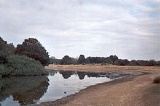
A number of sources claim the song's name is derived from the nickname of Little Ilford Park, on Church Road in the London
suburb of Manor Park
, where Small Faces' singer and song-writer Steve Marriott
grew up. The "itchycoo" nickname is, in turn, attributed to the stinging nettles which grew there. Other sources cite nearby Wanstead Flats
(Manor Park end) as the inspiration for the song.
Marriott and Small Faces manager Tony Calder
came up with the well-known story when Marriott was told the BBC
had banned the song for its overt drug references, Calder confirms:
Ronnie Lane on the true location of Itchycoo Park:
, called Valentines Park
, was also often referred to as Itchycoo Park.
Itchy Park is located in the East End of London and dates back to the Victorian era.
The hairy seeds from the Rose hip
(or wild Dog Rose) were called "Itchycoos" by English children in the 1950s The seeds could be broken out of the berry and dropped down someone's collar between shirt and back to cause itching.
Psychedelic pop
Psychedelic pop is a psychedelic musical style inspired by the sounds of psychedelic folk and psychedelic rock, but applied to a pop music setting...
song written by Steve Marriott
Steve Marriott
Stephen Peter Marriott , popularly known as Steve Marriott, was an English musician, songwriter, and frontman of several notable rock and roll bands, spanning over two decades...
and Ronnie Lane
Ronnie Lane
Ronald Frederick "Ronnie" Lane was an English musician, songwriter, and producer who is best known as the bass guitarist and founding member of two prominent English rock and roll bands; the Small Faces where he was nicknamed "Plonk", – and, after losing the band's frontman, Faces, with two new...
, first recorded by their group, the Small Faces. The song reached number three in the UK Singles Chart
UK Singles Chart
The UK Singles Chart is compiled by The Official Charts Company on behalf of the British record-industry. The full chart contains the top selling 200 singles in the United Kingdom based upon combined record sales and download numbers, though some media outlets only list the Top 40 or the Top 75 ...
, 1967.
Song profile
"Itchycoo Park" was released by mod band The Small FacesThe Small Faces
The Small Faces were an English rock and roll band from East London, heavily influenced by American rhythm and blues. The group was founded in 1965 by members Steve Marriott, Ronnie Lane, Kenney Jones, and Jimmy Winston, although by 1966 Winston was replaced by Ian McLagan as the band's...
in August, 1967. Together with "Lazy Sunday
Lazy Sunday (song)
"Lazy Sunday" is a song by English beat band Small Faces, reaching number two on the UK singles chart in 1968 . It was written by the Small Faces songwriting duo Steve Marriott and Ronnie Lane, and appeared on the band's 1968 concept album Ogdens' Nut Gone Flake and preceded the album as a...
", "Tin Soldier
Tin Soldier (song)
"Tin Soldier" is a Rock song written by Steve Marriott . It was released on 2 December 1967, by the popular English band Small Faces. The song peaked at number nine in the UK singles chart.-Song profile:...
" and "All or Nothing
All or Nothing (Small Faces song)
"All or Nothing" is a hit song written by Steve Marriott and Ronnie Lane of British mod group Small Faces in 1966.The song reached number one on the UK Singles Chart two weeks after being released and due to a change in the TOTP chart that week, shared spot with The Beatles song "Yellow...
", the song is one of the band's biggest hits and has become a classic of its time.
The song reached number 16 in the American Billboard Hot 100
Billboard Hot 100
The Billboard Hot 100 is the United States music industry standard singles popularity chart issued weekly by Billboard magazine. Chart rankings are based on radio play and sales; the tracking-week for sales begins on Monday and ends on Sunday, while the radio play tracking-week runs from Wednesday...
chart in 1968
1968 in music
-Events:*January 4 – Guitarist Jimi Hendrix is jailed by Stockholm police, after trashing a hotel room during a drunken fist fight with bassist Noel Redding.*January 6 – Gibson Guitar Corporation patents its Gibson Flying V electric guitar design....
.
Long running British music magazine NME
NME
The New Musical Express is a popular music publication in the United Kingdom, published weekly since March 1952. It started as a music newspaper, and gradually moved toward a magazine format during the 1980s, changing from newsprint in 1998. It was the first British paper to include a singles...
cites readers poll voting "Itchycoo Park" number 62 out of the top 100 singles of all time.
"Itchycoo Park" climbed the charts again when it was re-released on 13 December 1975.
The song was one of the first pop singles to use flanging
Flanging
Flanging is an audio effect produced by mixing two identical signals together, with one signal delayed by a small and gradually changing period, usually smaller than 20 milliseconds. This produces a swept comb filter effect: peaks and notches are produced in the resultant frequency spectrum,...
, an effect that can be heard in the bridge section after each chorus. Most sources credit the use of the effect to Olympic Studios
Olympic Studios
Olympic Studios was a renowned independent commercial recording studio located at 117 Church Road, Barnes, South West London, England. The studio is best known for the huge number of famous rock and pop recordings made there from the late 1960s onward....
engineer George Chkiantz
George Chkiantz
George Chkiantz is a recording engineer based in London who has been responsible for the engineering on a number of well-known albums, many of which are considered classics, owing in part to the high quality of the recordings....
who showed it to the Small Faces regular engineer Glyn Johns
Glyn Johns
Glyn Johns is a musician, recording engineer and record producer.-Career:He has worked with such artists as Bob Dylan, The Beatles, The Easybeats, The Band, The Rolling Stones, The Who, Led Zeppelin, Eagles, Eric Clapton, The Clash, The Steve Miller Band, Small Faces, Spooky Tooth, The Ozark...
; he in turn demonstrated it to the group, who were always on the lookout for innovative production sounds, and they readily agreed to its use on the single.
Although many devices were soon created that could produce the same effect by purely electronic means, the effect as used on "Itchycoo Park" was at that time an electro-mechanical studio process. Two synchronized tape copies of a finished recording were played simultaneously into a third master recorder, and by manually retarding the rotation of one of the two tape reels using the fingers, a skilled engineer could subtly manipulate the phase difference between the two sources, creating the lush 'swooshing' phase effect that sweeps up and down the frequency range. Because the the original single version was mixed and mastered in mono, the flanging effect in "Itchycoo Park" is more pronounced in its original mono mix, and is noticeably diluted in the subsequent stereo mix.
Inspiration
The song was first thought of, and largely written, by Ronnie Lane, who had been reading a leaflet on the virtues of OxfordOxford
The city of Oxford is the county town of Oxfordshire, England. The city, made prominent by its medieval university, has a population of just under 165,000, with 153,900 living within the district boundary. It lies about 50 miles north-west of London. The rivers Cherwell and Thames run through...
which mentioned its dreaming spires.
A number of sources claim the song's name is derived from the nickname of Little Ilford Park, on Church Road in the London
London
London is the capital city of :England and the :United Kingdom, the largest metropolitan area in the United Kingdom, and the largest urban zone in the European Union by most measures. Located on the River Thames, London has been a major settlement for two millennia, its history going back to its...
suburb of Manor Park
Manor Park, London
Manor Park is the name of an area in the London Borough of Newham, as well as of the local railway station and cemetery. There is another railway station - Woodgrange Park...
, where Small Faces' singer and song-writer Steve Marriott
Steve Marriott
Stephen Peter Marriott , popularly known as Steve Marriott, was an English musician, songwriter, and frontman of several notable rock and roll bands, spanning over two decades...
grew up. The "itchycoo" nickname is, in turn, attributed to the stinging nettles which grew there. Other sources cite nearby Wanstead Flats
Wanstead Flats
Wanstead Flats is the southern-most portion of Epping Forest in east London. It is surrounded by the heavily built-up areas of Leytonstone to the west, Wanstead to the north with Manor Park and Forest Gate to the southeast and south respectively. To the north-west it is connected by way of Bush...
(Manor Park end) as the inspiration for the song.
Marriott and Small Faces manager Tony Calder
Tony Calder
Tony Calder is an English rock and roll record manager, impresario, talent-spotter, Promoter and Public Relations agent...
came up with the well-known story when Marriott was told the BBC
BBC
The British Broadcasting Corporation is a British public service broadcaster. Its headquarters is at Broadcasting House in the City of Westminster, London. It is the largest broadcaster in the world, with about 23,000 staff...
had banned the song for its overt drug references, Calder confirms:
"We scammed the story together, we told the BBC that Itchycoo Park was a piece of waste ground in the East End that the band had played on as kids - we put the story out at ten and by lunchtime we were told the ban was off." - Tony CalderTony CalderTony Calder is an English rock and roll record manager, impresario, talent-spotter, Promoter and Public Relations agent...
(Manager)
Ronnie Lane on the true location of Itchycoo Park:
"It's a place we used to go to in Ilford years ago. Some bloke we know suggested it to us because it's full of nettles and you keep scratching". - Ronnie Lane
Other possible etymologies
Another local park, in the nearby town of IlfordIlford
Ilford is a large cosmopolitan town in East London, England and the administrative headquarters of the London Borough of Redbridge. It is located northeast of Charing Cross and is one of the major metropolitan centres identified in the London Plan. It forms a significant commercial and retail...
, called Valentines Park
Valentines Park
Valentines Park is, at , the largest green space in the London Borough of Redbridge, between Ilford and Gants Hill. It was acquired in various purchases and gifts of land, starting in 1898 and culminating in the 1920s...
, was also often referred to as Itchycoo Park.
Itchy Park is located in the East End of London and dates back to the Victorian era.
The hairy seeds from the Rose hip
Rose hip
The rose hip, or rose haw, is the fruit of the rose plant, that typically is red-to-orange, but ranges from dark purple to black in some species. Rose hips begin to form in spring, and ripen in late summer through autumn.-Usage:...
(or wild Dog Rose) were called "Itchycoos" by English children in the 1950s The seeds could be broken out of the berry and dropped down someone's collar between shirt and back to cause itching.
Uses and cover versions
- 1984: covered by progressive rockProgressive rockProgressive rock is a subgenre of rock music that developed in the late 1960s and early 1970s as part of a "mostly British attempt to elevate rock music to new levels of artistic credibility." John Covach, in Contemporary Music Review, says that many thought it would not just "succeed the pop of...
band The EnidThe EnidThe Enid is a British rock band founded in 1975 by Robert John Godfrey, Stephen Stewart and Francis Lickerish. Another early member was William Gilmour, who subsequently founded his own band Craft and now plays keyboards in Lickerish's band Secret Green.... - 1993: Blue Murder cover on the album, Nothin' But TroubleNothin' But Trouble- Track listing :All tracks by John Sykes except "Itchycoo Park" by Ronnie Lane and Steve Marriott# "We All Fall Down" - 4:47# "Itchycoo Park" - 3:46 # "Cry for Love" - 6:57# "Runaway" - 5:58# "Dance" - 4:08# "I'm on Fire" - 4:45...
- 1993: Heavy metalHeavy metal musicHeavy metal is a genre of rock music that developed in the late 1960s and early 1970s, largely in the Midlands of the United Kingdom and the United States...
band Quiet RiotQuiet RiotQuiet Riot is an American Heavy Metal band. They are best known for their hit singles "Metal Health" and "Cum On Feel the Noize". They were founded in 1973 by guitarist Randy Rhoads and bassist Kelly Garni, under the original name Mach 1, before changing the name to Little Women and finally Quiet...
covered on the album TerrifiedTerrifiedTerrified is the seventh album Quiet Riot recorded for Charles Band's movie Dollman vs. Demonic Toys, and was released on Moonstone Records, the soundtrack off-shoot of Band's film company Full Moon Entertainment.It features bassist Kenny Hillery, former mate of DuBrow and Cavazo's in the band Heat...
. - 1995: 90s danceElectronic dance musicElectronic dance music is electronic music produced primarily for the purposes of use within a nightclub setting, or in an environment that is centered upon dance-based entertainment...
band M PeopleM PeopleM People are a British house music act from Manchester, who formed in 1990 and achieved success throughout most of the 1990s. The name M People is from the initials of Mike Pickering, who formed the group.-Career:...
covered the song for their album Bizarre Fruit II: see "Itchycoo ParkItchycoo Park (M People song)Itchycoo Park is the fifth and final single from the re-released Bizarre Fruit: Bizarre Fruit II album by M People. It is a cover version of the 1967 classic song of the same name by The Small Faces and is M People's fourteenth single overall, released on 13 November 1995...
". - 1996: covered by Ben LeeBen LeeBenjamin Michael "Ben" Lee is an ARIA Award winning musician and actor. Lee began his career as a musician at the age of 14 with the Sydney band Noise Addict, but focused on his solo career when the band broke up in 1995. He appeared as the protagonist in the Australian film The Rage in Placid Lake...
for the I Shot Andy Warhol soundtrack - 1996: Tasmin ArcherTasmin ArcherTasmin Archer is an English pop singer. Her first album, Great Expectations, spawned the hit "Sleeping Satellite" which reached number one in the United Kingdom and Ireland.-Biography:...
covered the song as a bonus track to the Japanese edition of her album, Bloom - 1999: Itchycoo Park 1999 was a "Pre- Bonnaroo" like music festival in Manchester, TennesseeManchester, TennesseeManchester is a city in Coffee County, Tennessee, United States. The population was 10,102 at the 2010 census. It is the county seat of Coffee County...
, the same place in which Bonnaroo is today. The festival was successful its first year but did not fulfill its plans to return in 2000. - 1999: The song can be heard in the marijuana documentary GrassGrass (1999 film)Grass: History of Marijuana is a 1999 Canadian documentary film directed by Ron Mann, premiered in Toronto Film Festival, about the history of the United States government's war on marijuana in the 20th century.-Overview:...
. - 2006: The original version is heard in the opening scenes of the British film SeveranceSeverance (film)Severance is a British comedy horror film, written by James Moran, directed by Christopher Smith, and starring Danny Dyer and Laura Harris. In 2009, media interest in the film was revived following the alleged copycat murder of a UK teenager.-Plot:...
starring Danny DyerDanny DyerDanny Dyer is an English actor, media personality, and chairman of Greenwich Borough, a non-League football team.-Biography:Daniel John Dyer was born in Custom House, an area of East London, to Antony and Christine Dyer...
. - 2009: Used in soundtrack for the movie The Men Who Stare At GoatsThe Men Who Stare at Goats (film)The Men Who Stare at Goats is a 2009 comedy war film directed by Grant Heslov and written by Peter Straughan and released in theaters on November 6, 2009...
starring George ClooneyGeorge ClooneyGeorge Timothy Clooney is an American actor, film director, producer, and screenwriter. For his work as an actor, he has received two Golden Globe Awards and an Academy Award...
, Ewan McGregorEwan McGregorEwan Gordon McGregor is a Scottish actor. He has had success in mainstream, indie, and art house films. McGregor is perhaps best known for his roles as heroin addict Mark Renton in the drama Trainspotting , young Jedi Obi-Wan Kenobi in the Star Wars prequel trilogy , and poet Christian in the...
& Jeff BridgesJeff BridgesJeffrey Leon "Jeff" Bridges is an American actor and musician. He won the Academy Award for Best Actor for his role as Otis "Bad" Blake in the 2009 film Crazy Heart....
.